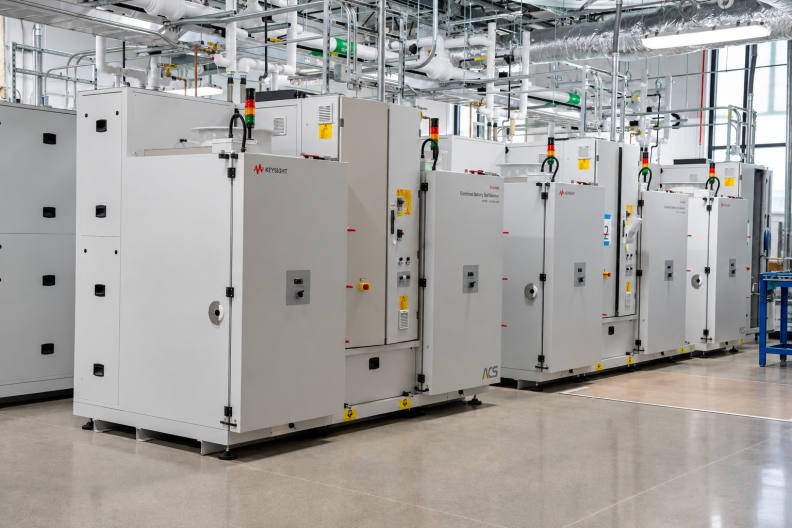
Toyota says a new facility in Washtenaw County will be its primary battery testing location in North America.( Toyota)
Toyota unveiled its new battery research facility in Washtenaw County’s York Township Thursday.
The $50 million, 30,000 square foot Toyota Battery Center east of Saline will be its primary testing facility in North America, the automaker said.
Congresswoman Debbie Dingell (D-MI 6) said investment like this one from Toyota will help keep out Chinese influence in electric vehicle technology.
The battery center, Dingell said, “is a tangible representation of what it means to keep Michigan at the cutting edge of innovation.”
“This facility is creating good-paying high-tech jobs, supporting American manufacturing, and ensuring that the next generation of automotive innovation happens right here in Michigan,” said Dingell.
Michigan Governor Gretchen Whitmer echoed those sentiments.
“This state-of-the-art facility will develop, test, and improve the batteries powering the next generation of vehicles,” Whitmer said.
Toyota will open the facility to the University of Michigan Electric Vehicle Center. Whitmer thinks that will help keep graduates from leaving the state.
“Researchers and students will work alongside industry experts to research cutting-edge technology, and this partnership will prepare students to tackle the biggest challenges of the future, right here at home,” she said.
In all, Toyota employs 2,000 people on the York Township campus. The battery center there will increase the number of jobs, but Toyota’s biggest battery investment is in North Carolina.
The company says it has invested nearly $14 Billion in a battery production facility there, with plans for more than 5,000 jobs.
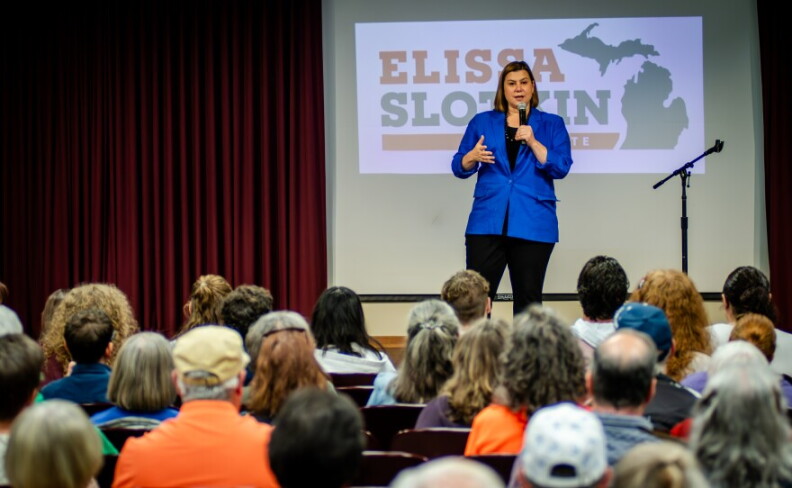
U.S. Representative Elissa Slotkin, the Democrat running for Michigan's open U.S. Senate seat, speaks at a campaign event at Central Michigan University on Thursday, October 17, 2024.(Adam J. Miedema / WCMU )
Michigan’s junior U.S. senator is warning about election interference in the midterm elections.
In a speech Wednesday to the Carnegie Endowment for International Peace in Washington, D.C., Senator Elissa Slotkin said President Donald Trump’s attempts at changing election processes so close to November are concerning.
“He has sued 30 states for their voter rolls,” Slotkin said. “He's tried to ban mail-in voting, and when that didn't work, he tried to make the post office the official judge of who gets to vote by mail.”
Trump signed an executive order in March to restrict mail-in voting, arguing it was a means to end voter fraud – although mail-in ballot fraud is overwhelmingly rare. That order was struck down by the U.S. Supreme Court in mid-September.
In August, the U.S. Department of Justice sent election observers to Detroit, Hamtramck, East Lansing, and Lansing “to ensure transparency, ballot security, and compliance with federal law” in the primary election.
While federal oversight is not uncommon, Slotkin is worried that it might escalate in the weeks ahead of the general election.
“If you hear in the next 34 days that there is a new security threat that you've never heard of, that somehow requires federal law enforcement or the military and not local police, an alarm bell should go off in your brain,” Slotkin said.
The Democratic senator laid out a roadmap for her party should they retake Congress following the midterm elections.
Part of that is prosecuting members of the Trump administration. Slotkin said it’s similar to what European countries have done following the ouster of authoritarians.
“In Poland, they called this plan the Iron Broom, cleaning the place up,” she said.
“The goal here is to have a list of signature cases that go after some of the most obvious and harmful abuses of taxpayer dollars.”
Slotkin believes Democrats made a mistake after Joe Biden won the election in 2020 and Trump supporters staged the January 6, 2021, insurrection at the U.S. Capitol. She said Trump’s first term should have opened some eyes.
“What we thought were laws were actually just norms, and a president who wants to completely obliterate our norms can do that easily, and Trump has,” Slotkin said. “Unfortunately, too many leaders on both sides of the aisle believe that the Trump era was behind us and not worth the heavy lift of changing laws to protect the future.”
Slotkin said Americans need to stay engaged if they want to change government for the better.
“That means normal people doing a little bit more than they're used to doing because the country they love is in trouble,” she said. “And just by showing up, you are engaged citizens.”
In Michigan, it’s never a bad idea to boost your relationship with auto workers — or ties to the auto industry.
Republican Mike Rogers spent 14 years in Congress, but before that he was an FBI agent and worked on cars.
“I started out in a car factory building Chrysler LeBaron convertibles. It’s a really good car. I love that car,” Rogers told reporters in Madison Heights this week.
Republican U.S. Senate Candidate Mike Rogers campaigns in Michigan in September 2026
Rogers worked in a non-union shop in the early 1980s making modifications to already-assembled cars.
His opponent, Abdul El-Sayed, is more white collar. He holds medical and public health degrees. However, he has blue collar backing — specifically, the United Auto Workers union.
In an interview with Michigan Public Radio, UAW President Shawn Fain explained why El-Sayed is the choice for the union’s nearly 1 million current and retired members.
“We’ve got to elect people that give a damn about workers, and not billionaires and corporate-class people,” Fain said. “I mean, and unfortunately, our political system has been hijacked by the richest people in the world.”
Michigan’s U.S. Senate race could help decide the balance of power in Washington D.C. next year. The ongoing trade war between the U.S. and Canada is just simmering under the surface.
Tariffs aren’t always the bad guy
Fain doesn’t outwardly dislike certain taxes on imports.
“We support strategic targeted tariffs. Blanket tariffs on everything under the sun, or tariffs just to force a country to do something for political reasons? That makes no sense whatsoever,” Fain said.
“And the 50% on Canada, we don’t agree with that. Like Canada is not the problem.”
The Trump administration has placed 50% tariffs on $27.6 billion in Canadian goods and materials. The Canadian government has responded with equal levies.
A strained relationship
Marchers at this month’s Labor Day Parade in Detroit weren’t happy about the tariffs or how we’re treating our closest trade partner. Retired tool and dye man Stan Geis was one of many who carried a sign emblazoned with images of an American flag and the Canadian maple leaf.
The message: “Solidarity. We stand with our neighbor.”
“I liked when we had the trade across the border … with men working in our country from Canada (going) back and forth. It was good. Now it just stinks.”
Sign at the Labor Day Parade.
That’s not to say the relationship between the UAW and the workers of UNIFOR — the Canadian auto workers union — hasn’t hit some potholes.
John D’Agnolo is the president of UNIFOR Local 200 across the border in Windsor. Southern Ontario is home to factories of several major automakers.
He says American autoworkers sometimes have the wrong idea.
“They think that we’re taking from them when we’re not.”
D’Agnolo has just wrapped up a grueling two weeks in contract negotiations with automaker Stellantis.
They’re not going well. Stellantis aims to sell an idled Jeep plant in Brampton, Ontario, to an armored car company.
D’Agnolo said the inconsistent tariffs are making the bargaining process more difficult.
“The challenge with these tariffs and not knowing what you’re going to get from day to day,” D’Agnolo said. “Companies are not going to invest in new programs.”
Uncertainty in Canada
Windsorites get all the Michigan political ads from Detroit-area TV stations. D’Agnolo said the current political climate is only fueling anxiety.
“You have to turn off the TV because you don’t want to hear it because it becomes your life. It becomes now you got mental issues because you’re worried,” D’Agnolo said.
“So yeah, it’s horrible right now.”
Opposite sides
In the U.S. Senate race, the two main party candidates are on opposite sides of the trade war.
El-Sayed doesn’t like that President Trump picked a fight with Canada.
“There’s a way that tariffs could be used to actually protect jobs. This ain’t it. Like all things Donald Trump, it is chaotic, ham-fisted, self-serving,” El-Sayed said.
El-Sayed points out that his Republican opponent was an advocate for free trade until this latest round of tariffs.
For his part, Rogers told C-SPAN this week he plans to collaborate with Trump in a way El-Sayed will not.
“I will go back to work with the president on tariffs that are working and work with the president on tariffs that are not working,” Rogers said.
“You know, my opponent, all he wants to do is fight with Trump.”
Cost of tariffs
A conservative free market organization, the National Taxpayers Union Foundation — says President Trump’s tariffs are costing Michigan households an extra $5,600 per year.
That’s the third-highest in the nation behind California and Texas.
Steve Grigorian heads the influential Detroit Economic Club. He thinks that could play a role in the election.
“We’re business people, but we go to the grocery store, we go to fill up our gas tank. So it’s definitely top of mind. I think it will definitely be top of mind as people go to the polls”
Ballots for the November election were sent out this week. Election Day is less than six weeks away.
Michigan U.S. Senate candidate Abdul El-Sayed campaigns among union supporters in September 2026.(Russ McNamara / Michigan Public Radio Network )
In Michigan, it’s never a bad idea to boost your relationship with auto workers — or ties to the auto industry.
Republican Mike Rogers spent 14 years in Congress, but before that he was an FBI agent and worked on cars.
“I started out in a car factory building Chrysler LeBaron convertibles. It’s a really good car. I love that car,” Rogers told reporters in Madison Heights this week.
Rogers worked in a non-union shop in the early 1980s making modifications to already-assembled cars.
His opponent, Abdul El-Sayed, is more white collar. He holds medical and public health degrees. However, he has blue collar backing — specifically, the United Auto Workers union.
In an interview with Michigan Public Radio, UAW President Shawn Fain explained why El-Sayed is the choice for the union’s nearly 1 million current and retired members.
“We've got to elect people that give a damn about workers, and not billionaires and corporate-class people,” Fain said. “I mean, and unfortunately, our political system has been hijacked by the richest people in the world.”
Michigan’s U.S. Senate race could help decide the balance of power in Washington D.C. next year. The ongoing trade war between the U.S. and Canada is just simmering under the surface.
Fain doesn’t outwardly dislike certain taxes on imports.
“We support strategic targeted tariffs. Blanket tariffs on everything under the sun, or tariffs just to force a country to do something for political reasons? That makes no sense whatsoever,” Fain said.
“And the 50% on Canada, we don't agree with that. Like Canada is not the problem.”
The Trump administration has placed 50% tariffs on $27.6 billion in Canadian goods and materials. The Canadian government has responded with equal levies.
Marchers at this month’s Labor Day Parade in Detroit weren’t happy about the tariffs or how we’re treating our closest trade partner. Retired tool and dye man Stan Geis was one of many who carried a sign emblazoned with images ofan American flag and the Canadian maple leaf.
The message: “Solidarity. We stand with our neighbor.”
“I liked when we had the trade across the border … with men working in our country from Canada (going) back and forth. It was good. Now it just stinks.”
That’s not to say the relationship between the UAW and the workers of UNIFOR — the Canadian auto workers union — hasn’t hit some potholes.
John D’Agnolo is the president of UNIFOR Local 200 across the border in Windsor. Southern Ontario is home to factories of several major automakers.
He says American autoworkers sometimes have the wrong idea.
“They think that we're taking from them when we're not.”
D’Agnolo has just wrapped up a grueling two weeks in contract negotiations with automaker Stellantis.
They’re not going well. Stellantis aims to sell an idled Jeep plant in Brampton, Ontario, to an armored car company.
D’Agnolo said the inconsistent tariffs are making the bargaining process more difficult.
“The challenge with these tariffs and not knowing what you're going to get from day to day,” D’Agnolo said. “Companies are not going to invest in new programs.”
Windsorites get all the Michigan political ads from Detroit-area TV stations. D’Agnolo said the current political climate is only fueling anxiety.
“You have to turn off the TV because you don't want to hear it because it becomes your life. It becomes now you got mental issues because you're worried,” D’Agnolo said.
“So yeah, it's horrible right now.”
In the U.S. Senate race, the two main party candidates are on opposite sides of the trade war.
El-Sayed doesn’t like that President Trump picked a fight with Canada.
“There's a way that tariffs could be used to actually protect jobs. This ain't it. Like all things Donald Trump, it is chaotic, ham-fisted, self-serving,” El-Sayed said.
El-Sayed points out that his Republican opponent was an advocate for free trade until this latest round of tariffs.
For his part, Rogers told C-SPAN this week he plans to collaborate with Trump in a way El-Sayed will not.
“I will go back to work with the president on tariffs that are working and work with the president on tariffs that are not working,” Rogers said.
“You know, my opponent, all he wants to do is fight with Trump.”
A conservative free market organization, the National Taxpayers Union Foundation — says President Trump’s tariffs are costing Michigan households an extra $5,600 per year.
That’s thethird-highest in the nation behind California and Texas.
Steve Grigorian heads the influential Detroit Economic Club. He thinks that could play a role in the election.
“We're business people, but we go to the grocery store, we go to fill up our gas tank. So it's definitely top of mind. I think it will definitely be top of mind as people go to the polls”
Ballots for the November election were sent out this week. Election Day is less than six weeks away.
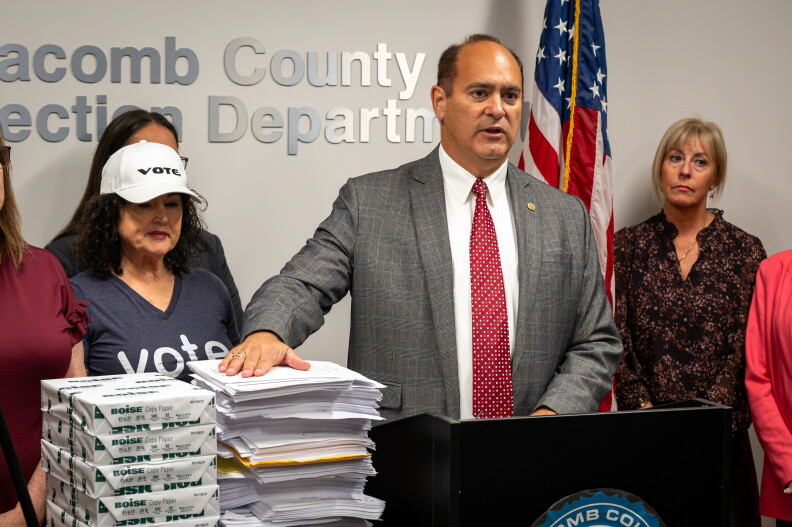
Macomb County Clerk Anthony Forlini speaks about voter registration drives at a news conference on September 23, 2026. Forlini is also the Republican candidate for Michigan secretary of state.(Russ McNamara / Michigan Public Radio Network)
Michigan Lieutenant Governor Garlin Gilchrist outlined his plan to overhaul the state’s campaign finance system in a Zoom call with reporters Wednesday.
Gilchrist, a Democrat, is running for secretary of state against Republican Macomb County Clerk Anthony Forlini.
Gilchrist said there needs to be mandated transparency in election financing.
“So I'm going to push for stronger disclosure rules, so voters can see who's funding the political messages coming across their TVs, their phones, and their mailboxes, social feeds, and streaming,” Gilchrist said.
Gilchrist also wants to speed up enforcement of campaign finance law by coordinating with the state attorney general’s office to crackdown on violations.
“The rules should be simple. If you break Michigan campaign finance law, there should be meaningful consequences quickly,” he said.
Gilchrist also supports limiting the number of certain fundraising committees tied to federal officeholders – called leadership political action committees – that candidates can have.
Forlini, for his part, has made election security the centerpiece of his campaign.
At a Wednesday news conference in his capacity as Macomb County Clerk, Forlini discussed ways that third-party groups are often a problem when it comes to voter registration.
Forlini said his office has processed over 5,000 voter registration applications in the past couple of weeks for people who were already registered.
“It takes time away from serving legitimate voters. It takes time away from preparing for an election, and it puts another workload on people who are already carrying a tremendous responsibility,” Forlini said.
Forlini reiterated that the groups generally aren’t breaking the law - though he did wonder why they were necessary.
“Many organizations conduct legitimate voter registration drives, but Michigan voters deserve to ask a very simple question: ‘Why should sensitive personal information have to pass through an unnecessary middleman when a voter can submit that information directly to the government?’”
Forlini indicated that state legislators have been uninterested in limiting the ability of these groups to operate.
The group Americans for Citizen Voting (ACV) took its concerns about the state ballot initiation approval process to the state House Monday.
This is the second time the Select House Committee has met and the first time it heard testimony.
Chairman of the ACV ballot campaign, Paul Jacob, offered his concerns about transparency within the process.
“We did not know when we would get the staff report,” Jacob said. “We didn't know other things because there's no set timetable.”
Jacob testified that ACV turned in its signatures ahead of the April deadline, but did not receive a staff report detailing the validity of signatures until August 17.
Jacob is advocating for more transparency and regulations.
“Having more clear rules and deadlines and more time would help,” Jacob said.
The Americans for Citizen Voting campaign turned in over 700,000 signatures, but a 1,000-vote sample determined not enough would be valid to qualify the measure for the ballot according to the Michigan Bureau of Elections (BOE).
In Michigan, you need more than 440,000 valid signatures to make it onto the ballot.
Michigan Department of State spokesperson Angela Benander SAID state laws were followed.
“The BOE’s timeline is driven by the statutory and constitutional deadlines for the Board of State Canvassers to review petitions,” Benander said.
In a March 2026 meeting of the Board of State Canvassers, BOE Director Jonathan Brater warned that certification of petitions like ACV’s would have to wait.
“In general, we process the candidate petitions first, then the initiated law petitions, then the constitutional amendment petitions so that we can handle this very labor-intensive and time-consuming process to make sure that we are doing it carefully,” Brater said.
The ACV campaign sought to create a Michigan constitutional amendment requiring citizenship verification for all voters in the state.
The move is the latest push by conservatives to curb what they describe as widespread voter fraud.
There have been infrequent cases of non-citizens voting, according to the Secretary of State’s Office – including 15 instances out of 5.7 million ballots cast in 2024.
Democrats have been critical of the added identification burden the ACV amendment would place on voters, calling it “voter suppression.”
The select committee’s existence is due to House Speaker Matt Hall (R-Richland Township). He has claimed – without evidence – that the Department of State under Benson has intentionally affected ballot measures backed by conservatives.
“Whenever a Republican-affiliated group submits something on the ballot, it takes months and months and months to review it, and then they always figure out a way to disqualify it,” said Hall.
“If it’s a Democrat group, they review it much quicker, and they always find a way to approve it, even if it’s suspect.”
The Michiganders for Money Out of Politics ballot campaign was approved by the State Bureau of Elections as well as the Board of State Canvassers.
Select Committee Chair Rep. Mike Harris (R-Waterford Township) opened last week’s hearing by saying the body is only looking at ways to improve the process.
”We are not here to decide whether we agree with the proposed amendment. We are not here to relitigate a political campaign, and we are not beginning this investigation with a conclusion about whether anyone did anything wrong,” Harris said.
For Jacob and the people backing Americans for Citizen Voting, streamlining the process is very important.
“It's the whole attitude about whether government is really there to facilitate democracy or to stand in the way,” Jacob said.
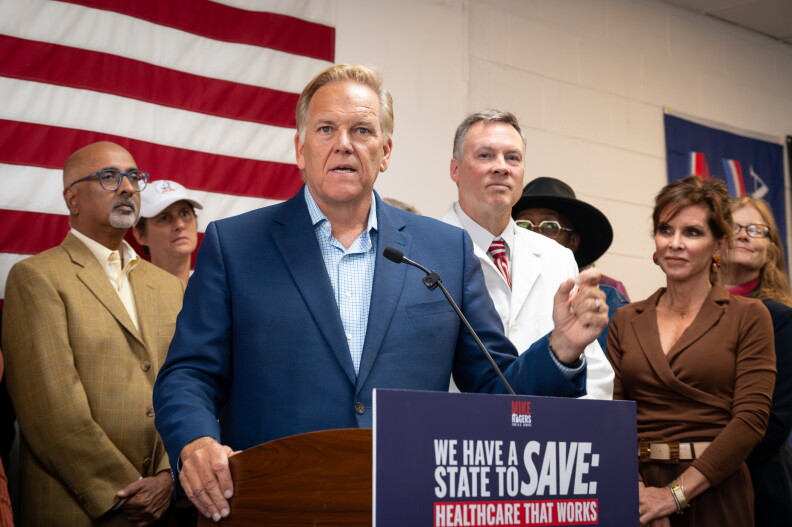
Michigan U.S. Senate candidate Mike Rogers speaks to reporters at a campaign office in Taylor, Michigan on Saturday, September 19.(Russ McNamara / MPRN)
In the race for Michigan’s open U.S. Senate, one big gap in policy is in health care.
Democrat Abdul El-Sayed has been an advocate for Medicare for All for well over a decade.
Republican Mike Rogers is not in favor of such wholesale changes. He laid out his policy at a media event in Taylor on Saturday. He railed against Medicare for All and prefers a more nuanced approach.
“The way we don't do it is blow up the system that we have,” Rogers said. “We fix the system that we have.” Rogers’ plan would lean into transparency and the free market.
“We go to open books to make sure that hospitals and insurance folks know and understand what the costs are, so that when a patient shows up, they understand what their costs are doing,” Rogers said.
The goal is for the patient to know what they’re paying and if they don’t like how much it costs, they can go elsewhere for care. He also wants insurance companies to make their denial rates publicly available.
“I think you get rid of the eight-dollar aspirins when you do that, and people start to realize that they can make better choices,” Rogers said.
Rogers has highlighted the high cost of prescription drugs in the U.S. in his campaign ads, citing Canada as an example of a place with cheaper medications.
However, he doesn’t want Canada’s government regulated health care system.
“Abdul talks a lot about wanting a system that looks like Canada,” Rogers said. “My argument is he should move to Canada. I mean, he might have better health care there.”
Canada regulates the maximum cost of prescriptions drugs – something the U.S. does not do.
Rogers’ plan calls for an expansion of the TrumpRx program to include more drugs.
El-Sayed argues Medicare for All would allow for further regulation and negotiation to bring down prescription costs. He also advocates for the government to manufacture commonly-used drugs like insulin.
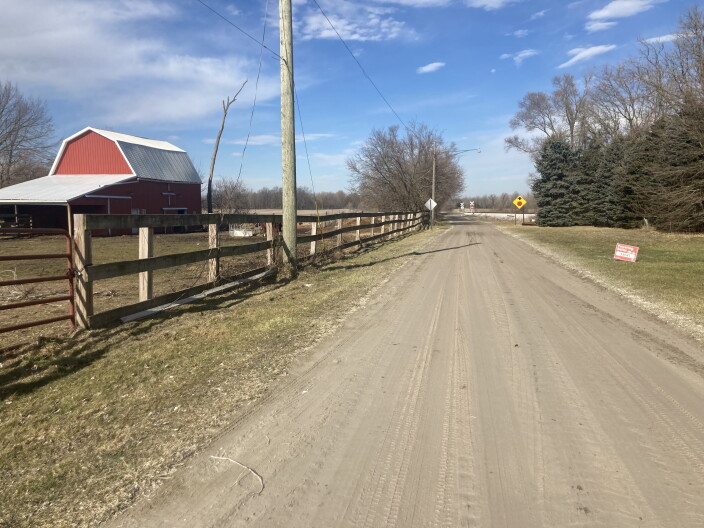
Early spring view of Ostrander homestead on the left(Tracy Samilton / Michigan Public)
The Trump administration’s military action in Iran has sent the price for diesel fuel soaring in the U.S.
AAA Michigan says the cost of a gallon of diesel is at an all-time high for the state at $6.54 per gallon. That’s $2.83 per gallon more than a year ago.
Iran has largely kept the Strait of Hormuz closed to oil tanker traffic following attacks by the U.S. and Israel in February.
Michigan businesses are now left to figure out the best way to proceed amidst increasing costs and inflation.
Cristina Benton, the Director of Market and Industry Analysis at Lansing-based Anderson Economic Group, said businesses are having to change their strategies to deal with the added costs.
“Some corporations may look at absorbing some of the costs in order to keep their prices down and gain market share relative to other corporations that might not be able to do that,” Benton said.
Fuel prices affect nearly every sector of the economy, from trucking to construction to the family farm.
“The high diesel prices are happening at the peak of the harvesting season, when farmers want to fuel combines and tractors,” Benton said.
Regardless of strategy by corporations or small businesses, the added costs will ultimately trickle down.
“Eventually, businesses, if they are not able to absorb those costs, they have to pass them along,” Benton said. “And eventually, the final consumer would see higher prices.”
Jocelyn Benson, Michigan's secretary of state and the Democratic candidate for governor, shares the stage with moderator Jason Colthorp at the Detroit Economic Club on September 16, 2026.(Russ McNamara / Michigan Public Radio Network )
Michigan’s gubernatorial candidates explained their plans to lower costs for residents in front of the Detroit Economic Club Wednesday.
Secretary of State Jocelyn Benson appeared before the group at Motor City Casino, while Congressman John James joined via Zoom from Washington D.C.
The program, moderated by WDIV’s Jason Colthorp, asked the candidates the same questions individually.
Tariffs
In Michigan, one of the key drivers for rising prices is the ongoing trade war between the U.S. and Canada sparked by tariffs levied by the Trump administration.
If elected, Benson plans to bypass the federal government.
“I will negotiate subnational agreements with Canada,” Benson said. “I'll partner with other governors from neighboring states like Pennsylvania, Wisconsin, Minnesota, who perhaps have similar need.”
She said the two countries should have a “shared economic vision.”
James said he was disappointed that Canada “walked away” from negotiations to the United States-Mexico-Canada Agreement – a free trade deal signed during President Trump’s first term.
He urged the Trump administration and Canada to get back to the bargaining table.
“Michigan will not be collateral damage in these negotiations,” James said.
In February, James voted against a bill that would have ended the tariffs on Canada.
Data Centers
The sharp drop in public support for data centers has sent ripples of concern through the business community.
James supports local – not state – control over decisions to put in the tech hubs.
“I'm a conservative. I'm against bans and mandates,” James said.
“Ultimately, if a local area determines that this is the direction they want to go, I'll help. If they decide this direction they don't want to go. I'll also help.”
He suggested artificial intelligence companies “proceed very carefully” when it comes to surveillance.
Benson likes the idea of data centers bringing jobs to the state, but is concerned about the cost – which she said did not just include dollar figures.
“It cannot happen at the expense of our privacy, our rights, our environment,” Benson said.
Benson believes there should be more transparency when it comes to where data centers are going and who is trying to put them in. She pledged to make an online portal so residents can look up projects.
Health Care
Benson called the rising cost of health care the “defining issue” of the gubernatorial race – especially in rural parts of the state.
“We're seeing hospital consolidations and closures drive up costs for residents who … have to drive much further to get to the healthcare they need,” Benson said. “And we're seeing physician shortages and nursing shortages as well as increased costs and stress.”
Benson largely stayed away from attacking James, but did mention his support for the One Big Beautiful Bill Act – President Donald Trump’s sprawling tax-and-spending law that the Congressional Budget Office says could leave an extra 10 to 14 million people uninsured – including hundreds of thousands in Michigan.
James focused on transparency around health care costs and discussed his Patients Deserve Price Tags Bill. He also wants residents to take a more holistic approach to their well-being.
“We have to do more around meals, mental health, and maternal health,” James said. “We need to make sure that we're feeding our children and our families better and more clean food.”
Governance
James told the crowd of business leaders and students that he draws upon his experience leading his family’s auto part supplier business.
“I think that before becoming CEO of a state, you should have run a business before,” James said. When it comes to changes to state government and services he said he’s more likely to use a “scalpel” than a “chainsaw.”
Naturally, Benson leaned on her experience in state leadership.
“We need a leader in this moment who will speak the truth, bring people together, and get stuff done. I've done that as Secretary of State,” Benson said.
She wants Michigan to be “the best place to be a kid, raise a kid, and call home.”
The two gubernatorial candidates will share the stage in the first of two debates early next month.
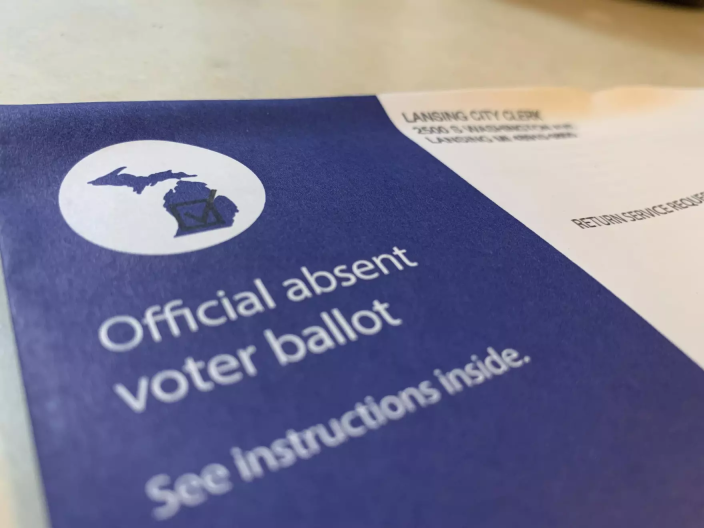
An absent voter ballot from the Lansing city clerk.(Karel Vega / WKAR-MSU)
Michigan Democratic U.S. Senator Gary Peters said Tuesday that the Trump administration's efforts to change the rules around mail-in voting are a reason to remain vigilant, even after the U.S. Supreme Court blocked new restrictions on absentee ballots.
Peters welcomed the ruling but said he doesn't expect the administration to stop trying to affect elections.
“They want to change the rules. They don't want free and fair elections. They want to do what they can to undermine the credibility of our elections,” Peters said. “So we have to be vigilant.”
The Supreme Court ruled the administration cannot restrict mail-in ballots through the Postal Service ahead of the midterm elections. Two justices dissented.
Justice Samuel Alito, joined by Justice Clarence Thomas, expressed concerns about voter fraud and said the Postal Service has broad authority to regulate the mail. President Donald Trump has claimedwithout evidence that absentee voting is rife with fraud.
Peters told Michigan Public Radio the ruling should have been unanimous.
“It's very disappointing that you'd have two justices of the Supreme Court basically doing the bidding of the president, not based on fact, but based on their partisan views,” Peters said.
The debate over election rules also extends to Michigan, where a state House committee has been convened to investigate why a ballot initiative requiring proof of citizenship to register to vote was denied a spot on the November ballot.
The Board of State Canvassers deadlocked 2-2 on the measure from Americans for Citizen Voting. The group submitted more than 700,000 signatures, but the board found a sample of 1,000 contained enough signatures with disqualifying problems that the campaign would not reach the signature threshold required to go before voters.
Republican state Representative Mike Harris, the committee's chair, said the panel plans to hear from election officials and people affiliated with ballot-measure campaigns.
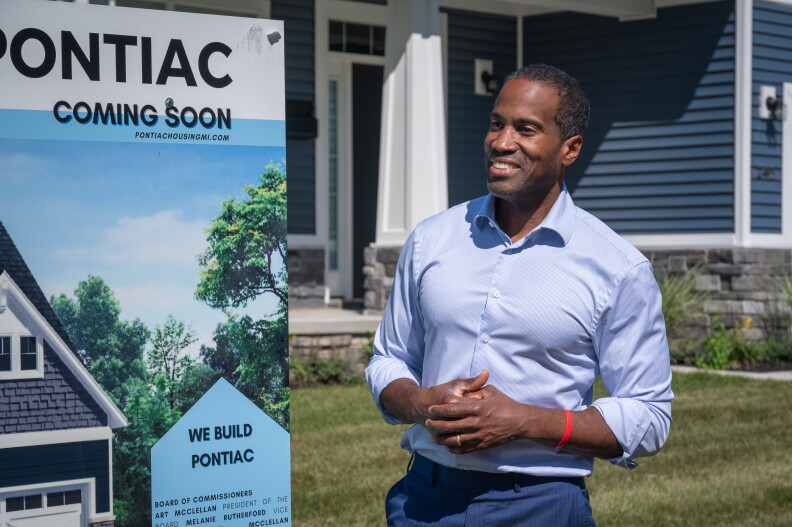
Congressman John James (R-MI 10) stands outside a newly-constructed home in Pontiac in September 2026.(Russ McNamara / Michigan Public Radio Network)
The two main candidates for Michigan governor are trying to build out their ideas for affordable housing.
Congressman John James (R-MI 10) toured a southwest Pontiac neighborhood Monday that has one newly built home, with a couple more on the way.
Asked for his plan to make new homes cheaper, James leaned into deregulation.
“We have to return control back to the locals. I actually think the best form of government is closest to the people, and I think the best state government is fair, efficient, and limited,” James said.
Michigan Secretary of State Jocelyn Benson, James' Democratic opponent, said she likes the idea of removing red tape and other barriers that slow down the permitting process. Benson said she prefers cutting costs by expanding tax credits for first-time homebuyers.
Benson also wants to make homes more energy efficient, but that’s not something James is concerned with.
“Everybody wants clean air and clean water. Everybody wants safety and fairness,” James said. “But sometimes you go too far when you have a protectionist mindset and not a stewardship mindset. We need to get to a stewardship mindset to lower the costs of doing business, whether it's for labor, material, or logistics.”
The Benson campaign has been critical of James’ support for the Trump administration’s trade war with Canada. The cost of building materials like copper, steel, and lumber have risen considerably due to tariffs.
James has also drawn criticism over a missed vote on a bipartisan housing bill back in June.
"While Jocelyn has been talking about her plan to lower home prices since March, James has been voting for tariffs that make homes more expensive while skipping votes that lower the cost of housing,” said Benson Press Secretary Rajan Srinivasan.
James was unfazed.
“Ultimately, I'm going to be a facilitator, not a dictator,” James said.
“I'm really going to be focusing my time, my effort on tearing down barriers … and making sure that we can get back to affordability, particularly in housing.”
The newly constructed Pontiac home toured by James is set to be listed at more than $400,000.

 Login
Login