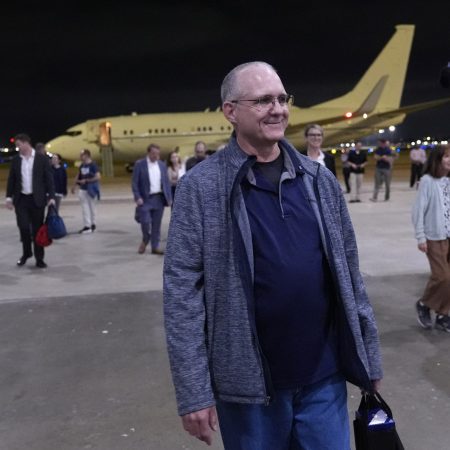
At the end of 2018 Russia arrested Michigan native Paul Whelan on bogus espionage charges.
He was convicted of spying and sent to a Russian labor camp.
Moscow released Whelan in a massive prisoner exchange two years ago. But Russia had taken more than just time from him. His job and home were gone.
Now Congress is considering a plan to help cover those losses for Whelan and other U.S. citizens held by rogue nations.
He says the Paul Whelan Hostage Compensation and Reintegration Act would fill a badly-needed financial void.
Interview edited for length and clarity.
Paul Whelan: When I returned home in August of 2024, I found that there wasn’t really much support for former hostages. We were well taken care of at the Brooke Army Medical Center, then we were well taken care of by the joint personnel recovery activity at Fort Sam Houston. But after that you were really just on your own. States like Michigan don’t offer unemployment insurance for former hostages, for example. There are no national organizations that take care of hostages. There is Hostage International, which is an international organization, but their reach is limited, especially in the United States. So we started looking for ways to assist former hostages with reintegration.
What we found is that hostages held in countries that sponsor terrorism are afforded compensation. But hostages held in countries that are not considered state sponsors of terrorism, such as Russia and China, are not compensated. And we can argue back and forth whether Russia supports terrorism or not. But the way things work, we would have to go to one of the world courts and try to sue Russia. And then Russia would say, “Well, we have sovereign immunity, so you can’t sue us.” There’s no way to gain compensation from a country like Russia.
So what we did is looked into using seized assets, frozen bank accounts and things like that from Russia, China, Syria, Iran, countries that are notorious for holding hostages. And then using those funds to compensate hostages for the income, retirement, and things like that they’ve lost while they were being held.
Quinn Klinefelter, WDET News: There has been a law on the books Congress had passed that’s supposed to help returning hostages. But, as we have talked about in the past, they had never funded that act. Would what you are talking about now be something in addition to that or would this actually fund that act?
PW: This would be in addition to that act. The existing act specifically mentions medical care, psychological care, things like that. And we’ve actually made some progress with Congress in providing those benefits through the State Department for those in need.
What we’re talking about now is monetary compensation paid to hostages based on the number of days that they’re held. That money would come out of frozen assets and frozen accounts of the rogue nations holding American citizens.
QK: Michigan Democratic Congresswoman Haley Stevens is pushing this. As far as you know, is it a bipartisan effort or is it coming mainly from the Democrats?
PW: No, this is an American issue. And Haley Stevens has been the main supporter of this idea. She has always been a big supporter of me and hostages in general. But we have broad support, Democrat and Republican, because this touches American citizens in every state. It doesn’t discriminate. And unfortunately one never knows during leisure travel or business travel when a foreign government might just get you in their sights and grab you. And then you’re held at their mercy.
QK: I know you have kept a keen eye on situations regarding current hostages and others that have been taken by Russia or other countries. There are a number of people from the U.S. who are still being held by Russia, some designated as “wrongfully detained,” as you had been.
PW: You’re absolutely right. Stephen Hubbard, a Michigan resident, I might add, was living in the Ukrainian area that Russia invaded. And when Russia invaded, they said, here’s an American. Even though he’s about 74-years-old, they took him into custody and said that he was working as a mercenary for the Ukrainian army. He has been designated as wrongfully detained and the State Department is actively trying to get him home. But there’s Andre Khachatoorian, there’s David Barnes, there’s Chuck Zimmerman. These are guys who, for one reason or another, ended up in Russia and none of those three did anything untoward. And because they had an American passport the Russians said, “This is an interesting person. Let’s grab them. Maybe we can make use of them.”
QK: Let me play Devil’s advocate for just a second. It’s a tough economy for a lot of people right now. Many people would love to get some extra finances sent to them. Here you have this bill where it would compensate you or others, depending on the time you’ve been out, for the time that was taken. What would you say to somebody who is struggling to pay their rent or something right now and tell them why you would deserve to be compensated for that time when they are not getting compensated for what they’re doing?
PW: That’s a good point. So let me be clear. The money is not coming from United States’ taxpayers. The money comes from foreign frozen bank accounts, from, say, Venezuela, from Russia, from Iran, from those rogue nations. And that money will be used to compensate hostages. Hostages lose freedom. I was held for 2,043 days. That means 2,043 days I wasn’t earning an income. I wasn’t saving for retirement. And when I came home, I found that my home was gone, my cars were gone, everything was gone. And I had to rebuild my life.
People that have car accidents have insurance and the insurance company pays them. People that break a leg, they have insurance, the insurance company takes care of their medical bills. Hostages have absolutely no social safety net at all. And what we’re hoping is that this compensation bill will provide that social safety net so when hostages come home they can rebuild their lives.
And it’s a process. Reintegration takes time. Maybe the first year they can’t work at all. Maybe the second year they’re getting back into the workforce. But most of us, especially those who are older, will never realize the same income level, the same salaries, the same benefits or retirement plans that we lost when we were taken hostage.
QK: You were held for more than five years. You’ve been back for a couple of years. How are you doing now?
PW: Actually, I’m doing pretty well. I have a lot of support from my family, my parents in Michigan, friends all over the country, actually all over the world. And then I do have family scattered around the world who are quite supportive also. People are interested in helping. They don’t always know how to help because being a hostage is kind of unique. But people are willing to go out of their way and do what they can to to support me as a former hostage and friend and family member.
I am very active with Congress. I’m very active with a few organizations that advocate for hostages. And I find that the advocacy is quite helpful for me. Being able to speak to organizations, civic groups and things like that really helps me to get the point across that if you’re traveling abroad, you have to be very careful. And if you’re in a country like Russia, you need to come home.
If you know of situations where people are traveling without the security they should have, they should take precautions like using the STEP (Smart Traveler Enrollment Program) where they can provide their itinerary and information to the U.S. State Department before they travel. So if something happens in that country or to them, the State Department knows who to contact back home. And that will greatly enhance the U.S. government’s ability to take care of them. I had registered with STEP when I went to Russia and that allowed the U.S. ambassador and State Department personnel in Moscow to contact my family very quickly. It is a unique situation. You know, I’m fortunate. I hope that everyone else that’s coming home has that same support network, but I fear that they don’t.
QK: You had said in the past that what you had to go through being held for all that time left scars, emotional scars, on you. Flashbacks to things like staying in a hotel room and wondering whether somebody might try to come and get you like the Russians had done. Has that all somewhat subsided now?
PW: Yes, it has. Part of the reason is that I live in the United States, land of the free, home of the brave, and I don’t have to worry about that sort of thing. I can go to a hotel and stay the night without having to worry about people kicking in my door. I don’t have to worry about the corruption that takes place in countries like Russia. From that standpoint, I’m doing quite well.
When I talk to civic groups or Congress about my experiences, it does bring back those memories of what we went through. And when Trevor Reed and I have conversations or I’m talking to other hostages that were held in Venezuela, Iran, Syria, or other countries. The issues that we dealt with during captivity and the issues we’ve dealt with since coming home do come up. You have to deal with them just like anything else. You have to kind of face it head on and overcome it. It’s difficult at times, but it’s a necessary compromise.

 Login