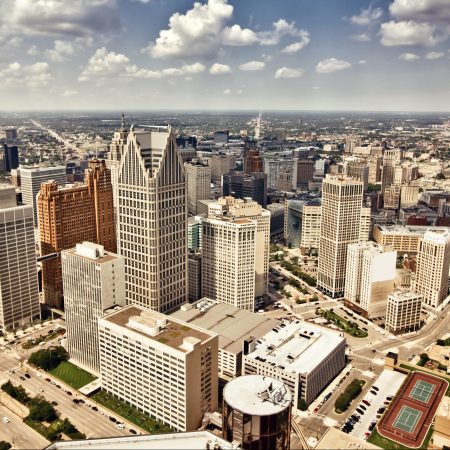
The Detroit population grew for a third straight year. A city that has been losing residents for decades is making a come back. In 2025 the Motor City gained about 5,000 new residents according to the U.S. Census Bureau. In 2024 Detroit had nearly 7,000 new residents.
The total population in 2025 is about 649,095. Grand Rapids was the only other city to add more than one thousand people.
The Census shows that Detroit also grew at a faster pace than other major cities that had 250,000 residents or more.
Additional headlines for Thursday, May 14, 2026
GLWA raises rates for water, sewage
In July of 2026, Detroiters will be paying higher water and sewer bills. The Great Lakes Water Authority voted to increase water rates by 5.8% and sewer rates by 4.26% earlier this year. This mimics an increase they did in 2025.
This increase worsens the affordability gap, where some residents can’t afford the high costs. There are pushes for a statewide water affordability plan from different coalitions backed by the People’s Water Board Coalition. This plan would connect water bills to the household income in the hopes of creating a stable and equitable revenue source.
Sports
NBA The Detroit Pistons face elimination on the road tomorrow after suffering a tough loss against the Cleveland Cavaliers yesterday in Game 5 of their series. Last night’s game went into the overtime and the Pistons struggled to overcome some late runs that ended with the game score 117—113.
The Pistons will have to win tomorrow’s game to bring it back to Detroit for a win or go home Game 7.
Tomorrow’s game will be at the Rocket Arena. Tip off is at 7:00 p.m.
MLB The Detroit Tigers face loss against the Mets yesterday in the score 2-3. The is the second straight loss to the Mets keeping the home team at the bottom of the American League Central Division.
‘Sons of Detroit’ documentary screening
Detroit Arts Institute is showing a screening of Son of Detroit. It is a film about the Motor City told through the lens of one unique family. Director Jeremy Xido returns to Detroit after 20 years to reconnect with the Black family who raised him as he confronts societal and racial struggles.
The screening is on Sunday, May 17 at the Detroit Institute of Art. For more information go to dia.org.
Listen to the latest episode of the “Detroit Evening Report” on Apple Podcasts, Spotify, NPR.org or wherever you get your podcasts.
Support local journalism.
WDET strives to cover what’s happening in your community. As a public media institution, we maintain our ability to explore the music and culture of our region through independent support from readers like you. If you value WDET as your source of news, music and conversation, please make a gift today.
At its peak, the city of Highland Park was described as a model city with more than 60,000 residents and the housing stock to hold it. Today, the population is less than 9,000 and neighborhoods are plagued with blighted and abandoned properties.
But city officials see an opportunity to rebuild the housing stock and population. Carlton Clyburn is the Director of Community and Economic Development in Highland Park. He spoke with WDET’s Bre’Anna Tinsley as part of our Crossing the Lines – Highland Park series. Clyburn says the city’s rebirth will start with building what he calls “the missing middle.”
Listen: Highland Park wants to build the ‘missing middle’ to address housing shortage
This interview has been edited for clarity and length.
Carlton Clyburn: So, the missing middle are your duplexes, triplexes, fourplexes. What that does… it brings more families in, right? But also, it helps with development costs. So, if you got a 2, 000 square foot home single family, it’s going to cost you the same as a 2,000 square foot duplex. The difference is you can get double rent or double the cost for your return on sale if it’s a duplex. And it fits, it matches some of the people that’s living out of wanting to get out of like apartment living, or looking to start a family those kind of things. So we’re really looking to fill in that missing middle gap.
Bre’Anna Tinsley: Okay, and so you said you just updated the master plan—
CC: No, we just created our economic development strategy. We’re in process. We were going to do some updates to our master plan, because we need to do some things with our zoning. And the new requirement from the state is to do a housing assessment.
I mean, you could kind of look and as we’re planning out the city, we got a couple areas where we’re looking at all market, single family, right? But we have a lot of areas where we can build out, and that’s what we’ll be looking at that missing middle.
BT: I want to talk about the water bill situation that has been like a big thing in Highland Park—and correct me if I’m wrong, if I get any of these numbers and figures wrong. But it started with a $54 million debt correct?
CC: Made up. Made up debt.
BT: And then the state, and then the state came in and provided, I think, about $30 million to help rebuild the infrastructure, which brought some of that debt down. Is that correct?
CC: So we have been overcharged by GLWA for years, since they started. They didn’t want to abide by us. So, they said, “no, we want to charge you more.” Part of that agreement was us putting meters in the ground. Okay? We have put meters in the ground, and we’ve already found a $1.5 million reduction. So, they’re still overcharging us.
The rate that Highland Park pays is comparable to what Wayne County pays, and that’s 43 communities, you see. So we’re being greatly overcharged, but by us putting these meters down, by us providing the data, somethings got to give now. I mean, we told y’all we was being overcharged. Y’all owe us some money. We need relief.
Because you’re right. That’s another thing that will keep the developers away. So you know, the timing is everything, because that gives you know, that gave us opportunity to start working on our plan, our economic development strategy, updates to the master plan, and while the water folks are battling that water deal, then we can put these plans into action.
BT: What about what residents are doing to rehab their own homes? Are there any resources available to them? Is the city looking to provide any resources to them?
CC: So right now we do have ongoing grants, like through the HOME program and some of the other programs, but… they’re more so for [ages] 60 and over. So, I’m looking for more monies for not 60 and over, right? Because we do have families in need for home repair.
And, you know, the developers I talked to about moving forward, or, “Hey, we built this block out, and it’s a few homes we got to find money for, you know, rehab for them as well.” Maybe not so much interior, but at least exterior, because the last thing we want is somebody you know to come in and build this neighborhood up and leave three or four houses looking like they look when we could pull money like a community benefits. I mean, if you’re pulling money out, give them, give them four houses, $5,000 a piece. Or, send your contractors over there to see, you know, what could be done within a scope to bring them up as well. So, I’m conscious of it.
BT: You might have mentioned it earlier, at the beginning of the conversation, but knocking down homes, there’s a lot of blighted properties. Where’s the city at with demoing more of the dilapidated buildings?
CC: We have $5 million worth of demolition happening, right? And that’s pretty much going to take our inventory out the state. Most of their properties are demoed. The county, most of them are demoed. They’re finishing up some more demo. The issue are the privately owned blighted properties that we do have nuisance abatement orders on. We are looking to, you know, hold negligent property owners accountable. It’s just a little bit longer process.
Highland Towers
BT: Highland Towers is coming down soon. Is there any plans to put, like, more housing there? Or what do you know, what the city is looking at?
CC: I would look so that’s something I’m talking to the county about, because we did have to transfer ownership. Oh, and Highland Towers was a privately owned property that we took through our nuisance abatement ordinance, and the county has money, so we transferred it to the county to knock down. So they’ll be knocking it down, and we’ll work with them on [a request for proposal] or what kind of development we want to see. But we probably want to see, you know, residential, retail, mixed use, something similar, just something creative like this, going up and down Woodward, and what’s in Brush Park.
You know, Brush Park is what I’m really a fan of, because it has a lot of the old bones. But you got this new stuff, you got the old stuff. That’s a good mix. And, when I saw what was going on in Brush Park years ago, I’m like, this is, this is what we can do in Highland Park.
BT: You mentioned the housing shortage, homelessness, do you think is that enough to drive people to Highland Park when the homes are available?
CC: I believe so. Yes. Because, like I say, with the Greenway, us being on Woodward, Davidson, 75, the Lodge, logistically, it makes sense. You got everything, what, three, four miles. You got all the field, all the sports teams right up the street. It is, logistically speaking, good luck.
Trusted, accurate, up-to-date.
WDET strives to make our journalism accessible to everyone. As a public media institution, we maintain our journalistic integrity through independent support from readers like you. If you value WDET as your source of news, music and conversation, please make a gift today.
WDET reporters have been visiting the city since March, getting to know Highland Park, its history, and its people. These conversations are part of our Crossing the Lines series, which explores what unites and divides metro Detroit as a region.
Highland Park is a city within a city, an enclave of Detroit. At its peak, more than 45,000 people lived in Highland Park, mostly auto workers. Ford and Chrysler called the city home for years. When they moved out, people left in droves. Today, the population is less than 9,000.
One person who stayed is Glenda McDonald. She came to Highland Park as a child in the 1970s and still lives in the city. Voters elected her mayor in 2022.
WDET’s Pat Batcheller spoke with the mayor about her life in Highland Park and her efforts to make the city better.
Listen: A conversation with Highland Park’s mayor
People, not borders, define the city.
Pat Batcheller: How has Highland Park managed to survive as a city despite enormous financial challenges?
Mayor Glenda McDonald: It’s a place where you come and you’re in a neighborhood, but it’s also a city, so everybody in the city rallies around each other, supports each other. We get our support from our partners, Wayne County, the state of Michigan, and others. And they continue to believe in the city, just like I know that right now, I’m believing in this city, and we’re going to move forward, and it’s going to continue to grow.
PB: What makes you believe in it?
GM: I believe because I’ve been here, I saw what the possibilities are, and I know the endless possibilities for Highland Park. You don’t find a place like this, like the housing stock is 100 years old and it’s still standing and they are beautiful. You don’t find neighbors and community the way you do here. This is one community, and that’s what I use as one of my models, is we are one community, even though it’s 2.9 square miles. I know a person on every single street here. You can’t find it in Detroit because it’s so large.
PB: So, it’s not just the borders that define the city, that make it unique?
GM: It’s the people. The people make it unique. It’s hard to explain that we love each other. We take care of each other when it when it’s necessary, and then also we can disagree with each other and move forward and continue to move forward.
Grow the tax base
PB: No city can survive long without a stable tax base at a stable population. As mayor, what are you doing to keep businesses and residents that you already have here and then attract new ones?
GM: One is to make sure that everybody knows that they’re loved and needed here. That’s one thing we have to do is to make sure that people in those businesses and in this community understand we are a people of unity. And you know, we have to make sure that they all already know, that they’re doing a service for folks that some other people are not willing to do.
And a lot of people stay here because they just love the space, they love the area. They love the fact that Highland Park is just a small community.
Yes, our budget is low right now, but it’s not going to always be that way, and that’s the hope for the future. And people that stay here know that there’s a future.
Fix the infrastructure
PB: Tell me about some of the work that’s going on in Highland Park.
GM: We’re replacing every lead line in this city. We were blessed to get some appropriations from the State of Michigan, and they are having us replace every single lead line in the city. Some of them were over 100 years old. Some were wood. There was, at one time, a lead problem, but there’s not anymore. We have our testing, and our testing show that there’s not lead in the water so. But it’s inevitable that [the lead lines] need to come up, because there’s popping going on.
You know, we have water main breaks, like every other city. And so, at this moment, it’s a great thing to be able to change. And that will help businesses come here, because they didn’t want to come to a failing infrastructure that they would have to replace on their own. Right now, it’s being replaced.
It’s a good opportunity for everyone to come now and start the developments that they would like to see, to start the growth of Highland Park again, get in on the ground floor and be the beacon of light for Highland Park.
A sign breaks down the city of Highland Parks water main replacement project.
PB: This was something that you’d been going back and forth with the Great Lakes Water Authority (GLWA) for years. You were looking, as I recall, at the prospect of maybe having to go through bankruptcy if you couldn’t work all that out.
You did make a deal. As you mentioned, the state came in with $100 million to help pay off not only the debt [to GLWA], but to fix the root cause of the problems. If you had not been able to secure that money, would Highland Park still exist?
GM: I think it would. I mean, we’re resilient. If we couldn’t go in directions that we needed to go, we could always find another direction. We have been surviving now with this water situation for 20 years. It’s been ongoing and ongoing, and I decided, and along with my team, we’re going to put an end to it right here in some kind of way. And so we got that tentative agreement taken care of.
We’re working with the state. We’re working with GLWA, and hopefully we’ll continue that moving forward. I would say that I would have used whatever was necessary for us to do, to survive in Highland Park, to stay alive.
The state took over in 2001
PB: Going back the beginning of the century, the state appointed an emergency manager for the city that lasted about eight years and then state returned control. That fixed some of the immediate problems, but it didn’t really fix all of the financial difficulties. What did the state get wrong?
GM: Emergency management! I mean, I think the biggest issue we had was that eliminating the things that brought people to the city or kept people here caused a flight. And that would be a reason for the decline of revenues.
So, I think if it should have been a different plan of, how do we keep people in the city? What do we do to make sure that the children, the working-class people, the seniors, and everyone else benefit from what we’re about to do? And I didn’t see a benefit in that. I think that especially closing our library, that has been a devastating point for the city of Highland Park.
PB: What kind of shape is the [McGregor Library] in after being closed this long?
GM: Well, we did have an evaluation done, and there are some things that need to be done to it, to get it back in place. And it will take some doing. But it’s not impossible to do.
Attract business
PB: Do you have any businesses coming in in the near future?
GM: Yes, we have, I think, three that’s going to be opening up by the summer. One, there’s a coffee shop coming. Two, there’s going to be a restaurant, and three, there’s going to be a juicing bar, all coming in the same building. One of our developers has a building that has a mixed use at the bottom, and he’s starting to rent it out. So there will be spaces there for them and other businesses that are in the queue.
Here to stay
PB: You say you’ve been here since you were 11. Why did you stay when so many other people left?
GM: Why should I leave? That’s the question. I mean, I own my home. I raised my children here. They were born here in Highland Park. Well, they were born in hospitals, but they grew up here, and it’s beautiful place to me.
It’s the people. You can’t match the people here that stay in Highland Park. They’re resilient, they’re loving, they’re kind, and we take care of each other. Like I said, we have our issues sometimes, but all in all, we love Highland Park, and I love Highland Park.
My children have started to convince me to leave for years, and I will not. I don’t want to go to Atlanta. I don’t want to go to North Carolina. I don’t want to go to where they are. I want to stay right here in the city that raised me and bring it back to where it should be so future generations can feel the same way I feel when they’ve been here 54 years.
Highland Park City Hall sits on Woodward Ave.
PB: What gives you pride in Highland Park?
GM: Everything. The people, the places, the possibility. I have a connection to every aspect of the city, the industry, the auto industry, everything like that, is something that has been a part of my life since I’ve been here. The schools, bringing back the school system, Highland Park Public School System, and we’re still working with the charter system that we have.
We are people who believe in in good things. We are people who believe that things are possible. And I’m one of those people that believes that things are possible if you just put your mind to it. It’s a challenge, but it’s a good challenge. As long as I live here, I’m going to do whatever I have to do to try to make sure that the city survives.
What happens in Detroit affects Highland Park
PB: Even though Highland Park and Detroit are different cities, their fates seem to be intertwined. The things that happen in Detroit have an effect here. We do now see some things, some progress in Detroit. Do you hope that Highland Park will benefit from that?
GM: I know it will. We’re the next leg of the development chain they have developed from Woodward downtown all the way up to the north end in Detroit. And when you’re the nucleus of a large city—and we call ourselves the capital of Detroit because we sit right in the middle—everything affects us. Because you can’t go to Pontiac without coming through Highland Park, leaving from downtown. Even coming through a freeway, you’re going to enter Highland Park off of Chrysler. You’re going to enter Highland Park off the Lodge. You’re going to be connected to the Davidson, which was the first freeway.
We have a connection that is like a bond. What affects them affect us, and that’s why we need to be working together to make sure that every aspect of this is healed, and Highland Park needs to be healed, and that’s what I see for it. I see a healing coming.
PB: Why wouldn’t being physically part of Detroit foster that healing.
GM: Blasphemy! I had to clutch my pearls. I’m sorry [laughs]. Because then it wouldn’t be Highland Park. Most people in Highland Park do not claim Detroit.
I love Detroit. Don’t get me wrong, I go to visit there. But if it’s just looking at Detroit, then you’re missing out on the opportunity to see what Highland Park has to offer, what Hamtramck has to offer. And I’m not advocate. You know, I love Hamtramck too, but my city has a lot to offer, and you miss out on that.
Everywhere I travel, the first thing they say is, “where are you from?” I said, “Highland Park.” “Oh, you’re from Detroit?” “No, I’m from Highland Park. And you need to look that up.”
PB: So, sell me. If I’m looking for a place, either to open a business or perhaps buy a home, what does Highland Park have to offer?
GM: Highland Park has a lot to offer. We have two corridors that are ripe for the picking right now to run a business. You have Woodward Avenue. There’s over 100,000 people who travel up and down Woodward Avenue every single day. And then you have Hamilton Avenue, which is what we used to call the antique row. We had all of these small businesses, and we’re building back that. We have a lot of people ready to build up on Hamilton.
Our housing stock here is one of the best in the country. We have had people travel from across the country to come buy houses. When we’re selling in the auction, we get people from California, from everywhere, who has done the research about Highland Park and the stock here, and why you can’t beat this. For the price of a house that you get here, you’re going to take that house and pick it up and put it in California, and it’s going to be $500,000 to almost $1 million.
So yes, you have to come here. You have to check out what we have. As far as housing stock, it’s amazing. It’s beautiful. We have Craftsmen houses. I live in a Craftsman bungalow. Those houses are very unique. We have Tudors, we have Colonials, we have a variety of housing here. We even have ranches and smaller ones, but they are here. So that’s the uniqueness of Highland Park. There’s every type of house that you imagine.
Support local journalism.
WDET strives to cover what’s happening in your community. As a public media institution, we maintain our ability to explore the music and culture of our region through independent support from readers like you. If you value WDET as your source of news, music and conversation, please make a gift today.

 Login
Login