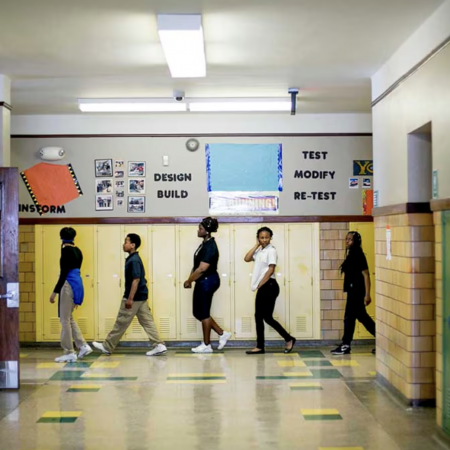
A new 10-week program is pairing Detroit Black older adults with Wayne State University students to improve social connection and digital literacy.
Dr. Rodlescia Sneed is the program director for the Intergenerational Wisdom Exchange (WiSE). She’s an assistant professor in Wayne State’s Institute of Gerontology and Department of Psychology.
She said social connections are important for health and well-being, but many people depend on technology to maintain that social connection.
“It was our goal to increase social connection and reduce loneliness among older adults, while also improving their technology skills so that we could make improvements that impact their health and well-being,” she said.
Sneed said the program focuses on developing one-on-one connections to make it easier for older adults to learn digital literacy.
“One thing that’s really important when you’re trying to learn something is that you feel comfortable with the person teaching you. Many older adults express that they’re not comfortable speaking up when they don’t understand technology, especially when they’re trying to learn it in a group format,” she said.
The first half of the program is focusing on sharing life stories of Detroiters. The second half is learning digital literacy.
Oral histories a focus of WiSE
The program is open to Black older adults who live in Wayne, Oakland, or Macomb County. Sneed said adults are paired with students who live nearby to reduce transportation barriers and increase accessibility.
She said undergraduate and graduate students from psychology, social work, engineering, and other disciplines participate in WiSE.
The adults will share their personal stories with the students, who will write them down and give copies to the adults.
“We’re talking about a community that may not traditionally have a lot of written history, and so particularly, I think there is value in families being able to have written histories that they’re be able that they’re able to share across generations, and we’re providing that,” she said.
Racial and technological divide
Sneed said there are large racial divides when it comes to accessing technology and using it. The program aims to reduce those gaps.
“We see divides both in access to technology and comfort with use of technology. We’re trying to close that racial gap. That’s why we specifically selected Black older adults,” she said.
She said students will have an opportunity to learn about the history of Detroit from Detroiters.
“Students really benefit from being able to talk to older adults, hear their wisdom..it really is helpful to them when they’re trying to make plans for their futures going forward. It’s a really good opportunity for students and older adults to make connection and also to learn new skills,” she shares.
The program ends around Thanksgiving this year. The program will repeat next semest
Support local journalism.
WDET strives to cover what’s happening in your community. As a public media institution, we maintain our ability to explore the music and culture of our region through independent support from readers like you. If you value WDET as your source of news, music and conversation, please make a gift today.
Michigan’s governor says the state needs to stay the course on education policy. In recent years, the state has changed its reading curriculum, offered free school meals to everyone and paid for literacy coaches. But the latest reading scores show slight declines across the state in the percentage of students in grades 3-8 who are reading at grade level.
Governor Gretchen Whitmer says the rather than making big frequent changes the state needs to focus on strategies it knows work. This school year, the state is changing how it funds districts based on the number of “at-risk” students they serve.
The governor also indicated she is waiting to decide whether to opt in to the Federal Scholarship Tax Credit. The program offers tax breaks for donations to organizations that grant scholarships to low-income students.
Opponents say the program violate the prohibition against giving public money to private schools that voters have supported several times. Michigan is one of 15 states that still hasn’t decided whether to join the program-despite calls from Republicans.
Whitmer says she’s still waiting on details from the U.S. Treasury Department about how the program would work.
Additional headlines for Sept. 9, 2026
SMART plans expansion
SMART is preparing to expand bus service into additional Metro Detroit communities after voters approved countywide transit funding while public transit usage is increasing, according to new data.
The agency’s report shows ridership rose about 25% over the past year. The SMART system currently operates 45 fixed routes across Wayne, Oakland and Macomb counties. The agency plans to extend service into communities that previously opted out of the regional bus system.
SMART has proposed adding eight new routes and five extensions. New routes have been proposed for the Telegraph, Middlebelt,and Seven Mile corridors, as well as the return of SMART service to Hamtramck. Saturday routes will also be added for the first time since cuts in 2011.
Detroit home repair programs
Applications for the Detroit home repair programs opened today. The Critical Home Repair option is open to owned homes with children under 18, seniors over 62 or residents with a documented disability. The Detroit LeadSafe program serves families who own or rent their homes with children under age 6 or with a pregnant woman in the home.
Both programs have income eligibility requirements and are only available to homes where property taxes are up to date or being paid through a payment plan. For more information, call 866-313-2520 or email hhfsHomeRepair@detroitmi.gov.
Art explores how Detroiters view home
Tomorrow is the opening reception for “Where We Belong: The Architecture of Home” at the Boulevard. The reception and exhibit explore the question of who gets to call Detroit home. Thursday’s event offers music, food and conversation as well as art.
On Saturday, Outlier Media’s Orlando Bailey will conduct “special interviews” exploring concepts of home, neighborhood, memory and belonging. On Sunday, the exhibit holds the conversation it calls “Building Belonging” with three Detroiters working in place, people and the built environment.
The exhibit runs through Sept. 20. For more information, visit abayomicdc.org/wwb.
Stevie Wonder in Detroit
Stevie Wonder is planning a stop in Detroit this fall as a part of a tour celebrating the 50th Anniversary of his album “Songs in the Key of Life.” The legend will play the Fox Theatre on Dec. 8-9.
Listen to the latest episode of the “Detroit Evening Report” on Apple Podcasts, Spotify, NPR.org or wherever you get your podcasts.
Support local journalism.
WDET strives to cover what’s happening in your community. As a public media institution, we maintain our ability to explore the music and culture of our region through independent support from readers like you. If you value WDET as your source of news, music and conversation, please make a gift today.
Since the pandemic, Michigan schools have faced a persistent problem: Students are not showing up enough to class.
In Detroit public schools, the chronic absenteeism rate has been higher than the rest of the state’s. Recently, that number has been decreasing.
In just one school year, chronic absenteeism dropped 10 percentage points. Even in comparison with other high-poverty school districts, a recent report shows Detroit public schools have been the most effective in the state at boosting attendance rates.
Why? And, should other school districts take note of what’s happening in Detroit’s schools?
Jeremy Singer is an assistant professor of education policy and leadership at University of Michigan-Flint, and does research with Wayne State. He helped write that report, and spoke about it with The Metro‘s Robyn Vincent.
Hear the full conversation using the media player above.
Listen to The Metro weekdays from 10 a.m. to noon ET on 101.9 FM and stream on-demand.
One-of-a-kind podcasts from WDET bring you engaging conversations, news you need to know and stories you love to hear. Keep the conversations coming. Please make a gift today.
Governor Whitmer as well as governors across the country have a decision to make regarding a federal program in connection with the Reconciliation Program. This week on MichMash…WDET’s Cheyna Roth and Gongwer News Service’s Zach Gorchow unpack the details of this program. They are joined by Prof Josh Cowen of Michigan State University and Peter Spadafore who leads the Michigan Alliance for Student Opportunity.
Cowen is known for being the nation’s leading critics of school voucher programs, but says this program is much different and offers real opportunities for public and private school students. “Unlike any other state voucher program that I have opposed…public school students can use this and they don’t have to exit the public schools to use it, there is a real revenue stream that is definitely available to public schools. That is not true for regular voucher programs.”
Spadafore, is against public schools oppose opting in to the credits because, ” It starts with a long standing opposition to any type of voucher program and this is unequivocally a voucher program. It’s public dollars for private schools. We stand in opposition to that. We have done so along with the voters of Michigan who have twice rejected these types of schemes alongside Governor Whitmer, who vetoed an education savings program that was passed by the legislature a few years back.” Governor Whitmer hasn’t indicated whether she would make a decision to opt in during the last months of her tenure.
One-of-a-kind podcasts from WDET bring you engaging conversations, news you need to know and stories you love to hear. Keep the conversations coming. Please make a gift today.
Michigan officials and advocates often say the state needs to give college graduates a reason to stay here and not look for economic opportunities elsewhere.
But a new report finds Michigan is actually doing a better job of keeping its homegrown students at home than many suggest.
The study, “Talent in Motion,” comes from the non-profit Strada Education Foundation.
The group’s research director at its Institute for the Future of Work is Dr. Peter Bahr. He says college-educated workers are still a key part of creating a thriving workplace.
Listen: Is there a ‘brain drain’ in Michigan? A new study says no
Interview edited for length and clarity.
Peter Bahr: We know that the highly educated populations help create and sustain economic growth. And as a result of that, many states, including Michigan, have set very ambitious goals to expand their college-educated workforces. But states are making investments to achieve those goals somewhat blind, without the critical information about where their college-educated workers actually come from. We conducted this study to help solve that problem. And we created the most complete portrait to date of the sources of states’ college-educated workers.
One of the most surprising findings was that, despite much attention to recruiting college-educated workers from other areas, a state’s main source of college-educated talent is their own high schools. Across the nation about 2/3 of college-educated workers live in the state where they graduated from high school. And 55 % graduated from both high school and college in the state where they now work. Michigan, however, was remarkable because it had 72%, the highest share of college-educated workers who had graduated from both high school and college in the same state.
Quinn Klinefelter, WDET News: You’d worked as a professor for the University of Michigan and Wayne State University. With that background, what did you think when you saw this data?
PB: I was surprised by how prominent Michigan was in that regard, what a strong share it had. I had heard for many years about the retention rate issue. And to see that Michigan is actually ahead of the average in terms of the retention of college graduates, I thought it was a very encouraging finding for a state that I think is just a wonderful place. On the other hand, many states are struggling with the contraction in their workforce driven by other factors, including retirements from the Baby Boom generation. That’s a big one with Michigan.
QK: You hear so much from government officials and others about the “brain drain” and the state losing homegrown talent. What are you finding in terms of how universities and state governments, for that matter, are operating to keep and retain talent?
PB: You’re definitely pointing to an important issue. We didn’t tackle that specifically in this report, but what we did find was related. College-educated workers that graduated from public colleges and universities are much more likely to be in that homegrown segment. And that’s especially true of the broad access publics like the regional four-year universities. I’m thinking Eastern Michigan, Western, Central. The share of their graduates that are homegrown is exceptionally high. We can contrast that with private institutions, where there’s a much smaller share of graduates who are homegrown. The public institutions, particularly non-selective or less selective, broad access, regional institutions are very much the backbone of the talent production pipeline.
In addition, colleges and universities can be part of the solution too. They need to make sure that their programs are connected to real opportunities in the workforce. And then reinforce those bridges to quality jobs by engaging their local employers in work-based learning opportunities for their students.
QK: And that’s not happening that much currently?
PB: I think everybody has got this on their mind. But it isn’t something that’s necessarily at the top of the priority list. But it is a key element of ensuring that graduates can get quality jobs.
Trusted, accurate, up-to-date.
WDET strives to make our journalism accessible to everyone. As a public media institution, we maintain our journalistic integrity through independent support from readers like you. If you value WDET as your source of news, music and conversation, please make a gift today.
This story was originally published by Bridge Michigan, a nonprofit and nonpartisan news organization. Visit the newsroom online: bridgemi.com.
On any given school day in Eastpointe, a student in special education may be working on speech skills with someone on a screen.
The student is receiving one-on-one support from a virtual speech pathologist. It’s two-on-one support if you count the paraprofessional there to escort the child, supervise them and sometimes help with exercises.
Eastpointe Community Schools Superintendent Christina A. Gibson has four virtual speech pathology providers and two in-person providers to help 149 students with speech services, including 37 pre-K students.
In a perfect world, she would prefer to have all in-person speech professionals. “This is not an ideal situation,” Gibson told Bridge. “I think the best speech services are delivered face-to-face.”
Competition for speech teachers is fierce, and demand is outpacing supply, said Gibson.
“Because the demand is there all over the country, speech pathologists can work wherever they want to,” Gibson said. “And districts don’t have choices. Our first priority is always to be compliant and to provide services to students.”
Couple that with a growing student need for speech services and you get vacancies. Some of those vacancies get filled by virtual therapists.
As of Friday, Feb. 27, Optimise, a statewide special education talent task force, listed 224 job openings for speech pathologists to work in Michigan’s public schools.
Temporary solution
In Ann Arbor, Dicken Elementary is using a virtual speech therapist after an in-person therapist resigned recently.
Andrew Cluley, an Ann Arbor Public Schools spokesperson, said the move is “temporary” and does not change students’ goals in their individualized education programs (IEPs), how often or how much speech service a student receives.
“Our intent is to ensure continuity of services during staffing shortages rather than allowing gaps in support for 27 Dicken students.”
Cluley said all speech languages services, regardless of if they are in-person or virtual, are being provided by Michigan-licensed speech language pathologists.
Ann Arbor Education Association President Fred Klein said the transition to virtual speech is a “Band-Aid, stop gap measure.”
He said he’s hopeful the district will be able to hire an in-person speech therapist but he said compensation remains a challenge in the district.
The union is negotiating a new contract with the district. More broadly, many have argued for an increase in teacher compensation to help attract and retain teachers.
Michigan ranks 44th nationwide in starting salaries, $41,645, while the average teacher pay of $69,067 ranks 19th among states, according to an analysis from the Education Policy Innovation Collaborative (EPIC) at Michigan State University.
Meanwhile, it’s unclear just how common virtual staffing is for special education.
Districts report job vacancy information to the state, but the Michigan Department of Education said it does not know how many special education positions are being filled by virtual contractors or employees.
MDE declined to say whether the department believes speech services should be offered in-person.
“Those types of decisions are made through an IEP developed at the local level based on the specific needs of each student,” said MDE spokesperson Bob Wheaton.
There are 215,449 students with Individualized Education Programs during the current school year, an increase of 1.8% than the previous school year.
“Whenever you’re doing any type of virtual services, you should be communicating with the family,” said Tina Lawson, vice president of the Michigan Association of Administrators of Special Education.
Bridge Michigan
“They should have a clear understanding of what is taking place. Whether that’s through an (individualized education program) discussion, or a direct phone call or some form of letter communication with the family to make sure that they understand the participation of it.”
Michigan special education teaching positions have a higher vacancy rate than other fields, according to a different analysis from EPIC.
“It’s not just vacancies, it’s also turnover,” said Tara Kilbride, associate director of EPIC, who researches the teacher workforce. “And turnover during the school year, especially, is higher in special education than other areas.”
‘Human relationships’
While virtual workers can help students individually, educators acknowledge there are some aspects that aren’t possible with someone on a screen. For example, they can’t just hop into a classroom to help a teacher out if a specific student is having a behavioral concern or needs some time to cool off.
In Potterville, the middle and high school uses a virtual social worker. Special education teacher Samantha Jean said the social worker is “amazing,” and attends IEP meetings, meets one-on-one with Jean and has helped students meet their goals.
“But then on the flip side of that is, you have those kids that really thrive on those human relationships. So I have had one student(s’) family say ‘until we have in-person, this just doesn’t benefit him. He sits there, refuses to talk.”
In response, Jean said she helps the student with his social skills.
“We have to figure out a way to give those kids the services they need,” Jean said.
Kilbride, the workforce researcher, said it’s important to consider tradeoffs.
“If the alternative is not having anyone at all, that’s obviously worse than having the virtual service provider,” Kilbride said. “If the alternative is having your existing staff spread thin or having higher caseloads, harder workloads among the special education service providers, that can also be a problem.”
Lawson, also the director of special education at Berrien RESA, said her intermediate district “would prefer in-person. It’s definitely much more beneficial for students to have that one-to-one in-person provision of services.”
Last spring, LaKesha Welch started the process of enrolling her son for first grade at Eastpointe. Welch said her son has autism and is nonverbal and hyperactive. Her son had already benefited from applied behavioral analysis therapy, and Welch hoped her son could become more independent in traditional public school. But she learned his speech services would be virtual, which Welch said she couldn’t “see that being a workable solution for my son.”
Ultimately, Welch chose for her son to enroll in L’Anse Creuse Schools, another Macomb County district.
Solutions for special education
Administrators acknowledged state efforts to increase the number of teachers and other roles that support students with disabilities.
Still, they say more should be done.
Jean wants districts and the state to ensure social workers who have never been in an education setting before have training on classroom management, verbal de-escalation skills and mandated reporting.
“Man, if I had that magic wand, it would be putting those people in those positions with the correct training behind it,” Jean said.
Gibson, of Eastpointe, said she continues to work with her local union to see if the district can provide financial incentives for hard-to-staff positions.
She also wants the state to change rules so that paraprofessionals can directly provide speech services with the guidance of speech therapists.
Staff shortages are forcing many Michigan schools to use virtual speech pathologists to language services to students. (Image from www.freepik.com)
A Lake Orion High School special education teacher is the Region 9 Teacher of the Year for the 2026-27 school year.
Erik Meerschaert, who was named the Oakland County High School Teacher of the Year in 2024-25, is one of 10 regional educators selected and now a finalist for the Michigan Teacher of the Year.
“We celebrate not only an exceptional educator, but a true champion for students,” said Superintendent Heidi Mercer. “Erik represents the heart of our district—dedicated, innovative, and unwavering in their commitment to helping every child succeed.”
A graduate of Western Michigan University, Meerschaert joined the district in 2019.
“Erik has been a dynamic force in engaging students through meaningful classroom activities and hands-on learning experiences,” said Lake Orion High School Principal Dan Haas. “His approach emphasizes active participation, ensuring that every student, regardless of ability, feels included and motivated. Erik serves as a role model by fostering an environment where students are encouraged to challenge themselves while being supported every step of the way.”
Erik Meerschaert is now a finalist for the 2026-27 Michigan Teacher of the Year.
photo courtesy MDE
NEW YORK (AP) — It’s been a confusing time for people with student loans. Collections restarted, then were put on hold. At the same time, borrowers had to stay on top of changes to key forgiveness plans.
Last year, the long-contested SAVE plan introduced by the Biden administration ended with a settlement agreement. President Donald Trump’s “Big Beautiful Bill” introduced new borrowing limits for graduates and raised challenges to the Public Service Loan Forgiveness program. While several changes for student loan borrowers will take effect this summer, other key questions remain unresolved.
More than 5 million Americans were in default on their federal student loans as of September, according to the Education Department. Millions are behind on loan payments and at risk of default this year.
Borrowers “genuinely struggle to afford their loans and then to hear that the administration is making it more expensive and taking away some of the tools and resources that help folks afford their loans is really, it’s panic-inducing,” said Winston Berkman-Breen, legal director at Protect Borrowers.
Last month, the Education Department announced that it would delay involuntary collections for student loan borrowers in default until the department finalizes its new loan repayment plans. The date for this is still unclear.
If you’re a student loan borrower, here are some key things to know:
If you were enrolled in the SAVE plan
The SAVE plan was a repayment plan with some of the most lenient terms ever. Soon after its launch it was challenged in court, leaving millions of student loan borrowers in limbo. Last December, the Education Department announced a settlement agreement to end the SAVE plan. What is next for borrowers who were enrolled in this repayment plan is yet to be determined.
“Seven and a half million borrowers who are currently enrolled in SAVE need to be moved to another plan,” Berkman-Breen said.
As part of the agreement, the Education Department says it will not enroll new borrowers, deny pending applications, and will move all current SAVE borrowers into other repayment plans.
The Education Department is expected to develop a plan for borrowers to transition from the SAVE plan, yet borrowers should be proactive about enrolling in other repayment plans, said Kate Wood, a lending expert at NerdWallet.
If you are looking to enroll in an income-driven repayment plan
Borrowers can apply for the following income-driven plans: the Income-Based Repayment Plan, the Pay as You Earn plan, and the Income-Contingent Repayment plan.
“They all have similar criteria, and they function similarly. Your payment is set as a percentage of your income, not how much you owe, so it’s usually a lower payment,” Berkman-Breen said.
The payment amount under income-driven plans is a percentage of your discretionary income, and the percentage varies depending on the plan. Since many people are looking to switch plans, some applications to income-driven repayment plans might take longer to process, said Jill Desjean, director of policy analysis at the National Association of Student Financial Aid Administrators.
You can find out which repayment plan might work best for you by logging on to the Education Department’s loan simulator.
If you’re working toward your Public Service Loan Forgiveness
There are no changes to the Public Service Loan Forgiveness Program yet. Last year, the Trump administration announced plans to change the eligibility requirements for participating nonprofits.
The policy seeks to disqualify nonprofit workers if their work is deemed to have “substantial illegal purpose.” The Trump administration said it’s necessary to block taxpayer money from lawbreakers, while critics say it turns the program into a tool of political retribution.
The proposal says illegal activity includes the trafficking or “chemical castration” of children, illegal immigration, and supporting foreign terrorist organizations. This move could cut off some teachers, doctors, and other public workers from federal loan cancellation.
“This is something that obviously is very stressful, very nerve-wracking for a lot of people, but given that we don’t know exactly how this is going to be enforced, how these terms are going to be defined, it’s not really something that you can try to plan ahead for now,” Wood said.
While this policy is currently being challenged by 20 Democrat-led states, it’s expected to take effect in July. In the meantime, Wood recommends that borrowers enrolled in the PSLF program continue making payments.
If your student loans are in default
Involuntary collections on federal student loans will remain on hold. The Trump administration announced earlier this month that it is delaying plans to withhold pay from student loan borrowers who default on their payments.
Federal student loan borrowers can have their wages garnished and their federal tax refunds withheld if they default on their loans. Borrowers are considered in default when they are at least 270 days behind on payments.
If your student loans are in default, you can contact your loan holder to apply for a loan rehabilitation program.
“They essentially come up with a payment plan where you’re making a reduced payment,” Woods. “After five successful payments on that rehabilitation plan, wage garnishment will cease.”
If you’re planning to attend graduate school
Trump’s “ Big Beautiful Bill ” has changed the amount graduate students can borrow from federal student loans. Graduate students could previously borrow loans up to the cost of their degree; the new rules cap the amount depending on whether the degree is considered a graduate or a professional program.
Wood said that if you’re starting a new program and taking out a loan after July 1, you will be subject to the new loan limits.
Under the new plan, students in professional programs would be able to borrow up to $50,000 per year and up to $200,000 in total. Other graduate students, such as those pursuing nursing and physical therapy, would be limited to $20,500 a year and up to $100,000 total.
The Education Department is defining the following fields as professional programs: pharmacy, dentistry, veterinary medicine, chiropractic, law, medicine, optometry, osteopathic medicine, podiatry and theology.
If you want to consolidate your loan
The online application for loan consolidation is available at studentaid.gov/loan-consolidation. If you have multiple federal student loans, you can combine them into a single loan with a fixed interest rate and a single monthly payment.
The consolidation process typically takes around 60 days to complete. You can only consolidate your loans once.
___
The Associated Press receives support from Charles Schwab Foundation for educational and explanatory reporting to improve financial literacy. The independent foundation is separate from Charles Schwab and Co. Inc. The AP is solely responsible for its journalism.
FILE – In this May 5, 2018, file photo, graduates at the University of Toledo commencement ceremony in Toledo, Ohio. (AP Photo/Carlos Osorio, File)
The University of Michigan will partly finance faculty research projects amid cuts to federal research funding, the university said.
The research funding program will begin this month and support projects across all three UM campuses — Ann Arbor, Dearborn and Flint, according to the announcement Friday in the University Record, a university-run faculty-staff news source. The program is meant to provide short-term support to help maintain research continuity, support research staff and remain competitive for future outside funding, UM said in the article.
A similar but separate program will be run through the university’s medical school.
“This program is not intended to replace federal funding or create a long-term safety net,” said Arthur Lupia, vice president for research and innovation in the article. “It is a targeted, one-time investment to help outstanding U-M researchers transition in a time of change and continue to do important work that serves the people of Michigan and the world.”
Researchers in charge of projects, known as principal investigators, can request up to one year of partial support under the program, the university said. Researchers can apply for up to 35% of the average annual direct cost that was originally requested in the researcher’s federal proposal, with a maximum of $150,000 per year. Central university support will cover up to half of the research cost, with the rest covered by the researcher’s school, college or unit.
All money must be spent at UM, the university said.
UM is among the nation’s top public universities in research spending. In 2024, UM’s annual research expenditures reached a record $2.04 billion — of that amount, federal funding accounted for $1.17 billion, for over half of the university’s total.
UM anticipates receiving $163 million less from the federal government through fiscal year 2026, budget projections approved by the Board of Regents in June show.
Michigan State University announced a similar funding program last April, called the Jenison Fund. The fund would provide strategic, targeted, time-limited assistance to graduate students who have lost funding and to faculty members experiencing disruptions in research funding, according to MSU.
Michigan State President Kevin Guskiewicz said a total of up to $5 million annually for the next three years would be allocated to the fund.
To date, the fund has awarded resources to 35 projects, MSU spokesperson Amber McCann said.
In October, Guskiewicz announced that 74 federally funded projects at MSU were ended by the federal government, with a multiyear impact estimated at $104 million. At the time, 86 projects were paused or affected by stop-work orders.
A flag blows in the wind atop the Michigan Union on the University of Michigan campus in Ann Arbor, Mich., Jan. 17, 2026. (AP Photo/Emily Elconin)
The first time Patrick Thaw saw his University of Michigan friends together since sophomore year ended was bittersweet. They were starting a new semester in Ann Arbor, while he was FaceTiming in from Singapore, stranded half a world away.
One day last June he was interviewing to renew his U.S. student visa, and the next his world was turned upside down by President Donald Trump’s travel ban on people from 12 countries, including Thaw’s native Myanmar.
“If I knew it was going to go down this badly, I wouldn’t have left the United States,” he said of his decision to leave Michigan for a summer internship in Singapore.
The ban was one of several ways the Trump administration made life harder for international students during his first year back in the White House, including a pause in visa appointments and additional layers of vetting that contributed to a dip in foreign enrollment for first-time students. New students had to look elsewhere, but the hurdles made life particularly complicated for those like Thaw who were well into their U.S. college careers.
Universities have had to come up with increasingly flexible solutions, such as bringing back pandemic-era remote learning arrangements or offering admission to international campuses they partner with, said Sarah Spreitzer, assistant vice president of government relations at the American Council on Education.
In Thaw’s case, a Michigan administrator highlighted studying abroad as an option. As long as the travel ban was in place, a program in Australia seemed viable — at least initially.
In the meantime, Thaw didn’t have much to do in Singapore but wait. He made friends, but they were busy with school or jobs. After his internship ended, he killed time by checking email, talking walks and eating out.
“Mentally, I’m back in Ann Arbor,” the 21-year-old said. “But physically, I’m trapped in Singapore.”
He was at Michigan ‘to think and take risks’
When Thaw arrived in Ann Arbor in 2023, he threw himself into campus life. He immediately meshed with his dorm roommate’s group of friends, who had gone to high school together about an hour away. A neuroscience major, he also joined a biology fraternity and an Alzheimer’s research lab.
Students walk around the University of Michigan campus in Ann Arbor, Mich., Jan. 17, 2026. (AP Photo/Emily Elconin)
His curiosity pushed him to explore a wide range of courses, including a Jewish studies class. The professor, Cara Rock-Singer, said Thaw told her his interest stemmed from reading the works of Philip Roth.
“I really work to make it a place where everyone feels not only comfortable, but invested in contributing,” Rock-Singer said. “But Patrick did not need nudging. He was always there to think and take risks.”
When Thaw landed his clinical research internship at a Singapore medical school, it felt like just another step toward success.
He heard speculation that the Trump administration might impose travel restrictions, but it was barely an afterthought — something he said he even joked about with friends before departing.
Thaw’s U.S. college dream had been a lifetime in the making but was undone — at least for now — by one trip abroad. Stuck in Singapore, he couldn’t sleep and his mind fixated on one question: “Why did you even come here?”
As a child, Thaw set his sights on attending an American university. That desire became more urgent as higher education opportunities dwindled after a civil war broke out in Myanmar.
For a time, tensions were so high that Thaw and his mother took shifts watching to make sure the bamboo in their front yard didn’t erupt in flames from Molotov cocktails. Once, he was late for an algebra exam because a bomb exploded in front of his house, he said.
So when he was accepted to the University of Michigan after applying to colleges “around the clock,” Thaw was elated.
“The moment I landed in the United States, like, set foot, I was like, this is it,” Thaw said. “This is where I begin my new life.”
Michigan Stadium at the University of Michigan campus in Ann Arbor, Mich., Jan. 17, 2026. (AP Photo/Emily Elconin)
When Thaw talked about life in Myanmar, it often led to deep conversations, said Allison Voto, one of his friends. He was one of the first people she met whose background was very different from hers, which made her “more understanding of the world,” she said.
During the 2024-25 school year, the U.S. hosted nearly 1.2 million international students. As of summer 2024, more than 1,400 people from Myanmar had American student visas, making it one of the top-represented countries among those hit by the travel ban.
A last-ditch effort to stay enrolled
A Michigan official said the school recognizes the challenges facing some international students and is committed to ensuring they have all the support and options it can provide. The university declined to comment specifically on Thaw’s situation.
While the study abroad program in Australia sparked some hope that Thaw could stay enrolled at Michigan, uncertainty around the travel ban and visa obstacles ultimately led him to decide against it.
He had left Myanmar to get an education and it was time to finish what he started, which meant moving on.
“I cannot just wait for the travel ban to just end and get lifted and go back, because that’s going to be an indefinite amount of time,” he said.
A flag blows in the wind atop the Michigan Union on the University of Michigan campus in Ann Arbor, Mich., Jan. 17, 2026. (AP Photo/Emily Elconin)
He started applying to colleges outside the U.S., getting back acceptance letters from schools in Australia and Canada. He is holding out hope of attending the University of Toronto, which would put his friends in Ann Arbor just a four-hour drive from visiting him.
“If he comes anywhere near me, basically on the continent of North America, I’m going to go see him,” said Voto, whose friendship with Thaw lately is defined by daylong gaps in their text conversations. “I mean, he’s Patrick, you know? That’s absolutely worth it.”
The Associated Press’ education coverage receives financial support from multiple private foundations. AP is solely responsible for all content. Find AP’s standards for working with philanthropies, a list of supporters and funded coverage areas at AP.org.
Students walk out of South Quad on the University of Michigan campus in Ann Arbor, Mich., Jan. 17, 2026. (AP Photo/Emily Elconin)
Lansing — Several of Michigan’s public university leaders gathered last week to reveal the results of a study analyzing the positive economic impact their institutions have on the state, generating $45 billion annually.
As public scrutiny of higher education and its mission has grown over the last five years, the speakers, including Michigan State University President Kevin Guskiewicz and Grand Valley State University President Philomena Mantella, explained on Tuesday how Michigan’s public schools are continuing to improve the lives of all Michigan residents.
It’s been 10 years since the last report on the economic impact of Michigan’s universities, said Britany Affolter-Caine, executive director of Research Universities for Michigan, an organization of the four Michigan research universities.
The report, done by the East Lansing-based Anderson Economic Group, shows that Michigan’s public universities contributed $45 billion in net new economic activity through operations, student spending and alumni earnings for the state. The report pointed out that this revenue was more than 28 times the amount given in state appropriations for the 15 universities.
“This is economic impact that would not exist in Michigan if these institutions were not here,” said Dan Hurley, CEO of the Michigan Association for State Universities.
However, about 70% of Americans now say higher education is going in the wrong direction, a poll by Pew Research released in October showed, up from 56% in 2020.
Guskiewicz and Mantella agreed that the public perception of higher education is something they’re trying to repair. Graduates coming out of college with jobs in their field, more affordable tuitions so students have less debt and showing the impact of universities in local communities are all ways the institutions can rebuild public trust, the speakers said.
Perception of higher education
Americans were losing confidence in higher education because they believe it’s too expensive, doesn’t provide the skills needed for today’s jobs and is “indoctrinating” students, Guskiewicz said.
The misinformation regarding the value of a degree conflicts with the real data that shows, Guskiewicz said, the social upward mobility and the opportunity that come with a degree, along with the improvements to quality of life in all sectors that touch a university.
“We have to do a better job of telling our story, just like we are today,” Guskiewicz said.
But negative perceptions of higher education held by lawmakers, federally and statewide, can hurt a university’s finances. In the past year, President Donald Trump’s administration has cut millions of dollars from Michigan universities, according to Treasury Department data compiled by the Center for American Progress, a liberal group.
Michigan House Republicans toyed with the idea of cutting $291 million from the University of Michigan’s and MSU’s state appropriations to redistribute among the other state universities. This was rejected by the Democratic-led Senate and Democratic Gov. Gretchen Whitmer, and all universities saw an increase in their state appropriations in the budget approved in October.
File photo from the campus of Central Michigan University. (Stephen Frye / MediaNews Group)
“That was an effort by one caucus in one chamber, which is a pretty distinct minority in the entire public body that ultimately is responsible for passing the state budget,” Hurley said. “All of our universities need to have reinvigorated state investment. … We are thankful for what the Legislature has done in recent years. … But we are conservatively at least 41st out of 50 in this country as it involves per student state support for public universities.”
The worth of a degree
Pew’s poll showed that about 80% of adult respondents said colleges and universities aren’t doing enough to keep tuition affordable, and about half said higher education wasn’t doing enough to prepare students for well-paying jobs.
The speakers acknowledged the longstanding problem of graduates struggling to find employment in their degree’s field, or any meaningful employment at all.
“This is not a new challenge,” Affolter-Caine said. “It happens to maybe be exacerbated in the current cycle.”
However, the report shows that graduates from Michigan universities make double what high school degree holders earn and, on average, about $20,000 more than what graduates from out-of-state public institutions make.
On average, the report said, Michigan university alumni ages 25-24 earn $91,073 yearly.
Mantella said Grand Valley, like other universities, has embraced and strengthened “experience-based learning.” This includes ensuring all students have access to an internship, project-based learning or other professional workforce experience while still in college.
“This is not only an opportunity to accelerate to the workforce,” Mantella said. “It’s so (students) come into the workforce at the appropriate levels, in the appropriate roles. … It also links the individual to a Michigan employer, so there’s a higher probability that they will, in fact, stay in the state and contribute to the state rather than go somewhere else.”
Hurley said about 84% of the top 50 most in-demand jobs over the next few years will require at least a bachelor’s degree.
“(Those jobs) are our state’s economy, our private sector, our non-private sector, our health care sector speaking,” Hurley said. “And so for us to be competitive in the future, we have to continue generating that talent. And of course, it’s the role of the state government to make sure that college remains affordable.”
File. University of Michigan campus. (Stephen Frye / MediaNews Group)
Minneapolis Public Schools will be closed Thursday and Friday “due to safety concerns related to today’s incidents around the city,” the district announced Wednesday night after a fatal ICE shooting earlier in the day in Minneapolis.
Minnesota Public Radio received a report that armed U.S. Border Patrol officers entered Minneapolis Roosevelt high school property during Wednesday’s dismissal period.
All district programs, activities and athletics were also cancelled. The district won’t move to e-learning, as that is only allowed in cases of severe weather.
The district said it will collaborate with the city on “emergency preparedness and response.”
Presidents of Michigan public universities aren’t sticking around as long as they once did.
At least, it seems that way. Two high-profile research university presidents departed in 2025: University of Michigan’s Santa Ono and Wayne State University’s Kimberly Andrews Espy. When UM-Dearborn’s Chancellor, Domenico Grasso, filled in as interim president of UM with plans to retire after his term, another public university lost a president.
“It’s always been a difficult job. You run basically what are equivalent to small cities,” said Robert LeFevre, president of the Michigan Independent Colleges and Universities association. “The demands are ever-increasing. Presidents are fundraising non-stop; they’re on the road a lot.”
And it’s not just public universities that have experienced more leadership loss this past year. Six community college presidents left their roles for retirement or other jobs, including at one of Michigan’s public universities.
Private universities, however, have largely been spared the leadership changes this year. One reason for this is that the presidents of those institutions don’t typically leave for another job, LeFevre said. Instead, presidents stay in the job until retirement, or in the rare cases, dismissal, he said.
The longevity of Michigan’s higher education leaders is largely in line with national trends, said Erica Orians, vice president of the Michigan Community College Association.
Nationwide, university presidents are sticking around for less time as a result of the challenges that affect the entire sector. Enrollment decline, lingering post-pandemic burnout and increasing concerns about federal funding for operations and student financial aid are all top of mind for leaders in higher education.
Despite this, the job is as rewarding as ever, said Dan Hurley, president of the Michigan Association of State Universities.
“(Michigan’s) institutions have missions that excite and drive those who want to serve as presidents,” he said. “… Leading the change is one of the most impactful things someone can do.”
Why presidents leave
Higher education sectors can have varying missions and different ways of operating. Public universities tend to be larger, for example, and independent colleges do not receive direct state or federal appropriations. However, all are impacted by a decade of declining enrollment, decreasing funding for operations and student aid and leadership burnout.
Fewer students are graduating high school because of decades of declining birth rates in Michigan, and some high school graduates are choosing to join the workforce immediately, rather than earn degrees. However, schools are finding their footing. But Michigan has experienced enrollments inching up as of late after a decade of decline.
Universities in Michigan experienced millions in research funding losses from President Donald Trump’s administration’s shift in priorities for higher education. This impacted public universities, like the University of Michigan and Michigan State University, but also, to a lesser extent, independent colleges, like Alma College and Lawrence Technological University, the Center for American Progress reports.
Orians said turnover in community college presidencies was the highest since she began at the Michigan Community College Association a decade ago. However, she said there has been a wave of retirements this year that left more schools looking for leaders, and she doesn’t think the trend will continue.
“No one is running away from the challenges of higher education,” she said. “That’s why they’ve gotten into this work.”
But it’s hard for a president to pass up an opportunity they might see as a better fit.
Russ Kavalhuna left his role at Henry Ford Community College for the presidency at Western Michigan University. Mike Gavin left his role at Delta College to continue his work “defending equity in higher education,” Inside Higher Ed reported in October.
Adding to this, tensions with a governing board might cause a president to feel pressured to leave. All of the last permanent presidents at Michigan’s top research universities, the University of Michigan, Michigan State University and Wayne State University, left after reported disputes with their boards.
LeFevre said that although presidents at Michigan independent schools don’t typically leave for other jobs, it didn’t mean that the sector hadn’t had its own massive vacancies in leadership in the past year. A couple of years ago, seven presidents either retired or were dismissed, he said.
“Once presidents fit with their boards, the school and the community, they have a tendency to stay,” he said.
How long presidents stay
Of all sitting university presidents in Michigan, the average length of tenure is about three years, with most having been in the role for about 18 months, an analysis of presidential term lengths by The Detroit News shows. Three presidents have been hired this year.
Hurley attributes this to a “cyclical” transition over the last 12-18 months. While the number of public universities that have looked for a permanent president in 2025 is higher than in previous years, he doesn’t believe it’s a trend that is here to stay.
Independent college and university presidents who are currently in the role have stuck around a little longer, a review shows. The average tenure for a sitting president is a little over five years, with most having served for three.
Four private university presidents have been in the role for over a decade: Adrian College’s Jeffrey Docking, Kettering University’s Robert McMahan, the University of Olivet’s Steven Corey and Spring Arbor University’s Brent Ellis.
The length of tenure for sitting community college presidents is longer, at about seven years, with most presidents having served for about five, a review shows.
Two community college presidents in Michigan have some of the longest tenures of any higher education president in Michigan. Daniel Phelan of Jackson College has held his role since 2001, and Curtis Ivery of Wayne County Community College has served since 1995.
“When I talk about curriculum and outcomes, it’s not abstract to me,” he told the magazine. “Nothing replaces the passion and love I have for people. I really sincerely believe that education is the only way out. And I don’t stutter about that. I am so committed to that.”
Orians said the Michigan Community College Association’s Leadership Academy tries to prepare potential community college presidents who are administrators or senior faculty to take on the role if the current president leaves. Those who’ve been through the academy have found work as presidents at colleges in Michigan or other states.
“Future leaders are equipped to lead (through the academy),” she said. “And they know the schools, the community … it’s a real hallmark of community colleges.”
A Harvard-trained biomedical researcher, Samuel Stanley Jr. earned a reputation at Stony Brook as a leader who strengthened the university, especially in science, technology, engineering and math, but struggled with transparency and communication skills at MSU. (David Guralnick/The Detroit News/TNS)
By Craig Mauger, Chad Livengood, Beth LeBlanc, MediaNews Group
Lansing — A group of seven Michigan House Republicans introduced bills this month that would exempt land owned by people without children in public schools from property taxes that benefit public schools.
The legislation, which has little to no chance of passing the state Legislature this term, would lead to significant funding cuts for K-12 schools in the coming years. However, the supporters of the proposals contended that it was unfair to require property owners who don’t directly use public schools to fund them.
“It’s fundamentally unjust to force people, including seniors, empty-nesters, those who pay for private school, and those without children, to subsidize a government education system they do not use,” Rep. Steve Carra, R-Three Rivers, argued in a press release. “This is especially unfair because our broken system spends a record amount of money, yet results continue to plummet.”
The exemption, under Carra’s proposal, would be phased in starting with a 40% drop in taxes in 2027 and then expanding by 15 percentage points annually until the school-connected property taxes were eliminated in 2031.
Among the other six lawmakers who co-sponsored the measures were Rep. Matt Maddock, R-Milford, vice chairman of the House Appropriations Committee, and Rep. Jim DeSana, R-Carleton, who also serves on the appropriations panel.
About 72% of Michigan households do not have a child in government schools, according to Carra’s press release.
Jess Newman, deputy political director for the advocacy group United for Respect, labeled Carra’s proposal an “unconscionable bill” and “a move to defund our public schools.”
“The result for our communities will be nothing short of devastating,” Newman added. “Families are already stretched thin by rising housing, health care and child care costs. Making parents shoulder the cost of education alone would be unbearable.
“We all benefit from healthy, well-funded schools, whether or not we have children attending, and this move will only further widen inequities between wealthy and low-income districts.”
Newman is part of the Invest In MI Kids campaign, which is seeking to put a constitutional amendment on the ballot in 2026 that would impose a 5% tax on income over $500,000 to increase funding for K-12 schools.
House GOP leaders sent the property tax exemption bills to the Government Operations Committee. In addition to the House, the Democratic-controlled Senate would have to approve them for them to become law, and Democratic Gov. Gretchen Whitmer would have to sign them.
Democrats in the Senate and Whitmer have promoted their efforts to increase K-12 school funding over the years.
Senator asks for AG convention opinion
State Sen. Ed McBroom, R-Vulcan, has asked Attorney General Dana Nessel for an official opinion on whether it’s legal for political parties to hold early nominating conventions to make binding picks of candidates for attorney general, secretary of state and other statewide offices.
Both Michigan Republicans and Democrats have scheduled nominating conventions for the spring of 2026, as a strategy to give their nominees an early start on the fall campaign. The parties have done the same thing previously.
However, Michigan law says each political party must nominate a candidate for lieutenant governor, secretary of state and attorney general at fall conventions after the August primary.
“It has come to my attention that one of the state’s major political parties intends to convene a separate ‘endorsement convention’ several months prior to the August primary election,” McBroom wrote to Nessel “Under the adopted party rules, only a person who has (a) obtained prior endorsement at that separate “endorsement convention” and (b) paid a fee of $10,000 to appear before the ‘endorsement convention; may be considered for nomination at the post-primary state convention.”
McBroom specifically asked Nessel to decide whether a political party may lawfully conduct an endorsement convention that “purports to bind, limit or otherwise condition the constitutional authority of the post-primary state convention to nominate candidates for attorney general and secretary of state.”
Duggan moving downtown
After 12 years of living in the Manoogian Mansion on the banks of the Detroit River, outgoing Mayor Mike Duggan is going to get a better view of downtown Detroit each morning.
Duggan and his wife, Dr. Sonia Hassan, are moving into a rental condo in the 33-story Book-Cadillac Hotel building on Washington Boulevard.
The one-time Livonia resident confirmed his post-mayoral residency plans in a Dec. 18 interview with The Detroit News editorial board.
“My wife and I are looking forward to being able to just walk out to dinner downtown like normal people, which we will be able to do in two weeks,” said Duggan, who is running for governor next year as an independent.
With his eyes set on moving into the governor’s residence in Lansing in 2027, Duggan said he and his wife got a one-year lease in the Book-Cadillac, which houses both luxury condos and a Westin hotel.
Duggan has lived at the Manoogian Mansion on the city’s east riverfront since he was first elected mayor in 2013. Detroit’s official residence for the mayor is named after its one-time owner, the late construction materials magnate Alex Manoogian, who donated it to the city in the mid-1960s.
A nonprofit group reportedly spent hundreds of thousands of dollars on improvements to the 4,000-square-foot home while Duggan has lived there.
Duggan told The News he expects Mayor-elect Mary Sheffield to make additional improvements to the century-old mansion.
“It’s in good shape now and Sheffield (will) fix it up even more,” Duggan said. “… It is a great place to live. I will miss the house.”
Andy Levin’s new (ad)venture
Former U.S. Rep. Andy Levin appears to be living his best life — and perhaps pinching himself.
Instead of trying to mount a comeback in Michigan politics, the former two-term congressman from Bloomfield Township has bought a cross-country skiing and snowshoeing resort in northern Ontario.
In a Dec. 20 post on LinkedIn, Levin divulged that he and his wife, Mary Freeman, are the new majority owners of Stokely Creek Lodge in Goulais River, Ontario, about 25 miles — or 41 kilometers — north of the International Bridge connecting Sault Ste. Marie with its sister city of the same name in Canada.
“We’ve been snowshoeing, skiing, canoeing and hiking in the Algoma region of Ontario since before we were married. In fact, I proposed to Mary on snowshoes high atop the Awausee Trail in Lake Superior Provincial Park,” Levin wrote.
The former congressman described the lodge in the foothills above Lake Superior as “a mix of unfussy, down-home comfort with high standards.”
Levin and Freeman still run their Detroit-based energy-efficiency consulting firm, Lean & Green Michigan. In his announcement post, Levin suggested they might use the resort to host retreats for progressive political allies.
“As we move into the holiday season in a world plagued with violence, greed and corruption, I’m grateful for the curveballs life throws our way.” Levin wrote. “Watch out: some of them just might open doors to adventures you didn’t even know you wanted to undertake!”
Whitmer calls Michigan troops
Gov. Gretchen Whitmer on Tuesday called Michigan National Guard troops deployed to Germany, Kuwait and the southeast border to wish them well ahead of the holidays and New Year’s.
More than 800 Michigan National Guard members are serving away from their families and homes of the holidays, according to the Michigan Department of Military and Veterans Affairs.
“As we celebrate the holidays and gather with family, friends, and loved ones, I encourage every Michigander to take a moment to acknowledge the selfless sacrifices that these individuals make every day and pray for their safe return home,” Whitmer said in a statement Tuesday.
The members she spoke with over video calls included those from the 217th Air Operations Group, 110th Wing, from Battle Creek; Alpha Company, 3-126 Infantry Battalion from Detroit; Bravo Company, 3-126 Infantry Battalion from Wyoming; and the 1430th Engineer Company from Traverse City, according to a statement from the governor’s office.
Pure Michigan plate wins in a landslide
The basic white Pure Michigan license plate will continue to carry the mantle of being the most popular license plate design in Michigan into 2026. The license plate adorns about 8.3 million vehicles and trailers, accounting for about 71.5% of license plate sales in Michigan, the Secretary of State’s office said last week.
Among the state’s standard plate options, the blue and yellow Water-Winter Wonderland plate is the second most popular, with 1.27 million plates or 10.9% of plates issued, and the multicolor Mackinac Bridge plate comes in third, accounting for 10.7% of plates issued at 1.25 million vehicles and trailers.
About 453,000 of the discontinued white, green, and blue Spectacular Peninsulas plates remain in circulation, as well as about 218,000 green and white Water Wonderland plates.
About 122,586 university fundraising plates are still on the road, with Michigan State University topping the list at 55,413 and the University of Michigan in second with 28,194.
The University of Michigan-Flint came in last with 536 fundraising plates in circulation.
Tweet of the Week
The Insider report’s “Tweet of the Week,” recognizing a social media post that was worthy of attention or, possibly, just a laugh, from the previous week goes to the Pure Michigan account on X, formerly Twitter.
On Christmas Eve, the state’s tourism organization posted a bird’s-eye view of a snow-covered Mackinac Island, proving the island is much more idyllic when covered in snow during the winter than when it’s filled with politicians and lobbyists in the spring for the Detroit Regional Chamber’s annual Mackinac Policy Conference.
Detroit Mayor Mike Duggan says he and his wife, Dr. Sonia Hassan, are moving into the Book-Cadillac Hotel building in downtown Detroit after he vacates the Manoogian Mansion, the official residence of Detroit’s mayor. (David Guralnick, Detroit News/The Detroit News/TNS)
Design students in LTU’s College of Architecture and Design will exhibit their product design work at Ann Arbor’s pop-up CultureVerse Gallery through Jan. 5, 2026.
The exhibition is titled “Artists & Their Teachers: The Power of Mentorship in the Transfer of Ideas.”
The exhibition is unique for its focus on a variety of professional and emerging artists.
Junior Ashgen Lourdes Davish from Commerce Twp. and senior Sofia Eddy, from Bloomfield Hills are among five LTU students participating in the event.
College of Architecture and Design Interim Dean Lilian Crum said industry-sponsored studios like this one with Design Declassified, a sustainable building materials company, are invaluable to students.
“They provide real-world constraints, professional expectations, and collaborative opportunities that prepare students for the complexities of contemporary design practice,” she said. “This partnership challenged our students to design products while addressing adaptability, resilience, and environmental impact.”
They will be showcased at the May 2026 International Contemporary Furniture Fair in New York City.
Exhibition hours are Friday and Saturday, from 4 to 7 p.m., and by appointment through Jan. 5, 2026. Appointments may be arranged by contacting A2 Jazz Fest administrative director Anna Gersh.
The CultureVerse Gallery is located at 309 S. Main St., Ann Arbor.
Erika Cross, CoAD adjunct professor of design and owner of Ann Arbor-based Erika Cross Studio, and her students, juniors Ashgen Boyer, Lourdes Davish, Delanie Shorten, and Ryan Sukhraj, and senior Sofia Eddy, are participating in the public exhibition with other artists and their students.
Photo courtesy Erica Cross Studio
WASHINGTON (AP) — The Trump administration is bringing back dozens of Education Department staffers who were slated to be laid off, saying their help is needed to tackle a mounting backlog of discrimination complaints from students and families.
The staffers had been on administrative leave while the department faced lawsuits challenging layoffs in the agency’s Office for Civil Rights, which investigates possible discrimination in the nation’s schools and colleges. But in a Friday letter, department officials ordered the workers back to duty starting Dec. 15 to help clear civil rights cases.
A department spokesperson confirmed the move, saying the government still hoped to lay off the staffers to shrink the size of the department.
“The Department will continue to appeal the persistent and unceasing litigation disputes concerning the Reductions in Force, but in the meantime, it will utilize all employees currently being compensated by American taxpayers,” Julie Hartman said in a statement.
In the letter to employees, obtained by The Associated Press, officials said the department needs “all OCR staff to prioritize OCR’s existing complaint caseload.” The office handles everything from complaints about possible violations of disability rights to racial discrimination.
More than 200 workers from the Office for Civil Rights were targeted in mass layoffs at the department, but the firings have been tied up in legal battles since March. An appeals court cleared the way for the cuts in September, but they’re again on hold because of a separate lawsuit. In all, the Education Department workforce has shrunk from 4,100 when President Donald Trump took office to roughly half that size now, as the president vows to wind down the agency.
The department did not say how many workers are returning to duty. Some who have been on administrative leave for months have since left.
The Office for Civil Rights had a backlog of about 20,000 discrimination cases when Trump took office in January. Since then, with a significantly reduced workforce, the backlog has grown to more than 25,000, AP reporting has shown using department data.
Trump officials have defended the layoffs even as complaints pile up, saying the office wasn’t operating efficiently, even at full staff.
The Office for Civil Rights enforces many of the nation’s laws about civil rights in education, including those barring discrimination based on disability, sex, race and religion. It investigates complaints from students across the country and has the power to cut funding to schools and colleges that violate the law, though most cases are resolved in voluntary agreements.
Some former staffers have said there’s no way the office can address the current backlog under the staffing levels left after the layoffs. Families who have filed discrimination complaints against their schools say they have noticed the department’s staffing shortages, with some waiting months and hearing nothing.
The Associated Press’ education coverage receives financial support from multiple private foundations. AP is solely responsible for all content. Find AP’s standards for working with philanthropies, a list of supporters and funded coverage areas at AP.org.
FILE – The U.S. Department of Education building is seen in Washington, Nov. 18, 2024. (AP Photo/Jose Luis Magana, File)
When six Southern public university systems this summer formed a new accreditation agency, the move shook the national evaluation model that higher education has relied on for decades.
The news wasn’t unexpected: It arrived a few months after President Donald Trump issued an executive order in April overhauling the nation’s accreditation system by, among other things, barring accreditors from using college diversity mandates. It also came after U.S. Secretary of Education Linda McMahon in May made it easier for universities to switch accreditors.
The accreditation process, often bureaucratic, cumbersome and time consuming, is critical to the survival of institutions of higher education. Colleges and their individual departments must undergo outside reviews — usually every few years — to prove that they meet certain educational and financial standards. If a school is not accredited, its students cannot receive federal aid such as Pell grants and student loans.
Some accreditation agencies acknowledge the process needs to evolve. But critics say the Trump administration is reshaping accreditation for political reasons, and risks undermining the legitimacy of the degrees colleges and universities award to students.
Trump said during his campaign that he would wield college accreditation as a “secret weapon” to root out DEI and other “woke” ideas from higher education. He has made good on that pledge.
Over the summer, for example, the administration sent letters to the accreditors of both Columbia and Harvard universities, alleging that the schools had violated federal civil rights law, and thus their accreditation rules, by failing to prevent the harassment of Jewish students after Hamas’ Oct. 7, 2023, terror attack on Israel.
The administration’s antipathy toward DEI has prompted some accreditors to remove diversity requirements. The Association to Advance Collegiate Schools of Business, for instance, removed diversity and inclusion language from its guiding principles earlier this year. Under White House pressure, the American Bar Association this year suspended enforcement of its DEI standards for its accreditation of law schools and has extended that suspension into next year.
But state legislatures laid the groundwork for public university accreditation changes even before Trump returned to the White House.
In 2022, Florida enacted a law requiring the state’s public institutions to switch accreditors every cycle — usually every few years — forcing them to move away from the Southern Association of Colleges and Schools Commission on Colleges, known as SACSCOC.
North Carolina followed suit in 2023, with a law prohibiting the 16 universities within the University of North Carolina system and the state’s community colleges from receiving accreditation from the same agency for consecutive cycles.
Then, the consortium of six Southern university systems this summer launched its new accreditation agency, called the Commission for Public Higher Education. The participating states include Florida and North Carolina, along with Georgia, South Carolina, Tennessee and Texas.
Florida Republican Gov. Ron DeSantis said in a news release that the commission will “break the ideological stronghold” that other accreditation agencies have on higher education. Speaking at Florida Atlantic University, he said the new organization will “upend the monopoly of the woke accreditation cartels.”
“We care about student achievement; we care about measurable outcomes; we care about efficiency; we care about pursuing truth; we care about preparing our students to be citizens of our republic,” DeSantis said.
Jan Friis, senior vice president for government affairs at the Council for Higher Education Accreditation, which represents accrediting agencies, said the century-old system is in the midst of its most significant changes since the federal government tied accreditation to student aid after World War II.
“If the student picks a school that’s not accredited by a recognized accreditor, they can’t spend any federal aid there,” Friis said. “Accreditation has become the ‘good housekeeping seal of approval.’”
What’s next for the new accreditor
Dan Harrison, who is leading the startup phase of the Commission for Public Higher Education, described accreditation as “the plumbing of the whole higher ed infrastructure.”
“It’s not dramatic. It’s not meant to be partisan. But it’s critical to how schools function,” said Harrison, who is the University of North Carolina System’s vice president for academic affairs.
Though the founding schools of the new commission are all in the South, Harrison said, he expects accreditation to shift away from the long-standing geography-based model. In the past, universities in the South were accredited by SACSCOC simply because of location. In the future, he said, public universities across the country might instead be grouped together because they share similar governance structures, funding constraints and oversight.
“In 2025, if you were designing accreditation from scratch, you wouldn’t build it around geography,” Harrison said. “Public universities have more in common with each other across states than they do with private or for-profit institutions in their own backyard.”
The Commission for Public Higher Education opened with an initial cohort capped at 10 institutions within the first six states. Harrison said that based on the interest, the group could have accepted 15 to 20.
“I thought we’d be at six or seven. We reached 10 quickly and across a wider range of institutions than expected,” he said. “We already have an applicant outside the founding systems. That’s well ahead of where I thought we would be.”
That early interest, he said, reflects frustration among public institutions around finances. In particular, public universities are mandated to undergo audits from the state, but also feel burdened by audits required by accreditors.
“Public universities already undergo multiple audits and state budget oversight,” he said. “Then accreditation requires them to do the same work again. It feels like reinventing the wheel and it pulls faculty and staff away from teaching and research.”
Harrison estimates it will take five to seven years for the new accreditor to be fully up and running, and that institutions will need to maintain dual accreditation to avoid risking Pell Grants and federal loans.
The commission is busy assembling peer review teams made up primarily of current and former public university leaders such as governing board members, system chancellors, provosts, chief financial officers, deans and faculty. In contrast to regional accreditors, which typically draw reviewers from both public and private institutions, the new commission is prioritizing reviewers from public universities.
“Ultimately, we want to be a true nationwide accreditor,” Harrison said. “Not a regional one. Not a partisan one. Just one that is organized around sector and peer expertise.”
While the creation of a public university accreditor is new, the concept of sector-specific accreditation exists in other parts of higher education, including for two-year colleges.
Mac Powell, president of the Accrediting Commission for Community and Junior Colleges, said that tailoring accreditation to a sector can make the peer-review model more meaningful, because reviewers can identify with similar challenges. He said reviewers have been moving away from measuring resources and bureaucratic compliance toward assessing what students actually get out of their education.
“The big shift was moving from counting inputs to asking, ‘Did students actually learn what we said they would learn?’” said Powell, whose organization accredits 138 colleges across Arizona, California, New York and the Pacific.
The most important metric all accreditation models should value is how they transition their students into the workforce, he said.
“Every accreditor today is paying much more attention to retention, persistence, transfer, career outcomes and return on investment,” Powell said. “It’s becoming less about how many books are in the library and more about whether students can find a pathway to the middle class.”
The institution evolves
Stephen Pruitt is in his first year as the president of SACSCOC, the accreditation organization that the half-dozen Southern state university systems just left. Pruitt, a Georgia native, jokes that his “Southern accent and front-porch style” has helped him break down the importance of accreditation to just about anyone.
In simple terms, he said, accreditation is the system that makes college degrees real. But he feels he has to clarify a misconception about the role of accreditation agencies like SACSCOC.
“There’s this myth that I’m sitting in Atlanta deciding if institutions are good or not,” he said. “That’s not how American accreditation works. Your peers evaluate you. People who do the same work you do.”
At the same time, Pruitt isn’t dismissing the concerns that prompted states such as Florida and North Carolina to explore alternatives to SACSCOC. According to Pruitt, institutions have long raised concerns about slow turnaround times, redundant paperwork and standards that have not always adapted quickly to the evolving landscape in higher education.
“Some of the frustration is real. Institutions want less redundancy and more responsiveness. Competition isn’t something we’re afraid of,” he said. “We’re doing a full audit of our processes. We have to be more contemporary. Faster approvals, more flexibility, more transparency. Accreditation shouldn’t just be the stick. It should be the carrot too.”
Soon to be graduates pose for a photo at the University of North Carolina on May 1, 2024 in Chapel Hill, North Carolina. (Sean Rayford/Getty Images North America/TNS)
Police are investigating a potential threat against Groves High School, officials said Friday.
The Beverly Hills campus is part of the Birmingham Public Schools district.
School staff alerted the police department’s school resource officer at 9:30 p.m. Thursday about a “concerning” image posted on social media, according to authorities. The image displayed several hunting rifles lying side by side. It had no captions and was posted on a group thread related to the school district, police said.
Officers visited the student’s home to conduct a welfare check. Investigators said the student and his parents were cooperative.
“It was determined last night that there was no immediate threat to the community and there were no guns located at the individual’s residence,” Edward Arnold, the village’s Director for Public Safety, said Friday.
He said there are no firearms registered to the parents, and the photo had been taken several months ago when the student was in the Upper Peninsula.
On Thursday, district officials told parents in a letter that the police department received a tip from the state’s OK2SAY system for reporting school threats anonymously.
The report involved a social media post made by a Groves student that included an image depicting several rifles, the letter said. “Importantly, there was no direct threat made toward any individual or toward the school.”
School officials said although police deemed there was no immediate threat to the school’s students and staff, they will “continue to exercise due diligence and work closely with law enforcement to thoroughly review all aspects of the situation.”
The district also said the student suspected of posting the image of the weapons will not return to the school while the investigation is conducted.
“Additionally, families can expect an increased police presence at Groves and our feeder schools throughout the day (Friday) to provide added reassurance for students and staff,” officials said.
Groves High School has about 1,100 students.
In August, Michigan State Police said the OK2SAY system received 11,671 tips in 2024, a 20% increase from the previous year and the highest reporting level of the program since its inception in 2014.
More than 600 of those tips related to threats, 252 were about guns,125 were about bombs, and 73 involved weapons possession, according to the program’s annual report. That compares to 741 tips about threats, 185 about guns, 64 about bombs, and 73 about weapons possession in 2023.
The growing awareness of the value among parents wanting to develop and inspire their child’s interests is not only driving more companies to develop educational products but pushing sales.
According to a report by Global Market Insights the STEAM (Science, Technology, Engineering, Arts and Mathematics) toy market is projected to reach $13 billion by 2032. Among the toymakers meeting the demand is Assaf Eshet, CEO and founder of Clixo , a flexible, origami-inspired magnetic system that was recently named one of Time magazine’s Best Inventions of 2025. As an industrial designer who has worked for some of the top names in the toy industry, Eshet said his mission has always been to create toys that inspire exploration rather than dictate outcomes.
Brooklyn Knott, 9, left, and Ava Salcio, 9, fourth-graders at Clintondale Community Schools’ McGlinnen Elementary School and members of its student council try out Clixo, one of several STEAM toys not only earning awards but the attention of kids who love to build things. (Photo courtesy of Alexandra Hichel/Clintondale Community Schools)
“Kids should have a real appetite for curiosity,” said Eshet. “Our job as parents, teachers and toymakers is to strike that nerve of wonder and keep it alive.”
That’s what Playmobil did for him as a child.
“I used to assemble them and then reassemble them to make them my own,” Eshet said during a phone interview from New York City.
Now children are taking his kits, assembling them as they are and then reimagining them to be something else.
“Things that we can’t even imagine they are already creating,” said Eshet, who launched the brand in 2020 with a few kits and has expanded it to include 20 kits ranging from $15 to $200. New this year for aspiring paleontologists is Dinosaur Adventure (6-up, $49.99).
“It’s an amazing set,” Eshet said, of the newest addition to the Clixo family featuring 36 pieces that can be used to make a variety of dinosaurs or whatever creature comes to mind.
“You can mix and match them, too,” said Eshet, whose Clixo brand is also in the running for the Toy Foundation’s Best Creativity Toy of the Year.
The company also earned the Best Creative Fun Award by Tillywig and was named to Toy Insider’s Top Holiday Toys list in 2023.
Clixo is a new favorite but the launch of STEM toys happened around the same time as the space race and the inauguration of the National Aeronautics and Space Administration in 1958.
“The scientific achievements of the next three decades from the moon landing, artificial heart, personal computing and cell phones all yielded a call for enhanced science education,” according to a report from Forbes. “The call was answered by the National Science Foundation (NSF), which established guidelines for the teaching of science, math, engineering and technology in grades K-12, introducing the acronym SMET. However, educators and policymakers found the term awkward and unappealing, evensuggesting it sounded like ‘smut’. So in 2001, the NSF officially rebranded the initiative STEM and more recently STEAM, as ‘Art’ was added.”
“A lot of parents are buying STEAM toys that have educational value and those toys become treasures,” said Julie Everitt, co-owner of Whistle Stop Hobby and Toy in St. Clair Shores, which has been in the business of selling toys for more than 50 years. Everitt said there are a number of cool new STEAM toys out this year including Rail Cube by Sanko Toys (3-up, $99.99-$199.99).
“The set comes with magnetic tubes that you connect to create a little monorail for a little engine,” Everitt said. “It’s a super cute set and it really goes.”
Another favorite at Whistle Stop is Hape’s Lock and Learn Playboard (3-6, $34.99), a wooden busy board featuring little exercises that teach kids meaningful tasks like how to unlock a latch or turn on a light. Among the STEAM toys growing in popularity among older kids is Rolife’s miniature kits ($49.99). Tweens and teens, even adults can build everything from little houses and book nooks to tiny greenhouses.
“Most of them are for ages 14 and up but we do carry some for 8-plus,” Everitt said, sharing but a few of the STEAM toys making this year’s hot list.
More toys
Looking for a few more toys. Check out our kids’ review of this year’s lineup of STEAM toys along with many others that are expected to make Santa’s Wish List inside the Homefront section and on our website.
Meet toymaker Assaf Eshet, an industrial designer who came up with the idea for Clixo, a STEAM toy that’s been making everyones hot list of toys this holiday season including Time’s 2025 Best Inventions. (Photo courtesy of Clixo)

 Login
Login