Poll: Democratic US senate candidates lead Rogers in general election
The democratic primary in the race for Michigan’s open U.S. Senate seat is one of the most-watched – and most-expensive – in the country. If Democrats want to retake control of the Senate, they must win Michigan.
At various points Mallory McMorrow, Haley Stevens, and Abdul El-Sayed have led in the primary polls.
A recent Zenith Research poll looked at each candidate’s viability in the general election.
Pollster Adam Carlson says his survey, which was commissioned by the pro-El-Sayed veterans group Common Defense, found that all democrats led GOP candidate Mike Rogers.
However, Carlson said he was surprised that El-Sayed – the most progressive of the trio – was able to buck conventional wisdom and have the largest lead over the republican.
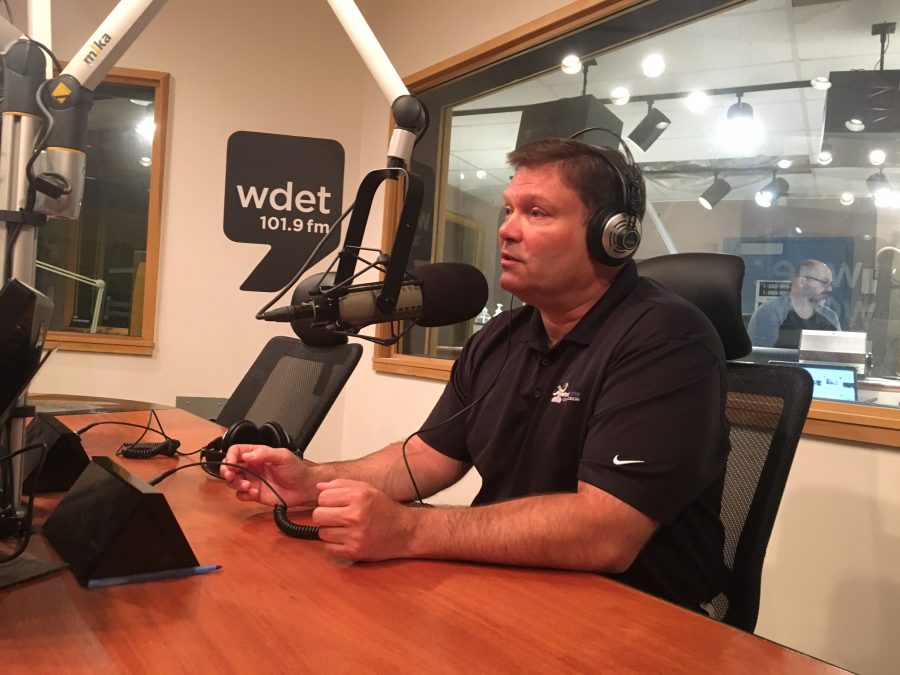
Carlson tells WDET’s Russ McNamara that there were other surprises in his poll
The following interview has been edited for clarity and length.
Carlson: A lot of the polling and the conventional wisdom that we’ve seen so far has shown that Abdul El-Sayed faces a penalty in the general election, that he does worse than Haley Stevens and or Mallory McMorrow, and I wanted to get in there myself.
I was approached by a client, to see what was happening under the hood, because I know AIPAC had gotten more involved directly in this race, and in a way that was much more open than a lot of other races around the country. When they were going through shell PACs, they’re much more open about their support for Haley Stevens through their primary super PAC United Democracy Project, and that had been covered extensively by state and local media, as well as some national media, so the timing of it was auspicious. There’s this theory of the case, from progressives and the left, and people backing candidates like Abdul around the country, the traditional definition of electability is more moderate candidates do better in an environment like this. I’ve never seen in my 13 years doing this voters so angry, frustrated with conventional wisdom, and being told who is electable, and inflation, cost of living and all that. Just much more responsive to populism, more than a left-right kind of divide, so I wanted to get in there myself and see what was happening.
And what I found was, if you’re taking a more statistical view of things, Abdul El-Sayed definitely does not face an electoral penalty for being the most progressive candidate in the race. He leads Mike Rogers 45% to 42% with 13% undecided. McMorrow leads Rogers 44% to 42% and Stevens leads him 43% to 42%. So not a huge difference among the three, and certainly not a comfortable lead for any of them.
I think it does dispel some conventional wisdom that Haley Stevens is the most electable candidate, or that Abdul is uniquely unelectable. You just have to look under the hood a little bit to see why, and the thing that struck me the most—and I love when my polls surprise me, means I’m doing something right, they’re kind of dispelling some of my own assumptions—31% of very progressive and liberal voters hold a strongly unfavorable view of Haley Stevens. 26% of very progressive liberal voters say they’re undecided if Stevens is the nominee against Mike Rogers, which is a shockingly large number. And again, this is not a huge portion of the electorate, but it’s enough that El-Sayed does two points better than her in the head to head ballots, so that is the main story here. In open ended responses in the survey, people cited ties to AIPAC, just the general Zionist Israel movement that were causing them either just want to stay home or vote third party, and it makes sense in Michigan, which is kind of the birthplace or the home base of the Uncommitted movement in 2024.
McNamara: That matches up what I’ve been seeing in the voters that I’ve talked to, because there’s still quite a hangover from 2024 and what they saw as general disrespect from the Harris-Walz campaign. Do you get the sense that Michigan is a lone case in this regard, or is this popping up in other areas?
Carlson: I’m doing a lot of polling in deep blue Democratic primary areas, which obviously—this is Michigan. This is the opposite of that. It is the swingiest of swing states, but also in some competitive swing states, like Georgia, what I see is, in Democratic primary electorates, Israel-Gaza is not the number one issue, or even the number two issue. It’s inflation, it’s cost of living.
I’ve never really seen in my career, and even before I started doing this professionally, public opinion shift this quickly among Democrats, at the very least, on Israel and Gaza. It is stark, and I’m not even sure that we’re done yet, to be honest with you. I think there’s more room to move, where you have kind of these more people that were probably right after October 7 tweeting out or posting on Facebook, saying I stand with Israel, who are now just kind of so disgusted with what the Netanyahu government is doing in Israel, and maybe, they’re not quite at Abdul’s position on like a full on arms embargo, pending Israel following international law, but it’s almost becoming a moral barrier to entry, basically being like almost a gut check, are your morals in the right place on this issue, and then if you pass that test, then I’ll look at your other stuff.
Again, this is a general election poll, but in a sense, we’re talking about the primary at the same time, based off of very progressive voters’ views of these candidates, and what we’re seeing, at least in this poll, and I welcome other data points here.
I always caution one poll is one poll, but it’s pretty compelling evidence here, particularly when you dig into the open-ended responses that people are very emotional about this, especially people from Dearborn and Dearborn Heights and Arab and Muslim voters doing this. This is progressive white voters all across the state, too. ‘I’m just going to stay home, or I am undecided,’ and whether they come home to Stevens in the general election is an open question, but I think it presents the conventional wisdom is that Abdul is the risky choice in the general election because he’s more progressive and could turn off kind of swing voters and moderates. That’s not what we found.
We found that, if anything, independents are slightly more negative on Stevens than they are on McMorrow and El-Sayed, and independents aren’t this group that are all super moderate on every single issue. I think that sometimes it’s how they’re framed. They’re pretty ideologically heterodox. ‘Maybe I’m very pro closed borders, but I’m very pro Medicare for all,’ and they don’t necessarily follow a traditional ideological map of like hard partisans, and I think that we’re seeing this response to not just this issue where El-Sayed is very clearly much more pro-Palestinian and critical of aid to Israel than the other two candidates in the race, but kind of a more economic populist message.
What we’re finding is that Haley Stevens might be the more risky general election choice, because people might say, ‘I stay home,’ because this is such a red line for people in Israel and Palestine that people don’t even necessarily want to hear what else she has to say if she can’t get there on this or soften a little bit on this. Stevens is very clearly backed by Schumer and the establishment, and we’re seeing some backlash to that. Chuck Schumer’s favorability overall in the state is -36 and even among private progressive voters it’s -20% 32%-52%. So he is toxic among all Democrats – only 47% of Democrats have a favorable view of Chuck Schumer. I haven’t really seen that been litigated a ton yet in this primary, that Stevens is kind of the default choice of the establishment, but all across the country we are seeing a backlash, DCCC candidates started losing. One just lost in Maine yesterday in ranked choice voting, another one in California a few weeks ago. It, with a few exceptions, can be a net negative, whereas in other cycles, like in 2018 where the electorate is very anti-Trump, but a little less angry as you’re combining like the cost of living crisis with anger towards Trump, whereas in 2018, the economy was much better, people were more satisfied with it, it’s creating this perfect storm where you could turn this idea of a traditional electability advantage or disadvantage on its head, and we won’t know until November, a poll is a poll, but I think that needs to be a bigger part of the conversation.
McNamara: And I feel like the last time we really had that feeling was Republicans in the Tea Party.
Carlson: 2010, that’s right, and the economy was bad then too, and that’s kind of the best-case scenario for Democrats this cycle, a Dem version of 2010.
We’re a massive wave. I think people are a little skeptical of that. Polarization has increased and redistricting and all that for the House, but when states like Alaska and Ohio and Texas and Iowa are in place in the Senate, if that comes to fruition, that’s pretty much the equivalent of a Democratic 2010, at least the Senate level.
The reason the Michigan Senate race is so interesting is Democrats can’t win the Senate if they don’t hold the seat, and there’s a lot of trauma around 2024 and they want to win. There’s a lot of nervousness around that, and a lot of confusion around who is the most electable kind of Democrat these days, and a lot of questioning and litigation of what that is. So, a lot of voters are almost acting like pundits and gravitating a little bit more towards the center versus voting with their heart. I think you’re starting to see more people do the latter, not just here, but in other parts of the country as well, and we’ll see how it all shakes out in August, but I don’t think we’re done with the twists and turns of this race yet.
McNamara: Did you get into the wedge issues at all?
Carlson: We also tested in the poll a few unnamed issue positions head to head. And then we also tested stuff on policy towards Israel.
Polling all across the country, I’m seeing Medicare for all is very popular. Would you be more likely to vote for a candidate that supports Medicare for all, which is what El-Sayed supports versus a private health insurance system, which is more in line with what Mike Rogers supports.
Some people were talking about how abolishing ICE and replacing it with a new immigration enforcement agency, like an INS or something like that, that we used to have. People were trying to equate that with defund the police, how it’s extreme position, it was an overly emotional reaction to what was happening in the moment that would hurt Democrats. But when I put abolishing ICE and replacing with a new immigration enforcement agency up against expanding ICE and increasing its funding, abolishing and replacing ICE actually narrowly won, almost exactly mapping onto Abdul El-Sayed’s overall lead over Rogers. But it’s certainly not this poison pill that a lot of more mainstream Democrats would have you believe in a state like Michigan.
Trusted, accurate, up-to-date.
WDET strives to make our journalism accessible to everyone. As a public media institution, we maintain our journalistic integrity through independent support from readers like you. If you value WDET as your source of news, music and conversation, please make a gift today.Donate today »
The post Poll: Democratic US senate candidates lead Rogers in general election appeared first on WDET 101.9 FM.