Reading view

There are new articles available, click to refresh the page.

The Metro: How ‘social prescribing’ could solve America’s loneliness epidemic

Some public health researchers are turning to a new kind of prescription to address the problem. It’s called “social prescribing.” According to former U.S. Surgeon General Vivek Murthy, Americans are in the midst of a loneliness epidemic, and it’s a problem that only seems to be getting worse.

Around 40% of Americans ages 45 and up report being lonely, which puts them at higher risk for all kinds of serious health concerns like dementia and stroke. 

Some public health researchers are turning to a new kind of prescription to address the problem. It’s called “social prescribing.”

Dr. Mary Henningfield is the executive director of the Wisconsin Research and Education Network at the University of Wisconsin. She joined the show to discuss why is loneliness so common, why it is difficult for people to overcome, and how “social prescribing” can help the healthcare can system address loneliness, instead of only its negative consequences.

Listen to The Metro weekdays from 10 a.m. to noon ET on 101.9 FM and streaming on demand.

Subscribe to The Metro on Apple Podcasts, Spotify, NPR.org or wherever you get your podcasts.

Support the podcasts you love.

One-of-a-kind podcasts from WDET bring you engaging conversations, news you need to know and stories you love to hear. Keep the conversations coming. Please make a gift today.

More stories from The Metro

The post The Metro: How ‘social prescribing’ could solve America’s loneliness epidemic appeared first on WDET 101.9 FM.

The Metro: A clinician’s perspective on why therapy is so inaccessible

For the first time in decades, more people are seeking talk therapy over medication

The good news is there’s less stigma preventing people from accessing care. The bad news: A lot of people struggle to access therapy. Some clinicians argue that one of the big issues is private equity. 

Private equity investments in health care have grown to over $750 billion over the past decade.

Linda Michaels says that’s had devastating consequences for both clients and clinicians. People are less likely to get the therapy they need. And therapists are in a worse position to offer it

That’s the premise of Michaels’ talk this Sunday at a local fundraiser for a metro Detroit clinic. She is a psychologist in private practice in Chicago and a co-founder of the Psychotherapy Action Network. She spoke with The Metro‘s Robyn Vincent.

The Metro reached out to two big health insurance providers, United Behavioral Health and Cigna. We wanted their perspective on how their administrative systems have complicated work for therapists, and made getting therapy harder. We did the same for several private equity groups. None of them offered a comment.

Listen to The Metro weekdays from 10 a.m. to noon ET on 101.9 FM and streaming on demand.

Subscribe to The Metro on Apple Podcasts, Spotify, NPR.org or wherever you get your podcasts.

Support the podcasts you love.

One-of-a-kind podcasts from WDET bring you engaging conversations, news you need to know and stories you love to hear. Keep the conversations coming. Please make a gift today.

More stories from The Metro

The post The Metro: A clinician’s perspective on why therapy is so inaccessible appeared first on WDET 101.9 FM.

The Metro: The Y Arts teen film festival gives young filmmakers a powerful platform

Young people have stories to tell. The Detroit Teen Truth Film Festival is a place for them to share those stories. It started in 2019 and has been growing ever since.

Teens from Wayne, Oakland, and Macomb Counties create films that are just fifteen seconds long.

Watch the 2025 grand prize film from the 2025 Detroit Teen Truth Festival, directed by Johan Calderon.

Fifteen seconds to share a perspective. Fifteen seconds to express what matters to them. Each year, the festival chooses a theme. The teens help pick it, so it reflects what they care about most. The films are creative, honest, and often really powerful. This year’s is “My Mental Health, Myself.”

Finalists can win cash prizes and scholarships. But even more important, they get a chance to be heard. These films help communities see the world through young people’s eyes. It gives teens a voice and empowers them to share it.

Margaret Edwartowski
Executive Director of Y Arts
YMCA Detroit
Nicolas Cucinella
Board member for The Y Arts
YMCA Detroit

In this conversation, we were joined by Y Arts Executive Director Margret Edwartowski and Y Arts Board member Nicolas Cucinella. We learned more about the importance of giving teens space to express their ideas.

The 2026 festival is Saturday April 25 at 2:00 p.m. at the Marlene Boll Theatre at the Boll Family YMCA.

Listen to The Metro weekdays from 10 a.m. to noon ET on 101.9 FM and streaming on demand.

Subscribe to The Metro on Apple Podcasts, Spotify, NPR.org or wherever you get your podcasts.

Support local journalism.

WDET strives to cover what’s happening in your community. As a public media institution, we maintain our ability to explore the music and culture of our region through independent support from readers like you. If you value WDET as your source of news, music and conversation, please make a gift today.

More stories from The Metro

The post The Metro: The Y Arts teen film festival gives young filmmakers a powerful platform appeared first on WDET 101.9 FM.

GOP governor candidate Tom Leonard says Michigan needs a Detroit Lions-esque turnaround

Michigan elects a new governor this year and WDET is talking to the candidates vying to replace term-limited Democrat Gretchen Whitmer.

One of those in the crowded Republican field for governor is former Michigan Speaker of the House Tom Leonard. He wants to lower taxes and reduce government spending.

But Leonard says he’s also running to protect the future for Michigan’s children, including his own kids.

Listen: GOP governor candidate Tom Leonard speaks with WDET’s Quinn Klinefelter

The following interview has been edited for clarity and length.

Tom Leonard: There’s three very simple reasons why I’m doing this. And those are Hannah, Thomas, and Danny. That’s our nine-year-old, our six-year-old, and our now 20-month-old.

When you look at the state of our state right now, the unemployment, the lack of income growth, a quarter of our population right now suffers from some type of mental health issue. Half of them are not getting treatment. The list goes on.

We are doing this because the last thing that we want is for one of our kids to come to us in the next 15-20 years and say, “Dad, we’d love to stay in the greatest state in the country. But unfortunately we have to leave because there’s no opportunity for us here in Michigan.” That’s why we’re doing this.

Education serves as a foundation

Quinn Klinefelter, WDET News: If you were elected governor, how would you try to address some of that?

TL: There are so many things that we have got to get done to turn this state around. One of the biggest issues that I’m focused on right now is education. Fourth graders right now in this state cannot read at a proficient level. Quinn, that is our foundation, that is our base. And I can tell you as a former prosecutor, if somebody has to drop out of school because they’re illiterate, you have created a pipeline to a welfare check or a prison cell.

I believe we need to make Michigan a right-to-work state again. Growth states in this country are right-to-work states. I believe we need to phase out the income tax.

I hear many of these candidates out there gaslighting people across the state, saying that they’re going to eliminate the state income tax on day one. That’s despite the fact that the legislature isn’t even sworn in until nearly two weeks after the governor comes into office.

I would say look at my past track record and my history. That’s what we did when I was speaker. And when I’m the state’s next governor that’s exactly what we’re going to do. We’re going to get these big-ticket items across the finish line.

Mental health crisis

QK: You mentioned education. What other issues do you think are vitally important at the moment to Michigan?

TL: I seem to be the one candidate out there right now that’s talking about this mental health crisis. As I said, a quarter of our population suffers from some type of mental health issue. Half of them are not getting treatment.

I believe it starts with ending the stigma that comes attached when somebody is diagnosed with a mental health issue. Think about this for a moment. If you or somebody is diagnosed with something physically, what do they typically do? They go to their friends, they go to their family, they go to their place of worship, they ask for prayer, they start treatment.

Sadly, when people are diagnosed with a mental health issue, they are scared. They don’t know what to do. We’ve got to end the stigma that comes attached.

Energy policy reform

TL: Energy costs. This is a big one right now as I travel the state. I’m hearing more and more of people that can no longer afford their electricity bills. Frankly, we’ve got a broken system. We’ve got a Michigan Public Service Commission that no longer works for the people of this state. They work for two monopoly utilities. They sign off on every single rate increase that they ask for.

Enough is enough. We are the one campaign that has put forth a plan to not only bring choice and competition to the state and the utility monopolies, but also shake up the Michigan Public Service Commission.

Right now those regulators, who dictate our rates, are three unelected bureaucrats appointed by the governor. That is way too much power given to the governor. The governor should never control those appointments. Our plan calls for increasing the Michigan Public Service Commission from three to five members, only giving the governor two appointments.

The other appointments would be made by the attorney general, the speaker of the Michigan house and the senate majority leader. These are the types of bold solutions we are putting on the table to address the problems that the people of this state are facing.

Data centers feed into energy problems

QK: There’s been concerns raised by some people about the possibility of rate increases and energy or water problems from the advent of data centers across the state. From some of your past statements, it sounds like you’re not exactly a fan of data centers.

TL: The one being proposed right now that’s being built in Saline Township is 1.4 gigawatts. That is equivalent to the energy used by a million homes. There’s now one being proposed in Van Buren that’s nearly double that, with energy use equal to 2 million homes. Quinn, there are only 4.5 million homes in this entire state. Two industrial-sized data centers alone that they’re proposing would equal the energy for 3 million homes.

I don’t want these things driving-up our energy rates. We need to end the tax subsidies that come attached with these things.

The legislature a couple years ago passed legislation to give tens of millions of dollars to these big tech data centers. They should not be taking money out of our pockets and putting it in the hands of big tech to go out and buy up our farmland. So, end the subsidies.

We need to ban the use of non-disclosure agreements. You’ve got these local governments that are signing these NDA’s. The local citizens have no idea who’s going to be built in their area. They have no idea who’s going to be running these data centers.

These data centers do not create long-term jobs. Yet there is the risk that they are going to drive up our energy rates. And every time I push back on this energy issue, people say, “Well, they’re going to be regulated.” And then I ask the question, “Who’s going to regulate them?” “The Michigan Public Service Commission.” And I say, “So the same three regulators that have given us some of the highest electricity rates in the country, the same three regulators that refuse to tell DTE Energy and Consumers Energy ‘No,’ we are now going to allow to regulate these data centers?” I don’t think so.

I fear that they’re going to drive up our rates. We’ve already got the highest rates in the Midwest and some of the highest in the country. We cannot afford to pay more on our electricity bills.

What to do about political division

QK: It’s no secret how politically divided not only lawmakers but the country and the state as a whole are nowadays. Do you think it’s possible that anyone who would be governor will be able to bring people together at this point in time? Or is it just simply a matter of, “We’ve got to go forward with our policies and hope the other side comes along at some point?”

TL: I believe Democrats gave Republicans a playbook two years ago for what happens when you wake up every day and you have no vision and your only focus is hatred of one person. You lose. And I believe, as a Republican, if Republicans wake up every day and their only focus is hatred of Democrats, they will lose.

They’ve got to put forth a vision. That’s why every single day I’m focused on tackling problems, not people. I’m going to stay bold in my convictions, I’m a strong conservative. I don’t shy away from that. But there is nothing wrong with working across the aisle when it comes to accomplishing things for our state. We’ve actually labeled it the “Dan Campbell” approach.

You may recall when Coach Campbell became the coach of the Lions and he stood on that stage at the first press conference. He didn’t focus on six decades of failure. He didn’t cast blame. He didn’t point the finger. He just simply said, “We’ve got a problem here. And with a lot of grit, a lot of determination, working together with a positive vision every single day, we’re going to turn this program around.”

If Coach Campbell was able to turn the absolute worst sports franchise in the history of all mankind around with that type of vision, we can do the same thing for this state.

Trusted, accurate, up-to-date.

WDET strives to make our journalism accessible to everyone. As a public media institution, we maintain our journalistic integrity through independent support from readers like you. If you value WDET as your source of news, music and conversation, please make a gift today.
Donate today »

The post GOP governor candidate Tom Leonard says Michigan needs a Detroit Lions-esque turnaround appeared first on WDET 101.9 FM.

Detroit Chief Public Health Officer Ali Abazeed aims to expand citywide health initiatives

Detroit Mayor Mary Sheffield recently appointed Ali Abazeed as the city’s new Chief Public Health Officer, saying he would be a part of creating a “health in all policies” approach to government.

“We’re really excited to get up and going and also to continue the good work that the department has done over the years, but also to upgrade the software of what public health can look like in the city of Detroit,” he shares. 

Abazeed previously created and led the city of Dearborn’s health department. He also worked as a public health advisor at the National Institutes of Health (NIH). 

Past policies shape today’s health issues

He says health is impacted by housing quality and environment. He hopes to work with the department’s staff of 280 people to create better health outcomes for Detroiters.

“The challenges that Detroit faces from a health perspective, those aren’t inevitable…  they’re created by decades, if not centuries of decisions made by man, policies that have been excluding people from opportunities,” he says.

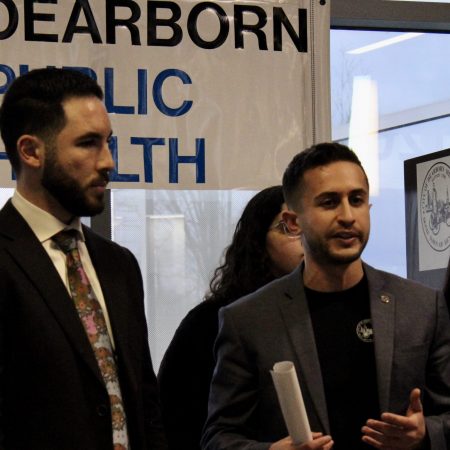
Ali Abazeed previously created and served as the Dearborn Department of Health’s Chief Public Health Officer.

Abazeed says the city focuses on a harm reduction approach by working with all city departments to connect the dots for people who live in the city. He says part of that will include having more health department officials out in the city.

“90% of your life expectancy happens in the communities where you live, learn, work, worship, play…  then it requires us to take that 90% collaborative approach across everything that we do at the city,” he says. 

Abazeed says Detroiters face health burdens like asthma, which he says require a multifaceted response. 

He says everyone is entitled to good health. 

“Understanding who has been disqualified, who has been sort of pushed to the side, and whether that’s… in Washington or Dearborn and now in Detroit, I think the work is relatively the same, even if it does take on a little bit of a different scale,” he says. 

Trusted, accurate, up-to-date.

WDET strives to make our journalism accessible to everyone. As a public media institution, we maintain our journalistic integrity through independent support from readers like you. If you value WDET as your source of news, music and conversation, please make a gift today.

Donate today »

The post Detroit Chief Public Health Officer Ali Abazeed aims to expand citywide health initiatives appeared first on WDET 101.9 FM.

The Metro: Roundup’s safety science is falling apart. The government is protecting it anyway

What happens when the regulatory systems we depend on to protect us break down?

In February, President Trump signed an executive order invoking the Defense Production Act — a wartime authority — to guarantee the domestic supply of glyphosate, the active ingredient in Roundup, the world’s most widely used weedkiller. The order extends legal immunity to its producers. It came one day after Bayer proposed a $7.25 billion settlement to resolve tens of thousands of cancer lawsuits without admitting wrongdoing.

The World Health Organization classifies glyphosate as a probable carcinogen.

Separately, the Supreme Court hears oral arguments April 27 in a case that could shut down state-level Roundup lawsuits nationwide. The EPA faces an October deadline to rule on glyphosate safety — with most of its research staff gone.

Last month on The Metro, Harvard historian Naomi Oreskes explained how the landmark safety study behind Roundup was ghostwritten by Monsanto, cited by regulators worldwide for 25 years, and finally retracted after she and researcher Alexander Kaurov documented its influence. Since then, she has identified more scientific research ghostwritten by Monsanto.

To discuss, Oreskes, author of “Merchants of Doubt,” returned to The Metro to join Robyn Vincent.

Hear the full conversation using the media player above.

Listen to The Metro weekdays from 10 a.m. to noon ET on 101.9 FM and streaming on demand.

Subscribe to The Metro on Apple PodcastsSpotifyNPR.org or wherever you get your podcasts.

Trusted, accurate, up-to-date.

WDET strives to make our journalism accessible to everyone. As a public media institution, we maintain our journalistic integrity through independent support from readers like you. If you value WDET as your source of news, music and conversation, please make a gift today.

Donate today »

More stories from The Metro

The post The Metro: Roundup’s safety science is falling apart. The government is protecting it anyway appeared first on WDET 101.9 FM.

Understanding road salt damage to Detroit’s tree canopy

As temperatures drop and snowfall increases this winter, Detroit’s road commissioners break out their plows and salt trucks in order to maintain safe roadways. 

However, the most common road salt used, sodium chloride, has been known by experts and road commissioners to cause damage to surrounding trees.

Dr. Bert Cregg, a Michigan State University Professor in the Department of Horticulture, says that excessive usage of this road salt can lead to tree death. 

Cregg says protecting trees from salt exposure and selecting salt-tolerant species are the first steps to mitigating this issue. 

Identifying salt damage in trees 

Cregg describes salt damage occurring in two ways: acute damage and chronic damage.

Acute damage refers to when tree trunks, branches, and leaves are exposed to salt. 

“If we think about the white coat of salt that accumulates on our cars this time of year, trees and shrubs adjacent to roadways are experiencing the same thing,” says Cregg

Acute damage is the easiest to identify.

In evergreen trees, such as Michigan White Pines, salt damage causes needle browning and can lead to tree death.

In deciduous trees, such as Oak and Maple trees, salt damage commonly causes “witch’s brooms,” which is when the ends of branches repeatedly die and grow back due to salt exposure, Cregg explains. 

Because chronic injury refers to damage that we can’t see as easily, it can be trickier to identify. Chronic injury occurs when road salt leaches into the surrounding soil and creates high concentrations of sodium and chloride.

Cregg says these high concentrations “reduce the plant’s ability to take up water from the soil solution, resulting in a form of drought stress.”

How to reduce salt damage on trees: protection and selection

Cregg suggests de-icing alternatives, such as beet juice or calcium magnesium acetate, which pose less environmental risk than typical road salt.

While the simple solution seems to be for road commissioners and residents to abandon their usage of road salt, this is an unrealistic approach considering sodium chloride continues to be the most affordable and efficient option for de-icing, and given Michigan’s harsh winters, public safety is often prioritized over environmental concerns. 

Due to this limitation, Cregg emphasizes the importance of creating physical barriers, such as placing burlap wrap or canvas screens around existing trees, to protect them from excessive salt exposure.

These physical barriers would help mitigate damage from the inevitable salt splash caused by cars on the roadway. 

When planting new trees around roadways, it’s important to consider that some tree species are more sensitive to salt exposure than others.

To aid this, Cregg advises homeowners and city planners to select salt-tolerant trees to ensure they can survive in the given environment. 

“Some salt-tolerant trees for our area include Bald Cypress, Kentucky Coffeetree, Japanese Tree Lilac, Dawn Redwood, Horse Chestnut, Hackberry, and Swamp White Oak.”

This story is a part of WDET’s ongoing series, the Detroit Tree Canopy Project.

Support local journalism.

WDET strives to cover what’s happening in your community. As a public media institution, we maintain our ability to explore the music and culture of our region through independent support from readers like you. If you value WDET as your source of news, music and conversation, please make a gift today.

The post Understanding road salt damage to Detroit’s tree canopy appeared first on WDET 101.9 FM.

The Metro: The dopamine loop kids can’t escape, and what Michigan is doing about it

Young people’s brains are changing.

Research shows social media activates the same dopamine-driven reward pathways in the brain as addictive substances. The scroll, the like, the notification — each one is a quick hit of pleasure that keeps you coming back.

The U.S. Surgeon General has warned that teens who use social media for more than three hours a day face double the risk of depression and anxiety, and the vast majority of American teenagers use social media. More than a third say they use it “almost constantly.” 

The platforms keep us sucked in so long that we now have new terms for our interactions with these devices, like “doomscrolling” and “brain rot.”

Now, the courts are getting involved. In Los Angeles, a jury is hearing claims that Meta and YouTube deliberately designed their platforms to get children addicted. In New Mexico, the state attorney general is suing Meta for allegedly failing to protect minors from sexual exploitation

In Michigan, legislators are cracking down on phones in schools. This month, Michigan banned smartphones in the classroom, affecting students in the fall. 

State Representative Mark Tisdel, a Republican representing Rochester Hills, sponsored the cell phone ban. He joined Robyn Vincent on The Metro to discuss how he believes lawmakers should stand up to Big Tech.

Listen to The Metro weekdays from 10 a.m. to noon ET on 101.9 FM and streaming on demand.

Subscribe to The Metro on Apple Podcasts, Spotify, NPR.org or wherever you get your podcasts.

Trusted, accurate, up-to-date.

WDET strives to make our journalism accessible to everyone. As a public media institution, we maintain our journalistic integrity through independent support from readers like you. If you value WDET as your source of news, music and conversation, please make a gift today.

Donate today »

More stories from The Metro

The post The Metro: The dopamine loop kids can’t escape, and what Michigan is doing about it appeared first on WDET 101.9 FM.

Callery Pear, Japanese barberry may be added to Michigan’s invasive species list

The Michigan Department of Agriculture and Rural Development may add six new plant species to the state’s list of invasive plants. This list could include Callery pear, Japanese barberry, and two aquatic plants.

If approved, water hyacinth and water lettuce would be considered illegal to sell or transport 30 days after they are officially listed. The Callery pear, common buckthorn, glossy buckthorn, and Japanese barberry would become restricted starting January 1, 2028. These regulations would prevent the sale or purchase of these plants but would not impact property owners who already possess them.

Officials state that these plants can pose risks to Michigan’s environment, economy, and public health. They have the potential to displace native species, damage infrastructure, and in some cases, host ticks that carry diseases.

Trusted, accurate, up-to-date.

WDET strives to make our journalism accessible to everyone. As a public media institution, we maintain our journalistic integrity through independent support from readers like you. If you value WDET as your source of news, music and conversation, please make a gift today.

Donate today »

The post Callery Pear, Japanese barberry may be added to Michigan’s invasive species list appeared first on WDET 101.9 FM.

The Metro: How a fake study shaped 25 years of pesticide policy

When a government agency decides whether a chemical in your food is safe, where does the science come from? Most of us assume it’s independent. In the case of Roundup — the world’s most widely used weedkiller — the manufacturer wrote the research, and it went unchallenged for 25 years.

In 2000, a study published in the journal Regulatory Toxicology and Pharmacology concluded Roundup posed no health risk to humans. But internal Monsanto emails released in 2017 litigation revealed company employees had ghostwritten the paper. Despite that, it remained in the scientific record, cited without caveat in hundreds of academic papers and dozens of government documents worldwide.

Harvard historian of science Naomi Oreskes and researcher Alexander Kaurov changed that. Their 2025 analysis found the ghostwritten paper ranked in the top 0.1% of all cited glyphosate literature. They requested the journal retract it. In November 2025, it did, citing “serious ethical concerns.” Oreskes and Kaurov also wrote about their findings in Undark.

The retraction comes as Bayer, which acquired Monsanto in 2018, faces roughly 65,000 Roundup cancer lawsuits. On February 17, the company proposed a $7.25 billion class settlement. The U.S. Supreme Court has agreed to hear a related case this term. Bayer maintains glyphosate is safe.

Oreskes, author of “Merchants of Doubt,” joined Robyn Vincent on The Metro to discuss how one ghostwritten paper shaped pesticide policy for a generation, and what it means now that it’s been thrown out.

Hear the full conversation using the media player above.


Listen to The Metro weekdays from 10 a.m. to noon ET on 101.9 FM and streaming on demand.

Subscribe to The Metro on Apple Podcasts, Spotify, NPR.org or wherever you get your podcasts.

Trusted, accurate, up-to-date.

WDET strives to make our journalism accessible to everyone. As a public media institution, we maintain our journalistic integrity through independent support from readers like you. If you value WDET as your source of news, music and conversation, please make a gift today.

Donate today »

More stories from The Metro

The post The Metro: How a fake study shaped 25 years of pesticide policy appeared first on WDET 101.9 FM.

Detroit Evening Report: MDHHS offers stipends for behavioral health interns

The Michigan Department of Health and Human Services is offering stipends for interns enrolled in a behavioral health bachelor or master’s program. MDHHS is allocating $1.25 million for the program.  

MDHHS Director Elizabeth Hertel says the funding supports mental health care workers. The Behavioral Health Internship Stipend Program is in its fourth cohort, which supported 159 students last year. The program offers money to students for unpaid internship costs such as tuition, fees, and living expenses. 

Students pursuing degrees in marriage or family therapy, behavioral analyst,  social workers and counselors are eligible to apply for the one-time stipend ranging from $5 to $15,000 each.

Applications close tonight.

Additional headlines for Monday, Jan. 26, 2026

Radon Action Month

January is Radon Action Month. Radon is an odorless, colorless, and tasteless radioactive gas that’s found in soil. It’s naturally created through the breakdown of uranium in soil around homes.

The gas can cause lung tissue damage through radiation, making it the leading cause of lung cancer in nonsmokers. 

Michigan’s Department of Environment, Great Lakes, and Energy recommends testing homes every two years for exposure. People can pick up a testing kit from their local health department.    

Al-Ikhlas Director Nadir Ahmad passes away 

Detroit’s Al-Ikhlas Training Academy’s Director and Founder, Imam Nadir Ahmad passed away on Jan. 22. His funeral was held on Saturday.

In 2020, the Dream Storytelling oral history project interviewed Ahmad. He told the archive he moved from Virginia to Detroit to study Islam at the Wayne County Community College as part of the Muslim World Studies Program in 1980.  Ahmad taught at the Clara Muhammad School in Detroit, later serving as assistant principal and then principal. Ahmad founded the Islamic school Al-Ikhlas Training Academy in Detroit in 1991.

Community members and current and former students posted several comments on Facebook, sharing memories and commemorating the educational leader as someone who defined an era in Detroit. Ahmad was also a U.S. military veteran.  

ProsperUs Detroit hosts training program

ProsperUs Detroit is hosting an Entrepreneur Training Program for the Spring of 2026. The 12-week program provides one-on-one support for businesses to learn how to register their business, create budgets and systems for bookkeeping. The group will also learn how to write a business plan.

Participants will also study business models, target markets, and finances. Applications are due by Feb. 1. 

Outlier and Detroit-ography host trivia

The Outlier Collective is hosting a trivia event next month. Test your knowledge of Detroit with Outlier Media’s Civic Life Reporter Briana Rice and Detroit-ography’s Alex B. Hill.

Editor’s note: Corrected Al-Ikhals Director Nadir Ahmad’s title, from Dr. to Imam 1/27/26. We apologize for the error.

Tickets are $5 a person. The event is being hosted by Outlier Media and Detroit-ography at the Brewery Faisan on Feb. 4 from 6:30-9 p.m. Register at outliermedia.org/our-events/.   

Listen to the latest episode of the “Detroit Evening Report” on Apple Podcasts, Spotify, NPR.org or wherever you get your podcasts.

Support local journalism.

WDET strives to cover what’s happening in your community. As a public media institution, we maintain our ability to explore the music and culture of our region through independent support from readers like you. If you value WDET as your source of news, music and conversation, please make a gift today.

The post Detroit Evening Report: MDHHS offers stipends for behavioral health interns appeared first on WDET 101.9 FM.

New book examines equitable degrowth as necessary to combat climate change

How does a global community provide for the needs of its citizens without destroying the planet? That’s the crux of “Anthropause: The Beauty of Degrowth,” a new book out this month.

In the early days of the Covid-19 pandemic, society shut down for a few months. As humans stayed inside, animals returned to their old habitats and pollution eased as industry slowed.

Stan Cox, author of “Anthropause: The Beauty of Degrowth”

Retired researcher—and new metro Detroit resident—Stan Cox looks at how that “anthropause” could be a preview of the necessary societal changes to save lives and the planet.

He spoke with All Things Considered – Detroit host Russ McNamara last month. Click on the media player to listen or read selected transcripts below.

Listen: New book examines equitable degrowth as necessary to combat climate change

Russ McNamara, WDET: Why did you write this book?

Stan Cox, Author: The main point I’m making in the book is imagining that we as a society, if we were to rapidly phase out fossil fuels and get by just on the energy that could be generated other ways; and if we stopped plundering the earth for minerals and cutting down forest and causing ecological damage; and we had less energy and materials, and had to allocate them carefully: people know that’s going to mean sacrifice. What am I going to have to give up and so forth?

And what I’m saying in the book is okay, yeah, there are certain things, obviously that will have to be given up. But let’s consider all of the dangers and nuisances, terrible stuff that we put up with an advanced industrial society that has all this energy and materials running through it.

We would be saying goodbye to a lot of those harms and ills by simply not doing a lot of the stuff that requires so much energy input. So the rest of the book, then, is going through specific technologies and activities and so forth that are really harmful to people and the environment, of course, that we would not have the fuel to undertake them, or we would be using resources for meeting people’s basic needs, and we wouldn’t be spending a lot of energy on these other things.

RM: You discuss this and I’m reminded of data centers to run artificial intelligence. People certainly don’t seem to want them and definitely don’t want these in their backyard because there is this concern about the high cost of electricity, and the amount of groundwater that is needed.

SC: That’s absolutely right. One of the big reasons these communities don’t want them is that they create this horrific noise at very high decibel levels and low low frequency noise, which is especially dangerous to human health. When I started writing the book, there wasn’t as much being said about A.I. and the data centers at that time, so I did eventually incorporated them, but the beginning of the second chapter is about noise pollution and and I just used it. It’s seemingly a very small thing, but it really brings out other issues. The leaf blower, especially the gas powered leaf blower, also produces this low frequency and very high volume sound—about eight times the decibel level that the World Health Organization says is safe – and they’re producing a wind about the speed of an EF five tornado. The low frequency sound can travel like three football fields. It’s still above the safe limit.

RM: So what are the societal impacts? Let’s say we start degrowth right now. What are the benefits?

SC: We can’t go on like we’re on the trajectory that we’re on now, because. A degrowth is going to happen. Either a chaotic, brutal degrowth where it’s a Mad Max kind of future, because we’ve tried to force growth to continue and have destroyed ecosystems

Or we can have a planned, rational degrowth that ensures that there’s enough for everybody and that we’re not causing ecological collapse. But there’s no way that growth can continue at this rate.

Sometime in the past three years, we passed a milestone. The quantity of human made stuff—that is everything that human society has manufactured or built or produced—if you weigh all of it up, the mass of all of that exceeds the total mass of all living things on Earth, all plants, animals, microbes, et cetera, and that quantity of stuff being produced is is doubling every 20 years. And clearly that can’t go on.

Herb Stein, an economist from the 70s or 80s was kind of the Yogi Berra of economists. He had a line: “if something can’t go on forever, it won’t” and that’s where growth cannot go on forever. So we have to pull back, create what I called in the book an “anthropause” of our own, and try to have a rational, safe and just reduction in the amount of economic activity for the good of everybody.


Support local journalism.

WDET strives to cover what’s happening in your community. As a public media institution, we maintain our ability to explore the music and culture of our region through independent support from readers like you. If you value WDET as your source of news, music and conversation, please make a gift today.

The post New book examines equitable degrowth as necessary to combat climate change appeared first on WDET 101.9 FM.

The Metro: A new superintendent, a long list of expectations for Michigan schools

Michigan’s schools are increasingly tasked with more than teaching.

They are expected to raise reading and math scores, address rising mental health needs, manage technology and discipline, and serve as safe, stable places for families under stress. In some communities, they’re also absorbing fear sparked by immigration enforcement actions. That includes the detention of Detroit students seeking asylum.

Academically, the picture is mixed. On national exams, Michigan’s scores remain close to the U.S. average. But since the pandemic, other states have improved more quickly, especially in early reading. Michigan has moved more slowly, and over time, that difference adds up.

Meanwhile, chronic absenteeism is improving, but many students, especially in Detroit, still miss school regularly.

The state has increased funding and continued free school meals. Educators say those steps help. They also say long-standing challenges persist in special education, staffing, and student support.

This is the landscape facing Michigan’s new top education official.

Dr. Glenn Maleyko was sworn in last month as State Superintendent of Public Instruction. He steps into the new role after nearly a decade leading Dearborn Public Schools. He has identified literacy as his priority and launched a statewide listening tour.

The Metro’s Robyn Vincent sat down with Maleyko to learn how he plans to lead a system being asked to do more than it was designed to handle.


Listen to The Metro weekdays from 10 a.m. to noon ET on 101.9 FM and streaming on demand.

Subscribe to The Metro on Apple Podcasts, Spotify, NPR.org or wherever you get your podcasts.

Trusted, accurate, up-to-date.

WDET strives to make our journalism accessible to everyone. As a public media institution, we maintain our journalistic integrity through independent support from readers like you. If you value WDET as your source of news, music and conversation, please make a gift today.

Donate today »

More stories from The Metro

The post The Metro: A new superintendent, a long list of expectations for Michigan schools appeared first on WDET 101.9 FM.

Detroit Evening Report: Dearborn receives firearm safety grant

Dearborn’s Department of Public Health has been awarded a $101,000 grant to advance firearm safety. The Michigan Department of Health and Human Services funding supports collaborative efforts to educate gun owners on safe handling and storage. 

Dearborn Mayor Abdulllah Hammoud says firearm injury prevention is a public health and safety priority. 

The city’s health department will distribute firearm safety kits, including gun locks, lockboxes, and educational materials.  Dearborn Chief Public Health Officer Ali Abazeed says the grant supports evidence-based education and access to safety tools. 

Additional headlines for Monday, Dec. 22, 2025

Michigan Chief Medical Executive makes Standing Recommendation regarding children’s vaccines 

Michigan’s Chief Medical Executive, Dr. Natasha Bagdasarian, made a Standing Recommendation to continue issuing vaccinations on schedule based on recommendations by the American Academy of Pediatrics (AAP) and the American Academy of Family Physicians (AAFP). 

Bagdasarian shared that public health experts are not in agreement with new federal vaccine recommendations, prompting the announcement. One of the recent changes was dropping the Hepatitis B vaccine at birth and removing the COVID-19 vaccine recommendation for healthy children and pregnant women. 

Bagdasarian’s Standing Recommendation was made with the Michigan Department of Health and Human Services’ Division of Immunization. 

She says the recommendation does not supersede clinical judgment. She also asks health care providers to make vaccines accessible by removing barriers for patients. 

Bagdasarian says vaccines keep people safe and potentially save lives. 

EGLE renews license for hazardous waste facility 

The Michigan Department of Environment, Great Lakes, and Energy (EGLE) has renewed the license for a hazardous waste treatment and storage facility in Detroit for the next 10 years.

Hazardous Waste Management Facility Operating License to EQ Detroit Inc., which does business as US Ecology Detroit South, was issued the license after regulatory review and a public comment process. Several people strongly opposed the facility because it emits strong odors leading to health concerns like asthma. The facility also has a history of clean air violations. 

EGLE renewed the license, adding new requirements, such as expanding air and groundwater monitoring. The facility must replace six tanks beginning in January 2026 and install odor control equipment by the end of Dec 2027.

Tunnel in southwest Detroit 

The Great Lakes Water Authority has started building a sewage relief system near the Rouge River in Southwest Detroit. Crews will spend at least two years digging a tunnel to carry excess stormwater to an underused retention and treatment center. Chief Operating Officer Navid Mehram says the $87 million project should reduce the risk of flooding and sewage backups during heavy rain. 

So this is an example where we’re making an investment in our existing system by rerouting some flows, so that we can leverage an existing facility that wasn’t receiving all the flow it can treat.”

Mehram says the project will not increase customers’ sewage bills. He says state and federal funding will help pay for the tunnel. 

New tech firm in town 

Detroit is getting a new high-tech security and AI solution firm, Eccalon. The defense tech company will create 800 new jobs ranging from $25-100 per hour. 

The facility will have manufacturing operations, training programs and an innovation center. 

The company’s headquarters is moving from Maryland to become a part of the tech innovation in Detroit. Eccalon will be located at the Bedrock-owned Icon building at 200 Walker Street. 

Eccalon Chairman and CEO André Gudger says the new headquarters will develop cybersecurity and advanced manufacturing and automation. 

The company hopes to open early next year. 

Listen to the latest episode of the “Detroit Evening Report” on Apple Podcasts, Spotify, NPR.org or wherever you get your podcasts.

Support local journalism.

WDET strives to cover what’s happening in your community. As a public media institution, we maintain our ability to explore the music and culture of our region through independent support from readers like you. If you value WDET as your source of news, music and conversation, please make a gift today.

The post Detroit Evening Report: Dearborn receives firearm safety grant appeared first on WDET 101.9 FM.

❌