Reading view

There are new articles available, click to refresh the page.

Detroit Evening Report: Stellantis fails to provide profit-sharing checks to workers this year, reports annual loss

UAW Stellantis workers are reportedly disappointed because they are not getting profit sharing checks from 2025. This follows the company facing a multibillion dollar deficit last year. It’s also the first time Stellantis hasn’t provided a profit-sharing bonus since the recession.

The Big Three has faced obstacles because of tariff uncertainty, Electric vehicle whiplash, interest rates and more, but Ford and GM still provided a profit-sharing checks to their employees. Stellantis says that it expects 2026 and its expanding product wave to bring profitable growth in North America.

Additional headlines for Friday, Feb. 27, 2016

Personnel shortage in behavioral health field

A new report from the Michigan Health Council shows that Michigan doesn’t have enough opportunities for students to become behavioral health care workers. This is contributing to a shortage of certified school-based mental health professionals across the state, according to the council.

This shortage puts a large workload on the personnel in this field. In the 2023-2024 school year Michigan had about 600 students per school counselor, over a thousand students per school psychologists, and almost 500 students per social worker. The report goes on to share that improving vocational programs could introduce thousands of high school students to fulfilling careers in behavioral health.

Sports updates

NBA

The Detroit Pistons face the Cleveland Cavaliers today at Little Ceasars Arena but—like their game against the Thunder—the opposing team is without their best players, with both Donovan Mitchall out with groin injuries and James Harden questionable with a thumb injury.

The Pistons are playing without their full strength with Isaiah Stweart out again because of his involvement in the fight with the Charlotte Hornets on Feb. 9. This is his sixth game of his seven game suspension.

Tonight’s game tip off is at 7 p.m. with a following away game against the Magic on Sunday, March 1.

NHL

The Red Wings face the Carolina Hurricanes tomorrow Feb. 28 at the Lenovo Center. The Red Wings are currently second in the Atlantic Divison with 34 wins and 19 losses. Game starts at 7 p.m.

Blueberry recall

More than 55,000 pounds of frozen blueberries, some of which were shipped to Michigan, have been recalled because of possible listeria contamination.

The Oregon Potato Company was the distributor of the recalled berries. This shipment was also sent to Oregon, Washington, Wisconsin and Canada.

The FDA recalled it initially on Feb. 12 and classified the recall as a Class 1 recall on Feb. 24, which means there is a reasonable probability that the use of or exposure to a violative product will cause serious adverse health consequences or death.

Go to your local grocery store to see if your purchase of frozen blueberries was in the mix.

Handmaid’s Tale in Detroit

And the dystopian world of the Handmaid’s Tale comes to the Detroit Opera House. The play, once a hit television series and novel, is a chilling look into a future where America’s democracy morphs into a religious tyranny.

There are showings on Sunday March 1, Thursday March 5 and Saturday March 7.

Listen to the latest episode of the “Detroit Evening Report” on Apple Podcasts, Spotify, NPR.org or wherever you get your podcasts.

Support local journalism.

WDET strives to cover what’s happening in your community. As a public media institution, we maintain our ability to explore the music and culture of our region through independent support from readers like you. If you value WDET as your source of news, music and conversation, please make a gift today.

The post Detroit Evening Report: Stellantis fails to provide profit-sharing checks to workers this year, reports annual loss appeared first on WDET 101.9 FM.

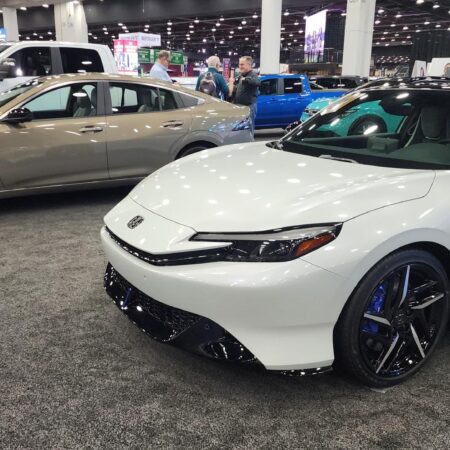
SCOTUS tariff ruling extends uncertainty for Detroit automakers

President Trump lashed out at the U.S. Supreme Court after it ruled his use of certain tariffs was illegal.

Trump noted he had other options, including blocking all trade with other nations.

“I can destroy the trade. I can destroy the country,” the president said. “I’m even allowed to impose a foreign country-destroying embargo. I can embargo. I can do anything I want. But I can’t charge $1.”

Trump later said he would impose a new global 15% tariff, though it initially began at 10%.

Congress would have to extend the tariff in about five months. The president could potentially get around that provision by announcing a new round of levies at that time.

Many businesses are weighing the impact of the tariff upheaval, including Detroit’s Big 3 automakers.

The head of the trade association MichAuto, Glenn Stevens, Jr., says car companies had anticipated the High Court’s decision.

Listen: SCOTUS tariff ruling extends uncertainty for Detroit automakers

The following interview has been edited for clarity and length. 

Glenn Stevens, Jr.: It was pretty much assumed that the justices would rule this way based on some of the preliminary arguments. We also felt that there would be a response from the administration that they might use additional or new tools if the Supreme Court ruled this way. And we have seen the president state that. I think it does reaffirm the power of Congress according to the U.S. Constitution, in the case of this particular act. But it leaves a lot of uncertainty with our industries and in our economy.

Quinn Klinefelter, WDET News: The High Court ruled on the reciprocal tariffs on other countries. But they’re still allowing levies imposed ostensibly to protect national security. The 25% tariffs on imported vehicles and auto parts still stands, except for imports covered under the North American trade deal. So, how do you see the Supreme Court decision affecting the auto industry in particular?

GS: It affects a portion of it. But not by any stretch all of the tariffs and trade deals that have been put in place since Jan. 20 of last year when the America First Trade Policy Act was issued. Yes, the national security tariffs remain in place. The unfair trade practice tariffs remain in place. Those are very tied heavily to China. Those are significant. But anything that did deal with this Emergency Powers Act has been struck down now.

What happens from here, we don’t know. There will be court challenges. The question of whether companies will be able to get a rebate, so to speak, on what they paid, there was no direction from the court on that. So, again, we have a lot of uncertainty moving forward. And then we have a new wild card, which we anticipated, where the president said that he’d use fair trade and anti-dumping subsidy tariffs. And there’s a whole process for that.

QK: And how would that affect the auto industry?

GS: It’s such a complex supply chain. It depends on where the vehicles are assembled. It depends on what is the country of origin where the components come from. For example, a lot of the parts and the components are still exempt on this continent under the current USMCA agreement. But if you’re importing parts from other countries outside of that agreement, it does impact you, the 25% on imported vehicles does apply. So it’s actually quite complex and has been for some time. And this may muddle it up a little bit more.

QK: The trade deal between the US, Mexico, and Canada was coming up for review this year. It’s vital for automakers in particular, considering the cross-pollination of parts and vehicles between the three countries. But with this new Supreme Court decision, do you think the president may have a lot less leverage to push for a new USMCA deal that he would like?

GS: I’m not so sure about the less leverage. What I do know is our organization and many others that are related to the industry, we remain steadfast that we need to get to a renewed and strengthened USMCA agreement. We are stronger together with Canada and Mexico in the current supply chain.

Are modifications and some things needed to be adjusted? Yes. Where that goes, we’re not sure. Discussions are at a bit of a stalemate. But we have quite a bit of runway yet up to July 1st with regards to that.

QK: Canada reached a deal recently with China to sell some Chinese vehicles in that country. The Ford Motor Company has talked about perhaps trying to set up their own deal with Chinese automakers. General Motors has said they did not want that type of a thing. In light of what’s happened with tariffs now, how do you think all that might play out?

GS: Let’s look at the Canada situation first. Prime Minister Carney has a tentative agreement with China to import a small quantity, a very controlled number, of electric vehicles. That was a significant development that has drawn some criticism from the White House. It may complicate things. Again, I underscore that it’s tentative. There are a lot of other things going on with regards to trade and we’re not really certain where this is going right now.

QK: Some automotive analysts have forecast that the impact of tariffs would force car companies to raise prices on new vehicles this year. Now we have this Supreme Court decision. Even if it only affects the auto industry to an extent, as you said, it does not totally rid it of any of the difficulties companies might suffer from having tariffs. So where do you see it going now in terms of potential price increases?

GS: That’s hard to say. It’s probably not going to impact things too directly. At this point, most of the companies have absorbed as much of the increases they can within their supply chains. Affordability of vehicles is an issue. The average in our country is about $50,000 for a new vehicle. That’s a high number. Anyone who sells, distributes, or makes vehicles in this country is very hesitant to raise those prices any further. We have seen some creep.

We’ve seen some certain charges increase, like destination charges on the delivery of a vehicle, and that’s been one way the extra cost has been passed through. But there haven’t been significant increases. Most of the time in any type of consumer product, when prices go up, they don’t tend to come down too quickly. So that’s not good for the consumer.

QK: One of the things you’ve mentioned several times is the uncertainty of the situation. I’ve heard many business executives over the last year or so complain that one of the hardest things about tariffs is the uncertainty they create for people trying to make a business plan. Now we also have this Supreme Court ruling. In your view, is this making it even more uncertain now?

GS: It could, yes. The key words the in last year have been instability and uncertainty. If you apply those two words to just about anything, they’re not good. Especially if you apply them to the automotive industry. It is a long lead time, complex supply chain business that requires stability and certainty to make capital decisions, to look at its workforce, to look at supply chains. We do have new tariffs now. That doesn’t give stability and certainty.

Trusted, accurate, up-to-date.

WDET strives to make our journalism accessible to everyone. As a public media institution, we maintain our journalistic integrity through independent support from readers like you. If you value WDET as your source of news, music and conversation, please make a gift today.

Donate today »

The post SCOTUS tariff ruling extends uncertainty for Detroit automakers appeared first on WDET 101.9 FM.
The Metro: A positive perspective on Michigan’s economy

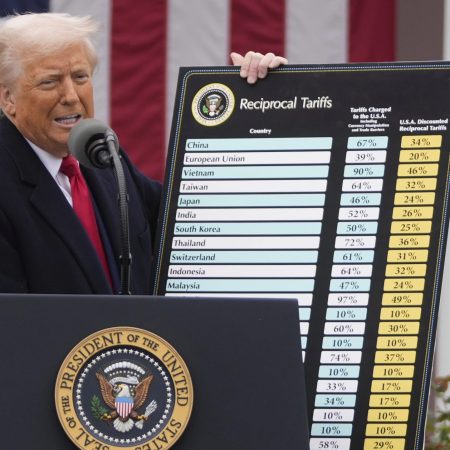
How is the Trump administration doing overall at managing the economy? 

There are bright spots: inflation is down, unemployment is low, and the stock market is strong. But there are also concerns: Prices are still high in many areas, there’s been a hiring freeze across a number of industries, and most of the investments energy is are concentrated in artificial intelligence — not spread across a diverse range of sectors. 

The U.S. Chamber of Commerce is traditionally pro-free market, pro-business, and conservative leaning — and that’s also true for their partner organizations around the country.

Faye Nemer is the CEO of the Middle East North Africa American Chamber of Commerce, which operates out of Dearborn. She told producer Sam Corey that she generally likes how the Trump administration is managing the economy. She thinks the tariffs are strategic. And while Nemer realizes small businesses are hurting, she thinks that’s likely to change as national policies will trickle down to everyone else.


Listen to The Metro weekdays from 10 a.m. to noon ET on 101.9 FM and streaming on demand.

Subscribe to The Metro on Apple Podcasts, Spotify, NPR.org or wherever you get your podcasts.

Support the podcasts you love.

One-of-a-kind podcasts from WDET bring you engaging conversations, news you need to know and stories you love to hear. Keep the conversations coming. Please make a gift today.

More stories from The Metro

The post The Metro: A positive perspective on Michigan’s economy appeared first on WDET 101.9 FM.

❌