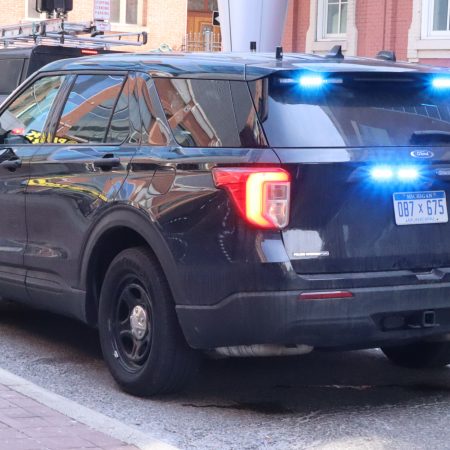
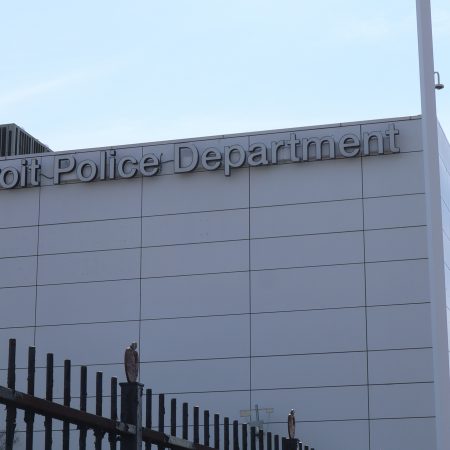
Detroit Police Chief Todd Bettison said Friday he will no longer seek to fire two cops who called U.S. Border Patrol during separate traffic stops, supporting instead a 30-day unpaid suspension imposed by the Detroit Board of Police Commissioners.
Communities across Michigan are asking how, exactly, local law enforcement is working with federal immigration agents as the Trump administration steps up aggressive enforcement, including the killing of two Americans in Minneapolis. In Detroit, that question is playing out on the pages of two police personnel files.
Detroit Police Chief Todd Bettison vowed to fire two officers who broke department rules by calling U.S. Border Patrol during traffic stops, handing people over to federal immigration agents. Then he dropped the terminations.
In one stop, an officer called Border Patrol, believing the person was undocumented. In the other, a sergeant called for help communicating with a driver who didn’t speak English, though the department runs a 24-hour translation hotline.
One-of-a-kind podcasts from WDET bring you engaging conversations, news you need to know and stories you love to hear. Keep the conversations coming. Please make a gift today.
Two of those killings happened in Minneapolis within three weeks of each other: Renee Good on January 7 and Alex Pretti on January 24. Both were U.S. citizens, age 37, and in both cases, masked federal officers opened fire, and the Trump administration’s initial accounts were later contradicted by video evidence.
Their deaths spurred protests across the country and accelerated a growing push by local and state governments to impose limits on federal immigration agents.
Local Pushback
In Detroit, City Council member Mary Waters has introduced the Alex Pretti Detroit No Masks Ordinance, which would prohibit any law enforcement officer — local, state, or federal — from concealing their face while performing their duties in the city. The proposal has been referred to committee but has not yet received a vote.
At the state level, the Michigan Senate held hearings last month on a package of bills aimed at how federal immigration enforcement operates in the state. They would ban law enforcement masks, bar ICE from operating in schools, hospitals, and houses of worship, and prevent state agencies from sharing data with federal immigration authorities.
Former chief warns about anonymity in law enforcement
Ike McKinnon led the Detroit Police Department in the mid-90s, laying the foundation for the community policing model in place today.
Former Detroit Police Chief Isaiah “Ike” McKinnon was among those who testified in support of the bills.
McKinnon joined the Detroit Police Department in 1965. Two years later, during the 1967 Detroit uprising, fellow white officers pulled him over while he was in full uniform, put a gun to his head, and shot at him. During that same period, officers across the department were removing their badges to avoid being identified. McKinnon survived — and stayed on the force. In 1993, Mayor Dennis Archer appointed him Detroit’s second Black police chief. Over five years, he overhauled the department’s approach to community trust.
Now 82, McKinnon told Michigan senators he sees the same pattern repeating: officers who conceal their identities operate without accountability.
He spoke with The Metro’s Robyn Vincent about how local police should respond to this moment.
Use the media player above to hear the conversation.
Listen to The Metro weekdays from 10 a.m. to noon ET on 101.9 FM and streaming on demand.
WDET strives to cover what’s happening in your community. As a public media institution, we maintain our ability to explore the music and culture of our region through independent support from readers like you. If you value WDET as your source of news, music and conversation, please make a gift today.
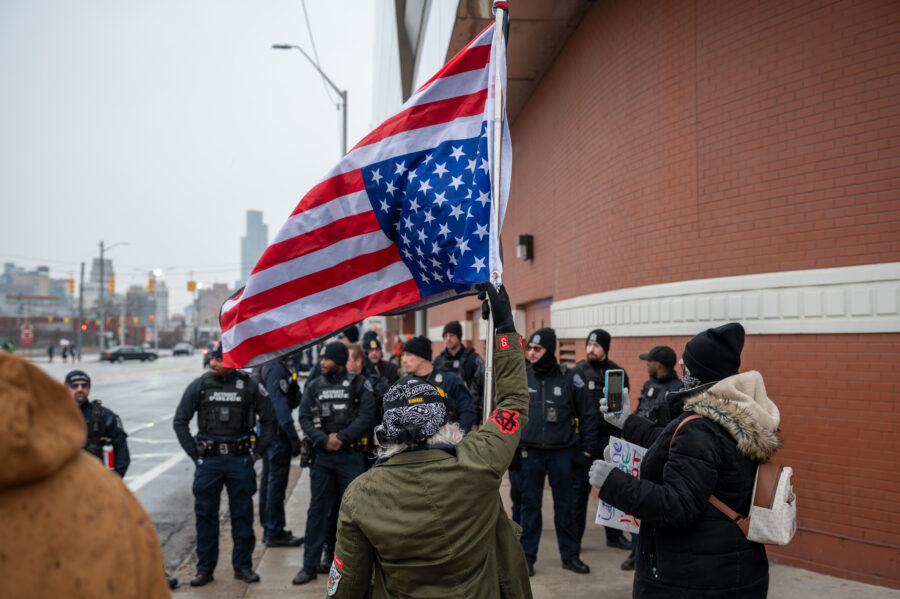
While President Trump was inside Motor City Casino on Tuesday, protesters outside were braving the elements and aggression by the Detroit Police Department.
A group of demonstrators marched from Cass Park in front of the Masonic Temple and to the sidewalk in front of the casino at the corner of Temple and Grand River Avenue.
After being allowed to peacefully assemble for a few minutes, Detroit Police forced protesters down Grand River to a less visible location on the casino’s west side at Trumbull Ave and Elm Street.
A Detroit Police officer – who would not give his name, only the numbers 168 – threatened protesters and members of the press with arrest if they did not move. At least two protesters were arrested.
What the protesters have to say
Sarah Reed of Farmington Hills carried an inverted American flag – a symbol of distress. She stood in front of the advancing officers in an act of defiance.
Farmington Hills resident – and granddaughter of a holocaust survivor – Sarah Reed protests President Trump as a line of Detroit Police force demonstrators to a different location.
Reed was surprised by their aggression. “It’s a public sidewalk, and if you and I were there this evening, this morning, before any of this, they’d have no issue with us being on the sidewalk,” Reed said.
Reed, the granddaughter of a Holocaust survivor, said she wants the president to resign. But she had a message for Democrats too. “Get off your asses and fight,” Reed said.
Troy resident Jake Malacos used his lunch hour to protest. He says he was happy to be around protesters because a show of solidarity is good for the community.
As for why he was picketing: “Well, the corruption from the Trump administration. The brutality. The murder of Renee Good. Most of the policies that he’s putting out are pretty rough for me,” Malacos said.
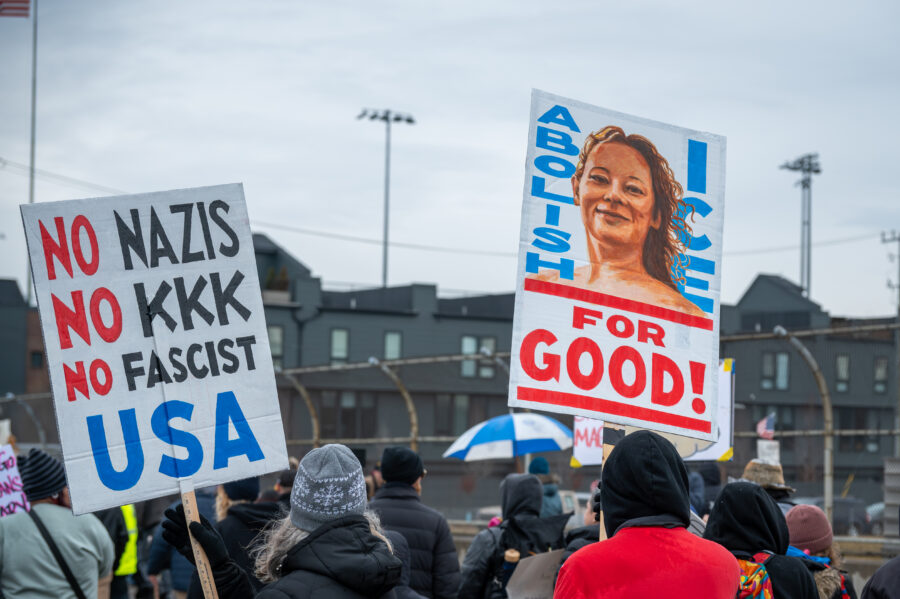
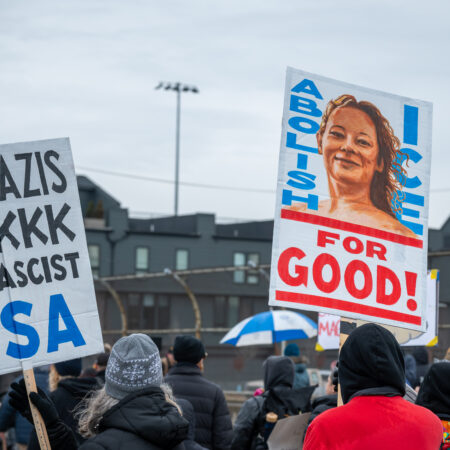
About 1,000 anti-Donald Trump protesters marched down Trumbull Avenue to Detroit Public Safety on January 13, 2026.
Troy resident Jake Malacos used his lunch hour to join the anti-Trump protest in Detroit on January 13, 2026.
An unidentified man is arrested by Detroit Police for refusing to protest President Donald Trump in a different location outside of Motor City Casino on January 13, 2026.
About 1,000 anti-Donald Trump protesters marched down Trumbull Avenue to Detroit Public Safety on January 13, 2026.
About 1,000 protesters demonstrated outside Motor City Casino in Detroit where President Donald Trump was speaking to the Detroit Economic Club.
About 1,000 anti-Donald Trump protesters marched down Trumbull Avenue to Detroit Public Safety on January 13, 2026.
Once DPD had pushed the protesters to the designated 1st Amendment area on Trumbull, about 1,000 protesters marched to Detroit Public Safety.
Officially, Detroit Police do not work with Immigration and Customs Enforcement, but they do share office space.
Support local journalism.
WDET strives to cover what’s happening in your community. As a public media institution, we maintain our ability to explore the music and culture of our region through independent support from readers like you. If you value WDET as your source of news, music and conversation, please make a gift today.
When the police make a mistake, who is around to hold them accountable? Sometimes it’s courts and attorneys.
But in many American cities, including those here in Michigan, there are civilian oversight boards. These boards do various things, including investigating civilian complaints, making disciplinary recommendations, and auditing police departments.
The Detroit Board of Police of Commissioners was established in the 1970s after widespread claims of police abuse. Today, after the murder of George Floyd and increased scrutiny of police, more pressure is on police commissioners to hold officers accountable and to make policing work for everyone.
Just before the new year, Detroit welcomed four new people to its Board of Police Commissioners, including Victoria Camille. She is the District 7 commissioner.
Why did she run for the position? How can policing improve in Detroit? And, what does she make of the role of policing in society?
Commissioner Camille joined Cary Junior II on The Metro to discuss.
Listen to The Metro weekdays from 10 a.m. to noon ET on 101.9 FM and streaming on demand.
WDET strives to make our journalism accessible to everyone. As a public media institution, we maintain our journalistic integrity through independent support from readers like you. If you value WDET as your source of news, music and conversation, please make a gift today.
A coalition of Detroit activists is denouncing a proposed city ordinance that would require some police footage to be made public, saying the measure would still protect officers who engage in misconduct.
A state appeals court handed a partial victory to critics of Detroit’s controversial ShotSpotter surveillance system, ruling that city officials violated a transparency ordinance when they approved contracts for the gunshot detection technology without properly notifying the public. In a published decision released Thursday, a divided Michigan Court of Appeals panel found that the Detroit […]

 Login
Login