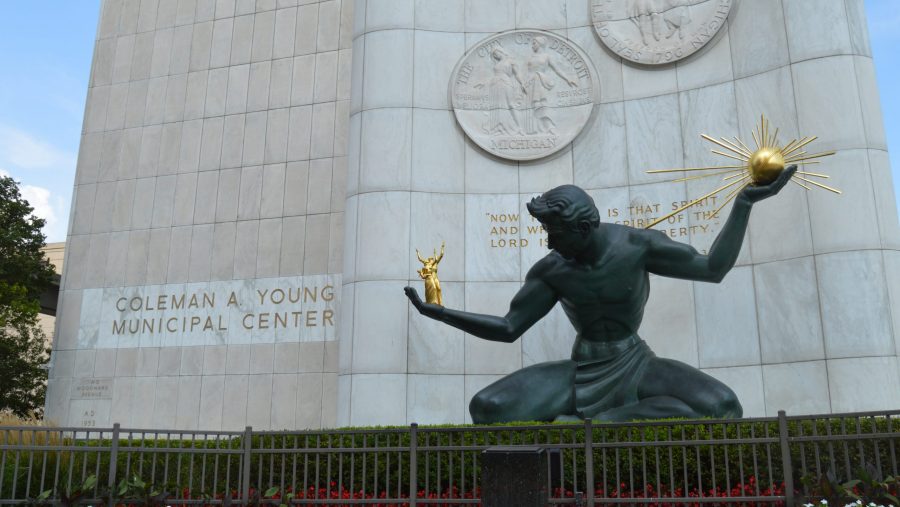
Last week President Trump threatened to block the Gordie Howe International Bridge from opening. In a rambling post on social media, Trump argued that Canada is treating the U.S. unfairly without making any specific demands.
That’s left politicians on the Michigan and Ontario sides of the new span scrambling. Windsor Mayor Drew Dilkens says he is unaware of any attempts by the Trump Administration to contact Canadian officials over the opening of the Gordie Howe International Bridge.
Listen: Mayor Dilkens discusses U.S. threat to block Gordie Howe Bridge
Dilkens says that while Canada paid to build the span, ownership of the bridge is shared.
“Canada as a federal government and the state of Michigan as a state government jointly own the Gordie Howe Bridge,” says Dilkens. “We’re 50-50 owners and we will repay the cost of construction through the collection of tolls over a period of many years, after which we will split the proceeds of toll revenue moving forward.”
Meeting with Morouns
The Windsor mayor blames the Moroun family for the President’s sudden desire to halt the bridge opening. There are reports of a meeting between the wealthy Ambassador Bridge owner Matthew Moroun and U.S. Commerce Secretary Howard Lutnick hours before Trump threatened the Gordie Howe Bridge.
“You know I’m not sure what the billionaires are doing behind the scenes,” says Dilkens, “but we’re really interested in the families that are affected by this on both sides of the border.”
The U.S. House Oversight Committee has sent a letter to Lutnick requesting all documents related to his alleged meeting with Matthew Moroun.
Dilkens says retaliating by blocking the Ontario side of the Ambassador Bridge is not something Canada would consider, regardless of the White House’s stance on the Gordie Howe span. The Windsor-Detroit Bridge Authority says the international span remains on track to open early this year.
Trusted, accurate, up-to-date.
WDET strives to make our journalism accessible to everyone. As a public media institution, we maintain our journalistic integrity through independent support from readers like you. If you value WDET as your source of news, music and conversation, please make a gift today.
Across the country, small businesses in immigrant communities are reporting the same pattern: customers are disappearing, workers aren’t showing up, and revenue is in decline.
Federal immigration enforcement has reshaped daily life in these neighborhoods, and some business owners say it’s hitting them harder than COVID, in part because there’s no PPP loan or government lifeline this time around.
In Los Angeles County, the vast majority of surveyed businesses reported negative impacts, with nearly 50% losing more than half their revenue. In Chicago’s Little Village, business sales have dropped an estimated 50 to 70%. And the Brookings Institution estimates that 2025 may have been the first year in over half a century that net migration to the U.S. went negative.
That same predicament is playing out in metro Detroit. In Southwest Detroit, Dearborn, and Hamtramck, the small businesses that anchor entire neighborhoods are under growing pressure. Business owners along Vernor Highway describe empty storefronts, canceled appointments, and streets that used to bustle with foot traffic now eerily quiet. Community networks — WhatsApp alert groups, volunteer patrols, whistle distribution — have emerged to help residents maintain their daily routines.
Mark Lee is the president and CEO of The Lee Group, a consulting firm that works with small businesses on strategy, marketing, and growth across Southeast Michigan. He joined Robyn Vincent on The Metro to talk about what he’s hearing from owners on the ground.
Listen to the full conversation using the media player above.
Listen to The Metro weekdays from 10 a.m. to noon ET on 101.9 FM and streaming on demand.
WDET strives to cover what’s happening in your community. As a public media institution, we maintain our ability to explore the music and culture of our region through independent support from readers like you. If you value WDET as your source of news, music and conversation, please make a gift today.
How is the Trump administration doing overall at managing the economy?
There are bright spots: inflation is down, unemployment is low, and the stock market is strong. But there are also concerns: Prices are still high in many areas, there’s been a hiring freeze across a number of industries, and most of the investments energy is are concentrated in artificial intelligence — not spread across a diverse range of sectors.
The U.S. Chamber of Commerce is traditionally pro-free market, pro-business, and conservative leaning — and that’s also true for their partner organizations around the country.
Faye Nemer is the CEO of the Middle East North Africa American Chamber of Commerce, which operates out of Dearborn. She told producer Sam Corey that she generally likes how the Trump administration is managing the economy. She thinks the tariffs are strategic. And while Nemer realizes small businesses are hurting, she thinks that’s likely to change as national policies will trickle down to everyone else.
Listen to The Metro weekdays from 10 a.m. to noon ET on 101.9 FM and streaming on demand.
One-of-a-kind podcasts from WDET bring you engaging conversations, news you need to know and stories you love to hear. Keep the conversations coming. Please make a gift today.
NEW YORK (AP) — It’s been a confusing time for people with student loans. Collections restarted, then were put on hold. At the same time, borrowers had to stay on top of changes to key forgiveness plans.
Last year, the long-contested SAVE plan introduced by the Biden administration ended with a settlement agreement. President Donald Trump’s “Big Beautiful Bill” introduced new borrowing limits for graduates and raised challenges to the Public Service Loan Forgiveness program. While several changes for student loan borrowers will take effect this summer, other key questions remain unresolved.
More than 5 million Americans were in default on their federal student loans as of September, according to the Education Department. Millions are behind on loan payments and at risk of default this year.
Borrowers “genuinely struggle to afford their loans and then to hear that the administration is making it more expensive and taking away some of the tools and resources that help folks afford their loans is really, it’s panic-inducing,” said Winston Berkman-Breen, legal director at Protect Borrowers.
Last month, the Education Department announced that it would delay involuntary collections for student loan borrowers in default until the department finalizes its new loan repayment plans. The date for this is still unclear.
If you’re a student loan borrower, here are some key things to know:
If you were enrolled in the SAVE plan
The SAVE plan was a repayment plan with some of the most lenient terms ever. Soon after its launch it was challenged in court, leaving millions of student loan borrowers in limbo. Last December, the Education Department announced a settlement agreement to end the SAVE plan. What is next for borrowers who were enrolled in this repayment plan is yet to be determined.
“Seven and a half million borrowers who are currently enrolled in SAVE need to be moved to another plan,” Berkman-Breen said.
As part of the agreement, the Education Department says it will not enroll new borrowers, deny pending applications, and will move all current SAVE borrowers into other repayment plans.
The Education Department is expected to develop a plan for borrowers to transition from the SAVE plan, yet borrowers should be proactive about enrolling in other repayment plans, said Kate Wood, a lending expert at NerdWallet.
If you are looking to enroll in an income-driven repayment plan
Borrowers can apply for the following income-driven plans: the Income-Based Repayment Plan, the Pay as You Earn plan, and the Income-Contingent Repayment plan.
“They all have similar criteria, and they function similarly. Your payment is set as a percentage of your income, not how much you owe, so it’s usually a lower payment,” Berkman-Breen said.
The payment amount under income-driven plans is a percentage of your discretionary income, and the percentage varies depending on the plan. Since many people are looking to switch plans, some applications to income-driven repayment plans might take longer to process, said Jill Desjean, director of policy analysis at the National Association of Student Financial Aid Administrators.
You can find out which repayment plan might work best for you by logging on to the Education Department’s loan simulator.
If you’re working toward your Public Service Loan Forgiveness
There are no changes to the Public Service Loan Forgiveness Program yet. Last year, the Trump administration announced plans to change the eligibility requirements for participating nonprofits.
The policy seeks to disqualify nonprofit workers if their work is deemed to have “substantial illegal purpose.” The Trump administration said it’s necessary to block taxpayer money from lawbreakers, while critics say it turns the program into a tool of political retribution.
The proposal says illegal activity includes the trafficking or “chemical castration” of children, illegal immigration, and supporting foreign terrorist organizations. This move could cut off some teachers, doctors, and other public workers from federal loan cancellation.
“This is something that obviously is very stressful, very nerve-wracking for a lot of people, but given that we don’t know exactly how this is going to be enforced, how these terms are going to be defined, it’s not really something that you can try to plan ahead for now,” Wood said.
While this policy is currently being challenged by 20 Democrat-led states, it’s expected to take effect in July. In the meantime, Wood recommends that borrowers enrolled in the PSLF program continue making payments.
If your student loans are in default
Involuntary collections on federal student loans will remain on hold. The Trump administration announced earlier this month that it is delaying plans to withhold pay from student loan borrowers who default on their payments.
Federal student loan borrowers can have their wages garnished and their federal tax refunds withheld if they default on their loans. Borrowers are considered in default when they are at least 270 days behind on payments.
If your student loans are in default, you can contact your loan holder to apply for a loan rehabilitation program.
“They essentially come up with a payment plan where you’re making a reduced payment,” Woods. “After five successful payments on that rehabilitation plan, wage garnishment will cease.”
If you’re planning to attend graduate school
Trump’s “ Big Beautiful Bill ” has changed the amount graduate students can borrow from federal student loans. Graduate students could previously borrow loans up to the cost of their degree; the new rules cap the amount depending on whether the degree is considered a graduate or a professional program.
Wood said that if you’re starting a new program and taking out a loan after July 1, you will be subject to the new loan limits.
Under the new plan, students in professional programs would be able to borrow up to $50,000 per year and up to $200,000 in total. Other graduate students, such as those pursuing nursing and physical therapy, would be limited to $20,500 a year and up to $100,000 total.
The Education Department is defining the following fields as professional programs: pharmacy, dentistry, veterinary medicine, chiropractic, law, medicine, optometry, osteopathic medicine, podiatry and theology.
If you want to consolidate your loan
The online application for loan consolidation is available at studentaid.gov/loan-consolidation. If you have multiple federal student loans, you can combine them into a single loan with a fixed interest rate and a single monthly payment.
The consolidation process typically takes around 60 days to complete. You can only consolidate your loans once.
___
The Associated Press receives support from Charles Schwab Foundation for educational and explanatory reporting to improve financial literacy. The independent foundation is separate from Charles Schwab and Co. Inc. The AP is solely responsible for its journalism.
FILE – In this May 5, 2018, file photo, graduates at the University of Toledo commencement ceremony in Toledo, Ohio. (AP Photo/Carlos Osorio, File)
A new report finds that the rise in requests to build huge data centers across the country could reshape the size and cost of the electric grid in Michigan.
The Union of Concerned Scientists estimates that within five years data centers could require well over half of all the new power demand in the state.
One of the report’s co-authors, Lee Shaver, specifically analyzed the likely impact of data centers on Michigan.
Shaver says the question is not how much new electricity Michigan will need, it’s who will pay for it.
Listen: Will massive data centers create large rate increase for Michigan customers?
The following interview has been edited for clarity.
Lee Shaver: The utilities have what’s called an obligation to serve. So they are going to build enough generation capacity to be able to meet the demand from data centers. The way that the system is supposed to work is that whoever causes that new demand pays for it. But the amount of demand we’re seeing from data centers kind of upsets the way that these things have been done historically. There’s a much higher likelihood that customers other than the data center would end up paying for a portion of those costs.
The big difference is just how much larger the data centers are. As an example, the total size of the data center that DTE Electric was just approved to connect to their grid in Saline Township would be 1.4 gigawatts, which is equivalent to the energy demand of over a million homes.
If could take decades for a million people to move into a new city. It’s slow growth that the utility can plan for over a long timeframe. Those costs can be spread out very easily. But when you’ve got a million homes showing up in a community in less than two years, that’s a massive amount of growth. There’s tons of new infrastructure that has to be built. And the regulation just can’t accommodate that level of growth without the way that those costs are covered being distorted.
Quinn Klinefelter, WDET News: The Michigan Public Service Commission says the agreement between the data center and DTE includes strong protections against a big rate increase for customers. I’ve also heard that some utilities require owners of data centers to pay what’s called a “large load tariff.” Just what is that?
LS: The word tariff is a bit misleading, especially since tariffs have been in the news so much. But when a utility talks about a large load tariff, they’re talking about a set of terms and conditions that data centers have to agree to in order to be provided with electric service.
And there are a lot of really good and positive things in those tariffs that utilities are proposing, like minimum contract terms, minimum monthly billing amounts. The challenge is that, especially in Michigan, especially with the DTE data center that was just approved, there’s just not enough detail that has been made public from these large load tariffs and from the applications that the data centers themselves are submitting for the public to have assurance that the costs are actually going to be covered.
QK: Is there a point where you finally find that out one way or the other? Does it have to be when the centers are operating or can it be determined while they’re constructed?
LS: There’s several points in the process at which that needs to be done. Obviously the large load tariff needs to be in place when that contract between the data center and the utility is signed. There has to be transparency. A lot of that information, though not all of it, should be public so that it can be reviewed. And there should be regular reporting on at least an annual basis. The utility and the data center should be providing information back to the regulators to say, here’s how much energy was provided, here’s how much it cost, here’s how it was paid for. And at the same time, look at how the billing of other customers changed over that same time period.
QK: Does it take until the things are actually up and going before you can really find that out? Or can you tell that during the construction process?
LS: You need both pieces. You’re not going to get assurance that it happened properly until after things are up and running. But if you don’t have a good framework in place at the beginning to collect and share that data, you would never get any reassurance that it’s been done properly.
QK: Beyond purely financial considerations, I’ve heard some concerns about the possible health or other costs that could be associated with these massive data centers. In your view, is it reasonable to be worried about some of those effects?
LS: Absolutely. What we know today is that any new data centers coming in the near term are going to result in more fossil fuels being burned to provide them with power. And when we burn fossil fuels, there’s emissions of heat trapping carbon dioxide, nitrous oxide, sulfur dioxide and other pollutants that have measurable health impacts. Our report found that due to data centers being built over the next 5-10 years, there’s close to $20 billion worth of health damages that would be caused from air pollution, most of which would happen directly in Michigan. And the global climate damages are estimated to be over $400 billion across the 2026-2050 timeframe.
QK: Having analyzed the issue, what, in your view, is the best strategy for a state like Michigan to follow in regards to where or how many data centers are allowed in?
LS: We didn’t speak to whether or not specific data centers should be allowed to operate, but we do make a couple of recommendations from the policy side.
In addition to the steps that need to be taken to ensure that data centers pay for their own costs, we also recommend what we’re calling a CO2 reduction policy. We found that’s necessary because, while Michigan does have some really progressive clean energy and renewable energy standards, with the growth in data centers, those standards are not enough to continue Michigan on the path to reaching net zero carbon emissions. A CO2 reduction policy would essentially set a limit on how much fossil fuel can be burned in the state of Michigan. And by enacting that limit, over time combustion of fossil fuels will be reduced and all of those negative health impacts would diminish.
QK: Considering the current makeup of Congress and the White House, in your view, how realistic is it that such prohibitions could actually get through?
LS: Our recommendation is actually at the state level, for exactly that reason. And our modeling shows that regardless of policies elsewhere, if Michigan were to enact a CO2 reduction policy, it would have significant impacts on reducing emissions in Michigan.
Trusted, accurate, up-to-date.
WDET strives to make our journalism accessible to everyone. As a public media institution, we maintain our journalistic integrity through independent support from readers like you. If you value WDET as your source of news, music and conversation, please make a gift today.
Small businesses are often described as the backbone of the economy. But in moments of stress, they can also be an early warning system.
In metro Detroit, inflation has slowed — consumer prices in the Detroit area rose about two percent over the past year, but that has not translated into relief for many households or business owners. Spending remains cautious, and many small business owners say they are no longer planning for growth. Instead, they are focused on endurance.
One pressure point keeps coming up in conversations with owners: health care. Small-business health insurance plans in Michigan are set to rise again in 2026, while tens of thousands fewer Michiganders are enrolling in individual marketplace coverage this year as premiums increase and federal assistance shrinks.
The result is a heavy load for small businesses. They are helping families stay afloat, providing places for connection and routine in neighborhoods, and absorbing rising costs that often land directly on owners.
In this conversation, The Metro’s Robyn Vincent examines how small businesses have become survival engines, community anchors, and stress points all at once — and what that means for workers, customers, and neighborhoods across metro Detroit.
Our guest is Mark Lee, president of the LEE Group, a consulting firm that works with small businesses on strategy, marketing, and growth. Lee also teaches business at Michigan universities and regularly speaks with owners across southeast Michigan about the challenges they’re facing.
Listen to The Metro weekdays from 10 a.m. to noon ET on 101.9 FM and streaming on demand.
WDET strives to cover what’s happening in your community. As a public media institution, we maintain our ability to explore the music and culture of our region through independent support from readers like you. If you value WDET as your source of news, music and conversation, please make a gift today.
There are weeks when the news feels like weather; something that happens over there, something you brace for and then move through.
And then there are times when it lands in your body.
In the last few weeks, vigils have spread across the country after a federal immigration officer killed Renee Good. People are mourning, but they’re also organizing — and not just with signs and speeches. Some are choosing disruption. Some are choosing civil disobedience. They’re asking a blunt question: if systems can take a life in broad daylight and then argue about vocabulary, what exactly are we supposed to do with our grief?
Detroiters know what it means to be extracted from, written off, and still survive. And that makes these stories feel like different chapters of the same book— a book about power, and whose lives it’s allowed to break.
To help us read that book more clearly, Robyn Vincent spoke with Saqib Bhatti of the Action Center on Race and the Economy. His work traces the money behind public pain, and it asks what happens when communities confront the power brokers who, he says, are facilitating that pain.
Listen to The Metro weekdays from 10 a.m. to noon ET on 101.9 FM and streaming on demand.
WDET strives to cover what’s happening in your community. As a public media institution, we maintain our ability to explore the music and culture of our region through independent support from readers like you. If you value WDET as your source of news, music and conversation, please make a gift today.
Lansing — Several of Michigan’s public university leaders gathered last week to reveal the results of a study analyzing the positive economic impact their institutions have on the state, generating $45 billion annually.
As public scrutiny of higher education and its mission has grown over the last five years, the speakers, including Michigan State University President Kevin Guskiewicz and Grand Valley State University President Philomena Mantella, explained on Tuesday how Michigan’s public schools are continuing to improve the lives of all Michigan residents.
It’s been 10 years since the last report on the economic impact of Michigan’s universities, said Britany Affolter-Caine, executive director of Research Universities for Michigan, an organization of the four Michigan research universities.
The report, done by the East Lansing-based Anderson Economic Group, shows that Michigan’s public universities contributed $45 billion in net new economic activity through operations, student spending and alumni earnings for the state. The report pointed out that this revenue was more than 28 times the amount given in state appropriations for the 15 universities.
“This is economic impact that would not exist in Michigan if these institutions were not here,” said Dan Hurley, CEO of the Michigan Association for State Universities.
However, about 70% of Americans now say higher education is going in the wrong direction, a poll by Pew Research released in October showed, up from 56% in 2020.
Guskiewicz and Mantella agreed that the public perception of higher education is something they’re trying to repair. Graduates coming out of college with jobs in their field, more affordable tuitions so students have less debt and showing the impact of universities in local communities are all ways the institutions can rebuild public trust, the speakers said.
Perception of higher education
Americans were losing confidence in higher education because they believe it’s too expensive, doesn’t provide the skills needed for today’s jobs and is “indoctrinating” students, Guskiewicz said.
The misinformation regarding the value of a degree conflicts with the real data that shows, Guskiewicz said, the social upward mobility and the opportunity that come with a degree, along with the improvements to quality of life in all sectors that touch a university.
“We have to do a better job of telling our story, just like we are today,” Guskiewicz said.
But negative perceptions of higher education held by lawmakers, federally and statewide, can hurt a university’s finances. In the past year, President Donald Trump’s administration has cut millions of dollars from Michigan universities, according to Treasury Department data compiled by the Center for American Progress, a liberal group.
Michigan House Republicans toyed with the idea of cutting $291 million from the University of Michigan’s and MSU’s state appropriations to redistribute among the other state universities. This was rejected by the Democratic-led Senate and Democratic Gov. Gretchen Whitmer, and all universities saw an increase in their state appropriations in the budget approved in October.
File photo from the campus of Central Michigan University. (Stephen Frye / MediaNews Group)
“That was an effort by one caucus in one chamber, which is a pretty distinct minority in the entire public body that ultimately is responsible for passing the state budget,” Hurley said. “All of our universities need to have reinvigorated state investment. … We are thankful for what the Legislature has done in recent years. … But we are conservatively at least 41st out of 50 in this country as it involves per student state support for public universities.”
The worth of a degree
Pew’s poll showed that about 80% of adult respondents said colleges and universities aren’t doing enough to keep tuition affordable, and about half said higher education wasn’t doing enough to prepare students for well-paying jobs.
The speakers acknowledged the longstanding problem of graduates struggling to find employment in their degree’s field, or any meaningful employment at all.
“This is not a new challenge,” Affolter-Caine said. “It happens to maybe be exacerbated in the current cycle.”
However, the report shows that graduates from Michigan universities make double what high school degree holders earn and, on average, about $20,000 more than what graduates from out-of-state public institutions make.
On average, the report said, Michigan university alumni ages 25-24 earn $91,073 yearly.
Mantella said Grand Valley, like other universities, has embraced and strengthened “experience-based learning.” This includes ensuring all students have access to an internship, project-based learning or other professional workforce experience while still in college.
“This is not only an opportunity to accelerate to the workforce,” Mantella said. “It’s so (students) come into the workforce at the appropriate levels, in the appropriate roles. … It also links the individual to a Michigan employer, so there’s a higher probability that they will, in fact, stay in the state and contribute to the state rather than go somewhere else.”
Hurley said about 84% of the top 50 most in-demand jobs over the next few years will require at least a bachelor’s degree.
“(Those jobs) are our state’s economy, our private sector, our non-private sector, our health care sector speaking,” Hurley said. “And so for us to be competitive in the future, we have to continue generating that talent. And of course, it’s the role of the state government to make sure that college remains affordable.”
File. University of Michigan campus. (Stephen Frye / MediaNews Group)
How does a global community provide for the needs of its citizens without destroying the planet? That’s the crux of “Anthropause: The Beauty of Degrowth,” a new book out this month.
In the early days of the Covid-19 pandemic, society shut down for a few months. As humans stayed inside, animals returned to their old habitats and pollution eased as industry slowed.
Stan Cox, author of “Anthropause: The Beauty of Degrowth”
Retired researcher—and new metro Detroit resident—Stan Cox looks at how that “anthropause” could be a preview of the necessary societal changes to save lives and the planet.
He spoke with All Things Considered – Detroit host Russ McNamara last month. Click on the media player to listen or read selected transcripts below.
Listen: New book examines equitable degrowth as necessary to combat climate change
Russ McNamara, WDET: Why did you write this book?
Stan Cox, Author: The main point I’m making in the book is imagining that we as a society, if we were to rapidly phase out fossil fuels and get by just on the energy that could be generated other ways; and if we stopped plundering the earth for minerals and cutting down forest and causing ecological damage; and we had less energy and materials, and had to allocate them carefully: people know that’s going to mean sacrifice. What am I going to have to give up and so forth?
And what I’m saying in the book is okay, yeah, there are certain things, obviously that will have to be given up. But let’s consider all of the dangers and nuisances, terrible stuff that we put up with an advanced industrial society that has all this energy and materials running through it.
We would be saying goodbye to a lot of those harms and ills by simply not doing a lot of the stuff that requires so much energy input. So the rest of the book, then, is going through specific technologies and activities and so forth that are really harmful to people and the environment, of course, that we would not have the fuel to undertake them, or we would be using resources for meeting people’s basic needs, and we wouldn’t be spending a lot of energy on these other things.
RM: You discuss this and I’m reminded of data centers to run artificial intelligence. People certainly don’t seem to want them and definitely don’t want these in their backyard because there is this concern about the high cost of electricity, and the amount of groundwater that is needed.
SC: That’s absolutely right. One of the big reasons these communities don’t want them is that they create this horrific noise at very high decibel levels and low low frequency noise, which is especially dangerous to human health. When I started writing the book, there wasn’t as much being said about A.I. and the data centers at that time, so I did eventually incorporated them, but the beginning of the second chapter is about noise pollution and and I just used it. It’s seemingly a very small thing, but it really brings out other issues. The leaf blower, especially the gas powered leaf blower, also produces this low frequency and very high volume sound—about eight times the decibel level that the World Health Organization says is safe – and they’re producing a wind about the speed of an EF five tornado. The low frequency sound can travel like three football fields. It’s still above the safe limit.
RM: So what are the societal impacts? Let’s say we start degrowth right now. What are the benefits?
SC: We can’t go on like we’re on the trajectory that we’re on now, because. A degrowth is going to happen. Either a chaotic, brutal degrowth where it’s a Mad Max kind of future, because we’ve tried to force growth to continue and have destroyed ecosystems
Or we can have a planned, rational degrowth that ensures that there’s enough for everybody and that we’re not causing ecological collapse. But there’s no way that growth can continue at this rate.
Sometime in the past three years, we passed a milestone. The quantity of human made stuff—that is everything that human society has manufactured or built or produced—if you weigh all of it up, the mass of all of that exceeds the total mass of all living things on Earth, all plants, animals, microbes, et cetera, and that quantity of stuff being produced is is doubling every 20 years. And clearly that can’t go on.
Herb Stein, an economist from the 70s or 80s was kind of the Yogi Berra of economists. He had a line: “if something can’t go on forever, it won’t” and that’s where growth cannot go on forever. So we have to pull back, create what I called in the book an “anthropause” of our own, and try to have a rational, safe and just reduction in the amount of economic activity for the good of everybody.
Support local journalism.
WDET strives to cover what’s happening in your community. As a public media institution, we maintain our ability to explore the music and culture of our region through independent support from readers like you. If you value WDET as your source of news, music and conversation, please make a gift today.
Artificial intelligence is already shaping daily life, whether we’re ready or not. That’s caused celebration and concern.
It’s reducing the work we do, helping us find answers more quickly, and some research suggests it has strong capabilities to diagnose illness, perhaps better than doctors.
Some of these concerns are the context for opposition to data centers. Those spaces house and advance artificial intelligence, and many don’t want them in their backyards.
In Monroe and Kalamazoo Counties, there’s been pushback, which has might permanently delay the creation of data centers there. In Saline, many are unhappy about a center planned for the area.
All of this is happening after Wayne State officially opened its own AI research center in October.
Ezemenari Obasi is the Vice President for Research & Innovation at Wayne State University and heads the university’s Institute for AI and Data Science.
The Metro‘s Sam Corey spoke with him about why he believes AI can help us solve some of our biggest problems.
Listen to The Metro weekdays from 10 a.m. to noon ET on 101.9 FM and streaming on demand.
WDET strives to make our journalism accessible to everyone. As a public media institution, we maintain our journalistic integrity through independent support from readers like you. If you value WDET as your source of news, music and conversation, please make a gift today.
The Trump administration recently announced $12 billion in bailout money in an effort to prop up the farming industry. That comes as farmers around the country have complained about trade wars and general economic conditions making it tough for them to do business.
What that money looks like by the time it makes its way to local farmers remains to be seen. Michigan Farmers Union president, Bob Thompson, says there are still questions surrounding the distribution.
Listen: Bob Thompson discusses issues facing Michigan farmers
“The Administration,” says Thompson, “still has to decide how much money is going to corn, versus wheat, versus soy beans, versus 15 different row crops.”
Thompson says about $11 billion of the $12 billion in the bailout will be dedicated to row crops. That means farmers growing specialty crops, like apples and cherries, will share the remaining funds.
Thompson warns the funding may not be enough to offset the challenges facing Michigan’s farms.
“The financial problems that a lot of farmers, particularly our smaller family farmers are experiencing, is a direct result of a lot of policies of the new administration,” Thompson explains, “ Particularly the tariff policies.”
He says the Trump administration’s crackdown on immigration has also hurt farmers in the state. About three-quarters of the seasonal workforce on farms comes from immigrant labor programs.
The Michigan Farmers Union says it may take a new long-term farm bill to stabilize the industry.
Trusted, accurate, up-to-date.
WDET strives to make our journalism accessible to everyone. As a public media institution, we maintain our journalistic integrity through independent support from readers like you. If you value WDET as your source of news, music and conversation, please make a gift today.
Tariffs have pushed up the cost of some goods. Unemployment has ticked up slightly. Hiring practices are shifting as artificial intelligence tools like ChatGPT become more prevalent in workplaces.
Those changes raise big questions for the state’s more than 900,000 small businesses — and the workers who depend on them. How are owners adapting to rising costs and new technologies? What does this moment feel like on the ground? And what should people be doing now to stay resilient?
To explore those questions, Mark Lee, founder of The Lee Group, sat down with The Metro’s Robyn Vincent. Lee hosts several talk shows and writes about business and the economy for Crain’s Detroit, with a focus on how national trends play out locally.
Listen to The Metro weekdays from 10 a.m. to noon ET on 101.9 FM and streaming on demand.
WDET strives to make our journalism accessible to everyone. As a public media institution, we maintain our journalistic integrity through independent support from readers like you. If you value WDET as your source of news, music and conversation, please make a gift today.
NEW YORK (AP) — The shopping rush leading up to Christmas is over and in its place, like every year, another has begun as millions of people hunt for post-holiday deals and get in line to return gifts that didn’t fit, or didn’t hit quite right.
Holiday spending using cash or cards through Sunday has topped last year’s haul, according to data released this week by Visa’s Consulting & Analytics division and Mastercard SpendingPulse.
But growing unease over the U.S. economy and higher prices in part due to President Donald Trump’s tariffs have altered the behavior of some Americans. More are hitting thrift stores or other discounters in place of malls, according to data from Placer.ai. The firm tracks people’s movements based on cellphone usage.
And they’re sticking more closely to shopping lists and doing more research before buying. That may explain why returns so far are down compared with last year, according to data from Adobe Analytics.
Here are three trends that defined the holiday shopping season so far:
A weaker holiday season for traditional gift giving
Americans are still spending on gifts, yet increasingly that shopping is taking place at thrift and discount stores, according to data from Placer.ai.
That’s likely forcing traditional retailers such as department stores to fight harder for customers, Placer.ai said.
Clothing and electronics that traditionally dominate holiday sales did have a surge but struggled to grow, according to Placer.ai. Both goods are dominated by imports and thus, vulnerable to tariffs.
For example, traffic doubled in department stores during the week before Christmas, from Dec. 15 through Sunday, compared with the average shopping week this year. But traffic in the week before Christmas this year fell 13.2% compared with 2024.
Traffic surged 61% at traditional sellers of only clothing in the week before the holiday compared with the rest of the year. But again, compared with the runup to Christmas last year, sales slid 9%.
Some of that lost traffic may have migrated to the so-called off-price stores— chains like TJ Maxx. That sector had a sharp seasonal traffic bump of 85.1% and a gain of 1.2% in the week before the holiday.
But it was thrift stores that were red hot, with traffic jumping nearly 11% in the week before Christmas compared with last year.
“Whether hunting for a designer deal or uncovering a one-of-a-kind vintage piece, consumers increasingly favored discovery-driven experiences over the standardized assortments of traditional retail,” Shira Petrack, head of content at Placer.ai, said in a blog post Friday.
Thrift stores broaden their appeal
In the past it may have seemed gauche to gift your mother a gently used sweater or a pair of pants from a local thrift store, but seemingly not so amid all of the economic uncertainty and rising prices, according to Placer.ai.
Through the second half of 2025, thrift stores have seen at least a 10% increases in traffic compared with last year. That suggests that environmental concerns as well as economic issues are luring more Americans to second-hand stores, Placer.ai said. Visits to thrift stores generally do not take off during the holidays, yet in the most recent Black Friday weekend, sales jumped 5.5%, Placer.ai. reported.
In November, as customer traffic in traditional apparel stores fell more than 3%, traffic in thrift stores soared 12.7%, according to Placer.ai.
The thrift migration has altered the demographics of second-hand stores. The average household income of thrift customers hit $75,000 during October and November of this year, a slight uptick from $74,900 last year, $74,600 in 2023 well above the average income of 74,100 in 2022, based on demographic data from STI:PopStats combined with Placer.ai data.
U.S. sales at thrift chain Savers Value Village’s rose 10.5% in the three months ended Sept. 27 and the momentum continued through October, store executives said in late October.
“High household income cohort continues to become a larger portion of our consumer mix,” CEO Mark Walsh told analysts. “It’s trade down for sure, and our younger cohort also continues to grow in numbers. ”
Fewer returns, so far
For the first six weeks of the holiday season, return rates have dipped from the same period a year ago, according to Adobe Analytics.
That suggests that shoppers are doing more research before adding something to their shopping list, and they’re being more disciplined in sticking to the lists they create, according to Vivek Pandya, lead analyst at Adobe Digital Insights.
“I think it’s very indicative of consumers and how conscientiously they’ve purchased,” Pandya said. “Many of them are being very specific with how they spend their budget.”
From Nov. 1 to Dec. 12, returns fell 2.5% compared with last year, Adobe reported. In the seven days following Cyber Week — the five shopping days between Thanksgiving and Cyber Monday, returns fell 0.1%.
From the Nov. 1 through Dec. 12, online sales rose 6% to $187.3 billion, on track to surpass its outlook for the season, Adobe reported.
Between Dec. 26 to Dec. 31, returns are expected to rise by 25% to 35% compared with returns between Nov. 1 through Dec. 12, Adobe said, and it expects returns to remain elevated through the first two weeks of January, up 8% to 15%.
This is the first year that Adobe has tracked returns.
Still, the last week of December sees the greatest concentration of returns: one out of every eight returns in the 2024 holiday season took place between Dec. 26 and Dec 31, a trend expected to persist this year, Adobe said.
Post-holiday shoppers pass a Christmas tree and festive display at Calef’s Country Store, Friday, Dec. 26, 2025, in Barrington, N.H. (AP Photo/Charles Krupa)
By JAMES POLLARD and LINLEY SANDERS The Associated Press
NEW YORK (AP) — Most Americans aren’t making end-of-year charitable giving plans, according to the results of a new AP-NORC poll, despite the many fundraising appeals made by nonprofits that rely on donation surges in the calendar’s final month to reach budget targets.
The survey, which was conducted in early December by The Associated Press-NORC Center for Public Affairs Research, found that about half U.S. adults say they’ve already made their charitable contributions for 2025. Just 18% say they’ve donated and will donate again before the year is over. Only 6% report they haven’t given yet but will do so by December’s end. The rest, 30%, haven’t donated and don’t plan to.
But weaker income gains and steep price inflation meant that lower-income households had less money to redistribute. Other surveys have also found a yearslong decline in the number of individuals who give.
December still serves as a “very important deadline” for donors, according to Dianne Chipps Bailey, managing director of Bank of America’s Philanthropic Solutions division. She cited estimates from the National Philanthropic Trust that nearly one-third of annual giving happens in the final month.
“December 31 does provide a target to make sure that they’ve given what they intended to give before the year is over,” Bailey said.
Few donate on GivingTuesday
Perhaps no day is more consequential for fundraisers than GivingTuesday. Beginning as a hashtag in 2012, the well-known celebration of generosity now sees many nonprofits leverage the attention to solicit donations on the Tuesday after Thanksgiving. Americans donated an estimated $4 billion to nonprofits this most recent GivingTuesday.
But Americans were much more likely to make a Black Friday purchase than a GivingTuesday gift this year. Just under half say they bought something for Black Friday, according to the poll, compared to about 1 in 10 who say they donated to a charity for GivingTuesday.
“Black Friday gets the lion’s share of things,” said Oakley Graham, a 32-year-old from Missouri. “And then you’ve got GivingTuesday a couple days later. Most people have probably spent all their spending money at that point.”
Graham said his family has “definitely tightened the financial belt” in recent years. He and his wife are dealing with student loan debts now that the Trump administration suspended their repayment plan. Their two young children are always growing out of their clothes. It’s good if there’s anything left for savings.
He still tries to help out his neighbors — from handiwork to Salvation Army clothing donations.
“Not that I’m not willing to give here and there,” he said. “But it seems like it’s pretty tough to find the extra funds.”
Checkout charity proves more popular
Another avenue for nudging Americans to give is more widely used, even if individual donations are small. The AP-NORC poll found that about 4 in 10 U.S. adults say they donated to a charity when checking out at a store this year.
Graham is among those who reported giving at the cash register. As an outdoorsy person who enjoys hunting and fishing when he can, he said he is “always susceptible to giving for conservation.” He said he likely rounded up once or twice at Bass Pro Shops for that reason.
“With the finances, I don’t do a lot of buying these days. But a couple cents here or there is like — I can do that,” he said. “It doesn’t sound like much. But I know if everybody did it would make a difference.”
The poll found that older adults — those over 60 — are more likely than Americans overall to donate at store checkouts.
One Texas architect’s unusual process for year-end donations
About one-quarter of Americans plan to donate in the last weeks of the year, and Chuck Dietrick is one of them. The 69-year-old architect applies what he calls a “shotgun approach” as the year comes to a close.
He and his wife give monthly to Valley Hope, a nonprofit addiction services provider where their son did inpatient rehab. And then there are eight or so organizations that they support with end-of-the-year gifts.
“We’re doing our own thing,” he said. “I don’t do Black Friday or Cyber Monday, either … So, I don’t do the GivingTuesday thing.”
Dietrick estimates their household donated somewhere between $501 and $2,500. The Dallas-Fort Worth area couple mostly contributes to organizations that have touched their lives or those of their friends.
There’s the Florida hospice that Dietrick said did a “super job” caring for his mother. He has relatives and friends who served in the military, so he also gives to the Disabled American Veterans and the Wounded Warrior Project.
“I would rather give a smaller amount of money to a variety of institutions that I care about rather than giving a big chunk of money to one,” he explained.
Giving plans went unaffected by federal funding cuts or the shutdown
Most 2025 donors say the amount they gave wasn’t affected much by this year’s federal funding cuts or the government shutdown, according to the AP-NORC poll, although about 3 in 10 say those situations did impact the charities they chose to support.
The survey suggests that, while private donors mobilized millions to fill funding gaps and hunger relief groups saw donation totals spike last month, many Americans did not respond with their pocketbooks to the nonprofit sector’s newfound pressures this year.
Jeannine Disviscour, a 63-year-old Baltimore teacher, is among 2025 donors who say the cuts prompted them to give more.
“I did not donate on GivingTuesday,” she said. “But I did donate that week because I was feeling the need to support organizations that I felt might not continue to get the support they needed to get to be successful.”
She estimates her household gave between $501 and $2,500. That included support for National Public Radio. Congress eliminated $1.1 billion allocated to public broadcasting this summer, leaving hundreds of NPR stations with some sort of budget hole. She said she wanted to ensure journalism reached news deserts where residents have few media options.
Living in an area that is home to many refugees, Disviscour also donated her time and money to the Asylee Women Enterprise. She said the local nonprofit helps asylum-seekers and other forced migrants find food, shelter, clothing, transportation and language classes.
“There is a gap in funding and there’s more need than ever,” she said. “And I wanted to step up. And it’s in my community.”
___
Sanders reported from Washington.
___
Associated Press coverage of philanthropy and nonprofits receives support through the AP’s collaboration with The Conversation US, with funding from Lilly Endowment Inc. The AP is solely responsible for this content. For all of AP’s philanthropy coverage, visit https://apnews.com/hub/philanthropy.
___
The AP-NORC poll of 1,146 adults was conducted Dec. 4-8 using a sample drawn from NORC’s probability-based AmeriSpeak Panel, which is designed to be representative of the U.S. population. The margin of sampling error for adults overall is plus or minus 4 percentage points.
Chuck Dietrick poses for a portrait at his home in Anna, Texas, Thursday, Dec. 18, 2025. (AP Photo/LM Otero)
MARIENBERG, Germany – In a workshop tucked into the rolling hills of eastern Germany’s Ore Mountains, rows of wooden soldiers stood at attention. Their red coats gleamed and their square-jawed mouths – designed to crack nuts but mostly decorative – formed the trademark stiff grin of Steinbach Nutcrackers.
For decades, these handmade figures have sailed across the Atlantic and into American homes, filling mantels and collectors’ shelves and appearing in countless Christmas card photos. Alongside gingerbread houses and fir trees with all the trimmings, they are one of the most recognizable German exports of the holiday season.
This year, however, tariffs imposed by President Donald Trump have given the stern-faced ornaments a new reason to grimace: About 95 percent of sales by the family-founded manufacturer, Steinbach Volkskunst, come from the United States and the company’s most reliable market has become its biggest bureaucratic headache.
Under a deal between Trump and the European Union reached earlier this year, most exports to the U.S. are subject to a 15 percent tariff. Separately, the Trump administration also ended the “de minimis” exemption – a rule that had allowed small parcels under $800 to enter duty-free.
The move was aimed at curbing low-cost imports from Chinese e-commerce giants such as Temu and Shein. But for niche businesses that rely on direct-to-consumer shipments, like Steinbach, that change hit even harder than 15 percent tariff.
“The biggest concern wasn’t price – it was instability,” CEO Rico Paul said, standing in front of a glass cabinet filled with colorful nutcrackers. “Policies changed depending on political mood. For us, planning ahead is essential. One day, the rules were one way, the next day they changed.”
For six months after Trump’s inauguration, confusion reigned. Initially, the president threatened tariffs of 30 percent or more on most goods, prompting the E.U. to ready plans for retaliation. The deal on 15 percent tariffs, reached in late July, ended that uncertainty.
But in late August, Trump issued an executive order ending the “de minimis” exemption, meaning a slew of new paperwork and bureaucracy.
Costs rose and delays mounted as Customs and Border Protection grappled to keep up with the surge in new parcels requiring clearance. With the holiday season approaching, Steinbach faced the possibility of its nutcrackers getting stuck in customs warehouses.
More than half of Steinbach’s business comes from online orders shipped directly to American doorsteps, and customers soon felt the increase. Prices are up roughly 25 percent compared to last year, because of the tariffs and customs costs, as well as rising wages.
“In the United States, our name is extremely well known,” Paul said. “We’re practically synonymous with the word nutcracker.” The outsize U.S. demand for Steinbach products, he added, “was always an advantage – until the tariff dispute.”
American affection for Steinbach’s products seems undiminished by the price increases. “We were worried Americans wouldn’t pay more,” Paul said, pulling up a fresh order from Monticello, Florida, on his phone. “But the loyalty is incredible. They’re still buying, even if it’s more expensive.”
That loyalty stretches back to the 1950s, when U.S. service members stationed in postwar Germany discovered the nutcrackers and brought them home as souvenirs. They quickly became a cultural shorthand for authentic European Christmas.
The nutcracker legacy itself is older. In Saxony’s Ore Mountain region, miners began carving these wooden figures in the 1600s, meant to bring protection and keep evil spirits at bay during the darkest months of winter.
French author Alexandre Dumas’ adaptation of E.T.A. Hoffmann’s 1816 story “The Nutcracker and the Mouse King” later inspired Tchaikovsky’s 1892 ballet “The Nutcracker.” The ballet, initially a flop in Russia, became an American holiday institution in the mid-20th century – catapulting the nutcracker to global fame as a Christmas icon.
On a late November morning at the Steinbach factory, about 40 artisans carved, sanded and painted wooden limbs, while sewing machines upstairs stitched miniature outfits. Outside, snow settled on fir branches as workers packaged the finished products for their long journey.
One detail is new: a bright yellow sticker on every box, addressed to the person who will decide if the toy enters the United States smoothly: “Dear U.S. Customs Officer,” it says, “Thank you for keeping the trade flowing.”
It may be wishful thinking. In October, U.S. news outlets reported that thousands of packages had stalled in customs hubs under the new rules. Some carriers reportedly disposed of abandoned shipments.
“Because of changes to U.S. import regulations, we are seeing many packages that are unable to clear customs due to missing or incomplete information,” UPS, the shipping company, said in a statement. “Our goal is to speed every package to its destination, while complying with federal customs regulations.”
In late November, UPS said that its brokerage team was clearing more than 90 percent of packages on the first day – but not without complications.
Still, Steinbach nutcrackers continue to sell well, particularly those with pop culture and political themes.
Last year, Steinbach introduced a pair of nutcrackers dubbed “Republican” and “Democrat,” bearing more than a passing resemblance to Trump and Kamala Harris. The Republican model sold out before Election Day.
Prices for the smallest nutcrackers start at about $150, while the largest and most intricate figures cost more than $700. Alongside traditional soldiers and Santas, Steinbach has embraced the American appetite for nutcrackers in all forms, including Star Wars stormtroopers, “Wizard of Oz” characters and even Pope Leo XIV.
But the tariffs and customs delays have prompted Steinbach to seek a work-around. “We are building a warehouse in Pennsylvania and hiring staff,” Paul said.
The nutcrackers will still be made in Germany – local craftsmanship remains a central selling point – but pre-shipping and storing finished goods in the United States stands to insulate the business from further regulatory whiplash. The tariffs and additional costs of maintaining and staffing the warehouse will be passed on to customers, but the move should eliminate paperwork and delays for shipments to individual buyers.
Steinbach is not alone. Across Germany, exporters large and small are recalculating.
“The escalation of U.S. import duties – now effectively averaging 15 percent on key industrial goods – has hit Germany particularly hard,” said Andreas Baur, foreign trade expert at the Munich-based Institute for Economic Research. “If you take January to September and compare it to the previous year, we have a decline [in exports] of about 8 percent, and for cars around 14 percent.”
OTTENDORF-OKRILLA, GERMANY – NOVEMBER 26: Baker Marlon Gnauck carries a board of traditional Dresden Christmas stollen in the Gnauck bakery on November 26, 2025 in Ottendorf-Okrilla, Germany. The Gnauck bakery is a fifth-generation family business. (Photo by Carsten Koall/Getty Images)
But beyond automakers, chemical giants and heavy industrial goods, the regulatory shift has quietly reshaped the fate of artisans whose exports trade more in memories than volume.
On the outskirts of Dresden, a 90-minute drive northeast of the nutcracker workshop, the sweet smell of raisins and butter filled Bäckerei Gnauck in the district of Ottendorf-Okrilla.
Bäckerei Gnauck is one of about 100 bakeries permitted to bake true Dresdner Christstollen – a dense fruitcake that is tightly regulated by the Dresden Stollen Protection Association.
Here too, the lifting of the de minimis rule has left fifth-generation baker Marlon Gnauck kneading frustration into this year’s cake loaves.
Stollen, another German Christmas tradition that has gone global, has deep roots in and around Dresden, where it first appeared in the 14th century as a simple, butter-free loaf made under strict Advent fasting rules.
That changed in 1491, when Pope Innocent VIII issued the “Butter Letter,” allowing bakers to enrich the dough. Spices, candied fruit and almonds followed and, by the 18th century, Dresden bakers were presenting enormous loaves to royalty, securing the bread’s vaunted holiday status.
OTTENDORF-OKRILLA, GERMANY – NOVEMBER 26: A traditional Dresden Christmas stollen is packaged at the Gnauck bakery on November 26, 2025 in Ottendorf-Okrilla, Germany. The Gnauck bakery is a fifth-generation family business. (Photo by Carsten Koall/Getty Images)
Today, mass-produced versions fill German supermarkets, but only a small group of certified bakeries may call their loaves Dresdner Stollen. Dotted with raisins, and carefully folded together before being baked and doused in confectioners sugar, Stollen is supposed to represent the image of a swaddled baby Jesus.
Every holiday season since 1999, Gnauck, a fifth-generation baker in his family, has shipped some of his stollen to Americans – half as corporate gifts, he estimates, and a quarter to families with German ancestry.
He has enjoyed hearing from happy customers, even those who make him wince with their “American innovations” such as toasting stollen or spreading it with peanut butter.
“Just a good slice of stollen, with a cup of coffee – that’s it, ” he said. “That’s how it should be enjoyed.”
But now a single two-kilogram shipment, with postage and duties, costs more than $170, he said as he attached the required documents to parcels bound for Dorchester, Massachusetts; Raleigh, North Carolina; and Houston.
“You’re looking at paying between $60 and $70 in import charges for a two-kilo stollen,” Gnauck said. “The product costs 50 euros [about $59]. Shipping is almost another 50. And then roughly $70 of customs and administrative fees.”
Only about 2 percent of Gnauck’s sales are to the United States, but the time required for paperwork and the additional costs for longtime customers have tainted the festive cheer. Gnauck’s verdict: “The Grinch lives in the White House,” he said. “Because what he’s actually doing is completely ruining the gifts.”
In October, after the first seasonal orders were shipped across the Atlantic, Gnauck temporarily stopped shipping to the U.S. after customers complained about unpredictable costs.
“We called the next 50 customers who had placed an order,” he said. “A quarter of them canceled. Another quarter of them reduced their order to a 1 kg, and the rest said they’d pay no matter what.”
Sending stollen to America was never economically logical, he said. “It was emotional. A gesture. And now that gesture is expensive.”
Some Dresden bakeries have stopped exporting to the United States altogether. But like Paul, the Steinbach CEO, Gnauck isn’t ready to quit. Both men said they simply want one thing from Trump: predictability.
Paul said a limited-edition nutcracker resembling Trump at the Resolute Desk – with a price tag of $399 – has nearly sold out. “The president is sitting at his desk and is signing a declaration, granting the Steinbach company duty-free status for all eternity,” he quipped.
For now, that remains fantasy: a wooden wish for stability in a season built on nostalgia – and customs logistics.
MARIENBERG, GERMANY NOVEMBER 26: Wooden nutcrackers stand on a shelf at Steinbach Volkskunst in Marienberg, Germany, on November 26, 2025. Steinbach Volkskunst is a family-run business that produces traditional nutcrackers as well as modern versions featuring characters such as Darth Vader, Sherlock Holmes, and Uncle Sam. Located in the Ore Mountains of Saxony, a region known for its Christmas crafts, Steinbach Volkskunst exports 95 percent of its production to the USA. (Photo: Carsten Koall/Getty Images)
By SEUNG MIN KIM, JOSH FUNK AND DIDI TANG, Associated Press
WASHINGTON (AP) — President Donald Trump is planning a $12 billion farm aid package, according to a White House official — a boost to farmers who have struggled to sell their crops while getting hit by rising costs after the president raised tariffs on China as part of a broader trade war.
According to the official, who was granted anonymity to speak ahead of a planned announcement, Trump will unveil the plan Monday afternoon at a White House roundtable with Treasury Secretary Scott Bessent, Agriculture Secretary Brooke Rollins, lawmakers and farmers who grow corn, cotton, sorghum, soybeans, rice, cattle, wheat, and potatoes.
Farmers have backed Trump politically, but his aggressive trade policies and frequently changing tariff rates have come under increasing scrutiny because of the impact on the agricultural sector and because of broader consumer worries.
The aid is the administration’s latest effort to defend Trump’s economic stewardship and answer voter angst about rising costs — even as the president has dismissed concerns about affordability as a Democratic “hoax.”
Upwards of $11 billion is set aside for the U.S. Department of Agriculture’s Farmer Bridge Assistance program, which the White House says will offer one-time payments to farmers for row crops.
Soybeans and sorghum were hit the hardest by the trade dispute with China because more than half of those crops are exported each year with most of the harvest going to China.
The aid is meant to help farmers who have suffered from trade wars with other nations, inflation, and other market disruptions.
The rest of the money will be for farmers who grow crops not covered under the bridge assistance program, according to the White House official. The money is intended to offer certainty to farmers as they market the current harvest, as well as plan for next year’s harvest.
China purchases have been slow
In October, after Trump met Chinese leader Xi Jinping in South Korea, the White House said Beijing had promised to buy at least 12 million metric tons of U.S. soybeans by the end of the calendar year, plus 25 million metric tons a year in each of the next three years. Soybean farmers have been hit especially hard by Trump’s trade war with China, which is the world’s largest buyer of soybeans.
China has purchased more than 2.8 million metric tons of soybeans since Trump announced the agreement at the end of October. That’s only about one quarter of what administration officials said China had promised, but Bessent has said China is on track to meet its goal by the end of February.
“These prices haven’t come in, because the Chinese actually used our soybean farmers as pawns in the trade negotiations,” Bessent said on CBS’ “Face the Nation,” explaining why a “bridge payment” to farmers was needed.
During his first presidency, Trump also provided aid to farmers amid his trade wars. He gave them more than $22 billion in 2019 and nearly $46 billion in 2020, though that year also included aid related to the COVID-19 pandemic.
Trump has also been under pressure to address soaring beef prices, which have hit records for a number of reasons. Demand for beef has been strong at a time when drought has cut U.S. herds and imports from Mexico are down due to a resurgence in a parasite. Trump has said he would allow for more imports of Argentine beef.
He also had asked the Department of Justice to investigate foreign-owned meat packers he accused of driving up the price of beef, although he has not provided evidence to back his claims.
On Saturday, Trump signed an executive order directing the Justice Department and Federal Trade Commission to look at “anti-competitive behavior” in food supply chains — including seed, fertilizer and equipment — and consider taking enforcement actions or developing new regulations.
An earlier version of this story incorrectly attributed the connection to tariffs to a White House official.
Associated Press writers Michelle L. Price in Washington, Bill Barrow in Atlanta and Jack Dura in Bismarck, North Dakota contributed to this report.
President Donald Trump walks the red carpet before the 48th Kennedy Center Honors, Sunday, Dec. 7, 2025, at the John F. Kennedy Center for the Performing Arts in Washington. (AP Photo/Julia Demaree Nikhinson)
Bitcoin and companies tied to cryptocurrencies extended a nearly two-month swoon Monday, tracking with a broader market sell-off in technology companies that many see as overvalued.
Bitcoin slid 6.5% after being down nearly 12% earlier in the day, settling in just above $85,000. The most-traded cryptocurrency is down about 33% since hitting a record $126,210.50 on Oct. 6, according to crypto trading platform Coinbase. Bitcoin had soared since April in line with the stock market and driven partly by a more crypto-friendly tone in Washington.
Companies that enable investors to buy and sell cryptocurrencies, as well as the growing number of companies who have made investing in bitcoin their main business focus, were hammered in Monday’s sell-off.
Coinbase Global fell 5.4% and online trading platform Robinhood Markets lost 4.4%. Bitcoin mining company Riot Platforms dropped 2.8%.
Strategy, the biggest of the so-called crypto treasury companies that raises money just to buy bitcoin, tumbled 10%. The company has reported holding 649,870 bitcoin. As of 1 p.m. ET Monday they were worth about $55 billion.
American Bitcoin, in which President Donald Trump’s sons Eric Trump and Donald Trump Jr. hold a stake, fell 8.1% and is now down more than 41% since Sept. 30.
Other Trump-related crypto ventures have seen declines as well. The market value for the World Liberty Financial token, or $WLFI, has fallen to about $4.14 billion from above $6 billion in mid-September, according to coinmarketcap.com And the price of a meme coin named for President Donald Trump, $TRUMP, is $5.67, a fraction of the $45 asking price just before his inauguration in January.
One popular way of investing in bitcoin is through spot bitcoin ETFs, or exchange-traded funds, which allow investors to have a stake in bitcoin without directly owning the cryptocurrency. According to data from Morningstar Direct, investors pulled $3.6 billion out of spot bitcoin ETFs in November, the largest monthly outflow since the ETFs began trading in January 2024.
Bitcoin futures are down nearly 24% in the past month. At the same time, gold futures are up almost 7%.
Analysts point to a number of factors that have led to the sell-off in bitcoin and other crypto investments, including a broad risk-off sentiment that has gripped markets this fall, sending investors toward safer havens such as bonds and gold.
In a research note to clients last week, Deutsche Bank analysts also attributed the recent declines in crypto to institutional selling, other long-term holders collecting profits and a more hawkish Federal Reserve. Stalled crypto regulation has also contributed to the uncertainty, Deutsche Bank said.
“While volatility remains inherent, these conditions indicate Bitcoin’s portfolio integration is being tested, and raises questions of whether this is a temporary correction or a more prolonged adjustment,” the analysts wrote.
On the regulatory front, the crypto industry received a boost in July when Trump signed into law regulations that set initial guardrails and consumer protections for stablecoins, which are tied to assets like the U.S. dollar to reduce price volatility compared with other forms of cryptocurrency.
But a bill that creates a new market structure for cryptocurrency remains stalled in the Senate. The bill has been a top priority for the crypto industry since it spent heavily to elect Trump and install other allies in Washington.
FILE – Bitcoin tokens are seen on April 3, 2013, in Sandy, Utah. (AP Photo/Rick Bowmer, File)
President Donald Trump over the weekend floated an idea that took real estate agents, mortgage brokers and housing experts by surprise: the 50-year mortgage.
On Saturday, Trump posted an image on Truth Social titled “Great American Presidents.” It included a photo of President Franklin D. Roosevelt under the words “30-year mortgage” and a photo of Trump beneath the words “50-year mortgage.” (Mortgages were extended to 30 years in the 1940s as part of Roosevelt’s push to make home buying more affordable.)
Housing economists say the longer time frame could save buyers a couple hundred dollars a month, depending on the size of the mortgage and other details. But it would be costlier in other ways, including with more interest paid over a longer period of time. Implementing such a policy would also require tedious changes from regulators, plus buy-in from lenders and the broader housing finance industry.
So far, there’s little sense of how popular a 50-year mortgage would be. Here’s what we know so far.
– – –
What has the Trump administration said?
After Trump’s Truth Social post on Saturday, Bill Pulte, the administration’s top housing finance official, posted on X that “we are indeed working on The 50 year Mortgage – a complete game changer.” Pulte is the head of the Federal Housing Finance Agency who also made himself chair of mortgage behemoths Fannie Mae and Freddie Mac, companies that have been under government control since the 2008 housing crisis. Fannie and Freddie are essential to the smooth functioning of the U.S. mortgage market and together guarantee about half of existing home loans.
In a statement, a White House official who declined to be named said Trump “is always exploring new ways to improve housing affordability for everyday Americans. Any official policy changes will be announced by the White House.”
An FHFA spokesperson who also declined to be named said, “We are studying, and have not finalized, a wide variety of options related to multi year loans, including the ability to make mortgages transferable or portable. If banks can sell someone’s mortgage, we should at least explore if there are opportunities for regular Americans to have flexibility.”
One person close to the White House said the announcement came after Democrats swept in last week’s elections, in part on pledges to boost affordability for housing and more. But that person, speaking on the condition of anonymity because they were not authorized to discuss it publicly, said Trump’s social media post had no substantial policy behind it yet.
– – –
Would 50-year mortgages save buyers money?
With a longer timeline, home buyers have much more time to pay back a loan. And they would have lower monthly payments along the way. For example, let’s assume a home sells for $400,000. A buyer puts up 10 percent – or $40,000 – for a down payment. The buyer gets a 6.25 percent interest rate, slightly above last week’s 30-year fixed rate average of 6.22 percent.
That buyer would owe about $2,300 each month on a 30-year mortgage. On a 50-year loan, they would owe about $2,000. They might pay more than that, though – that math assumes a buyer gets the same rate for both mortgages, which is unlikely, since shorter loans typically have lower rates. So rates on 50-year loans could be higher than on 30-year ones.
A lower monthly payment could be beneficial for new buyers looking to get a foothold in the market. But it might also work against them if they are only planning on living in the house for a few years, or if they don’t know how their needs will shake out across decades.
– – –
What about potential drawbacks?
Buyers’ monthly payments may be lower, but they’ll end up paying much more interest over two more decades. With a 50-year loan, total interest on that $400,000 home would amount to $816,396, compared with $438,156 on a 30-year loan. That’s 86 percent more interest over the life of the loans, said Joel Berner, senior economist at Realtor.com.
And it will take much longer for owners to build equity. Ten years into paying off a 30-year mortgage on that $400,000 home, an owner would have a 24 percent stake in a house, setting aside rising home values. With a 50-year mortgage, that would be 14 percent.
Berner said addressing the nation’s affordability problems will take lots of ideas, including how to generate more construction so there are enough homes to meet Americans’ needs. But a new mortgage offering could juice demand before supply can catch up – which would push prices even higher.
“This is a creative way to solve this problem,” Berner said, “but I don’t think it addresses the fundamental issues that we have.”
– – –
What would it take to offer a 50-year mortgage?
Establishing a new kind of mortgage could be possible, albeit complex, wrote Jaret Seiberg, managing director at TD Cowen, in a Monday analyst note. The Dodd-Frank Act – the landmark legislation that reformed the financial system after the 2008 financial crisis – says mortgages that exceed 30 years do not meet the definition of a qualified mortgage, which also means Fannie and Freddie can’t buy them.
But regulators have the ability to alter those qualifications to keep mortgages affordable. All told, the process could take at least a year to implement, Seiberg wrote, and it’s unlikely that lenders would originate 50-year mortgages without clear policy changes first.
Without changing the qualifications, the new loans could be hard to find – and more expensive. Lenders may be less willing to offer 50-year mortgages if they know Fannie and Freddie can’t buy them, a spokesperson for the Mortgage Bankers Association said in a statement. Limited interest from investors could also push interest rates up.
– – –
What’s next?
Any details from the White House or FHFA would be needed for the market to prepare for such a change. Joe Brusuelas, chief economist at RSM, said that for now, the administration’s posts appear to be more about messaging than substantial policy. But, Brusuelas said, younger generations “may look at this differently.”
“If they think they’re saving $300 or $400 a month, then that’s a big deal,” he said. “That covers the car payment, maybe.”
Home under construction in a new neighborhood in Washington Township. (Stephen Frye / MediaNews Group)
WASHINGTON (AP) — The government shutdown likely means there won’t be an inflation report next month for the first time in more than seven decades, the White House said Friday, leaving Wall Street and the Federal Reserve without crucial information about consumer prices.
“Because surveyors cannot deploy to the field, the White House has learned there will likely NOT be an inflation release next month for the first time in history,” the Trump administration said in an email.
Some of the inflation data is collected electronically, but most is gathered in person by government employees who visit stores across the country. The Bureau of Labor Statistics, which prepares the inflation report, has already reduced the data collected each month because the Trump administration’s hiring freeze left some cities without surveyors.
The announcement follows Friday’s release of September inflation data, which showed prices ticked higher but remained lower than many economists had expected. That report, which was delayed by nine days from its originally-scheduled release, was based on data that was collected before the shutdown began Oct. 1.
In past shutdowns the consumer price index — the government’s principal inflation measure — was compiled based on partial data. But it may be too late to gather even that level of information, the Labor Department said.
A woman looks at shoes at a Sam’s Club, Wednesday, Sept. 24, 2025, in Bentonville, Ark. (AP Photo/Charlie Riedel)

 Login
Login