Reading view

There are new articles available, click to refresh the page.

The Metro: A 93-year-old pipe flooded Southwest Detroit. Now GLWA wants historic rate hike

The price of water has been steadily rising in Southeast Michigan. Now, one of the steepest rate increases in the Great Lakes Water Authority’s decade-long history is up for a vote.

GLWA is proposing roughly a 7% water rate hike and a 6% sewer rate hike for the fiscal year starting July 1 — the second straight year exceeding the 4% cap the authority held for its first decade. GLWA says the money is needed to replace aging infrastructure: 83.6 miles of transmission main are past their useful life, and the system is largely funded by ratepayers.

At the authority’s January board meeting, residents pushed back. A GLWA representative acknowledged that 155,000 Detroiters are already enrolled in water assistance programs, roughly one in four residents.

Noah Kincade, who leads Detroit Documenters for Outlier Media, joined Robyn Vincent to break down what’s driving the increase, how rates are set, and what residents can do.

Listen to the full conversation above.

How to get involved

Residents can contact state lawmakers about Senate Bills 248–256, which address water affordability, or call We the People of Detroit’s water hotline at 1-844-429-2837. The GLWA board holds its public hearing and vote on Feb. 25 at the Water Board Building (735 Randolph St., Detroit) and via Zoom. Last year, public testimony led the board to reduce its proposed hike before the final vote.

Listen to The Metro weekdays from 10 a.m. to noon ET on 101.9 FM and streaming on demand.

Subscribe to The Metro on Apple Podcasts, Spotify, NPR.org or wherever you get your podcasts.

Trusted, accurate, up-to-date.

WDET strives to make our journalism accessible to everyone. As a public media institution, we maintain our journalistic integrity through independent support from readers like you. If you value WDET as your source of news, music and conversation, please make a gift today.

Donate today »

More stories from The Metro

The post The Metro: A 93-year-old pipe flooded Southwest Detroit. Now GLWA wants historic rate hike appeared first on WDET 101.9 FM.

MDOT’s ‘Restore 94’ project will start in 2026

The Michigan Department of Transportation has big plans for I-94 in western Wayne County. 

Crews will rebuild and repair the freeway between I-275 and Michigan Ave. at the Detroit-Dearborn city limits. 

MDOT project engineer Bill Erben says the work will start with clearing shoulders and medians in February. Erben says that includes removing some trees.

“For every tree that we cut, we replace trees at the end,” he says.

February weather is notoriously unpredictable, so the timing is important—especially for wildlife.

“There’s a prohibition on cutting trees during the season that’s conducive to bats mating,” Erben says. “So, we have to get the tree removal done from an environmental standpoint.”

Reconstruction and rehabilitation

Erben says the Restore 94 project has two main components—rebuilding and repairing.

“We start just to the east of Wayne Road and it’s all-new pavement through Beech Daly,” he says. “And then there’s significant section of pavement on westbound 94 from Southfield to the [Ford] Rouge [complex] that will get replaced as well.”

Between I-275 and Michigan Ave., MDOT will install five new bridges and create a new interchange at Ecorse Rd.

MDOT plans to build a new interchange on I-94 at Ecorse Road.

Spokesperson Diane Cross says drivers will have access to Metro Airport at all times.

“Drivers will always have I-275, which we redid in the last couple of years,” she says. “If we’re working at Merriman Rd., we’ll make sure Middle Belt Rd. is open and vice versa.”

Getting around it won’t be easy

MDOT plans to shift traffic from one side of the freeway to the other, starting with the westbound lanes. That will reduce traffic from six lanes to four. Erben says the goal is to keep traffic moving on 94 throughout the project.

“There will be local detours, but the bulk of the project is to try to maintain traffic on the freeway,” he says. “We’ll have temporary ramps that will carry traffic from one side to the other.”

The three-year project will affect homes and businesses along 94 in Allen Park, Dearborn, Dearborn Heights, Melvindale, Romulus and Taylor. That includes the Ford Rouge complex.

Erben says he’s listening to stakeholders. “We’ve met with Ford already, we’ve met with the mayor of Taylor,” he says. “We’re going to do whatever we can to keep that line of communication open.”

Toward that end, MDOT has two public meetings on the project. The first takes place at 1 p.m. on Feb. 2 at the Allen Park Department of Public Services on West Outer Drive. The second happens at 4 p.m. on Feb. 11 at Taylor City Hall on Goddard. 

Trusted, accurate, up-to-date.

WDET strives to make our journalism accessible to everyone. As a public media institution, we maintain our journalistic integrity through independent support from readers like you. If you value WDET as your source of news, music and conversation, please make a gift today.

Donate today »

The post MDOT’s ‘Restore 94’ project will start in 2026 appeared first on WDET 101.9 FM.

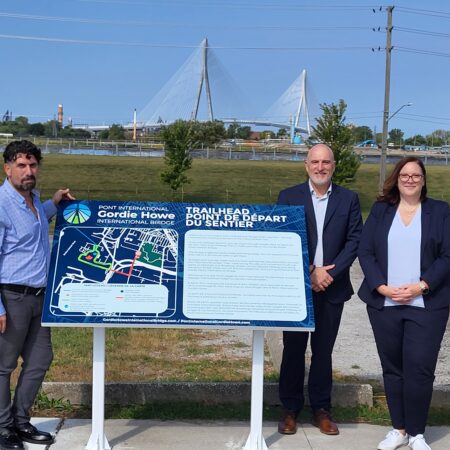
The Metro: What was in the Gordie Howe International Bridge community benefits plan?

The Gordie Howe International Bridge connecting Detroit and Windsor is nearly open, and its community benefits process is winding down.

The bridge will create a second international crossing between Detroit and Windsor-Essex and has been in the works for years. It was first proposed in the early 2000s and the Windsor Detroit Bridge Authority was created in 2012. In 2019, a Community Benefits Plan was published by the Windsor Detroit Bridge Authority

Residents on both sides of the border, including Delray in Detroit and Sandwich in Windsor, were engaged through a number of meetings and an advisory council was assembled. The report highlights key issues raised by community members:

  • Workforce development
  • Landscaping and aesthetics
  • Construction effects
  • Community safety 
  • Economic development opportunities

Heather Grondin is the Chief Relations Officer for the Windsor Detroit Bridge Authority. She joined The Metro to look at what community benefits were delivered for residents of Delray on the Detroit side, and Sandwich on the Windsor side.

Listen to The Metro weekdays from 10 a.m. to noon ET on 101.9 FM and streaming on demand.

Subscribe to The Metro on Apple Podcasts, Spotify, NPR.org or wherever you get your podcasts.

Trusted, accurate, up-to-date.

WDET strives to make our journalism accessible to everyone. As a public media institution, we maintain our journalistic integrity through independent support from readers like you. If you value WDET as your source of news, music and conversation, please make a gift today.

Donate today »

More stories from The Metro

The post The Metro: What was in the Gordie Howe International Bridge community benefits plan? appeared first on WDET 101.9 FM.
GLWA takes steps to reduce sewage backups in southwest Detroit

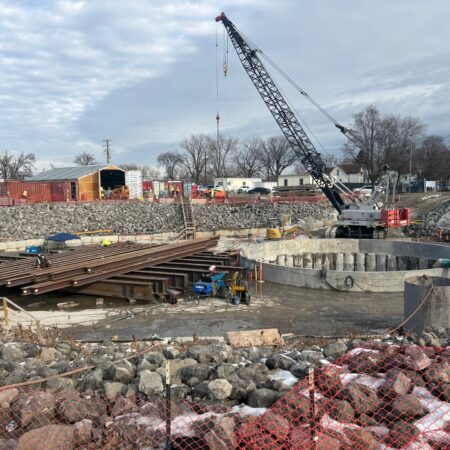
The Great Lakes Water Authority has started building a new tunnel in southwest Detroit. The project will divert excess stormwater from a large sewer line along the Rouge River to a retention and treatment basin nearby.

Potential to address a longstanding problem

GLWA Chief Operating Officer Navid Mehram says the tunnel will reduce the risk of flooding. Additionally, it should mean fewer basement sewage backups during heavy rain. “We’re making an investment in our existing system by rerouting some flows, so that we can leverage an existing facility that wasn’t receiving all the flow it can treat,” Mehram says.
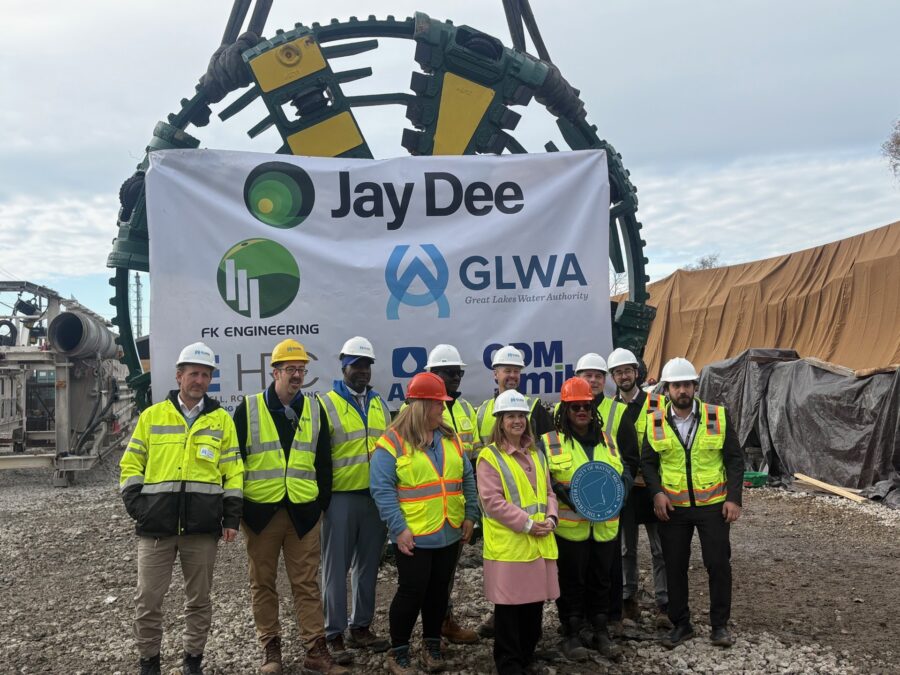
GLWA officials pose with part of a tunnel boring machine
The tunnel will be almost 4,000 feet long and several feet wide. Nehram says GLWA expects to finish the job in 2028. “Our projects are very large,” he says. “This is a tunneling project, which is extremely complicated.” Besides reducing sewage backups, Mehram says the project will also make the system more resilient to heavy rain. “This not only provides us with water quality improvements along the Rouge River, but it can also provide a backup for our Water Resource Recovery Facility,” he says.

Who’s paying for it?

The project will cost $87 million. Mehram says GLWA will use both government grants and sewer rate revenues to pay for it. He says it will not increase customers’ bills.

Trusted, accurate, up-to-date.

WDET strives to make our journalism accessible to everyone. As a public media institution, we maintain our journalistic integrity through independent support from readers like you. If you value WDET as your source of news, music and conversation, please make a gift today.

Donate today »

The post GLWA takes steps to reduce sewage backups in southwest Detroit appeared first on WDET 101.9 FM.
❌