The Trump administration recently announced $12 billion in bailout money in an effort to prop up the farming industry. That comes as farmers around the country have complained about trade wars and general economic conditions making it tough for them to do business.
What that money looks like by the time it makes its way to local farmers remains to be seen. Michigan Farmers Union president, Bob Thompson, says there are still questions surrounding the distribution.
Listen: Bob Thompson discusses issues facing Michigan farmers
“The Administration,” says Thompson, “still has to decide how much money is going to corn, versus wheat, versus soy beans, versus 15 different row crops.”
Thompson says about $11 billion of the $12 billion in the bailout will be dedicated to row crops. That means farmers growing specialty crops, like apples and cherries, will share the remaining funds.
Thompson warns the funding may not be enough to offset the challenges facing Michigan’s farms.
“The financial problems that a lot of farmers, particularly our smaller family farmers are experiencing, is a direct result of a lot of policies of the new administration,” Thompson explains, “ Particularly the tariff policies.”
He says the Trump administration’s crackdown on immigration has also hurt farmers in the state. About three-quarters of the seasonal workforce on farms comes from immigrant labor programs.
The Michigan Farmers Union says it may take a new long-term farm bill to stabilize the industry.
Trusted, accurate, up-to-date.
WDET strives to make our journalism accessible to everyone. As a public media institution, we maintain our journalistic integrity through independent support from readers like you. If you value WDET as your source of news, music and conversation, please make a gift today.
Former University of Michigan head football coach Sherrone Moore has been arraigned in a Washtenaw County courtroom. He faces one felony charge of third-degree home invasion, as well as misdemeanors for stalking in a domestic relationship and breaking and entering.
Moore was fired from his job earlier this week. A statement from the university says the termination was “for cause” after an internal investigation found he had an inappropriate relationship with a staff member.
According to Washtenaw County assistant prosecutor Kati Rezmierski, the victim had been in a years-long affair with Moore but broke it off earlier this week.
“Eventually, she presented herself to the University of Michigan,” says Rezmierski, “cooperated in some form of investigation there. As we all no know, the defendant was at some point on Wednesday afternoon fired from his employment.”
Prosecutors allege that, after learning of his termination, Moore broke into the victim’s home, grabbing several butter knives and a pair of scissors. He then began threatening to take his own life in front of her.
“’My blood is on your hands. You ruined my life,’” Rezmierski quoted. “And a series of very, very threatening, intimidating [and] terrifying, quite frankly, statements.”
Moore was arrested on Wednesday evening and has been held in Washtenaw County jail since.
The former coach has posted his $25,000 bond, and is being released with a GPS tracking device and a no-contact order. He also must keep up with mental health treatment as a condition of release.
Moore is due back in court next month.
The University of Michigan has named Biff Poggi interim head coach while it decides on Sherrone Moore’s permanent replacement.
Trusted, accurate, up-to-date.
WDET strives to make our journalism accessible to everyone. As a public media institution, we maintain our journalistic integrity through independent support from readers like you. If you value WDET as your source of news, music and conversation, please make a gift today.
Michigan residents demanded more scrutiny of the plan to provide electricity to a proposed data center in rural Washtenaw County on Wednesday night.
They also expressed frustration and distrust with DTE Energy. The utility is asking the state for expedited approval of the company’s contracts with Oracle Corp. for a data center planned in Saline Township, near Ann Arbor.
The facility would require 1.4 gigawatts of power from the electricity provider. The data center is part of Stargate, OpenAI’s $500 billion investment in AI infrastructure around the United States.
DTE Electric has asked the Michigan Public Service Commission to fast-track approval for its plan with Oracle to power the data center. That would bypass a process called a “contested case” that requires the commission to consider evidence and testimony from a variety of sources. Michigan’s Attorney General expressed alarm about the process, calling the hearing “performative listening” in a rebuke last month.
Protest
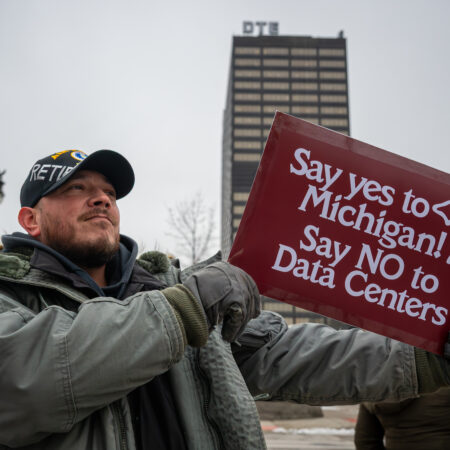
A small group of protesters gathered Wednesday afternoon across the street from DTE Energy’s Detroit headquarters. They were unhappy that DTE has tried to push plans for the data center through without public hearing.
Sarah Brabbs is from York Township, next to Saline. While she is not totally opposed to a data center, she said she’s not a fan of DTE trying to push the project through without allowing the public in on the process.
“Putting rate payers in a situation that you know we will be paying for, probably on multiple levels, is disingenuous, dysfunctional, and unacceptable,” Brabbs said.
Others at the protest said they’re concerned about the potential environmental impact, like how much water the facility could use and the amount of energy it would need to function.
“The access to the Great Lakes, they’re definitely taking advantage of whatever God-given resource in order to just implement whatever quantum, whatever new level of science and technology that they haven’t got consent from the people on if they even want it in the first place,” said Elijah Williams.
Michigan Public Service Commissioners Katherine Peretick, Daniel Scripps, and Shaquila Myers listen to public comments about a proposed data center near Saline, Michigan on Wednesday, December 3.
A virtual hearing Wednesday evening drew almost 90 participants. About 45 people spoke over the two and a half hours, with more in queue when the meeting ended at 9 p.m.
Appealing to Michigan’s workforce
A few speakers voiced support for the project. Most of the supporters represented trade unions or business associations who supported the project for creating jobs.
Randall Whitaker is the president of the Washtenaw County Skilled Building Trades Council. He said the project was an investment in Michigan’s workforce.
“A project like this is huge for workers,” he said.
Constructing the data center would create about 2,500 union jobs, according to DTE’s application. Other supporters argued that the facility would generate millions in tax revenue and attract talent to Michigan.
Burdening the electric grid?
DTE has said it expects the facility to increase its current peak electrical load by about 25%, but building out the capacity to accommodate that demand would not affect current ratepayers. DTE argues in its application that the data center won’t impact existing customers’ rates because of safeguards they’ve placed in the contracts with Oracle.
“The project strengthens Michigan’s long-term competitiveness in the fast-growing AI and advanced computing sectors, helping ensure our state remains a destination for innovation and talent,” Gov. Gretchen Whitmer said in a statement supporting the project.
But most participants opposed DTE’s request, citing the same concerns as the protesters – future electricity costs, how much water the facility would use, and whether the data center would actually benefit the local community.
A lack of transparency
Nichole Biber is a member of the Little Traverse Band of Odawa Indians, one of the 12 federally recognized tribes in Michigan. She said she doesn’t trust DTE or Oracle to do what’s best for residents.
“These ‘meaningful guardrails,’ from what I’ve heard so far, are all on the assurances of DTE and the multibillion dollar corporations that are pushing AI and data centers on us,” she said. “That does not reassure me.”
DTE’s application, which includes the contracts with Oracle, is partially redacted.
Maggie Kaercher, who runs a small fish farm in Dexter and also attended the hearing, said she wants the commission to deny DTE’s request and have the application available for a more thorough review.
“You can’t pretend that there’s transparency when there is so much redacted out of the papers that we’ve been able to see,” she said.
“What we are asking, and what many other people are asking for as well, is that the Commission give DTE’s proposal the proper scrutiny and ensure transparency,” said Katie Duckworth, an attorney with the Environmental Law and Policy Center. “Because this is the largest data center to be proposed in Michigan, and it’s one of the largest in the nation.”
Renewable energy or more fossil fuels?
Duckworth said the organization is concerned with how the data center’s power load will impact DTE’s ability to comply with Michigan’s climate change plans.
“It would also significantly increase the company’s renewable energy obligation under Michigan’s clean energy laws,” she said.
DTE is prepared for that challenge, the company said.
“Bringing on a data center of this size means more renewables, and more battery storage,” DTE said in a statement. The company also said the data center’s operators will finance the energy generation and storage needed to run the facility.
Duckworth said that solution would be “transformational” for DTE’s grid – if it happens.
“It raises a lot of questions including as to how those batteries would be charged and whether they will be charged by renewable energy, or whether it would involve prolonging the life of polluting fossil fuel plants or even building additional fossil fuel plants in the future,” she said.
Oracle expects the facility to open in December 2026. It won’t reach its maximum capacity of 1.4 gigawatts until December 2027, according to DTE’s application to the commission.
In October, DTE asked the commission to issue a decision by Friday, December 5. The commission is meeting at 1 p.m. that day.
At the virtual hearing, commissioners encouraged members of the public to attend a hearing on December 18 about the facility’s wetland impact permit, hosted by the state Department of Environment, Great Lakes, and Energy.
This story was initially published on Michigan Public Radio’s site and was produced in partnership with WDET.DTE is among WDET’s sponsors.
Trusted, accurate, up-to-date.
WDET strives to make our journalism accessible to everyone. As a public media institution, we maintain our journalistic integrity through independent support from readers like you. If you value WDET as your source of news, music and conversation, please make a gift today.
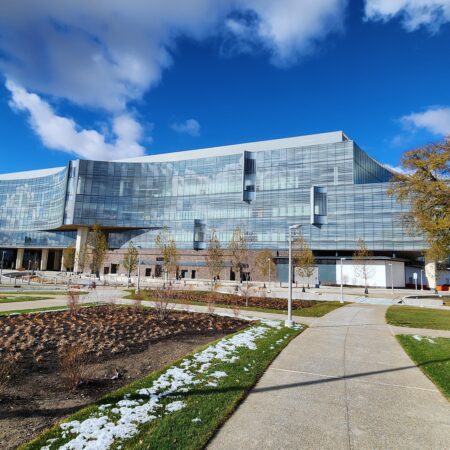
Ford Motor Company is moving into its new world headquarters in Dearborn. Called “The Hub,” it’s a seven story tall, 2.1 million square foot facility with four floors.
The building replaces the manufacturer’s outgoing HQ along Michigan Avenue near the Southfield Freeway. Ford Land Chair and CEO Jim Dobleske says, for years, that building has presented challenges when it came to collaborating.
Listen: A look inside the design center and office spaces at Ford’s new world headquarters
“They had to get in a car,” says Dobleske, “drive five minutes, park, walk into the building, get set up. So it was about a half hour venture before they could really get together.”
But that won’t be an issue for The Hub, where everyone from finance to the design teams will be in the same place. Project architects say the building’s wide-open rooms, sweeping staircases and collaborative areas put a focus on movement.
Officials say about 99% of The Hub is exposed to natural light.
Craig Dykers is founding partner of architecture firm Ford enlisted to design the building, Snøhetta. He says incorporating nature was an important part of the design process.
“Of course it’s important to humans,” says Dykers. “We need fresh air and daylight and access to nature to help us thrive — and so that was an important feature of making this.”
In total, the new building cost Ford around $1.2 billion to construct. But company officials say that price tag is well worth it — as they expect The Hub to serve as the automaker’s HQ for the next hundred years.
Trusted, accurate, up-to-date.
WDET strives to make our journalism accessible to everyone. As a public media institution, we maintain our journalistic integrity through independent support from readers like you. If you value WDET as your source of news, music and conversation, please make a gift today.

 Login
Login