 Login
LoginMacomb executive says county thrives despite economic uncertainty
The head of Macomb County’s government says the economic uncertainty felt in some sections of Michigan has yet to truly impact his area.
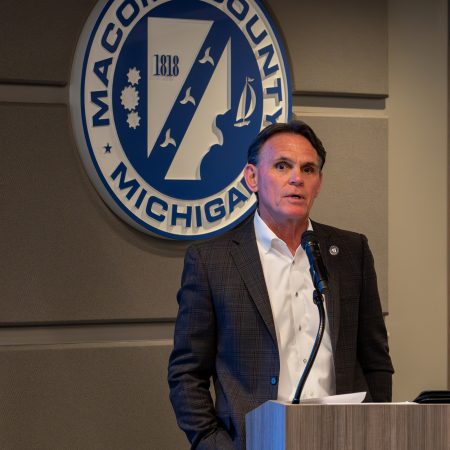
County Executive Mark Hackel summed up the situation in his annual State of Macomb County speech.
Hackel says the county is not just weathering the ebbs and flows of the overall U.S. economy but thriving in the midst of them.
Listen: Macomb executive says county thrives despite economic uncertainty
The following interview has been edited for length and clarity.
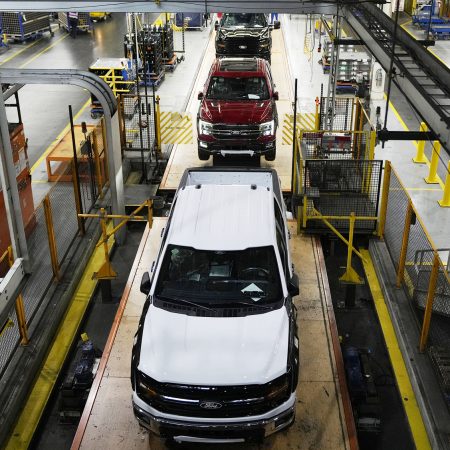
Mark Hackel: With our financial situation, our economic foundation, we’re in a great place. I know the things that you’re hearing across the country are challenging. But there’s so many things that kind of help lift us up. We’re pretty diverse too, though we rely heavily upon the automotive and defense industries and manufacturing. But the reality is Macomb is in a very sound place.
Quinn Klinefelter, WDET News: President Trump’s tariffs have impacted various segments of the U.S. economy, including the auto sector, which does have a pretty significant presence in Macomb County. Some of the prices for vehicles are starting to climb now. Do you have any concerns about how tariffs or the overall economic outlook are going to impact jobs or other parts of Macomb County’s economy?
MH: We’re always concerned about what happens at the federal and or state level that may have an impact on our economy. But look at what happened in 2010. There was a huge challenge with manufacturing, job losses, housing shortages that we faced back then. And we doubled down on manufacturing. By doing so, we’ve seen our economy continue to grow here.
Macomb County is a $54.2 billion economy. That’s bigger than the states of Vermont and Wyoming. We are right now at an all-time high. There’s never been a better time in Macomb County with our economy being as robust as it is right now. So whatever might happen with some of these tariffs or other economic concerns, we’re not seeing it directly have an impact right now. We’re in a good place with that.
QK: There is some financial stress in other parts of the country, other parts of Michigan, other parts of metro Detroit, for that matter. In your view, why is Macomb County doing well when some of these other places are having a bit of a struggle?
MH: We decided to double down on manufacturing. We retooled some of our manufacturing facilities. They’re different than they once were. We upgraded them. We really put a full-court press on making sure people understood that with our workforce, from concept to consumer, no one does it better than right here in southeast Michigan. And Macomb County is a major part of that. We are the defense capital of the Midwest. More contracts are awarded to Macomb County, as far as the actual number and the money associated with them, than anywhere else in the entire Midwest. So we keep promoting that, we keep pushing that.
And I think all the attention that we’ve been trying to drive has really helped us. We used a protecting growth strategy when we first got in and worked with the state on that. And we’ve done so well that we’re not really as worried about protecting anymore because we’re seeing that continuous growth. So we’re fortunate. Working with everybody has really had an impact on where we’re at today.
QK: In last year’s State of the County speech, you said that Macomb needed to focus on partnerships instead of partisanship. There was a line about not reaching across the aisle but getting in the aisle. How’s that bipartisan effort been going for you?
MH: Aside from a certain election here or there, for the most part, partisanship is not our conversation. None of that drives what we do here in Macomb County. People are willing to work with each other. You’ve heard that phrase, “Us versus everybody.” Some sports teams use it sometimes, municipalities or communities use it, as a sense of pride, a sense of esprit de corps. But when I look back on 15 years of how Macomb County has got to where it’s at and how we’ve evolved, we’ve kind of flipped the narrative on that. We look at it as, “Macomb with everybody.”
We’re trying to partner at the local, state and federal level. And never do we look at it as, “We can’t talk to them because they’re Democrats or Republicans. We can’t let their idea soak through or let them get successful because their party may get credit for it.” We don’t talk about that, don’t think about it. It’s a call for everybody who wants to come to be part of the solution. And if somebody looks more like they’re wanting to be part of the problem or be just a naysayer, we accept that. But the reality is we continue to forge ahead with people that want to provide solutions and help us get to where we need to go.
QK: When you talk about bipartisan cooperation, there are elections next year that could be pretty significant on a number of fronts. Michigan U.S. Rep. John James, for one, is running for governor and leaving a seat open that represents part of Macomb County. And there is a gubernatorial race underway. Whoever ultimately wins, what would you like to see from Lansing that you think could really affect Macomb County?
MH: That same willingness to partner and work with us rather than figure out how they could get credit by giving support to one particular area or segment of the state as opposed to somewhere else. Ensuring they are not ignoring any community within the state of Michigan. Specifically for Macomb County, whoever the governor is needs to realize they’re not the governor on behalf of the party, they’re the governor on behalf of the people. So govern on behalf of the people. That’s all I ask from whoever the next governor is. Work together on projects that matter, whether it’s in Macomb County, southeast Michigan or beyond.
QK: In terms of the partnerships that you’ve had, are there specific projects that you would like to see either the state or the federal government partner with Macomb on? Or projects that you’re pleased that they have partnered with you on to date?
MH: I’ll go with the ones I’m pleased that they have done to date. We got some support from the state because they realized the importance of our new jail project. It isn’t just about a jail. It’s about dealing with people that are going to be assessed for mental health or substance abuse when they’re brought in at the first point of contact. Every municipality now is partnered-in on this particular facility. We make a determination whether there’s any substance abuse, then decide what we need to do. The state partnered with us with some financial contributions because it impacts the state prison system too. When people are leaving our facility and sentenced on a felony, they’re going to the state facility. We look at what happened with Mound Road, a quarter of a billion dollar project. We got some state funding to help support that as well as federal and local. And then look what happened with Selfridge Air National Guard Base and us pushing the defense industry here in Macomb County. We are the defense capital of Midwest. And I do declare that at some point in time we’re going to be the defense capital of America.
There’s so much happening and we’re so excited about that. But there’s more to be done. We’re partnering on trying to figure out how we retool a facility or find a new use for the Romeo Ford engine plant. We’re looking at the Romeo airport. There’s a lot more that we need to do with our water quality. The support we get from Candice Miller and her team at Public Works. I’m telling you, there’s another trusted voice and a fierce advocate for cleaning our waterways and making sure we’re addressing underground issues. So, a lot has been happening. We’re going to continue those conversations and hopefully wherever the next governor is, they’re willing to address the issues that we’re talking about as opposed to politics.
The whole issue of where we’re headed as a region and even as a state is incredibly important. The biggest thing is that we all need to come together because we need to be competitive with other regions around the globe. And southeast Michigan is a major player. But our biggest challenge right now is our workforce, making sure that we’re attracting people to this area so they take on these jobs. That provides better opportunities for these manufacturers or companies that do the things that they do here in southeast Michigan. Us all coming together to promote the region as one.
Trusted, accurate, up-to-date.
WDET strives to make our journalism accessible to everyone. As a public media institution, we maintain our journalistic integrity through independent support from readers like you. If you value WDET as your source of news, music and conversation, please make a gift today.Donate today »
The post Macomb executive says county thrives despite economic uncertainty appeared first on WDET 101.9 FM.