❌

Reading view

There are new articles available, click to refresh the page.

Michigan DNR to track fish stocking using 23andMe-style gene testing
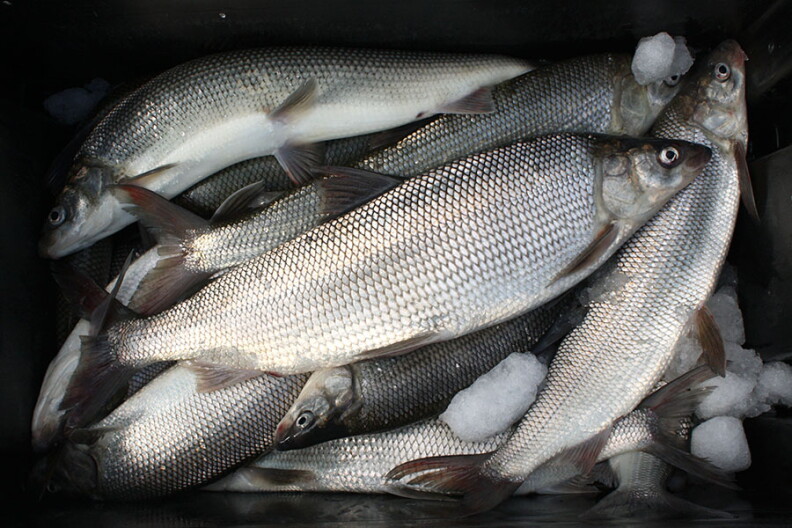
Lake whitefish on ice. The popular fish's reproduction rates declined to the point there's concern about whether commercial fishing will be viable in the future.
Lake whitefish on ice. The popular fish's reproduction rates declined to the point there's concern about whether commercial fishing will be viable in the future. ( Michigan Sea Grant)

The Michigan Department of Natural Resources has begun using genetic testing to track the success of some of its fish-stocking operations.

The goal is to find out if fish living in a particular water body descended from the parents of stocked fish. Doing so helps the DNR know if its multimillion-dollar stocking efforts are paying off by telling them if the stocked fish are living on in the waterway.

“Think about genetics (testing) like Ancestry.com, 23andMe,” Jen Johnson, senior fisheries management biologist for the DNR, told the Michigan Natural Resources Commission during its meeting Wednesday in Marquette. “Are you related? That’s the big question that we’re asking here.”

The DNR spends about a third of its annual budget on fish rearing and stocking. In the 2024-25 fiscal year, that totaled over $11 million. According to the department, past methods of tracking success have been limited or costly.

Pilot research with the new method, known as parentage-based tracking, has been cost-effective, freed up staff time, and has shown some illuminating results.

“This tool is going to open up a lot of insights into what we do at the fish division,” said Randy Claramunt, fisheries chief for the DNR.

It will allow the division to assess whether fish they catch were born naturally or from fish bred and stocked by the DNR, which will give them a sense of which approach is working better.

The DNR breeds and stocks fish primarily to create new places for people to fish a certain species or to add numbers to struggling populations. The department can check to see if stocked fish are surviving in their introduced location by tagging the fish and then searching for them there at a later date.

But tagging methods have been problematic. Using physical tags has meant individually tagging fish. Tags can get lost or an angler may fail to report when they reel in a tagged fish.

Another method of tagging involves internally marking fish, but that method can only be verified on dead fish using a microscope, and it takes up a lot of staff time. It’s also more expensive than genetic testing.

Parentage-based tagging involves genetically analyzing the DNA of the parents of a brood of stocked fish. Researchers collect the parents’ DNA since their offspring are fragile when young. Doing so can also help them determine the qualities of the most successful parents.

Later, when fish are caught in an area where stocking occurred, their DNA is sent to a lab at Michigan State University to find out if they were related to the parents of the stocked fish.

“It’s a really cool technique. But before we actually implemented this statewide, it was a wise idea to start a smaller pilot project to see if this is an actual effective technique,” Johnson said.

So she decided to use parentage-based tagging to evaluate the success of the DNR’s walleye stocking methods in Dickinson and Iron counties in the Upper Peninsula.

Between 2024 and 2025, Johnson’s team collected fish from some waterbodies there and the results were pretty illuminating.

Out of 25 fish caught in Lake Emily, 24 were found to be related to the stocked fish family. So stocking was working there.

But the opposite was found in two other lakes. Out of 147 fish caught in Hargerman Lake, only two were related to the stocked fish. Out of 34 fish caught in Lake Ottawa, again just two were related to the stocked fish.

Using further genetic analysis, Johnson determined that the walleye in Hagerman Lake were not related at all to the walleye found in Little Bay de Noc, which is where they had been getting the parents for recent walleye stocking reproduction efforts.

However, they found that the walleye in Hagerman Lake were genetically indistinguishable from walleye found in Lake Gogebic, where the parents for fish stocking efforts of the 1980s were taken from. Efforts from that decade were successful, while the recent efforts in the lake were not.

“Stocking’s an expensive endeavor, and annoyingly, we’re trying to do stocking attempts that were largely ineffective,” Natural Resources Commissioner Brandon Fewens said.

“If I had my way, all 20 million fish we stocked would be tagged, so we could evaluate them,” responded Claramunt, the fisheries chief.

For this upcoming fiscal year, the DNR will take 500 samples of stocked walleye from waterbodies across the state to have them genetically tested. Johnson said this “is going to help enable biologists with their stocking decisions.” For example, they will not continue to stock Hagerman Lake.

Expanding the program to other species in the future would “ultimately help us answer a lot of these management questions we have.”

___

This story was originally published by Bridge Michigan and distributed through a partnership with The Associated Press.

Michigan communities invest millions in their rivers. Will it bring returns?

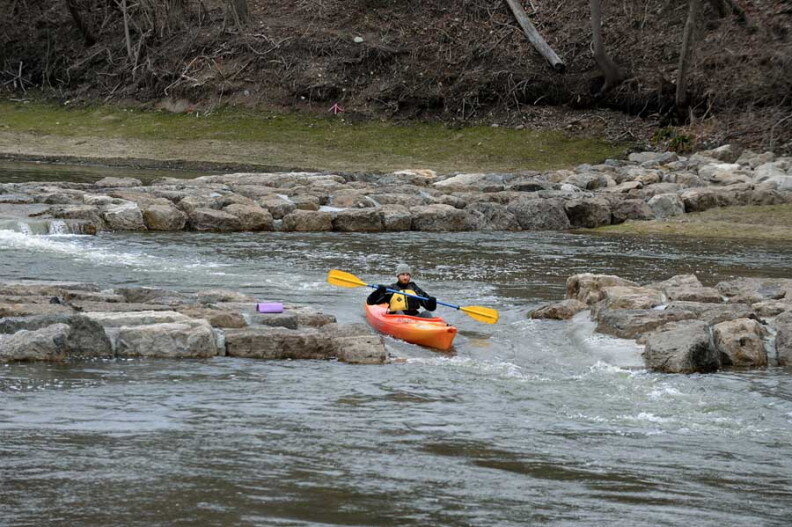
kayaker on river
(City of Ann Arbor)

On a recent sunny fall morning, a couple dozen people paddled in bright-colored kayaks past factories, a docked freighter and miniature mountains of industrial materials on southeast Michigan’s Lower Rouge River.

“This is really exciting to have this many people out here kayaking the Rouge because, when I was a kid, the Rouge was so dirty they told you, ‘Don’t touch it,’” said Sally Petrella, watershed ecologist with Friends of the Rouge, which organized the paddling event.

The river was once so polluted it famously caught on fire. Petrella told attendees it has “a long way to go,” but restoration efforts have made it “safe enough for you to be out here paddling.”

Communities across the state are pumping hundreds of millions of dollars into rivers like the Rouge, hoping for both environmental and economic returns.

Battle Creek has pitched a project to renaturalize part of the Kalamazoo River that runs over concrete. Grand Rapids is working to restore rapids to the Grand River downtown. A state park is being built around Flint’s riverfront. The state announced earlier this month it’s investing $89 million to clean up the Detroit, Kalamazoo and other rivers.

Backers envision more riverside development bringing tourists to kayak, fish and otherwise enjoy cleaner waterways that are more hospitable to native plants and animals.

Economic impact studies aren’t always completed for such projects, but many point to a 2007 Brookings Institution study that predicted a $3 return for every $1 invested in waterway restoration. A study on the Huron River in 2017 found the river produced $53.5 million in economic activity annually, while a 2023 White River study pegged its economic impact at $20 million.

“We’ve actually done studies in Muskegon that have showed a 6-to-1 return on investment,” said Alan Steinman, a professor at Grand Valley State University’s Annis Water Resources Institute and a co-author of the Michigan Blue Economy report. “The number is less important than the concept that, ’Oh my God, these properties really do have inherent value, cultural value and economic value that had none associated with (them) prior to the restoration effort.”

Kris Martin, an urban planner with Battle Creek Unlimited, the firm helping to look into whether part of the Kalamazoo river should be renaturalized, said removing the aging concrete channel would make the river “a greater amenity to the downtown.”

“Right now, it’s not accessible for the public at all,” he said. “And it’s quite dangerous.”

Martin said costs for the project will depend on the path forward but are expected to be “in the millions.” An economic cost-benefit analysis is expected to be a component in the next report released by the US Army Corps of Engineers.

For the Flint state park project, an economic analysis is not currently planned, because it would cost money, but project spending includes $30.2 million plus a $41 million endowment for future operations and maintenance.

As for Grand Rapids, the project is estimated to cost at least $19 million. Economic impact for the project as it stands today has not been publicized.

Even when the economic impact is not calculated, administrators say river restoration projects can be a worthwhile investment.

Starting in the mid-2000s, the Traverse City area began what has been deemed the largest dam removal project in Michigan’s history. Three dams along the Boardman River were taken out to reconnect coldwater streams and restore fish habitat. The project cost more than $27 million.

Conservation Resource Alliance — which served as the project manager and financial administrator for the effort — said it doesn’t actually know what the economic benefits have been.

“It’s something that’s really hard to quantify and would take a lot of time and investment from the partner collective that removed those dams to do so,” said Gavin MacDonald, communications manager for Conservation Resource Alliance.

But MacDonald said that, anecdotally, the payoff is that the dam removals restored a more free-flowing river that benefits fish and people.

“The river is now navigable, so you can paddle large stretches of the Boardman River,” MacDonald said. “It’s made it more accessible for the people that live in the region and the people that visit to explore and be more connected with nature.”

Sometimes the payoff is known.

For decades, prime downtown waterfront property in Detroit included vacant buildings and abandoned lots. The area has now been transformed to a nationally recognized waterfront that includes greenways and parks, more than eight miles of trails, places to get a drink and go sledding. About $2 billion in public and private dollars have been invested into the project so far and the Detroit Riverfront Conservancy says visitors spend $82 million a year.

The Huron River’s water trail was designated a part of the National Water Trail System in 2015. Elizabeth Riggs, deputy director at the Huron River Watershed Council at the time, had a hunch that the water trail and other restoration work benefitted the river, but she wanted proof.

“I and others working on the campaign were keen on trying to tell that story of (the river) in dollar terms — which is, as we know, a good way to tell a story — to try to reach as many people as possible, and to help convince decision-makers to invest in rivers and protecting them and restoring them,” she said.

The watershed council commissioned a study, published in 2017 by Grand Valley State University, to evaluate the economic impact of the Huron River. Researchers found that the river and its water trail were estimated to generate $53.5 million in economic output annually and that the river provided $150 million a year in economic value services through recreation, flood reduction, harboring rare organisms and more.

In 2023, Grand Valley State University also published an economic assessment of the White River. The river is located in west Michigan and runs through the Huron-Manistee National Forests. It’s fed by coldwater streams and can support salmon and trout.

The study found that nearly 70,000 visitors came to the White River in a year and that the river’s total economic impact was valued at $20 million.

“It’s a good number to know,” said John Stivers, secretary of the White River Watershed Partnership.

But he said that, when it comes to the White River, it’s a little complicated.

The river was designated as a Country-Scenic River by the Michigan Natural Resources Commission in 1975. Development on certain stretches need to go through a Natural Rivers Zoning Review Board, he said, and the river is further protected because it runs through national forest land.

Stivers said some people see the White River as a secret and they want to keep it that way.

“There are a lot of people that love it the way it is and aren’t really too interested in turning it into a high economic engine,” he said. “It’s a balance.”

___

This story was originally published by Bridge Michigan and distributed through a partnership with The Associated Press.
❌