❌

Reading view

There are new articles available, click to refresh the page.

Michigan held four debates this week. Here's what they showed.
Two podiums stand opposite each other. In the background is a semi-transparent, darkened ballot. In the top right corner is the It's Just Politics logo.
(Kalloli Bhatt / Canva)

It was a jam-packed week of political debates in Michigan. We’re covering the gubernatorial, U.S. Senate, 7th Congressional District, and secretary of state debates today. Biggest takeaway: Each debate offered insight into how the candidates want voters to evaluate them. Let’s dig in.

Michigan Gubernatorial Debate

Democratic Secretary of State Jocelyn Benson and her Republican opponent, Congressman John James (R-MI 10), used questions on foreign policy and energy to argue who should be held responsible for Michigan’s problems and who has the authority to fix them.
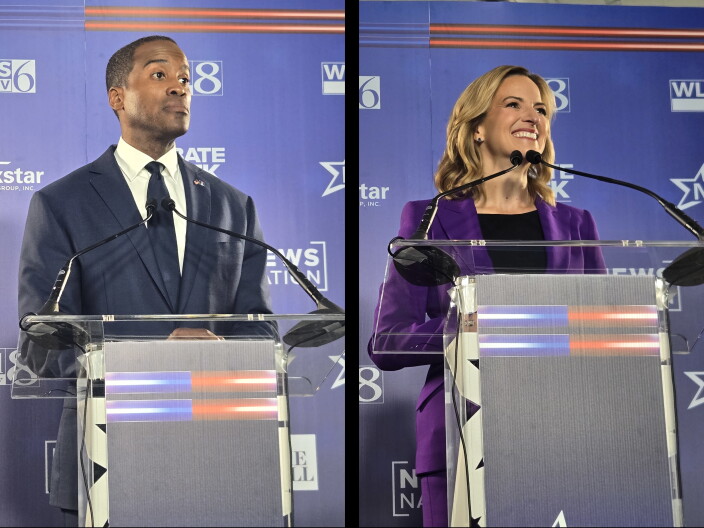
Republican John James and Democrat Jocelyn Benson stand at their lecterns during a gubernatorial debate on October 6, 2026.
Republican John James and Democrat Jocelyn Benson stand at their lecterns during a gubernatorial debate on October 6, 2026.(Colin Jackson / Michigan Public Radio Network)

When talking about federal policy, like tariffs or the war with Iran, Benson repeatedly tried to connect James to President Donald Trump. All the while, James pointed to instances that showed his willingness to stand up to the president.

On the subject of affordability, Benson said she would suspend Michigan’s gas tax, a stance she hasn’t previously taken publicly. She also proposed negotiating a sub-national trade agreement with Canada that could exempt Michigan from tariffs. James challenged whether a state has the authority to make such an agreement, given federal control over international trade policy.

When discussing data centers, Benson said she supported a statewide moratorium while additional protections are being considered. James said he also supported a moratorium, but would support local communities’ choices to welcome or reject data centers.

When pressed on how that would count as a moratorium, he said “it’s a moratorium on Lansing and not the people.”

The exchanges highlighted two different arguments.

Benson sought to connect James to the Trump administration’s policies, while James questioned the feasibility of some of Benson’s proposals and emphasized his own disagreements with the president.

Democratic nominee for U.S. Senate Abdul El-Sayed, left, appears with Republican nominee for U.S. Senate Mike Rogers during a televised debate at WOOD-TV, on Thursday, Oct. 8, 2026, in Grand Rapids, Mich.
Democratic nominee for U.S. Senate Abdul El-Sayed, left, appears with Republican nominee for U.S. Senate Mike Rogers during a televised debate at WOOD-TV, on Thursday, Oct. 8, 2026, in Grand Rapids, Mich.(Paul Sancya / POOL AP)

U.S. Senate Debate

Former Republican Congressman Mike Rogers and his Democratic opponent Abdul El-Sayed had a particularly heated debate.

WOOD-TV’s Rick Albin had to repeatedly chime in, telling both candidates to keep their responses short in order to stay on time. At one point, Albin said, “I’d like to be a part of the debate, too.”

Throughout the debate, Rogers launched personal attacks on El-Sayed. El-Sayed’s response: Rogers was distracting voters from economic concerns, like gas and grocery prices, and repeatedly flip-flopping on positions.

This debate highlighted the significant differences between the candidates’ stances on Iran, Israel, surveillance and federal spending, but the confrontations became so disruptive Albin had to repeatedly ask candidates to answer the questions.

There were two obvious competing campaign messages: Rogers wants voters to scrutinize El-Sayed’s associations and judgment, while El-Sayed wants them focused on economic conditions and Rogers’s political record.

Republican Congressman Tom Barrett and Democratic challenger Will Lawrence prepare to debate.
Republican Congressman Tom Barrett and Democratic challenger Will Lawrence prepare to debate.(Andrew Roth / WKAR)

7th Congressional District Debate

Republican U.S. Representative Tom Barrett and Democrat Will Lawrence met for their first debate Tuesday. Each candidate spent the debate trying to turn each other’s record into a liability.

Barrett kept referring to Lawrence’s past social media statements, particularly his previous support for defunding the police, to use his opponent’s past to discredit his current political positions.

After the debate, Lawrence told WKAR’s Andrew Roth, “I'm somebody who thinks out loud.” He added, "I've spent my share of time thinking out loud, like lots of millennials on the internet. I'm not afraid to change my mind and live and learn. And I've answered for those comments."

Lawrence has said he now supports funding police alongside community violence intervention and mental health programs. Barrett, however, questioned whether Lawrence’s change in position was genuine.

During the debate, Lawrence pressed Barrett on his voting record, specifically on policies that affected tariff rates, healthcare subsidies, data centers and artificial intelligence. All the while repeatedly connecting his opponent’s voting record to the current presidential administration’s policies.

Barrett defended his tariff-related vote and argued that AI regulation should have a strong federal framework, while allowing states and local governments to add certain protections.

You can see this in action when they debated affordability and federal policy.

The 7th district includes strongly Democratic communities, around Lansing and Michigan State University, as well as strongly Republican areas, such as Howell, meaning neither candidate can rely exclusively on voters in their party's strongest communities.

That makes the candidates’ contrasting arguments particularly relevant: Barrett is asking voters to consider Lawrence’s past statements, while Lawrence is asking them to consider Barrett’s recent decisions in Congress.

With control of the U.S. House potentially coming down to a handful of competitive districts, the arguments these candidates make about one another could have consequences beyond mid-Michigan.
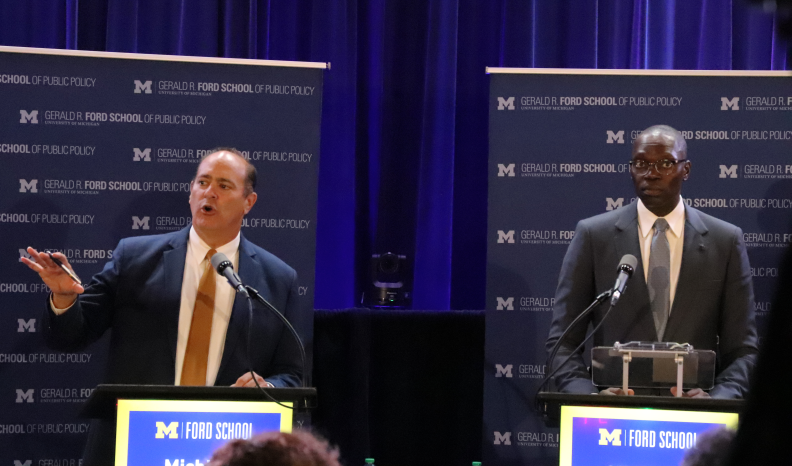
Garlin Gilchrist and Anthony Forlini, candidates for Michigan Secretary of State, at a debate held in Ann Arbor
Garlin Gilchrist and Anthony Forlini, candidates for Michigan Secretary of State, at a debate held in Ann Arbor(Etai Smotrich-Barr / Michigan Public)

Secretary of State Debate

Democratic Lieutenant Governor Garlin Gilchrist and Republican Macomb County Clerk Anthony Forlini covered a lot of topics, but their sharpest disagreement concerned election integrity and denialism.

Gilchrist accused Forlini of accommodating election deniers and warned that amplifying election conspiracies could place additional pressure on local election officials.

Gilchrist specifically criticized Forlini’s decision to hire a January 6 protester to help recruit and train election workers. Forlini defended the hiring decision as an example of including people with differing opinions, while distancing himself from the employee’s public views.

Forlini argued addressing election security concerns was important. He also noted that Gilchrist had questioned the results of the 2017 election for Detroit city clerk, which Gilchrist lost.

As Michigan Public’s Etai Smotrich-Barr reports, “Gilchrist sought a partial recount in the 2017 race, which found errors with the way ballots were processed and stored but confirmed Gilchrist’s loss. After the recount, Gilchrist conceded the election.”

That distinction matters.

Requesting a recount through an established election process isn't the same as denying a verified election result.

The exchange also revealed different approaches to public distrust. Forlini emphasized addressing concerns from voters who question election procedures, while Gilchrist warned that giving credence to unsupported claims can undermine confidence in elections.

Because Michigan's Secretary of State oversees statewide elections, that disagreement illuminates how each candidate says they would approach the office.

What do these debates show?

All four debates highlighted the different issues, records and responsibilities that these candidates want voters to consider.

The gubernatorial race is asking: Who is responsible for Michigan’s problems and political independence?

The U.S. Senate race is asking: Do personal associations outweigh policy proposals?

The 7th Congressional District race is questioning: Which past matters more–publicly available statements or congressional voting records?

The Secretary of State debate is asking: Which approach to election integrity and maintaining public trust matters more?

All different races and responsibilities, but with a common thread: the candidates are trying to shape not only how voters see their opponents, but which issues and records voters consider most important.

Throughout all four, candidates aren’t just competing over the answers to questions on how they would perform in office, but also over which questions voters should be asking in the first place.

More election resources

Debate summaries

Fact-checking the debates

Until next week,

Kalloli Bhatt, Digital Content Producer

_______________________

More Political News

_______________________

IJP On the Road

_______________________

Today’s newsletter was written and produced by Kalloli Bhatt, and edited by Michelle Keller and Rebecca Williams.

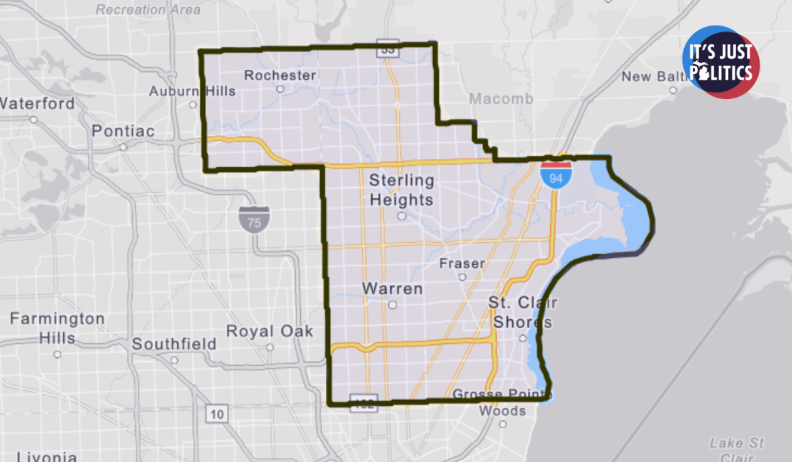
What's at stake in Michigan's 10th Congressional District

A photo of Michigan's 10th Congressional District. The It's Just Politics logo is in the top right corner.

Michigan’s 10th Congressional District is among several races that may determine which party controls Congress after the midterms. That’s why we’re watching it so closely this election season.

Is it really a toss-up?

Michigan's 10th Congressional District is currently represented by Republican John James, who is running for governor, leaving the seat open. The district has leaned Republican in recent elections, with Donald Trump carrying it by six points in 2024, but the race to replace James is now considered a toss-up. Michigan Public’s Steve Carmody covers this in detail here.

Republicans have plenty of reasons to feel good about Michigan's 10th District. Donald Trump carried the district by six points in 2024, and Macomb County, which makes up the majority of the district, has backed Trump in each of the past three presidential elections.

But there's a complication: Trump isn't on the midterm ballot.

And that gets at one of the biggest questions hanging over the race to replace James: Can Republicans turn out the Macomb County GOP voters even when Trump isn't running?

The Trump-era shift of the 10th district

The 10th district is made up of the southern half of Macomb County, along with Rochester and Rochester Hills, part of Oakland County.

In a recent conversation with Stateside, David Dulio, professor of political science and director of the Center for Civic Engagement at Oakland University, said it’s important to remember that Macomb County produced the Reagan Democrats of the 1980s.

These traditionally Democratic, working-class voters crossed party lines to support President Ronald Reagan. According to Dulio, Trump's performance there represents another major shift in the county's politics.

“The last three presidential cycles, Macomb County [was] carried by Donald Trump,” Dulio said. “And that's because I think he has made incredible inroads with working-class, blue-collar voters that are all over the place in southern Macomb County.”

But presidential elections aren't the whole story. Governor Gretchen Whitmer carried Macomb County in both of her gubernatorial campaigns.

To Dulio, that's evidence that the county's Republican shift isn't necessarily complete.

“Until we see a Republican gubernatorial candidate in a midterm year when the president is a Republican carry Macomb County, it's not complete,” Dulio said.

In other words, Macomb has shown it will vote differently depending on who's on the ballot, making an open-seat midterm a particularly interesting test.

What each candidate brings

While neither candidate in the 10th district has previously held office, they both enter the race with something Dulio thinks could matter.

Republican candidate Michael Bouchard Jr., a military veteran and son of the long-time Oakland County sheriff, has both name recognition and his veteran status as a potential advantage.

“For a veteran and in a place like the 10th district, the defense corridor is there and there are a lot of voters that are connected with those corporations as well as military installations, and so I think that that makes a ton of sense,” Dulio said.

On the flip side is Democratic candidate Christina Hines, who two years ago ran for Macomb County Prosecutor, but was ultimately defeated by Pete Lucido. Dulio said her potential advantage is her past campaign experience.

“Her experience in that race and having run countywide, I think, sets her up to have some success because she knows how to run a race,” Dulio said. “She knows that it takes a bunch of money to do so, especially in a place like Macomb.”

The Trump question

So, if both candidates have respective advantages and the 10th District is a toss-up, where does that leave Michigan?

Dulio pointed to two broader factors that political scientists use to understand midterm elections: a president’s approval ratings and the surge-and-decline theory.

Historically, an incumbent president’s approval ratings are actually the best indicator of seat loss by the party.

“By this time, people have maybe become disappointed or frustrated or angry with the president's performance,” Dulio said. “And I think we see that today reflected in those job approval numbers.”

The other factor, the surge-and-decline theory, should make Republicans a bit more nervous about the 10th district. This phenomenon occurs when, during a presidential election, there’s a surge of turnout of supporters, but conversely during a midterm, there’s a big decline.

So, the big question for this race is whether Republicans can get those voters who would typically stay home to turn out and vote. And in a year when control of the U.S. House could come down to a handful of districts, that's what makes Michigan's 10th Congressional District worth watching.

Until next week,

Kalloli Bhatt, Digital Content Producer

_______________________

Have questions about Michigan politics? Or, just want to let us know what you want more of (less of?) in the newsletter? We always want to hear from you! Shoot us an email at politics@michiganpublic.org!

_______________________

_______________________

Other political news to watch

_______________________

Next week on the newsletter

Morning Edition interviews Michigan Supreme Court candidates ahead of the midterms. We’ll bring you all of the interviews (text, audio and visual).

In the meantime, you can read this edition of The Mids on researching judges or this article on how Michigan’s judicial system works.

_______________________

_______________________

Today’s newsletter was written and produced by Kalloli Bhatt, and edited by Michelle Keller.

U.S. Supreme Court ruled against Trump . . . for now

A grayscale image of a hand placing a ballot into a ballot box in front of the U.S. Supreme Court building, with trees in the background. The It’s Just Politics logo appears in the upper right corner.
(Kalloli Bhatt / Canva)

There’s a couple of big stories this week, but let’s focus on the mail-in ballots story.

Here’s a quick refresher:

  • In March, President Donald Trump issued an executive order that established a national list of eligible voters and directed the U.S. Postal Service (USPS) to transmit mail-in ballots only to voters on that list.
  • A lawsuit ensued and the U.S. Supreme Court ruled that the plaintiff states didn’t have the standing to sue, leaving open the possibility for USPS to implement its plan.
  • After that ruling, 21 states, including Michigan, and the District of Columbia filed another lawsuit to block USPS' plan to implement the order.
  • Earlier this month, a federal judge in Boston issued a preliminary injunction in response to the suit, blocking the USPS from implementing the new ballot requirements from the executive order.

USPS and the election

That brings us to Monday, when the U.S. Supreme Court ruled against President Donald Trump.

The majority decided to keep the Boston-based federal judge’s injunction. However, in his concurring opinion, Conservative Justice Brett Kavanaugh wrote that this sort of election administration could potentially be within USPS’ jurisdiction, but that implementing it for this election would be “in violation of the Administrative Procedure Act because state and local election officials do not have sufficient time to reasonably implement the rule before the elections.”

Voter confidence

Alongside this Supreme Court decision are the results of a new Glengariff poll showing Michiganders' confidence in the election system.

The poll surveyed about 800 likely Michigan voters. Of those, 74.4% said they believe the system is fair and accurate. That’s a drop from 2025’s 79.4%.

Additionally, while 85% of Republicans, Democrats and Independents trust their own county’s election results, 48% don’t trust other counties to do it right.

With voter confidence on the decline and the impending possibility that USPS could gain election admin jurisdiction, we checked in with Ottawa County Clerk Justin Roebuck for some clarity on the election process.

The following is an excerpt from the transcript that has been edited for length and clarity.

The interview

Kalloli Bhatt: When someone trusts the election you administer in Ottawa County but doesn't trust Wayne County's, what would you want them to understand about how similar (or different) the processes actually are?

Justin Roebuck: Across the state of Michigan, we follow the same laws, the same rules and regulations. And what's really important to note is, you know, there's three key factors that I think really are our pinch points of election integrity. You know, the cornerstones of election integrity. And that is that our elections are bipartisan.

That means that basically anytime your ballot is being counted, it's being counted in an environment where members of both political parties are at the table. There are election workers from both political parties who have taken an oath of office to uphold the laws of the state and the Constitution, and they're watching and checking each other's work.

The other element is that it's transparent. Also, anytime your ballot is being counted, it is being counted in public. You know, I mean, these are public events. You can actually go in and watch and observe absentee ballots being counted. You can go in and observe early voting and election day processes. And then also, we are trained professionals.

You know, our election administrators are constantly going through continuing education. But also we have over 30,000 election workers in Michigan. And these are your neighbors, my neighbors, people who've taken an oath of office to uphold the law and the Constitution.

That's not unique to one community or another. So I think voters can be confident that there are processes and rules and laws in place to be followed all across the state of Michigan.

KB: In the recent U.S. Supreme Court ruling, Justice Kavanaugh suggested the issue wasn't necessarily whether USPS has the authority to impose these requirements, but whether election officials had enough time to implement them for November. If something similar returns before 2028, what would clerks need in order to implement a major change like that without disrupting an election?

JR: I think it was so critical to have that Supreme Court decision, at least in time for us to know the ground rules going into this election. But I think moving forward, there are a couple of critical elements that would be needed in that process in order for us to comply with that.

Importantly, the use of ballot envelopes that are uniform and approved by USPS for election mail purposes. You know, we've already checked that box in Michigan.

The use of intelligent mail barcodes, that was another requirement in the rule set. What that means is sort of like a hyper tracking process that occurs right where this barcode is printed on every single outgoing piece of mail and incoming piece of mail where a voter can actually track their ballot coming and going a little bit more thoroughly, which is a great feature. It's certainly a feature that we would need time and resources to prepare.

And then, finally, probably the biggest lift of this entire rule set would be the state submission of absentee voters or voters who had applied for and were being mailed a ballot. This massive submission of the lists from every state to USPS for them to check and run against their database.

I think what to me is ironic about the USPS rule set is that it actually doesn't accomplish what a lot of people in the political sphere are talking about it accomplishing, which is somehow this idea that USPS would prevent ineligible voters from casting an absentee ballot.

There was no such assertion in the rule set at all. In fact, USPS said, "We are not messing with that portion of it. We are leaving that responsibility in the hands of the states. We would take the list that the states gave us and mail ballots to those people."

End of excerpt.

All of this still leaves one question: what’s next?

Well . . . voting as usual. Since the U.S. Supreme Court upheld the preliminary injunction, there will be no changes for this election.

As for the future, who knows? But, rest assured Michigan Public and the It’s Just Politics crew will keep bringing you updates and analysis as they happen.

Until next week,

Kalloli Bhatt, Digital Content Producer

Psssst: You didn’t hear it from me, but The Mids is talking about absentee ballots and (more importantly) how you can get this year’s “I voted” stickers even though you voted absentee on Oct. 5. Subscribe today at michiganpublic.org/mids.

_______________________

Have questions about Michigan politics? Or, just want to let us know what you want more of (less of?) in the newsletter? We always want to hear from you! Shoot us an email at politics@michiganpublic.org!

_______________________

_______________________

❌