Macomb County to install two inflatable bladders into pipe to help reduce combined sewer overflows into Lake St. Clair( Macomb County)
The state of Michigan wants to know what you want to know about the state's infrastructure.
That includes roads, gas and electricity, drinking water, internet, and other essential services.
The Michigan Infrastructure Council is collecting questions in a survey, which will be used to create a Statewide Infrastructure Guide.
Palencia Mobley is head of the council. She says it's quite common for residents to have questions about the complex systems that support their daily lives, including who maintains them, and how they're paid for.
Mobley said there's been a serious lack of investment in many of these essential things for decades.
"There are multiple things that have led us to where we are now, and we just really believe that an engaged and an informed citizenry are our best advocates and our best allies for ensuring that we can meet the infrastructure challenges that do exist," she said.
The survey will be used to create a Citizens' Guide to help residents become better educated and more involved in the issues. The survey runs through October 30.
More intense storms fueled by climate change are knocking down more limbs and trees which takes a toll on power lines, sometimes knocking out power to hundreds of thousands of homes and businesses across the state.(Lester Graham / Michigan Public)
Utility bill credits for power outages would be significantly higher under legislation introduced by state Senate Democrats.
The credits would start out at $5 an hour, in the first hour a customer loses power, and ratchet up to $25 an hour after 72 hours without electricity.
Frequent outages would also result in credits: $100 for four service interruptions in a period of 12 months, and $200 for more than four service interruptions.
Renters whose landlords pay the electric bill would be eligible for a $50 credit for spoiled food, lodging, or other costs after four hours without electricity (more if the actual loss is greater) and a $200 credit after 24 hours (also more if the actual loss is greater).
The proposed credits are much more extensive than current credits required by the Michigan Public Service Commission, which mandates a credit of $44 a day during a widespread outage, and that only begins accruing four days after a customer has lost power. Six or more power outages in a 12-month period also merits an additional $44.
Democratic State Senator Stephanie Chang (D-Detroit) is one of the bills' sponsors. She said the legislation is intended to encourage utilities to reduce outages and speed restoration, and it would also better reflect the true costs to customers of losing power.
"We are really trying to incentivize our electric utilities to do a better job of restoring power quicker," Chang said. "We have heard time and again from residents that losing power, losing food, it could be really devastating. Food is really expensive. Replacing it is expensive."
Chang said the MPSC has been working to address reliability, and the legislation reflects the state Legislature working in partnership with the regulatory agency to that end.
Other bills in the package would require regulated utilities to submit reports to the MPSC delineating the cause of service interruptions, tree trimming projections, grid hardening and reliability projects, and a list of the top 20% worst-performing circuits in the utility's service territory.
Consumers Energy said in a statement that it is reviewing the legislation.
“Michigan and New York are currently the only states that require electric utilities to issue automatic bill credits or compensation to customers," the statement continued, "and Consumers Energy complies with the outage credit requirements established by the Michigan Public Service Commission. On the topic of outages, investing in reliability improvements and restoring power safely and quickly will remain our top priorities.”
DTE Energy said in a statement that it shares Michiganders' expectation that DTE keep the lights on and keep bills as low as possible.
The statement continued, "which is why we're making historic investments in infrastructure upgrades, tree trimming and grid modernization to build a stronger, more resilient electric system."
"Across Michigan, utilities are facing increasingly severe weather that can damage electric infrastructure and disrupt service. That's why we're focused on strengthening the grid, hardening critical equipment, and deploying new technologies that help reduce outages and speed restoration when storms occur."
"We're already seeing progress, and we remain committed to continuing the investments that improve reliability while keeping energy affordable for customers. Our goal is simple: fewer outages, shorter outages, and better service for the communities we serve," DTE said.
Editor's note: Consumers Energy is among Michigan Public's corporate sponsors.
U of M Professor of Engineering Steven Ceccio, project lead for U of M's planned research computing center in Ypsilanti Townhip, explains details of the center at a second town hall at the Ann Arbor Marriott Ypsilanti at Eagle Crest on Thursday, October 1, 2026(Tracy Samilton / Michigan Public)
The University of Michigan's second town hall about its controversial plan for a computing center in Ypsilanti Township drew another crowd of opponents Thursday night.
There was less jeering and profanity than the first town hall three weeks ago, but just as much emotion, as residents lined up at the mics to express a litany of objections, calling the plan to build a joint academic and military research center with Los Alamos National Laboratory "environmental racism," among other charges.
University officials said they had considered other locations for the data center, but the site in Ypsilanti Township, near the Ford Rawsonville plant, was chosen for its position in an industrial zone near high transmission power lines. Officials said the center will not use water from the Huron River, nor will it spike residents' electric bills.
But residents said the University could have found a better location, and they said the data center will create unbearable 24/7 noise, pollution of air and water, and destroy the quality of life in the township.
"We need to know what you expect to gain so it can be weighed against what we stand to lose," township resident Rory McGuinness said. "We live in a good place. It is our responsibility to protect it. That is what my neighbors and I are trying to do here tonight. We've come to a moment in our history when not only wild creatures, but also human beings are expected to compete with computers for clean air, fresh water and a place to live. Speaking personally, I would hate to look back on my time and know that I used my voice and my skills and my intelligence to stand up for the machines."
Drew Smith, the university's interim vice president of Finance, responded to an accusation that neither he nor any other University person involved in the project would be willing to live near the planned computing center.
"If I thought this project was going to do any of the things that you all are afraid - understandably, afraid that it is going to do, I wouldn't be involved with it," he said, over a chorus of angry comments. "And it's absolutely the case. I would live next to it."
Brenda Stumbo is Ypsilanti Township Supervisor. She has accused University officials of initially lying to her about the scope of the project. She received a standing ovation when she told the panelists the data center is not wanted.
"The harm, the tears, the fear, the mental anguish you guys have put on our community. I can't even measure it," Stumbo said. "It's so harmful. Please just stop, just stop. Rethink it. And I want to beg you, but I've already tried that. I've already tried begging. So we're going to fight. We're going to fight the whole time."
Stumbo said she would be organizing her own townhall, and said she would invite University officials to attend as co-panelists with her and others opposed to the project.
Editor's note: The University of Michigan holds Michigan Public's broadcast license.
Antrim County Clerk Victoria Bishop(Antrim County Clerk / Antrim County Clerk Facebook page)
The Michigan Board of State Canvassers approved three of the four petitions submitted for a recall election of Antrim County Clerk Victoria Bishop on Friday.
Bishop has until October 5 to file an appeal of the decision. Organizers said they initiated the recall effort due to her alleged violations of numerous rules and laws.
In early June, the State Bureau of Elections rescinded Bishop's access to the state Qualified Voter File, which is a list of people who have registered to vote and are eligible to vote. That's after Bishop allegedly canceled some county voters' registrations, in violation of state law.
In a September 18 letter, the bureau delineated a list of trainings and other actions that Bishop had failed to complete in order to regain temporary access to the QVF. Sam May, press secretary for Secretary of State Jocelyn Benson, said in an email to Michigan Public that it was the last communication the Bureau has had with Bishop.
And, in June, the Michigan State Police began a separate investigation of Bishop, after the clerk allowed her husband unsupervised access to her office and county computer.
After reviewing the investigation, Attorney General Dana Nessel's office found no criminal conduct occurred, but said given the sensitive nature of records in Bishop's control, including the Qualified Voter File, that her actions were "a clear misstep from adequate practices and prudent policy."
Ashley Areeda, the communications director for the Recall Victoria Bishop Committee, said Republican members of the Board of State Canvassers rejected earlier petition submissions, so organizers decided to submit four more with additional details requested by those canvassers.
The Board told the committee they can now choose one of the three approved petitions for the recall campaign. Areeda said this is the language that will appear on petitions:
"Between July 24, 2025, and June 3, 2026, Antrim County Clerk Victoria Bishop changed voter status codes in the Qualified Voter File to ‘Cancel’. For example, Bishop changed six voter records in Mancelona Township to ‘Cancel’ on January 9, January 13, January 23, January 27, January 29, and April 16, 2026. The township clerks responsible for those voter records had not asked Bishop to make those changes on their behalf."
Bishop has until October 5 to appeal the Board of State Canvassers' decision. Bishop's attorney, Kevin Kijewski, told Votebeat that Bishop is “reviewing the decision and all her options.”
“In the meantime she will continue serving the people of Antrim County,” the statement continued. “A recall is ultimately decided by the voters, and if it reaches them, she looks forward to making her case directly to them.”
The campaign to recall Bishop said it needs to collect 4500 valid signatures within 60 days to put the recall on the ballot in Antrim County, but that it's aiming for at least 6,000.
The campaign hopes to place the recall on the county's regular spring election day, in May.
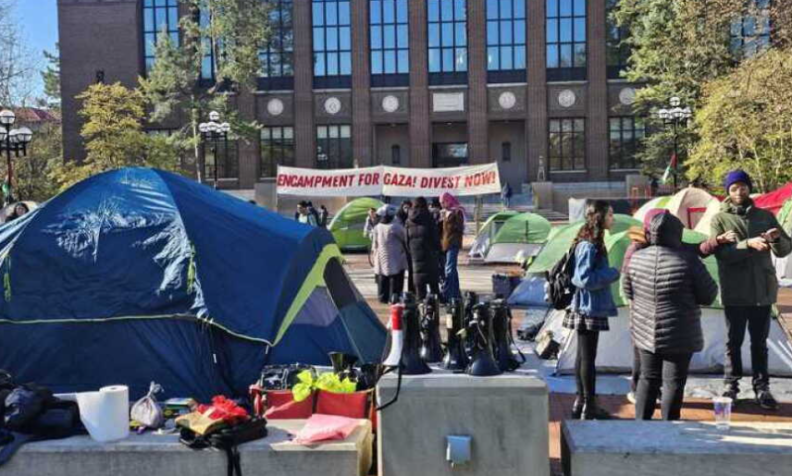
Students set up an encampment to call on the University to divest its investments in Israel, Israili companies, as well as American organizations supplying military equipment to Israel(AJ Jones)
An ACLU report released this week alleges the University of Michigan, along with other universities, has violated the constitutional rights of pro-Palestine protestors holding rallies, marches and other demonstrations on campus.
The report says the University of Michigan's response to a surge of pro-Palestine activism has been harsher than its response to other kinds of student-led activism in the past.
"Many of the larger protests have resulted in the university and its police arresting, detaining, physically harming, and using chemical sprays against protestors; initiating a variety of disciplinary proceedings against protestors; ordering protestors not to appear on campus under threat of criminal trespass sanctions; and adopting a new, ill-defined policy broadly prohibiting 'disruptions' anywhere on campus," the ACLU said in its report.
The ACLU of Michigan and five affected protesters sued over the bans, which in some cases lasted longer than a year, as well as the new policy that bans protest activity in campus buildings and at campus events that are deemed disruptive.
The lawsuit says the demonstration crackdowns and the new policy violate the plaintiffs' free speech rights, and the trespass warnings violate the plaintiffs' right to due process, since they were not allowed a meaningful way to appeal the orders to stay off the University campus.
The university took issue with that characterization.
"The University of Michigan is firmly committed to freedom of speech, academic freedom and the right to peaceful protest, including expression that challenges the university and its leadership," a University of Michigan spokesman said in a statement. "U-M does not restrict speech or take disciplinary action based on political viewpoint. University policies apply regardless of cause or message and are intended to protect both free expression and the ability of our community to learn, teach and work. "
"When demonstrations threaten safety, damage property, block access or substantially disrupt university operations, the university has a responsibility to respond," the statement continued. "Law enforcement and disciplinary decisions are based on the circumstances and actions involved, not the viewpoints being expressed."
Editor's note: The University of Michigan holds Michigan Public's broadcast license.
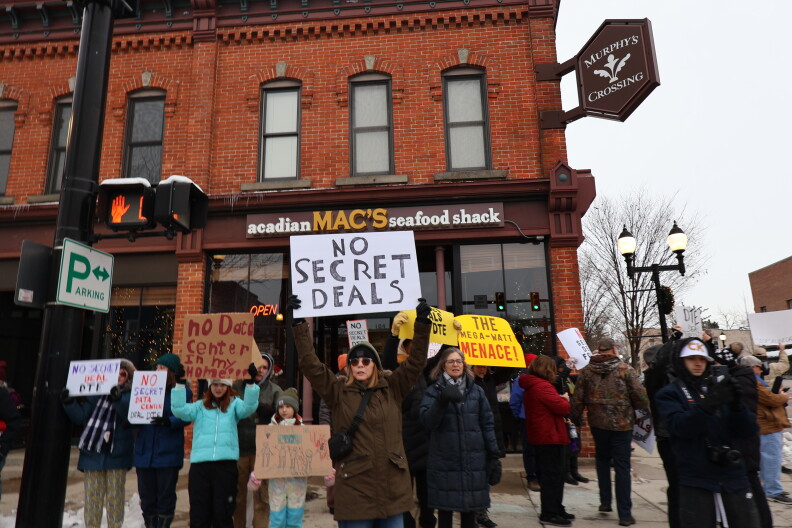
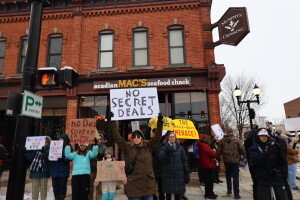
Saline residents hold signs protesting against a data center proposal downtown on Tuesday evening. One sign in the center reads “No Secret Deals.”(Anna Busse / Michigan Public)
DTE Energy says its proposed long-term energy plan, not yet filed with utility regulators, will keep electricity reliable and bills as low as possible.
The utility said the plan, known as an Integrated Resource Plan, or IRP, anticipates much higher electricity demand in the future — which it will meet with an "all of the above," resource mix, including updating its Fermi II nuclear power plant, dramatically increasing solar and long term storage, and constructing two new natural gas plants.
Despite the two new plants, DTE said it will remain on track to meet Michigan's 2040 energy goal of net zero carbon emissions.
But critics said there's something very risky built into the plan: data centers.
Bryan Smigielski is with Sierra Club of Michigan. He said the planned power plants will likely serve the electricity requirements of power-hungry, financially risky data centers.
Smigielski said his group will ask the Michigan Public Service Commission, which oversees utilities in the state, to require DTE to make that connection transparent, by modeling future energy needs with no data centers in their analysis, and comparing that to future energy needs including data centers.
"We just want to see them be very transparent about who's causing the need for additional generation in our state or in our region. And we all know it's data centers," Smigielski said. "I think if we can get this clear modeling done, it'll say that pretty clearly."
He said residential customers could be left paying the entire bill for an unneeded natural gas plant, if some data centers are unable to make a profit and go bankrupt.
"Why are we taking on those risks when a bank likely would not even take on those risks," Smigielski asked. "If they do go belly up, then we have a big gas plant with billions of dollars to pay, and that's enough of a financial burden that it could profoundly impact our economy."
DTE president and CEO Joi Harris said the plan would be $3.5 billion less expensive than the company’s previous IRP from 2022, after accounting for changed laws and other factors since then.
"We're building a stronger tomorrow for Michigan's children and grandchildren," she said.
"We listened closely to our customers throughout this process, and this plan reflects what they told us matters most to them: reliable power, affordable bills and a practical path to a cleaner energy future. It balances those priorities while ensuring Michigan has the energy it needs to continue growing for decades to come."
Republican U.S. Senate candidate Mike Rogers speaks at a campaign event on September 23, 2026.(Steve Carmody / Michigan Public )
Abdul El-Sayed, the Democratic candidate running for Michigan's open U.S. Senate seat, appeared at the Michigan Theater on Wednesday, during a campaign event focused on students' concerns.
It was his second stop in Ann Arbor in less than a month.
El-Sayed spoke about the need to regulate artificial intelligence to keep it from swallowing up the white collar jobs that the college students in the audience would be seeking upon graduation.
He also said there's a need to rein in bad landlords and high rents and help young people afford a house.
El-Sayed, who has said he'll refuse donations from corporate political action committees, argued it's imperative to get corporate control out of the Democratic Party, one politician at a time. He said he hoped getting elected without corporate support would prove it can be done.
"It's a good thing if my Senate colleagues say, you know, I used to take corporate money and I stopped. The problem I worry about is people saying, well you used to take it and you're forever corrupted. No. Give them an incentive to be better," El-Sayed said.
"We've got to work from a place more of hope and inspire people about what we can do, rather than this place in our politics where everything is 'lash people with what they didn't do,'" said the Democrat.
Mike Rogers, El-Sayed's Republican opponent, held a campaign event in Shelby Township Wednesday in which he cast El-Sayed as anti-American.
"The American dream is on the ballot. We have to decide: Do you want to give your family divisiveness and anger, or do you want to give them the promise of America?" Rogers said.
“He believes that if you want to make the American dream, you should move to Canada," Rogers said of El-Sayed.
Rogers, a former congressman who has supported the Trump administration's military action against Iran, called for it to end at his Shelby Township event.
Rogers said the Iran war is beginning to hurt Michiganders by raising the cost of gas. He called for a suspension of taxes on gasoline last week, and El-Sayed agreed — though the odds of such a measure getting approved look slim.
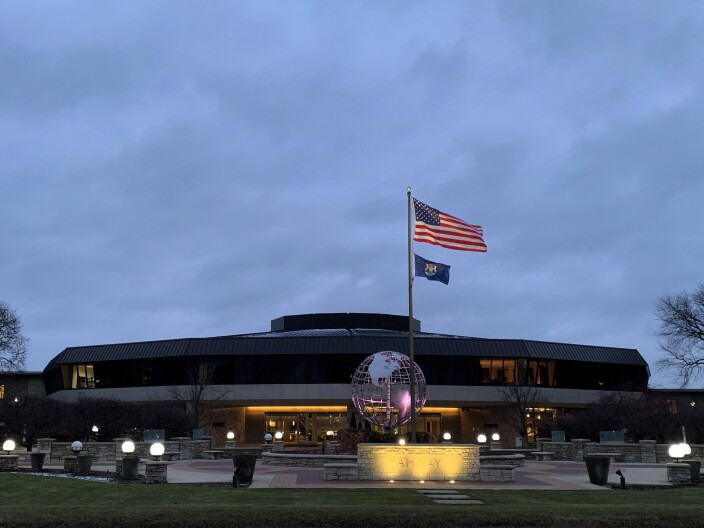
Amway's world headquarters is in Ada, Michigan, about 10 miles from Grand Rapids.(Dustin Dwyer / Michigan Radio)
Personal product giant Amway, which is headquartered near Grand Rapids, and two of its affiliates have entered into a settlement agreement with the Federal Trade Commission to resolve claims they deceived workers and instructed workers to report inflated product sales numbers.
The FTC said nearly all of the $225 million of the proposed settlement would go to people whom Amway and its affiliates allegedly misled about how much they could make buying and reselling Amway's soap and other products.
In its complaint, the FTC said workers, whom Amway refers to as "Independent Business Owners," or IBOs, were falsely told they could expect to earn substantial income, exceeding $40,000 a year, or enough income to replace their full time job and retire early, when most who joined after 2020 spent more money on Amway products and training than they received from Amway.
"Amway and its affiliates misled prospective workers with false earnings claims and then pressured them to buy Amway products they were unlikely to be able to sell," said Christopher Mufarrige, director of the FTC's Bureau of Consumer Protection.
The lawsuit also named World Wide Group and Leadership Team Development, Amway's affiliates.
In addition to the monetary fines, the settlement agreement requires Amway and affiliates to change some business practices, including requiring IBOs to sell to others at least 70% of the products they purchase from Amway each month.
In a statement, Amway said it disagrees with the FTC's characterization of its business and rejects the agency's assertion that its sales data is inaccurate. "This settlement, like all settlements, required compromise. Resolution positions us to move forward and focus our energy where it belongs: on our customers, IBOs and employees."
Michigan is launching what officials said is the nation's first public-private crop insurance program for regenerative farming.
Regenerative farming is the practice of creating healthier soil with cover crops, natural fertilizers, no-till planting, livestock grazing, and crop diversity. The goal is improving soil so it retains water and nutrients, saves money on chemical fertilizers, increases crop yields, and reduces the risk of crop losses.
Tim Boring is director of the Michigan Department of Agriculture and Rural Development.
He says gardeners who have worked over time to enrich their home garden soil understand what healthy soil looks like — it has a crumbly, almost 'chocolate cake' kind of texture and appearance. And it's the same thing for agricultural land, just on a larger scale.
"When a soil's more alive, and we have a thriving biological environment, with more organic material and microbes in the soil, it can provide a positive place for crop development and ultimately higher crop yield," he said.
Boring said the state pilot will enroll about 80 farmers in Michigan's Thumb region. Crop insurance companies will use the state's field-by-field AI analysis of existing databases, along with collecting physical soil samples throughout the year, to set a lower insurance price for the enrolled farmers, because of the lower risk of crop failure.
Boring said the state has big ambitions for the program, national as well as statewide.
"Crop insurance is highly (federally) subsidized," Boring said. "So there's a lot of taxpayer implications. It's going to be prohibitively expensive moving forward to continue our current approaches of ensuring risk and revenue protection for farmers, and addressing the pretty dire economic situations we have as farmers. So efforts like this could eventually inform a U.S. Farm Bill in the future."
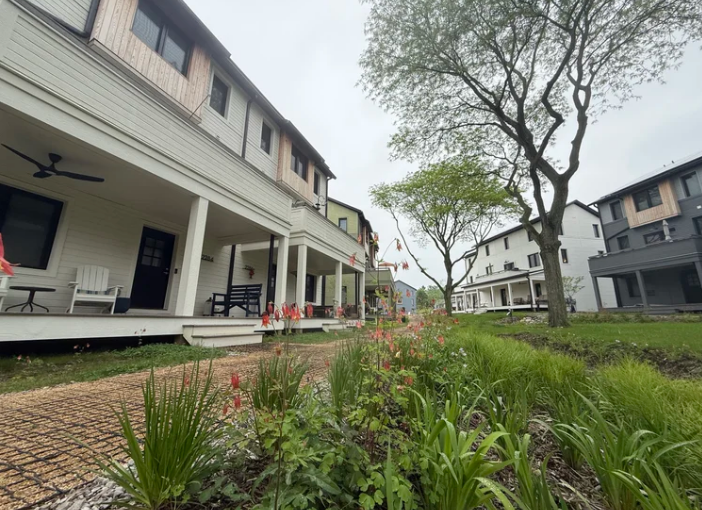
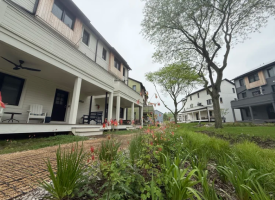
The homes in Veridian at County Farm housing community use only solar, geothermal, and home battery storage for heating and cooling. The community will be the source of DTE Energy's new pilot project to study how the utility can use locally produced excess electricity generation for the grid.( Veridian at County Farm)
The development is designed to produce at least as much energy, through renewable sources, as its residents consume.
All of the homes in the development are heated and cooled primarily with electricity from solar panels, with help from a geothermal system, which uses the ground's year-round stable temperature to help heat or cool a building as needed. The excess electricity that homeowners produce is stored in home batteries for later use when the sun is not producing enough for the home's needs.
In fact, the community could very well produce quite a bit more than its own needs. That's why it is a perfect match for DTE Energy's first Virtual Power Plant pilot project, according to Veridian founder Matt Grocoff.
Virtual power plants are systems that tap into and aggregate many small sources of locally produced electricity, like what's produced by residential solar panels, and stored in homeowners' home batteries or electric vehicle batteries. The electricity can service local needs, as well as be dispatched to serve the greater electric grid.
Large virtual power plants have the capability of replacing actual power plants like coal- or gas-burning facilities. Virtual power plants can also include off-site control of smart thermostats, so the utility can turn down participating homeowners' air conditioning a degree or two during times of peak demand.
Grocoff said homeowners at Veridian at County Farm are currently producing nearly all their electricity needs with their solar panels.
One homeowner (the one with two, rather than one, electric vehicles to charge) did have to pay DTE Energy about $2.37 recently for a month's worth of utility-produced electricity, he said. But most homeowners are taking tiny sips of DTE-produced electricity, and their bills are often just a few cents. Nearly all the homeowners also have large credits on their DTE bills for producing more electricity than they use.
"And because they can't use all of the power while the sun is shining, they store a good percentage of that power inside their batteries," Grocoff said.
It's that stored battery power that will be the focus of DTE's virtual power plant. The utility will study how homeowners store and use it, and DTE will dispatch some of the excess electricity at regular intervals.
In a statement, the company said it will "learn how assets like the batteries owned by pilot participants perform under real-world conditions."
"Pilots like this one give us the opportunity to learn how customers respond and engage with the program and gain insight into how to scale potential future residential battery offerings across our service territory," the company said.
Grocoff hopes the project will be a proof point for developers and city planning officials in Michigan and around the country that net zero housing developments, combined with virtual power plants, can reduce reliance on monopoly utilities and the fossil fuel power plants they operate. It's a more democratic, bottom-up approach, he said, that allows communities to create carbon-free electricity from the sun that strikes their own roofs, and from the ground under their own houses.
"We need to have an example of how to decarbonize the grid and make it affordable and reliable, which currently it is not — and it's going to get worse with time if we don't address this now," Grocoff said.
Oaks Correctional Facility in Manistee County( MDOC)
The Michigan Department of Civil Rights has charged the Michigan Department of Corrections with discriminating and retaliating against a Muslim inmate during Ramadan.
The charging document says in 2024, corrections officers ordered a Muslim man incarcerated at Oaks Correctional Facility in Manistee County to report to segregation, where he was strip searched, placed in a shower, and ordered to produce a urine sample for a drug test, despite the officers having no reason to suspect drug use.
The investigation found that the inmate requested additional time to produce the sample, because he was dehydrated from fasting during Ramadan, and the officers refused. According to the Civil Rights Department, officers gave the inmate one cup of water and then ordered him to drink hot water from the shower. After an hour and 8 minutes, the charging document says, officers gave the inmate a disciplinary action for allegedly refusing to submit to the drug test.
The charge says shortly afterwards, the inmate was able to comply, and the test was negative. He was placed in isolation for 10 days anyway, the Civil Rights Department said. Upon his release from the segregation cell, an internal Corrections Department investigation said the disciplinary action should not have been imposed, because it was known within the correctional facility that fasting can produce dehydration.
The Department of Civil Rights has asked that involved staff be ordered to attend non-discrimination and non-retaliation training, and that the Department of Corrections be ordered to compensate the inmate for emotional distress, financial hardship, and lost property during his period of isolation, along with other damages the Michigan Civil Rights Commission deems appropriate.
The Department of Corrections said it does not tolerate discrimination of any kind and has instituted a policy that prohibits discrimination against prisoners based on their religious beliefs or practices. The Corrections Department said it does not agree with the charges of discrimination and retaliation filed by the Michigan Department of Civil Rights.
An administrative law judge will hear the case, with the final decision made by the Michigan Civil Rights Commission.
In an unusual action — or inaction — the Michigan Public Service Commission did not issue an anticipated final decision this week on whether to allow or block Consumers Energy's proposed sale of its hydroelectric dams.
That’s after administrative law judge James Varchetti ruled in June that Consumers’ sale of its aging dams to a private equity firm is not in the public interest.
The commission’s inaction leaves the case in temporary limbo.
After the administrative law judge’s decision, Consumers Energy filed proposed modifications to the sale terms. Intervenors filed objections to those modifications, saying arguments in the case could not be renewed in that way.
Then, on Thursday — the day expected for the commission’s final order — Consumers Energy announced it was “voluntarily extending the timetable for a decision on the sale of our 13 dams for another 60 days."
"This provides time for Consumers Energy and Confluence Hydro [the proposed purchaser] to work with parties in the regulatory case to address concerns some have raised," the utility said.
Howard Learner, an attorney with the Environmental Law and Policy Center, represents a group of opponents of the sale.
He said they'll attend the negotiations, even though he believes the commission doing the wrong thing.
“There's a principle of administrative law of finality,” Learner said. “The commission should exercise its legal responsibilities to decide this case. We're going into the negotiations in good faith, but if the negotiations aren't going anywhere, it's the commission's responsibility to issue a final decision.”
In a statement, Consumers Energy said it is now focused on working with parties in the regulatory case to address concerns and reach a “collaborative solution.”
“There’s widespread support for the sale of our dams to Confluence Hydro statewide and particularly in the communities that depend on them,” the statement continued. “We’re hopeful we will now make progress toward an outcome that keeps the dams in place for another 30 years.”
The Michigan Public Service Commission declined comment on the controversy.
Editor's note: Consumers Energy is among Michigan Public's corporate sponsors.
U.S. Energy Secretary Chris Wright speaks after the signing of an oil agreement between the US and Venezuela at Miraflores presidential palace in Caracas, Venezuela, Wednesday, Sept. 2, 2026. (AP Photo/Pedro Mattey)(Pedro Mattey/AP Photo/Pedro Mattey / AP)
In a defeat for the Trump administration, a federal court on Friday ruled that the Energy Department exceeded its authority when it forced a Michigan coal-fired power plant to stay open past its scheduled retirement date last year.
Energy Secretary Chris Wright had said the 64-year-old J.H. Campbell plant was needed to ensure reliable electricity in the region and used emergency powers to keep it operating. Environmental groups and three states — Michigan, Illinois and Minnesota — went to court to try to overturn orders keeping the plant online.
The U.S. Court of Appeals for the District of Columbia Circuit sided with the states and the groups, saying there was no real emergency under the law.
The section of the Federal Power Act that allows emergency orders “is essentially a narrow, last-resort backstop," Appeals Court Judge Cornelia Pillard wrote for a unanimous three-judge panel.
By reversing the Campbell plant's “long and carefully planned retirement ... the results are disruptive," Pillard wrote. There was “no ‘emergency’ within the meaning” of the statute, she added.
The Michigan case is one of several legal disputes that have emerged across the country as the Trump administration uses emergency powers to force a half-dozen coal-fired plants from closing. The orders are raising ratepayer bills, critics say, and adding air and water pollution that could otherwise have been avoided.
Keeping the Michigan plant open cost at least $135 million in 2025 alone, officials said.
Ted Kelly, U.S. clean energy director at the Environmental Defense Fund, said the court ruling rejected the Trump administration’s nationwide effort to force “unreliable, aging coal plants that are bleeding money and polluting communities to stay online.”
The Energy Department's “unlawful actions attempted to make families and businesses in the Midwest wastefully pay hundreds of millions of dollars for a coal plant that should have been shut down over a year ago,” Kelly said Friday. The Campbell plant and other aging sites are “incredibly expensive, dangerous to our health and break down frequently,” he said.
A spokesperson for the Department of Energy issued a statement that included unsubstantiated claims.
"The Energy Department's emergency orders, including at Campbell, prevented blackouts and likely saved hundreds of lives during peak capacity events this past year. The Energy Department’s emergency orders were essential for keeping the lights on during Winter Storm Fern," the spokesperson said.
The statement continued, "At the peak of the storm, coal generation in impacted regions increased 25% compared to the same time last year. In Michigan, the J.H. Campbell Coal Plant in Michigan operated at over 650 MW every day between January 21-February 1. Rest assured, the Department of Energy will continue to protect and defend energy security for all Americans."
Michael Lenoff, an attorney with Earth Justice, one of the groups that sued the Energy Department on the issue, said the department's claims about prevented blackouts and saved lives are demonstrably false, based on data from the Midcontinent Independent Systems Operator – the regional electric grid that includes Michigan.
"At the most grid-stressed times during Winter Storm Fern, Summer 2025, and Summer 2026, MISO had unused available excess generation far exceeding the amount of power being supplied by the coal plants subject to [DOE] orders," he said.
Lenoff also disputed that keeping Campbell operational is necessary for grid reliability. In fact, it's the opposite, he said.
"Campbell’s output since the orders began on May 23, 2025, demonstrates its unreliability and the dangers to grid reliability of relying on old coal plants. For instance, on June 23, 2025, the grid’s most stressed day that summer, Campbell Unit 1 suddenly dropped offline in the middle of the day. Meanwhile, Campbell Unit 2 was already offline that day, had been offline since May 23, and has barely been able to stay online during the entire term of the 202(c) orders."
The Department of Energy did not say if it will appeal the vacating of its original order to the U.S. Supreme Court.
There is another factor that could keep the dispute from being resolved for some time. The Court of Appeals order applies only to the DOE's first order in the Campbell plant case. Subsequent orders – the most recent of which was issued less than a month ago – have renewed the directive that Consumers Energy keep the plant running. Lenoff said if the DOE does not rescind those orders, his and other groups will sue again.
In a statement, Consumers said the plant is still running while it reviews the court ruling.
"While that happens, we are continuing to comply with the current 90-day Department of Energy order that keeps the Campbell plant operating. Ultimately, we will follow the law and work to ensure that everyone who benefits from power from the Campbell plant across the Midwest pays their fair share."
Editor's note: Consumers Energy is among Michigan Public's corporate sponsors.
A volunteer joins a classroom as part of Nevada Reading Week in 2025.( <a href="https://nnss.gov/wp-content/uploads/Nevada-Reading-Week_04-1246x935.jpg" target="_blank" link-data="{"cms.site.owner":{"_ref":"00000179-84c8-d933-ad7f-f5f846b10000","_type":"ae3387cc-b875-31b7-b82d-63fd8d758c20"},"cms.content.publishDate":1773447492386,"cms.content.publishUser":{"_ref":"0000017d-95e3-dada-a9ff-fdeb3d1e0000","_type":"6aa69ae1-35be-30dc-87e9-410da9e1cdcc"},"cms.content.updateDate":1773447492386,"cms.content.updateUser":{"_ref":"0000017d-95e3-dada-a9ff-fdeb3d1e0000","_type":"6aa69ae1-35be-30dc-87e9-410da9e1cdcc"},"cms.directory.paths":[],"anchorable.showAnchor":false,"link":{"cms.directory.paths":[],"attributes":[],"linkText":"Nevada National Security Sites","target":"NEW","attachSourceUrl":false,"url":"https://nnss.gov/wp-content/uploads/Nevada-Reading-Week_04-1246x935.jpg","_id":"0000019c-e9b5-d18f-abbe-e9ff25ba0000","_type":"ff658216-e70f-39d0-b660-bdfe57a5599a"},"_id":"0000019c-e9b5-d18f-abbe-e9ff25ba0001","_type":"809caec9-30e2-3666-8b71-b32ddbffc288"}">Nevada National Security Sites</a>)
Some education advocates in Michigan urged Governor Gretchen Whitmer Thursday to decline participation in a new federal tax credit for making donations to scholarship programs.
Starting next year, people can qualify for a new tax credit, up to $1,700, if they donate to an pre-approved scholarship program for K through 12 students.
Families that are eligible to receive those scholarships must be at or below 300% of the area's median gross income.
Pamela Pugh, the president of the State Board of Education in Michigan, said the overwhelming majority of schools that have scholarship programs are private, so it's likely that's where most of the money would go.
And because the income limit for scholarship recipients is generous, private schools could be in a better position to gain students, at the expense of public schools.
Pugh said the tax credit is really a voucher program, designed to weaken public schools by transferring tax dollars to more affluent families to lower the cost of attending private schools.
"So instead of asking, 'how can public schools get a piece of a voucher money,' we should be asking, 'why aren't we fully funding the public schools that educate our children in the first place,'" she said.
The nonpartisan congressional Joint Committee on Taxation estimated the tax credit could reduce federal revenue by about $26 billion over 10 years.
The Michigan Education Association, the state's largest teachers union, also opposes opting into the program.
The group said public schools are unlikely to be able to get any of the scholarship funds, since by law, they already provide essential services at no cost.
"For public schools to see any significant revenue as a provider of eligible services under the federal voucher program, they would need to begin charging fees to students for services not mandated by state law. Doing so is incompatible with the mission, purpose, and role of public schools in our communities," the MEA said in a statement.
Governor Gretchen Whitmer said she is waiting to obtain full guidance from the U.S. Treasury before making a decision on opting in.
Republican leaders and Trump administration officials have been pushing her to join the program for months.
Republican gubernatorial candidate John James, a metro Detroit congressman, supports the tax credit.
"I want to make sure our parents have the resources they need and opting into the Education Freedom tax credit is priority one for me,” he told reporters last week.
Democratic gubernatorial candidate Jocelyn Benson, currently Michigan's secretary of state, said in a statement that she is open to any policy that gets more resources into state schools.
"But let’s be clear," the statement continues, "Donald Trump is not being transparent about where the money from this program will go or how it will improve educational outcomes. As governor, I can’t commit taxpayer dollars to a program under Trump’s control with zero transparency or assurance it will deliver for Michigan students. That’s reckless and irresponsible."
Benson's statement added she is highly skeptical of the program's design and intent.
“The Trump administration has not even released final guidance for the implementation of this program, and frankly everything we’ve seen from this administration tells us we cannot simply take them at their word when it comes to doing right by our students, parents, and teachers."
A crowd at a town hall meeting hosted by the University of Michigan listens to audience questions and a panel's answers about a proposed research computing center in Ypsilanti Township.( University of Michigan on <a href="https://www.youtube.com/watch?v=BlexIlb50Ms" target="_blank" link-data="{"cms.site.owner":{"_ref":"00000179-84c8-d933-ad7f-f5f846b10000","_type":"ae3387cc-b875-31b7-b82d-63fd8d758c20"},"cms.content.publishDate":1789022851460,"cms.content.publishUser":{"_ref":"0000017d-95e3-dada-a9ff-fdeb3d1e0000","_type":"6aa69ae1-35be-30dc-87e9-410da9e1cdcc"},"cms.content.updateDate":1789022851460,"cms.content.updateUser":{"_ref":"0000017d-95e3-dada-a9ff-fdeb3d1e0000","_type":"6aa69ae1-35be-30dc-87e9-410da9e1cdcc"},"cms.directory.paths":[],"anchorable.showAnchor":false,"link":{"cms.directory.paths":[],"attributes":[],"linkText":"YouTube","target":"NEW","attachSourceUrl":false,"url":"https://www.youtube.com/watch?v=BlexIlb50Ms","_id":"000001a0-8a12-d9db-afe3-8f973e6f0000","_type":"ff658216-e70f-39d0-b660-bdfe57a5599a"},"_id":"000001a0-8a12-d9db-afe3-8f973e6f0001","_type":"809caec9-30e2-3666-8b71-b32ddbffc288"}">YouTube</a>)
The University of Michigan said it wanted to begin a dialogue with Ypsilanti Township residents at Wednesday night's town hall meeting, to discuss its proposed "advanced research center," in partnership with Los Alamos National Laboratory.
That dialogue did not take place.
Instead, a hostile crowd cursed, harangued, and insulted the five U of M officials on the panel, which also included an official from DTE Energy, to express their anger and fear about what they say is a data center by a different name.
U of M Professor of Engineering Steven Ceccio is the project lead for the center. Through a barrage of interruptions, he attempted to explain why the university feels the facility is needed, and why the industrial site near a local Ford plant was chosen.
Ceccio said the facility would only be about 1/10 the size of the mega data center in nearby Saline Township; it would focus on research that could spur dramatic improvements in clean energy and cancer treatments. And he said the project is working on a way to cool the facility without drawing water directly from the Huron River.
Residents demanded specific details, such as how much noise the facility would make, which the panelists said they did not know yet. Audience members at the town hall said the site had Native American remains on it, that the University is destroying its reputation in the area, and that property values, water and air quality, and quality of life in nearby residential areas would plummet.
One after another, residents demanded, or begged, the university to scrap the plan.
Many accused the panelists of lying. Karen Lovejoy-Roe, an Ypsilanti Township Board member, said the university initially misrepresented the project to her and other board members. She said the university is disrespecting a historically hardscrabble, working class community.
"We don't want it here," she said. "We don't need it here. Our children, our grandchildren, we've been hurt enough."
Ypsilanti Township resident Shalina Nicohl Rankin asked Ceccio and the rest of the panel whether any of them had the authority to stop the project. She was told no — only the U of M Regents could do that.
"And you want to bring Los Alamos to our back yard, that's who you want to be in business with? You want to be part of the techno surveillance state?" she asked. "We want you to leave, and when you come back in October, bring the regents."
U of M officials allowed the meeting to be extended an extra hour, to allow those in line to express their feelings and ask questions. The university plans to hold a second townhall meeting on October 1.
Editor's note: The University of Michigan holds Michigan Public's broadcast license.
Doctor, healthcare expert and medical worker with plaster on arm of sick child after covid vaccine, help with medical emergency and consulting with patient at hospital. Girl with bandage after injury.(Nina Lawrenson/peopleimages.com - stock.adobe.com / 527959530)
Michigan's school vaccine waiver rate climbed again in the 2025 to 2026 school year.
Experts say the trend is leaving schools and the public vulnerable to preventable outbreaks of serious diseases.
Michigan schools require students to have vaccines that protect against eight serious diseases: measles, mumps, rubella, diphtheria, tetanus, whooping cough, polio, and chickenpox. But parents can get waivers, either on religious, medical, or philosophical grounds.
More and more parents are asking for those waivers.
Last year the average vaccination waiver rate was just over 7%, compared to just over 6% the year before. That rate represents students who are partially or fully unvaccinated. But in some schools, over 40% of students have vaccine waivers.
Dr. Natasha Bagdasarian, the state's chief medical executive, said in schools with very high vaccine waiver rates, measles would spread extremely rapidly among the student population.
"We as a society, we've forgotten how devastating these illness are," she said. "I just want to remind people that these diseases are not minor inconveniences. Mumps, we know, can make someone infertile for life. Measles — people can die from measles, they can end up with hearing loss from measles."
Bagdasarian said the big problem is that parents are being exposed to a surge of misinformation about vaccines on social media.
She urged parents to consult pediatricians, who have been medically trained and understand the research behind the safety and efficacy of vaccines instead.
Consumers Energy logo on its headquarters building in Jackson, Michigan.(Lester Graham / Michigan Public)
Consumers Energy filed its long-term energy plan with state regulators on Thursday.
Known as an Integrated Resource Plan (IRP), utilities in Michigan must regularly show state regulators that they can meet future demand for electricity, and also how they are going to meet that demand.
It's a crucial roadmap toward reliably meeting the state's electricity demand, in addition to working toward the state's hoped-for clean energy future.
Consumers Energy said it will need to more than double its capacity between 2028 and 2040. It says it will do that mostly with clean energy — wind, solar, and battery storage — but it will also need to build two new natural gas plants.
The plan also builds in demand for a new data center.
Anita Griffin is a vice president of commercial operations and planning at Consumers Energy.
She said the plan meets the requirements of the state's 2023 clean energy goals, while also meeting the overall increased demand for electricity.
"We support Michigan's growth, whether it's new homes, or new manufacturing, or if it's supporting data centers," Griffin said. "So we are planning for all of those scenarios, and our plan does account for data center growth."
Environmental groups say the state should make sure the gas plants — which produce carbon emissions — are necessary, and aren't built just to serve the future data center.
"There are a lot of renewable energy resources in the plan," said Katie Duckworth, a staff attorney with the Environmental Law and Policy Center, "but there's also significant amounts of new gas plants being proposed. So we will be scrutinizing the plan and how much data centers are driving that."
Editor's note: Consumers Energy is among Michigan Public's corporate sponsors.

 Login
Login