❌

Reading view

There are new articles available, click to refresh the page.

Just 1 in 4 Michigan juniors are ‘college ready,’ SAT scores indicate

Students taking a test
Students taking a test( <a href="https://education.ohio.gov/Topics/Student-Supports/English-Learners/AOEL/Instructional-Roadmap/EL-in-the-General-Education-Classroom" target="_blank" link-data="{&quot;cms.site.owner&quot;:{&quot;_ref&quot;:&quot;00000179-84c8-d933-ad7f-f5f846b10000&quot;,&quot;_type&quot;:&quot;ae3387cc-b875-31b7-b82d-63fd8d758c20&quot;},&quot;cms.content.publishDate&quot;:1738203620266,&quot;cms.content.publishUser&quot;:{&quot;_ref&quot;:&quot;0000017d-95e3-dada-a9ff-fdeb3d1e0000&quot;,&quot;_type&quot;:&quot;6aa69ae1-35be-30dc-87e9-410da9e1cdcc&quot;},&quot;cms.content.updateDate&quot;:1738203620266,&quot;cms.content.updateUser&quot;:{&quot;_ref&quot;:&quot;0000017d-95e3-dada-a9ff-fdeb3d1e0000&quot;,&quot;_type&quot;:&quot;6aa69ae1-35be-30dc-87e9-410da9e1cdcc&quot;},&quot;cms.directory.paths&quot;:[],&quot;anchorable.showAnchor&quot;:false,&quot;link&quot;:{&quot;attributes&quot;:[],&quot;cms.directory.paths&quot;:[],&quot;linkText&quot;:&quot;Ohio Department of Education &amp; Workforce&quot;,&quot;target&quot;:&quot;NEW&quot;,&quot;attachSourceUrl&quot;:false,&quot;url&quot;:&quot;https://education.ohio.gov/Topics/Student-Supports/English-Learners/AOEL/Instructional-Roadmap/EL-in-the-General-Education-Classroom&quot;,&quot;_id&quot;:&quot;00000194-b502-d957-adfe-ff5759770001&quot;,&quot;_type&quot;:&quot;ff658216-e70f-39d0-b660-bdfe57a5599a&quot;},&quot;_id&quot;:&quot;00000194-b502-d957-adfe-ff5759770000&quot;,&quot;_type&quot;:&quot;809caec9-30e2-3666-8b71-b32ddbffc288&quot;}">Ohio Department of Education &amp; Workforce</a>)

Michigan slipped once again this year in college readiness, as measured by how well high school students perform on the SAT.

According to the latest results, only a fourth of 11th graders in Michigan are college ready, a slight dip from 26.6% last year. A decade ago, it was 35%.

“It’s true that SAT scores are only one predictor of college readiness,” said Charlotte Pierce, senior policy analyst at EdTrust-Midwest, which released a report earlier this year about the need for more rigorous coursework. “However, these results align with other concerning opportunity gaps we see across Michigan schools, particularly those serving students with the greatest needs.”

The decline in college readiness comes as the state continues to struggle in other academic performance measures, including low reading scores and an absenteeism rate that remains above 27%.

Success in college is critical as Michigan strives to remain competitive. The state’s goal is that 60% of its population have a post-secondary credential by 2030. As of 2024, less than 52% had one, according to one report.

The College Board, the group behind the SAT, says a student is college ready if they score above a certain level on the math test and the reading and writing test.

Statewide, 26.5% of students met the math benchmark during the 2025-2026 school year and 52.1% met the reading and writing mark.

In interviews with Bridge, high school principals and others acknowledged the low scores, but cautioned that the SAT is only one metric to measure student success.

“A student might not score college ready, but if they’re hard workers and we’ve made them leaders and good individuals that work hard, they’re going to be ready to go off to college,” said Sarah Allen, principal at Grayling High School. “That one score doesn’t necessarily determine if they are or are not — although I understand we have to have a benchmark that we strive for.”

The College Board defines college ready as having a 75% chance of getting at least a C “in first-semester, credit-bearing college courses” in specific subjects.

For example, a student who is college ready in math by the SAT has a 75% chance of earning at least a C in algebra, statistics, precalculus or calculus, according to the College Board. “It’s important to note that college readiness is a continuum — students scoring below the SAT benchmarks can still be successful in college, especially with additional preparation and perseverance,” the College Board says on its website.

College ready or not, Michigan high school students are graduating at a record rate. The four-year graduation rate in 2025 hit 84%. Meanwhile, about 54.6% of graduates enroll in college within six months.

Emily McEvoy, director of data and assessment at the Anchor Bay School District, pointed to state data that shows that more students earn college credit within a year or four years of graduating high school than the share of students deemed college ready.

“For that reason, I would argue that college credit attainment is a stronger indicator of whether Michigan students are prepared to succeed after high school. While SAT results provide useful information about academic preparedness at a single point in time, actual college performance provides evidence of what students can accomplish in real-world postsecondary settings.”

Still, Michigan scores are trending downward.

An unexplained drop

In the last decade, Michigan students’ college readiness has dropped from 34.9% to 25.3%, according to state data. In that time, the test switched from paper to online, the pandemic deeply disrupted school and some colleges made submitting test scores optional.

It’s unclear what led to the drop in scores.

Students’ socioeconomic status has long correlated with test scores. Statewide, only 11.5% of students who are economically disadvantaged are considered college-ready compared to 36% of students who are not economically disadvantaged.

US News & World Report ranks Michigan 32nd for college readiness. Michigan is one of only a handful of states that require juniors to take the SAT. Many other states use the ACT.

As Michigan leaders wrestle with how to measure success in educating K-12 students for life after high school, other states are also making changes.

Massachusetts eliminated a high stakes test that was used to determine if a student graduates and New York is aiming to end a similar type of test and phasing in new graduation requirements. Meanwhile, Indiana is implementing new graduation standards aimed at giving students needed skills.

How high are the stakes?

The SAT, administered to juniors, is one of three components of the Michigan Merit Exam, which “provide a measure of individual performance based on Michigan’s high school content standards as well as college and career readiness.” The scores are also used in Michigan’s school accountability system.

While the majority of colleges are test-optional, some Michigan high schools are taking steps to help their students prepare for the test.

At Grayling High School, the vast majority of juniors take a test prep course for one trimester, where teachers “try to talk through the importance of the test, even if you’re not going to college” and keep students motivated to persist through the test, said Allen, the principal.

Later this month, ninth, 10th and 11th graders will take the PSAT/NMSQT, a practice test that allows the district to track students’ progress over time and gives students options to qualify for scholarships.

In Belding High School in Ionia County, juniors also take a prep course.

While the state does not require a test preparation course, high school principal and assistant superintendent Michael Ostrander said many schools offer them because it helps the school’s metrics, helps the student get into the college they want and potentially earn scholarships.

Brandy Johnson, president of the Michigan Community College Association, told Bridge that if a student isn’t ready for college but enrolls in college, they may need more support to pass their entry-level courses.

That ultimately could mean it takes longer for a student to graduate and if they drop out, “that doesn’t help us get closer to 60 by 30,” said Johnson, referring to the state’s goal of getting 60% of working age adults with a college degree or skills certificate by 2030.

Steven Snead, supervisor of curriculum and assessment at Oakland Schools, told Bridge the SAT results should be used for districts to look at curricula, coaching for teachers and “perhaps, most importantly, listen to students.”

“Big data like SAT doesn’t really answer questions for practitioners on the ground but it can be a direction pointer to say, ’hey, take a look at this over here, look at your own local data, look at your own local curricula because there might be some issues we need to address. And again, my encouragement to everybody, we all have work to do.”

If not SAT, then what?

Bob Kefgen, associate director for government relations at the Michigan Association of Secondary School Principals, said leaders should also consider how many students are close to meeting proficiency and how many students are deemed college ready in one subject rather than both.

“I think we are, as a state, not doing perfectly, but doing far better than what people think of when they see a statistic of only 25% of students are college ready when they graduate. That statistic is misleading.”

Meanwhile, the Michigan Department of Education pointed to several other stats on student achievement.

State Superintendent Glenn Maleyko “has been very clear that Michigan needs to improve student achievement on assessments, however, there are other metrics besides SAT scores that need to be considered to tell the complete story,” said MDE spokesperson Bob Wheaton.

Among them: an increase in students taking and scoring well on Advanced Placement tests, participation in dual enrollment, early middle college and career technical education programs. “These programs are producing thousands of credentialed, college-credit-earning students each year — a direct contribution to the state’s Sixty by 30 goal. When we look beyond one test score, we see a system that is providing students with multiple, meaningful opportunities to access college, careers and high-wage, high-demand occupations.”

Allen looks at pass rates for students who take Advanced Placement courses and if students who are participating in work-based learning programs are doing well. Similarly, Belding schools looks at if students are participating in dual enrollment, career and technical courses, Advanced Placement and getting internships.

“Are we giving them experiences that prepare them for life after high school?,” said assistant superintendent and high school principal Michael Ostrander. “Because college is for some, but it’s not for all. And you know, any standardized test can’t really measure communication skills. It can’t always measure problem-solving skills. It can’t measure collaboration skills. And those are things that we want students to be prepared for.”

Snead, of Oakland Schools, also sits on the board of the Michigan Assessment Consortium. He said the state has a good balance of ways to test students.

How can the state improve? He said he wants to see Michigan continue to spend on early literacy efforts and provide opportunities for high schoolers to explore science, technology, engineering and math options. He also wants investments in teachers, project-based learning for students and efforts for equitable funding.

___

This story was originally published by Bridge Michigan and distributed through a partnership with The Associated Press.


Supreme Court rejects appeal over Michigan school's ban on ‘Let’s Go Brandon’ sweatshirts

FILE - A spectator wears a Let's Go Brandon shirt in the stands during the first half of the Hula Bowl NCAA college football game, Jan. 15, 2022, in Orlando, Fla. (AP Photo/Phelan M. Ebenhack, File)
FILE - A spectator wears a Let's Go Brandon shirt in the stands during the first half of the Hula Bowl NCAA college football game, Jan. 15, 2022, in Orlando, Fla. (AP Photo/Phelan M. Ebenhack, File)(Phelan M. Ebenhack/AP Photo/Phelan M. Ebenhack / FR121174 AP)

WASHINGTON (AP) — The Supreme Court won't hear a challenge to a school district's ban on shirts with the phrase “Let’s Go Brandon,”

The phrase is a jab at former President Joe Biden with a coded reference to profanity. A Michigan mother of two says the school's ban is a First Amendment violation.

The school told her sons to take off the sweatshirts she bought them for Christmas in 2022.

Lower courts upheld the ban, finding the veiled vulgarity of the phrase allows schools to ban it. It functions as a stand-in for “F-— Joe Biden."

The woman's attorneys argued that the decision wrongly gives school officials wide latitude to squelch political speech based on their personal ideas of what is vulgar. The phrase itself doesn't contain any swear words or sexual implications, they said.

The school district urged the justices to reject the case, arguing that messages with lewd implications have no place in school, even if they touch on political topics. There has been evidence that some students wore clothing that read “Make America Great Again” or had messages supporting President Donald Trump, a Republican who lost the 2020 election to Biden, a Democrat.

The phrase originated in 2021, when people in the crowd at a NASCAR race chanted the obscenity directed at Biden and a TV sports reporter said they were calling out “Let’s Go, Brandon," apparently believing they were chanting for driver Brandon Brown, who had just won a race.

Despair over future fuels political anxiety for Michigan college students on the cusp of adulthood

William Lawrence, Democratic candidate for U.S. House of Representatives in Michigan's 7th District speaks on the campus of Michigan State University during a campaign event Tuesday, Sept. 15, 2026, in East Lansing, Mich. (AP Photo/Paul Sancya)
William Lawrence, Democratic candidate for U.S. House of Representatives in Michigan's 7th District speaks on the campus of Michigan State University during a campaign event Tuesday, Sept. 15, 2026, in East Lansing, Mich. (AP Photo/Paul Sancya)(Paul Sancya/AP Photo/Paul Sancya / AP)

Frankie Llerandi, 21, has been unable to land a single internship in his three years at Michigan State University.

He will graduate in the spring with an economics degree and an interest in data analytics, but true adulthood seems maddeningly far away. Most of his cousins have not been able to buy a house or start a family deep into their 30s.

Kira Saiti, a 19-year-old sophomore, is more upset about the broader world than her own future. Every time she looks at her phone she sees images of violence and horror, both in the Middle East and closer to home.

“It’s kind of hard to look at that and say, ‘This world is a great place,’” she said.

Julian Bautista, 20, saw his chosen profession of environmental work decimated by Trump administration cuts, pushing the junior to decide he will leave the United States to find work in the Netherlands when he graduates. He considers what remains his home country for the next 18 months to be a failure of democracy led by what he sees as corrupt politicians.

“Throughout my life, we’ve either stagnated or declined, we haven’t improved,” Bautista said.

For many of their classmates on campus and elsewhere around the country, the present looks bleak and the future uncertain at best. Their anxiety is fueling a restlessness with a national political system that they worry is no longer capable of improving their lives or no longer interested in helping.

Two years ago, grim economic vibes helped Donald Trump win a far larger share of young voters than is typical for a Republican — 47%, according to AP VoteCast, an extensive survey of the electorate. Now, anxiety about artificial intelligence and the Iran war has been added to the mix, powering a wave of disruptive candidates on the opposite end of the political spectrum who have been embraced by college students.

Llerandi, Saiti and Bautista all support a slate of progressive, antiestablishment Democratic candidates in Michigan who are pledging to shake up the status quo. Among them are Abdul El-Sayed, a former public health official running for U.S. Senate, and Will Lawrence, a liberal activist trying to unseat Tom Barrett, the Republican congressman who represents the swing district that includes the university.

The future looks bleak for many students

Anxieties about the job market, homeownership and adulthood are widespread across the campus, even among those who are not deeply involved in politics.

“It’s just something to laugh at, but, you know, I really do want a house when I’m older,” said Praveen Amunugama, a 21-year-old biochemistry major who plans to go to graduate school in hopes the job market improves over the next two years.

His friends feel the same way.

“They want to be able to afford things, raise a good family,” he said.

Despite the economic angst among young people, at first blush the picture does not look that bad for them. The unemployment rate for those age 22 to 27 is 7.2%, higher than the broader rate of 4.1% but lower than some other moments of economic calm.

A 2024 study found members of the younger generation known as Generation Z are poised to be wealthier than millennials, who themselves are wealthier than the prior generation despite the persistent sense of economic doom that accompanied their entry into the job market during the Great Recession.

Kevin Corinth, the economist who co-authored that study, said he understands Gen Z angst, given modern uncertainties, especially the prospect of AI reshaping various industries and data showing younger people are taking longer to leave home and start families.

“For previous generations, if you took certain paths you were likely to succeed, to do better than your parents,” said Corinth, who is at the American Enterprise Institute, a center-right think tank. For young people now, he acknowledged, that path is not as clear.

Kathryn Edwards, a Texas-based economist, noted that unemployment among recent college graduates is at 5.6%, higher than at most other times in recent history other than the Great Recession. Combined with historically high housing prices and rising costs for essentials such as food and healthcare, that is a challenging environment for young people.

“It's pretty bad for them,” Edwards said, adding that young people are picking up on broader warning signs in the economy. “So many aspects of our current economy, I think young people have gotten right.”

They are also fully exposed to the new form of job hunting: AI-powered, digital and done almost exclusively online, where it is hard to discern real job openings from fake ones.

“Think about the amount they get spammed and scammed, and there are tons of fake jobs out there,” said Marla McGraw, assistant dean of career management in Michigan State's business school. “They’re always coming in here going, ‘Is this real?’”

She spends a lot of time trying to buck up disenchanted students.

“Our message right now is the job market is tough, but you’re tougher,” McGraw said.

Students say political leaders are falling short

Young Americans' optimism about the job market has plummeted since 2024 and the gap between their view of the economy and those of their elders is greater than almost anywhere in the world, according to a Gallup survey earlier this year.

They are less likely to be engaged in politics and less likely to think it is important to vote, an Associated Press-NORC Center for Public Affairs Research poll found. They also are less likely to be concerned about political violence.

That dissolution of beliefs in traditional political values worries Karlee VanAntwerp.

The 21-year-old Michigan State senior is also head of the local chapter of Turning Point, the group for young conservatives whose founder, Charlie Kirk, was assassinated last year. VanAntwerp has been horrified to see Kirk's killing repeatedly, and sometimes menacingly, mocked online.

“Gen Z tends to be more extreme with their views,” VanAntwerp said. “It makes it hard to work with people of different political beliefs, because even if you're in the middle, they assume you're crazy.”

VanAntwerp sees that feeding into the despair many of her generation feel about real change ever happening.

“One administration does a bunch of stuff, another administration comes in and wipes it all out,” said VanAntwerp, who is also working for Barrett's campaign. “It feels like we always go in circles. That contributes to the political temperature being so high, because people feel nothing changes.”

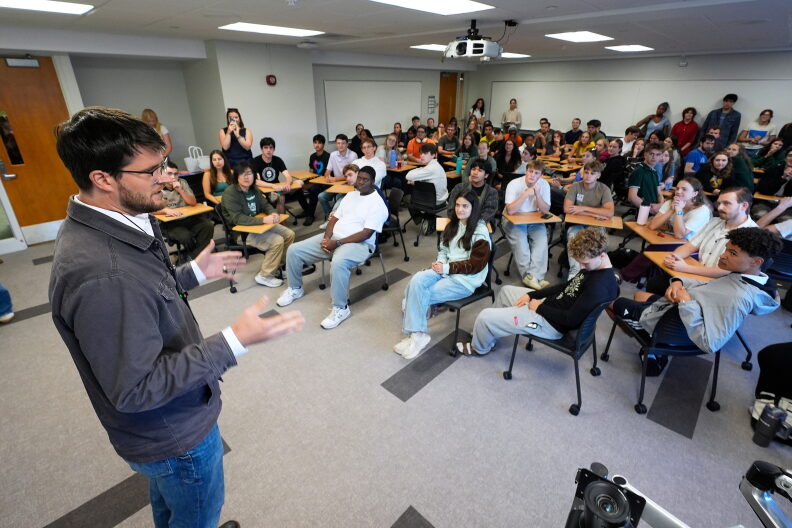
Her politics are the polar opposite of many liberal students who gathered to hear Lawrence, Barrett's Democratic challenger, talk in a classroom one recent evening, but there was a similar desire for dramatic change. Lawrence sympathized with the glum feelings of early adulthood and urged the students not to succumb to despair.

“When I was a little younger I wanted to drop out of society, and it was organizing that gave me a path in life,” Lawrence said.

After the candidate left, however, Bautista still sounded on the verge of despair. He talked about how online influencers he trusts deride Democrats such as Senate Minority Leader Chuck Schumer of New York as “mini-mes” because, Bautista contended, they are just watered-down versions of Trump.

“Our leaders are representing us less,” Bautista said. “People are desperate for big stuff.”

Homeland Security defends officers in immigrant's fatal car crash in Michigan

(Yuriy T - stock.adobe.com / 1477657534)

Federal immigration officers were about a half-mile away when a man who was illegally in the U.S. crashed a car at high speed and died in Michigan last weekend, authorities said Thursday, attempting to rebut any claim that they were in hot pursuit.

The death of Mario Coronado Juarez has angered friends and activists, and Gov. Gretchen Whitmer has directed state police to investigate the Sunday morning crash in Grand Rapids.

Juarez, a native of Guatemala, apparently was not the specific target of officers. But he was driving a car that was registered to another person who was also in the U.S. illegally and wanted back in Guatemala, the Department of Homeland Security said in a statement.

“As officers attempted the stop to confirm the identity of the driver, the driver of the vehicle fled at a high rate of speed,” DHS said. “In the interest of public safety, ICE officers immediately discontinued the enforcement action."

“A short time later, officers saw smoke nearly half a mile from the attempted stop and discovered the vehicle had crashed into a tree and caught fire,” DHS said.

The agency said officers tried to help Juarez and put out the fire before Grand Rapids first responders arrived. Juarez, who was in his 30s, died at the scene.

ICE officers have followed and arrested people believed to be targets who turn out to be someone else. But as the agency rapidly expands with the hiring of 12,000 officers, its long-held practices are getting more scrutiny.

In Evanston, Illinois, a U.S. citizen was left bloodied on the side of the road Sunday after a confrontation with immigration officers who mistook him for a fugitive, police said. Homeland Security said the man initially refused to identify himself despite “lawful commands.”

Grand Rapids Mayor David LaGrand supports a state police investigation of Juarez's death. The city police department said it had no role Sunday until called to the crash site.

“While we don’t know what Mario was thinking and feeling, we know that his death happened in the context of a national effort to create fear among our immigrant neighbors,” LaGrand said.

Juarez was supporting a wife and three children by working in construction in Grand Rapids and saving money to build a home for them in Guatemala, where they live, said Gema Lowe, an immigrant rights activist.

She led a chant of Juarez's name at a plaza outside city hall Tuesday and said he had died because of ICE's “vicious persecution of immigrant workers.”

Democratic U.S. Rep. Hillary Scholten, who represents Grand Rapids, sent a detailed letter to ICE that included a request that any video recorded by officers be preserved.

Republican Mike Rogers courts Michigan Democrats and Trump voters as GOP hopes to hold the Senate

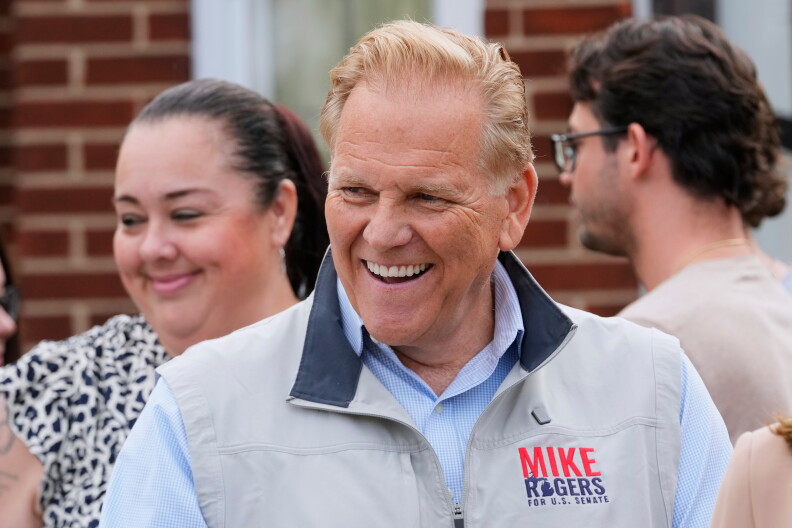
Republican nominee for U.S. Senate Mike Rogers smiles during a campaign event Thursday, Aug. 20, 2026, in Detroit. (AP Photo/Paul Sancya)
Republican nominee for U.S. Senate Mike Rogers smiles during a campaign event Thursday, Aug. 20, 2026, in Detroit. (AP Photo/Paul Sancya)(Paul Sancya/AP Photo/Paul Sancya / AP)

Mike Rogers stood outside Cody High School on Detroit’s west side on a recent drizzly morning and decried Michigan's decline in reading achievement.

“This is the civil rights issue of our lifetime,” said the Republican nominee for U.S. Senate in the open-seat race in November.

It had the look and sound of a Democratic campaign policy event, set in one of the nation’s Democratic-voting strongholds.

The contest has quickly become a focal point in the fight for Senate control, and Rogers is working to appeal to segments of Michigan's Democratic electorate. It's a key to what the former congressman sees as his path to defeating progressive Democrat Abdul El-Sayed this fall.

Rogers lost his first bid for Senate two years ago by barely 19,000 votes out of more than 5.5 million cast. This time, he is betting he can win over some Democrats and independents, particularly Black and Jewish voters who may be turned off by El-Sayed's positions, which are to the left of his party’s establishment, notably on U.S.-Israel relations. At the same time, Rogers must rally Donald Trump loyalists to turn out to vote, even though the president isn't on the ballot.

“He is threading a needle,” said Bobby Schostak, Rogers' campaign finance chairman.

Rogers is reaching into heavily Democratic Detroit

Rogers' event outside Cody was part of his promotion of a nonprofit program to boost literacy in Michigan's largest city. A few days later, he promoted a home construction plan in downtown Detroit, where many thousands of lots remain vacant almost 20 years after the Great Recession.

Rogers' campaign sees opportunity in racially and culturally diverse Wayne County, home to Detroit, where roughly three-quarters of the population is Black.

In the 2024 Senate race, then-U.S. Rep. Elissa Slotkin, a Democrat, won the county by more than a 2-to-1 margin over Rogers, or 264,000 votes. Squeezing even a couple more percentage points there in November could be enough for Rogers to win. His team is optimistic in part because in this year's Democratic primary, U.S. Rep. Haley Stevens beat El-Sayed in the county.

El-Sayed has faced resistance from some of Detroit’s older and more establishment-aligned Black Democrats, who favored Stevens' longer-standing ties to Black churches and work on the Obama administration's auto industry rescue plan.

Some local Black activists also faulted El-Sayed, who if elected would be the first Muslim senator, for supporting the “uncommitted” campaign in the 2024 Democratic presidential primary. Some Black Michigan Democrats believe the effort, aimed at pressuring the Biden administration over Gaza, cost then-Vice President Kamala Harris in her campaign as the first Black woman to be a major party presidential nominee. Trump beat Harris by 1.4 percentage points in the state.

Harris plans to campaign with El-Sayed in Michigan on Tuesday, and the Congressional Black Caucus has endorsed El-Sayed.

Democratic leaders have dismissed Rogers' efforts at inroads.

"I don’t think anyone’s buying it,” the state party chair, Curtis Hertel, said of Rogers' efforts to court Black voters in Detroit. “I don’t think (Rogers) has a connection in those communities, I think he’s going to have a hard time.”

Some Jewish Democrats are siding with Rogers

Rogers has also leaned into the defections by some Democratic Jewish voters, an influential group particularly in Oakland County, Michigan's second most-populous county.

A day after the August primary, a prominent Democrat, Detroit-area business leader Brian Hermelin, called Schostak, Rogers' campaign finance chairman, asking how he could help. Within 10 days, Rogers was headlining a fundraiser hosted by the Hermelin family and attended by about 130 people, mostly Democrats, Schostak said.

El-Sayed opposes U.S. military aid to Israel and has called the U.S. ally's military campaign in Gaza a "genocide,” an accusation rejected by the Israeli and U.S. governments. The former public health official also has angered some Jewish Democrats with statements he made after the March attack on Temple Israel, Michigan’s largest Jewish congregation.

El-Sayed's suggestion that “hurt people hurt people” was interpreted by some as justification for the attack. El-Sayed later apologized for his response, but the remark helped push some influential Jewish Democrats toward Rogers.

Oakland County commercial real estate broker Benji Rosenzweig, who is Jewish and tends to vote for Democrats, plans to vote for the Republican.

“As a Jew, my family doesn't feel safe with Abdul El-Sayed,” Rosenzweig said.

Michigan is a potential Republican firewall

The seat is open because Democrat Gary Peters is not seeking reelection. If Rogers wins, Republicans would retain their Senate majority even if Democrats pick up as many as four GOP-held seats in November.

Ad spending reflects the stakes. More money has been spent in Michigan — almost $125 million since the Aug. 4 primary — than in any other state where Republicans have a chance at gaining a seat, according to the advertising-tracking firm AdImpact. That is spending by El-Sayed, Rogers and allied groups.

The race has jumped to the top of the Trump political team's priority list.

No Going Back, a new entity linked to Trump's MAGA Inc. super PAC, early this month spent $18.5 million to air ads and reserve advertising time in Michigan, the most the group has committed to any 2026 Senate race so far, according to AdImpact.

The ads show the split-screen tack Rogers and his allies are taking in reaching out to atypical Republican voters while working to inspire the Trump base.

Rogers' campaign organization is airing ads, many of them with him direct to camera, promoting him as the son of a middle-class family, a collaborator during his time in Congress and interested in bringing down costs, notably for healthcare.

The super PACs supporting his candidacy are swinging the hammer. For instance, the super PAC associated with GOP Senate leadership is airing ads noting El-Sayed's past association with left-wing streamer Hasan Piker and the candidate's support for abolishing U.S. Immigration and Customs Enforcement.

Rogers has walked a fine line on Trump

The division of messaging reflects that Rogers' team is wary of Trump's low approval, especially on handling the economy, and wants to be seen among the broad swath of Michigan voters as not beholden to the president.

As he says in one ad, “Michigan comes first.”

Yet he has shifted closer to Trump.

After the 2020 election, Rogers was unequivocal that Democrat Joe Biden defeated Trump for the White House, and Rogers he criticized Trump's unfounded claims of widespread fraud. But in July, after Trump's primetime address recycling the disproven claims, Rogers praised Trump's “commitment to transparency."

He has not shied away from the rhetoric that appeals to Trump's supporters, but delivers it in a less edgy tone.

Speaking to the Republican midterm convention in Dallas on the 25th anniversary of the Sept. 11, 2001, attacks, Rogers referenced “radical Islamic terrorism.” He also said El-Sayed had “chosen Hasan Piker as his running mate."

Piker, who in 2019 said the U.S. “deserved 9/11,” had hosted El-Sayed on his livestream and later campaigned with him at rallies during the primary. El-Sayed has since disavowed Piker’s controversial statements and ended plans for joint campaigning, but has not categorically repudiated him nor apologized for appearing with him.

Not once during Rogers' convention speech did he mention Trump, as so many speakers did over the two-night event.

Instead, Rogers closed by echoing a quote attributed to Michigan native Todd Beamer, among the passengers aboard United Flight 93 before its crash in Pennsylvania on Sept. 11.

Jabbing a finger toward the audience, Rogers said, “America, let's roll."

F-16 crashes during training in Northern Michigan; pilot ejects safely

A U.S. Air Force F-16 Fighting Falcon, assigned to Ohio National Guard’s 180th Fighter Wing, flies over the flightline before landing at Joint Base Elmendorf-Richardson, Alaska, during U.S. Northern Command Exercise ARCTIC EDGE 2022, March 14, 2022. AE22 is a biennial homeland defense exercise to provide high quality and effective joint training in austere cold weather conditions. (U.S. Air National Guard photo by Staff Sgt. Kregg York)
A U.S. Air Force F-16 Fighting Falcon, assigned to Ohio National Guard’s 180th Fighter Wing, flies over the flightline before landing at Joint Base Elmendorf-Richardson, Alaska, during U.S. Northern Command Exercise ARCTIC EDGE 2022, March 14, 2022. AE22 is a biennial homeland defense exercise to provide high quality and effective joint training in austere cold weather conditions. (U.S. Air National Guard photo by Staff Sgt. Kregg York)(Staff Sgt. Kregg York/Arctic Edge 2022 / Digital)

DETROIT (AP) — An F-16 fighter jet from Texas crashed in rural Michigan during a routine training exercise on Thursday, and the pilot ejected safely, a military spokesman said.

Local authorities ordered people within one mile of the crash site in Grand Traverse County to evacuate.

Sgt. Derek Gutierrez, a public affairs specialist with the 149th Fighter Wing, said the pilot was receiving medical treatment at a local hospital. Gutierrez declined to release details about the pilot’s identity or any injuries, citing military policy.

Michigan State Police said no other injuries were reported.

The plane was participating in training exercises at a National Guard base in Alpena, about 190 miles (305 kilometers) north of Detroit.

Witnesses reported hearing a loud crash, and images posted to social media showed a dark plume of smoke in the air.

Grand Traverse County Emergency Management posted on social media telling people to "evacuate away from the intersection of Co Rd 633 and Jefferson Pl."

"Follow instructions from emergency personnel," the post continued.

Michigan State Police said the evacuation was because of "a hazardous chemical spill related to the plane crash."

Wendy Sobeck said she and her husband heard a “very loud crash” down the road, minutes from their rural home.

“We thought there was a car accident outside our house. We saw big billowing black smoke. We couldn’t tell what it was, so my husband got into his pickup truck and saw what happened,” Sobeck said. “You could see the plane debris in the field. Explosions kept happening.”

Fred Sobeck, 65, said he drove down the road and saw a “big fireball in the field” near a house and a camper, which were not hit.

“Police told me to get out of there because of explosions,” he said.

Local authorities set up a shelter at Kensington Church on Secor Road, about 5 miles from Traverse City. "If you have evacuated and need a place to go, Kensington Church and the American Red Cross are there to assist residents," the local emergency management agency said.

The jet was one of several F-16 aircraft from Joint Base San Antonio-Lackland, Texas, taking part in the Michigan training exercises, Gutierrez said.

The military began flying the first F-16s in 1979. There have been at least 14 “Class A mishaps” involving F-16s since 2000, according to the Air Force Safety Center. The Class A mishap designation is generally used when the damage totals more than $2 million, when an aircraft is destroyed or when a service member is killed.

In December, an F-16C Fighting Falcon with the Air Force’s elite Thunderbirds demonstration squadron crashed in the Southern California desert, and the pilot in that crash was also able to eject safely.

NCAA admits replay errors, reiterates it can't change result of Western Michigan-Michigan game

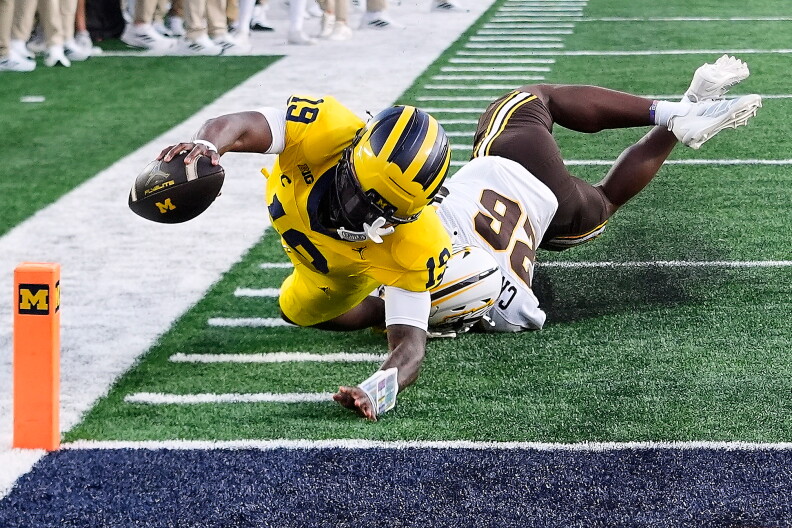
Michigan Wolverines football player dives toward the end zone with the ball as a defender tackles him near the orange pylon.
Michigan quarterback Bryce Underwood (19) reaches but is short of the goal line pylon as Western Michigan safety Kouri Crump (26) makes the tackle the during the first half of an NCAA college football game Saturday, Sept. 5, 2026, in Ann Arbor, Mich.(Paul Sancya / AP)

INDIANAPOLIS (AP) — Western Michigan and its conference have insisted Michigan should not have been given an extra second in its dramatic win over the Broncos two weeks ago.

The NCAA agrees, but said it can't do anything about it.

The NCAA Football Bowl Subdivision Oversight Committee announced Wednesday that proper replay protocols weren't followed in Michigan's Hail Mary win, altering the outcome of the game.

The committee also reiterated what the NCAA said last week: It doesn't have the authority to overturn the result.

“The committee consulted with national officiating leadership regarding the instant replay protocols,” the committee said in a statement.

“Based on that information, the committee agreed that the instant replay protocols were not followed in the contest’s second-to-last play,” the statement continued. “Had the protocols been followed, the outcome of the game would have been different.”

Michigan, now ranked No. 19, won the September 5 game 13-12 on a Hail Mary pass after the replay official had put 1 second back on the clock when Wolverines quarterback Bryce Underwood’s first try was incomplete.

The Mid-American Conference initially accepted the Big Ten's explanation of what happened at the end of the game, but joined Western Michigan in asking for the result to be overturned.

A few hours later, the NCAA said the result would stand, noting its playing rules do not have a protocol for overturning the outcome of a game and the oversight committee does not have the authority to do so, which it confirmed again on Wednesday.

“The playing rules governing the result of a contest are clear: once the referee declares a contest to be final, no appeal of the outcome is permitted, according to (rules),” the committee said.

Abbott agrees to settlement over closure of largest baby formula plant in the US

FILE - A sign at an Abbott Laboratories campus facility is displayed, April 28, 2016, in Lake Forest, Ill. (AP Photo/Nam Y. Huh, File)
FILE - A sign at an Abbott Laboratories campus facility is displayed, April 28, 2016, in Lake Forest, Ill. (AP Photo/Nam Y. Huh, File)(Nam Y. Huh/AP Photo/Nam Y. Huh / AP)

Abbott Laboratories will pay $385 million to resolve claims tied to an investigation of contamination at a baby formula factory in Sturgis, Michigan, the largest in the country, which led to the supply shortages in 2022.

Problems at the facility prompted a lawsuit by the Justice Department and recall of powdered infant formula at the facility.

The recall covered several infant formula brands, including Similac, and squeezed inventory that had already been strained by supply chain disruptions and stockpiling during COVID-19 shutdowns.

The settlement, which Abbott says does not represent any finding of fault or liability, also pertains to lawsuits filed by certain relators and the Attorneys General of several states.

Abbott said on Monday that tests by government regulators of unopened product from the homes of the infants under investigation at the time of the 2022 recall were negative for Cronobacter sakazakii, a bacterium that can cause illness in infants. The company also said that no unopened, distributed Abbott infant formulas have ever tested positive for Cronobacter sakazakii.

The Justice Department under President Donald Trump closed its criminal investigation into the matter.

The Biden administration eased import rules for foreign manufacturers, airlifted formula from Europe and invoked federal emergency rules to prioritize U.S. production during the supply shortage.

Abbott closed the Sturgis facility in February 2022 after the Food and Drug Administration began an investigation. The plant was reopened by June of that year.

Federal court rejects Trump order keeping Michigan coal plant open

U.S. Energy Secretary Chris Wright speaks after the signing of an oil agreement between the US and Venezuela at Miraflores presidential palace in Caracas, Venezuela, Wednesday, Sept. 2, 2026. (AP Photo/Pedro Mattey)
U.S. Energy Secretary Chris Wright speaks after the signing of an oil agreement between the US and Venezuela at Miraflores presidential palace in Caracas, Venezuela, Wednesday, Sept. 2, 2026. (AP Photo/Pedro Mattey)(Pedro Mattey/AP Photo/Pedro Mattey / AP)

In a defeat for the Trump administration, a federal court on Friday ruled that the Energy Department exceeded its authority when it forced a Michigan coal-fired power plant to stay open past its scheduled retirement date last year.

Energy Secretary Chris Wright had said the 64-year-old J.H. Campbell plant was needed to ensure reliable electricity in the region and used emergency powers to keep it operating. Environmental groups and three states — Michigan, Illinois and Minnesota — went to court to try to overturn orders keeping the plant online.

The U.S. Court of Appeals for the District of Columbia Circuit sided with the states and the groups, saying there was no real emergency under the law.

The section of the Federal Power Act that allows emergency orders “is essentially a narrow, last-resort backstop," Appeals Court Judge Cornelia Pillard wrote for a unanimous three-judge panel.

By reversing the Campbell plant's “long and carefully planned retirement ... the results are disruptive," Pillard wrote. There was “no ‘emergency’ within the meaning” of the statute, she added.

The Michigan case is one of several legal disputes that have emerged across the country as the Trump administration uses emergency powers to force a half-dozen coal-fired plants from closing. The orders are raising ratepayer bills, critics say, and adding air and water pollution that could otherwise have been avoided.

Keeping the Michigan plant open cost at least $135 million in 2025 alone, officials said.

Ted Kelly, U.S. clean energy director at the Environmental Defense Fund, said the court ruling rejected the Trump administration’s nationwide effort to force “unreliable, aging coal plants that are bleeding money and polluting communities to stay online.”

The Energy Department's “unlawful actions attempted to make families and businesses in the Midwest wastefully pay hundreds of millions of dollars for a coal plant that should have been shut down over a year ago,” Kelly said Friday. The Campbell plant and other aging sites are “incredibly expensive, dangerous to our health and break down frequently,” he said.

A spokesperson for the Department of Energy issued a statement that included unsubstantiated claims.

"The Energy Department's emergency orders, including at Campbell, prevented blackouts and likely saved hundreds of lives during peak capacity events this past year. The Energy Department’s emergency orders were essential for keeping the lights on during Winter Storm Fern," the spokesperson said.

The statement continued, "At the peak of the storm, coal generation in impacted regions increased 25% compared to the same time last year. In Michigan, the J.H. Campbell Coal Plant in Michigan operated at over 650 MW every day between January 21-February 1. Rest assured, the Department of Energy will continue to protect and defend energy security for all Americans."

Michael Lenoff, an attorney with Earth Justice, one of the groups that sued the Energy Department on the issue, said the department's claims about prevented blackouts and saved lives are demonstrably false, based on data from the Midcontinent Independent Systems Operator – the regional electric grid that includes Michigan.

"At the most grid-stressed times during Winter Storm Fern, Summer 2025, and Summer 2026, MISO had unused available excess generation far exceeding the amount of power being supplied by the coal plants subject to [DOE] orders," he said.

Lenoff also disputed that keeping Campbell operational is necessary for grid reliability. In fact, it's the opposite, he said.

"Campbell’s output since the orders began on May 23, 2025, demonstrates its unreliability and the dangers to grid reliability of relying on old coal plants. For instance, on June 23, 2025, the grid’s most stressed day that summer, Campbell Unit 1 suddenly dropped offline in the middle of the day. Meanwhile, Campbell Unit 2 was already offline that day, had been offline since May 23, and has barely been able to stay online during the entire term of the 202(c) orders."

The Department of Energy did not say if it will appeal the vacating of its original order to the U.S. Supreme Court.

There is another factor that could keep the dispute from being resolved for some time. The Court of Appeals order applies only to the DOE's first order in the Campbell plant case. Subsequent orders – the most recent of which was issued less than a month ago – have renewed the directive that Consumers Energy keep the plant running. Lenoff said if the DOE does not rescind those orders, his and other groups will sue again.

In a statement, Consumers said the plant is still running while it reviews the court ruling.

"While that happens, we are continuing to comply with the current 90-day Department of Energy order that keeps the Campbell plant operating. Ultimately, we will follow the law and work to ensure that everyone who benefits from power from the Campbell plant across the Midwest pays their fair share."

Editor's note: Consumers Energy is among Michigan Public's corporate sponsors.

Unless a buyer steps up, the Toledo Blade to print last edition at the end of the year

A delivery van for the Toledo Blade, a nearly 200-year-old paper in Northwest Ohio, is parked in a lot.
A delivery van for the Toledo Blade, a nearly 200-year-old paper in Northwest Ohio, is parked in a lot. (Mbrickn / Wikimedia Commons)

The Toledo Blade will print its final edition at the end of the year, unless a buyer steps in before then, according to an email sent by the nearly 200-year-old paper’s current owners to its staff on September 8.

Block Communications, which has held The Blade since 1925, reached the “extremely difficult decision” due to financial considerations, president and chief operating officer Jodi Miehls informed staff, as reported by the paper.

“The Block Family’s continued investment to keep the Blade open is no longer an option,” Miehls wrote. “The financial losses the Blade has endured for years are simply not sustainable.”

Miehls’ notice came after negotiations over a contract late last month.

The NewsGuild, which represents Blade’s staff, said that its Toledo chapter voted down a proposed contract in a 46-25 vote.

“The Company’s proposal would have axed seniority, halved severance for its most experienced employees, and allowed the outsourcing of all Guild work,” said Lillian King, Blade features writer and Toledo NewsGuild bargaining chair. “All content at The Blade could be created or edited with Al, with no protections for journalists or requirements to disclose Al usage to its readers.”

Instead of returning to the bargaining table last week, the NewsGuild said that the Block Communications board decided to sell or shutter the paper.

Block Communications similarly cited financial losses when it announced in January that it would cease publishing another newspaper, The Pittsburgh Post-Gazette. But about two weeks before it was to shut down in May, Block announced that the nonprofit Venetoulis Institute for Local Journalism would buy the newspaper and keep it open.

A team of reporters from The Blade won the Pulitzer Prize in investigative reporting in 2004 for articles about an elite Army platoon accused of killing unarmed Vietnamese civilians in 1967. Reporters at the newspaper also were finalists for the prestigious journalism award in 2000, again for investigative reporting, and in 2006 in the public service category.

Among the newspaper’s alums was Mildred Wirt Benson, better known to legions of Nancy Drew fans as Carolyn Keene, the original author of the mystery books featuring the plucky amateur detective.

Detroit area reporter Larry Vellequette grew up in Toledo and came of age working at The Blade. He joined April Baer on Stateside to talk about what place the paper occupied in metro Toledo and in journalism throughout the years.

"For decades, the blade was this shining, little outperforming newspaper in a small Midwestern city," Vellequette said. "From a pay standpoint, it's pay rivaled that of you know, the the Cleveland Plain Dealer, much larger paper, Chicago. In this little town. It was a very wonderful place to work and, and especially to, to start a career."

The Blade was founded in 1835 — two years before Toledo was officially incorporated as a city — and says it is the city’s oldest continually operating business. Paul Block Sr., a newspaper mogul, took over the paper in August 1926.

An advertisement printed the day after Block was introduced to the newspaper staff said the date “will long be remembered by us as the beginning of a new era of good will in our association with the Toledo Blade,” along with a list of all of the newspaper’s employees, according to the paper.

“Block Communications Board of Directors and the Block Family are truly disappointed to have reached this point,” Miehls said in Tuesday’s email, just over a hundred years later. “Unfortunately, the realities facing local journalism have left us in this situation.”

Vellequette believes that if The Blade ceases production, it will be a loss for the city and for journalism.

"I think that Toledo, like so many cities, it suffers without a newspaper," he said. "Because you don't have somebody covering the local townships, for example, like we used to. You don't have somebody, you barely have somebody covering City hall. [...] These decisions that are so, so influential and impactful upon our lives are happening now in the dark because newspapers across the country, which traditionally covered these boards and local boards and local politicians have disappeared because people decided that if it was on their phone and it was free, why should I pay for it? [...] It is a tragedy beyond tragedy."

This story was originally published on September 8, and was updated to include an interview with journalist Larry Vellequette that aired on Stateside on September 17.

NCAA says it can't overturn Michigan's Hail Mary win over Western Michigan

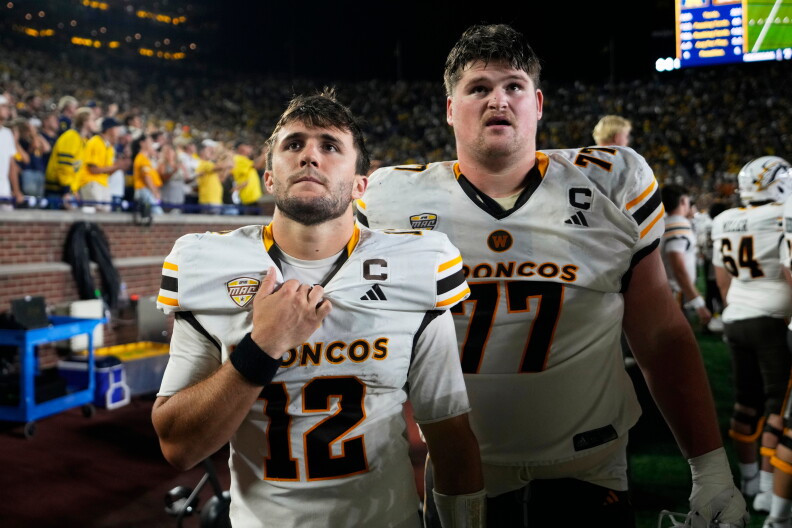
Western Michigan quarterback Broc Lowry (12) and Hunter Whitenack (77) watch from the bench at the end of the second half of an NCAA college football game against the Michigan Saturday, Sept. 5, 2026, in Ann Arbor, Mich. (AP Photo/Paul Sancya)
Western Michigan quarterback Broc Lowry (12) and Hunter Whitenack (77) watch from the bench at the end of the second half of an NCAA college football game against the Michigan Saturday, Sept. 5, 2026, in Ann Arbor, Mich. (AP Photo/Paul Sancya)(Paul Sancya/AP Photo/Paul Sancya / AP)

KALAMAZOO, Mich. (AP) — After review, the Mid-American Conference wants Western Michigan recognized as having defeated Michigan after all.

The MAC cited what it believes to be an “extraordinary” circumstance in appealing the outcome of the Michigan-Western Michigan game and asked NCAA and College Football Playoff administrators on Tuesday to recognize the Broncos as the winner instead of the Wolverines. The CFP's bracket selection choices in December carry significant financial benefits to teams that make the playoff.

The NCAA said the result will stand, noting its playing rules do not have a protocol for overturning the outcome of a game and the Division I Football Bowl Subdivision Oversight Committee does not have the authority to do so. According to the NCAA Football Rules Book, the team with the most points at the end of the game is the winner and the score is final when the referee declares the game has ended.

“No rule decision may be changed after the ball is next legally snapped, legally free-kicked or the second or fourth periods have ended,” the rule book says.

Michigan won 13-12 on a Hail Mary pass Saturday night after the replay official had put one second back on the clock when Bryce Underwood’s first try was incomplete.

An NBC replay showed a clock expiring before the ball hit the ground or any player, and Terry McCaulay — the rules analyst on the broadcast — said that was a synced version of the stadium clock.

The Big Ten said later that the call was correct and published a recording of the replay as it was reviewed by officials. The conference said it too used a shot of the game clock in the stadium, which showed 1 second remaining when the ball was touched by WMU’s Micah Davis. Since Davis had just been out of bounds, the clock would stop on such contact.

The Big Ten on Tuesday stood by its postgame statement and declined further comment. Michigan spokesman David Ablauf had no comment on the appeal other than, “The Big Ten handles all replay reviews and discussion. We don’t have any involvement in replay as an institution.”

The CFP did not respond to a request seeking comment.

The controversy was the talk of college football on the long holiday weekend with many questions surrounding how the officiating crew decided to put the second back on the clock and give Michigan one more try at the win. The MAC initially accepted the Big Ten explanation, but that had changed by Tuesday.

In a letter to the FBS Oversight Committee, MAC Commissioner Jon Steinbrecher said “established protocol” in this situation is that the television truck is contacted with a request to insert the in-stadium game clock onto “the program feed” — and that is supposed be the sole source of the replay decision.

“Had the prescribed protocol been followed and the program-feed clock been used, no additional time would have been restored, no additional play would have been awarded and Western Michigan would have won the game 12–7,” Steinbrecher wrote.

Game results are rarely, if ever, changed after the fact unless the NCAA throws out or vacates results because of rules infractions, though there are countless examples of decisions by officiating crews affecting the outcome (Colorado beating Missouri on a fifth down in 1990 is familiar to many).

Western Michigan was voted the preseason favorite in the MAC, and that would suggest that the possibility certainly exists for it to factor into the CFP rankings. The highest-ranked team from the Group of Six leagues gets an automatic bid to the playoff. Michigan was ranked No. 16 in the preseason AP Top 25 poll but dropped out of the rankings Tuesday.

“I recognize that the oversight committee does not ordinarily alter results recorded on the field,” Steinbrecher said. "Nevertheless, the circumstances of this game are extraordinary. ... Western Michigan should not be disadvantaged because the prescribed replay protocol was not followed and an unsynchronized clock was used to award a play that, under the applicable procedure, should not have occurred.”

Veteran coaches surprised that stadium clock was not official clock in wild Michigan win Saturday

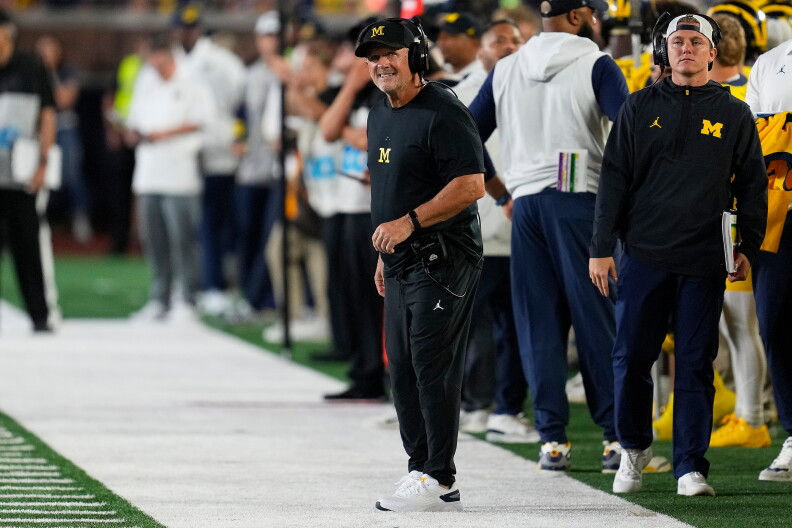
Michigan head coach Kyle Whittingham watches against Western Michigan during the first half of an NCAA college football game Saturday, Sept. 5, 2026, in Ann Arbor, Mich. (AP Photo/Paul Sancya)
Michigan head coach Kyle Whittingham watches against Western Michigan during the first half of an NCAA college football game Saturday, Sept. 5, 2026, in Ann Arbor, Mich. (AP Photo/Paul Sancya)(Paul Sancya/AP Photo/Paul Sancya / AP)

Longtime coach Kyle Whittingham was unaware the stadium clock he watched Saturday night at Michigan might not reflect the official game time. Purdue coach Barry Odom also was caught off guard as he watched on television more than 250 miles away.

The two Big Ten coaches acknowledged Monday they did not know there could be a discrepancy between what everyone was seeing on television and inside the stadium and the conference's tracking system.

But that's how conference officials explained the dramatic finish in Whittingham's debut for No. 16 Michigan. After time appeared to expire with Western Michigan leading 12-7, the refs added 1 more second and the Wolverines capitalized on their second chance with J.J. Buchanan hauling in Bryce Underwood's desperation heave for a 47-yard touchdown and a stunning 13-12 victory.

"Well, I guess they have this Hawkeye system? I was unaware of that,” Whittingham said Monday. “But as I looked, I knew it was close. When the ball sailed back to the end zone, I glanced up at the clock, and it was just ticking to zero, and somebody touched it. I didn’t know who had touched it, but apparently, it was a defender that had already established an out-of-bounds position. I’m assuming they got it right. They looked at it, and the technology they have is very advanced, I guess.”

It was a learning experience for both longtime coaches, who are relatively new to the Big Ten.

The 66-year-old Whittingham joined Utah's staff in 1994 and stayed through last season, coming out of a brief retirement to take the Michigan job. He won a school record 177 games including 11 bowl games as the Utes head coach from 2005-25.

The 49-year-old Odom returned to his alma mater, Missouri, as an assistant coach in 2003 and spent a total of 14 seasons on the Tigers staff, the last four as their head coach. His tenure at Missouri was split by a short stint at Memphis, from 2012-14, and following his firing as the Tigers head coach in 2019, he went to Arkansas for three seasons before returning to the head coaching ranks at UNLV in 2023 and moving to Purdue in 2025.

The Boilermakers (1-0) beat Indiana State 44-19 on Friday night to snap a 10-game losing streak.

“I didn’t until Saturday night,” Odom said at his weekly news conference when asked if he was aware a second clock, not visible inside the stadium, kept the official game time.

The Big Ten issued a statement two hours after the game, clarifying the process that was used and citing the rule that was enforced about when the clock stops if a player touches the ball out of bounds.

“It was determined (Western Michigan safety Micah Davis) started his jump from an established out-of-bounds position (left foot) and made contact with the ball with 1 second remaining on the clock,” the conference said. “A side-by-side view of the play and the game clock, using a direct shot of the game clock in the stadium, was used to determine the final ruling.”

Based on that explanation, Whittingham and Odom believe the refs got it right.

Mid-American Conference Commissioner Jon Steinbrecher and Western Michigan President Russ Kavalhuna also told ESPN on Sunday night they accepted the explanation though Kavalhuna believes more transparency is needed. The Broncos (0-1) play in the MAC.

“If you look at what they saw, then you reach the conclusion they reached,” Kavalhuna said. “However, if you look at what the broadcasters broadcast, you reach a different conclusion. I think it would be good to ask ourselves, can we sync those up so that the viewers could see what the officials would be looking at?”

The ACC even allows television viewers to hear the discussion between the game officials and the replay center before reaching a conclusion.

But it wasn't just fans who were confused.

“I believe those charged with orchestrating, administering and officiating the game, they have to make decisions based on all the information they get, and then it’s their job to communicate that to us. I would assume that’s what happened in Ann Arbor," Odom said. “Like the other night, we were exiting the field for halftime and the official stopped me and said, ‘Hey, we’ve got to make sure that that last play there...' They wanted to make sure everything lined up the way it did. So it’s never over till it’s over. Until they blow the whistle or whatever that indicator is.”

Whittingham now believes the matter is closed as he moves on from the season-opening win and focuses on hosting No. 10 Oklahoma in one of this week's featured games.

“I think everyone’s fairly satisfied with the explanation. I am, and I think Western Michigan came out with a statement that, ‘Hey, we’re not going to question this anymore,’” he said. "They gave us a fairly transparent answer, and we’ll move forward.”

___

AP Sports Writer Larry Lage contributed to this report.

Michigan politicians spent Monday shaking hands with voters, a day after an armed man charged at an Ohio candidate

Democratic candidate Abdul El-Sayed on Labor Day, September 7, 2026.
Democratic candidate Abdul El-Sayed on Labor Day, September 7, 2026.(Steve Carmody / Michigan Public)

Candidates on the ballot in November’s general election marched with union members at Detroit’s Labor Day parade on Monday. 

A day before, the an armed man charged toward the Democratic candidate for Ohio governor at a campaign event at a local fair.   

The Ohio State Highway Patrol says an armed assailant charged toward the Democratic candidate for Ohio governor, Amy Acton, during a campaign stop at the Canfield Fair, injuring several people before he was stopped by troopers.

The highway patrol said in a statement that a man it identified as Patrick Havas forced his way through a crowd, knocking over multiple members of the audience as he moved toward Acton, the state’s former public health director.

The Mahoning County Sheriff’s Office said two handguns and a set of brass knuckles were recovered after his arrest, and “no weapons were ever brandished or even removed from their holsters.”

Havas was taken to the county jail and booked on charges of disorderly conduct and two counts of assault, the highway patrol statement said.

Acton is facing Republican Vivek Ramaswamy, who called Sunday's incident unacceptable.

“Candidates should be able to meet with voters without having to worry about threats or violence. What happened today is completely unacceptable and has no place in politics,” Ramaswamy’s communications director, Connie Luck, said in a statement.

Jocelyn Benson is the Democrat running for Michigan governor. Benson is running against Republican John James in the November election to replace outgoing Governor Gretchen Whitmer.

Benson spent part of Monday at the annual Labor Day parade in Detroit, surrounded by thousands of union members.

Benson expressed concern about how political rhetoric may be fueling political violence.

“It is a sobering reminder the consequence of the hateful rhetoric that often times even the President himself spews,” said Benson. “In this moment we all have to recognize the importance of seeing each other as humans and civility, keeping people safe.”

Abdul El-Sayed also spent part of Monday shaking hands and taking pictures with supporters along the parade route. The Democratic Party’s U.S. Senate nominee is facing Republican Mike Rogers in the November general election to fill Michigan's open U.S. Senate seat.

El-Sayed calls this a “dangerous moment.”

“Everyone has the collective responsibility to bring some of that temperature down,” said El-Sayed. “Politics and democracy are supposed to be the way by which we resolve our differences peaceably.”

Democratic U.S. Representative Debbie Dingell is a veteran of many political campaigns.

She said this weekend’s violence in Ohio will not deter her from meeting with voters. 

“I’m out so people know they can come and talk to me,” Dingell said, amid a throng of union members.

Dingell pointed out President Trump personally attacked her in a Truth Social post over the weekend, in which he referred to her as “Debbie Dingbat.”

“She says nothing but bad about your favorite President, ME! Every time I see that Third Rate Loser ripping me, I’m amazed, because I’m a loyal person, I don’t do things like that but, that’s OK — It’s Politics. However, it shouldn’t be that way! President DONALD J. TRUMP,” read the Truth Social post.

The country has seen a rise in political violence over the past decade.

Federal political committees spent more than $40 million on expenses labeled as security during the 2023-24 campaign cycle, the most recent one for which data are publicly available, according to a report released in April from the Public Service Alliance, a nonpartisan group that focuses on security for public officials.

Michigan among states mailing ballots this month as litigation over Trump order creates uncertainty

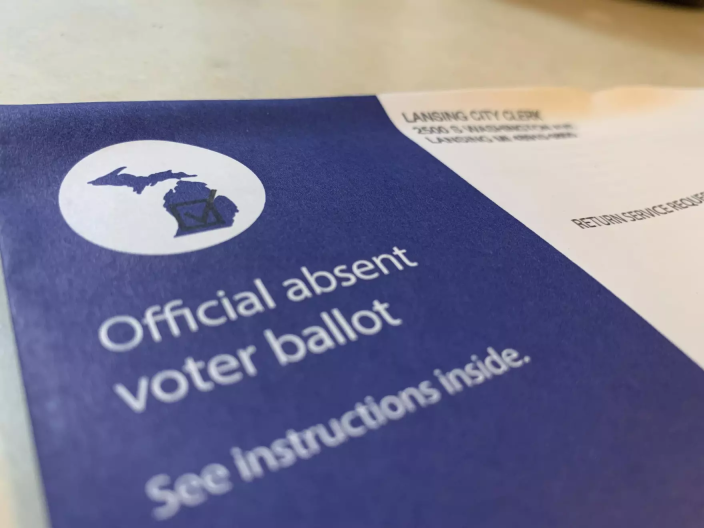
An absent voter ballot from the Lansing city clerk.
An absent voter ballot from the Lansing city clerk.(Karel Vega / WKAR-MSU)

Statewide mail voting for this year’s midterm elections kicked off Friday amid a churning legal battle over President Donald Trump’s attempts to limit the practice and mounting concern over Postal Service changes that some state officials blame for a rise in rejected ballots.

The developments have created a sense of uncertainty about a popular voting method used by one-third of the nation’s voters.

North Carolina on Friday became the first state to widely distribute mail ballots for this year’s elections, which will determine the balance of power in Congress for the remainder of Trump’s term.

Election officials said that while they are closely monitoring the litigation, ballots will be mailed out as expected and the state is prepared to administer a secure election even if the new limits go forward.

“We believe that we are well positioned,” Sam Hayes, executive director of the State Board of Elections, told reporters during a news conference in Raleigh on Thursday.

Trump frequently castigates mail voting and has falsely blamed it for his 2020 loss to Democrat Joe Biden, which he sought to overturn. Though he has repeatedly voted by mail himself, the president is pushing to curtail access for others.

In March, Trump signed an executive order seeking to limit mail balloting. States would have to submit lists of eligible voters to the Postal Service through an online portal that apparently is still inactive. Ballot envelopes also would have to comply with new Postal Service rules and include barcodes.

Trump's directive has been held up by multiple lawsuits. One in which Michigan is a plaintiff led to a preliminary injunction Friday against its implementation — a decision the administration quickly appealed.

Election offices move forward, try to combat voter confusion

Election officials warn that headlines about the executive order and court fights have already confused some voters.

“The biggest part of this is that it has sparked questions about what it is. ‘What does this mean? What are you guys doing? Can I not vote by mail anymore?’” said Michael Dickerson, director of the Mecklenburg County Board of Elections.

“I just want people to be assured that, yes, you can still vote by mail,” he said, adding “it’s a safe and secure process.”

While the issue has ping-ponged around the courts, election workers in North Carolina had been working hard to get ready for the Friday deadline, officials there said in interviews.

Wake County elections employees have been processing absentee request forms, which come in daily online and in paper form, said Olivia McCall, the county's director of elections. They've also been coding ballots, running pre-election accuracy testing and packaging absentee packets that include a ballot, instructions and photo ID fliers, she said.

About 5,000 ballots will go out during Wake County's first wave, she said.

The turnaround time for ballots being returned could be quick, too, noted Dickerson, especially for military and overseas voters who can vote through an online portal.

“I guarantee you” votes will begin rolling in that way by Saturday, he said.

‘Business as usual,' North Carolina election official says

North Carolina Attorney General Jeff Jackson is among Democratic state officials who have aligned in one of the lawsuits challenging Trump's executive order and the changes proposed by the Postal Service.

In a recent court filing, a representative of the office argued it was “far too late in the election cycle to introduce such dramatic changes” and warned that implementing them would “imminently cause significant harm, confusion and disruption in North Carolina election administration.”

The League of Women Voters of North Carolina is issuing its standard advice to voters, while urging them not to wait until the last minute to return their mail ballot.

Officials with the State Board of Elections, which is led by a Republican majority, have projected confidence for a midterm cycle that is expected to see robust turnout, especially with a competitive U.S. Senate race on the ballot.

“It is business as usual, as far as I'm concerned,” Hayes, the board's executive director, said during the news conference.

The board has confirmed it has taken some initial steps to comply with the executive order, including submitting its envelopes to USPS for review. Hayes said they were approved. The state opted against submitting its voter information while the legal proceedings are pending.

A whistleblower told Congress this week that with the voter portal, the Postal Service is rushing an untested product that is likely to be riddled with errors that could lead to millions of mail ballots being rejected. On Friday, Postmaster General David Steiner issued a statement saying the agency's standards are not being compromised and he stands behind “the rigor of our process.”

He also sought to address the growing concerns about the agency's ability to deliver ballots and return them on time.

“Regardless of political party or perspective, we share a common goal: ensuring that Americans can have confidence that their election mail will be handled securely and delivered reliably should their election officials choose to use the mail for ballot delivery,” he said.

USPS operational changes blamed for spike in rejected mail ballots

Election officials elsewhere are warning voters to avoid delays in returning mail ballots, but not for reasons related to Trump's attempts to alter the rules.

They are pointing to a change in how the Postal Service processes mail —- with postmarks stamped at distant processing centers rather than local post offices — as a reason for what they say has been a spike in mail ballot rejections. In many states, mail ballots arriving several days after an election can still be counted as long as they are postmarked by the final day of voting.

In California, nearly 150,000 voters had their mail-in ballots rejected in the state's June primary, mostly because they were postmarked too late. Wisconsin officials wrote to the Postal Service after hundreds of ballots arrived too late to be counted during elections in April, which has prompted at least some of the state's 1,850 municipal clerks to start sending mail ballots to voters earlier than usual.

In Washington, where voting is done almost entirely by mail, state officials issued a report this week saying the number of mail ballots rejected in the August primary because of a late postmark was 32% higher than the primary two years earlier.

“Why are we disenfranchising Americans when we've had one of the best systems in the United States?” Democratic Sen. Maria Cantwell said during a news conference in her home state to promote the report.

The Postal Service has addressed the issue on its website, saying it is not changing its postmarking practices but acknowledging that “adjustments to our transportation operations” mean that postmark dates might not match the day mail was picked up by a letter carrier or dropped off at a post office. The agency said voters can request a manual postmark at a local post office.

More states are preparing to deliver mail ballots to their voters

Other states will soon follow North Carolina in kicking off their mail ballot process throughout September, including Alabama on September 9 and Michigan on September 19. By the middle of the month, all states are required to send ballots to military and overseas voters.

David Becker, executive director of the Center for Election Innovation and Research and a former Department of Justice lawyer, said the time to implement any major election changes for this year's midterms “has long since passed.”

The group has filed legal papers supporting states in the fight against the new postal rules.

“That’s true even if they were good changes, which the mail EO definitely is not," Becker said. “The first ballots being mailed only confirms this fact.”

Don Millis, a Republican who also chairs the Wisconsin Election Commission, said it was not surprising that some local clerks had already started sending out mail ballots earlier than they normally would. The fear is that if the Supreme Court gives a green light to Trump's executive order, it would tilt the election into chaos.

“There’s a fundamental concern this thing is not going to work,” he said.

___

Associated Press writers Nicholas Riccardi in Denver and Tom Verdin in Sacramento, California, and video journalist Allen Breed in Raleigh, North Carolina, contributed to this report.

Trump administration halted Great Lakes invasive species project. Then Whitmer called Trump.

Michigan Gov. Gretchen Whitmer speaks at the Detroit Auto Show, Wednesday, Jan. 15, 2025, in Detroit. (AP Photo/Jose Juarez)
Michigan Gov. Gretchen Whitmer speaks at the Detroit Auto Show, Wednesday, Jan. 15, 2025, in Detroit. (AP Photo/Jose Juarez)(Jose Juarez/AP / FR171038 AP)

WASHINGTON (AP) — An unexplained Trump administration hold on construction of a state-federal project aimed at preventing invasive carp from reaching the Great Lakes was abruptly lifted this week, hours after a call to President Donald Trump by Michigan Gov. Gretchen Whitmer.

The Army Corps had halted work without explanation on the Brandon Road Interbasin Project near Joliet, Illinois, in July, leaving officials in Illinois and Michigan struggling for answers about the pause even as environmental officials warned that invasive carp were being found alarmingly close to Lake Michigan.

Then Whitmer, a Democrat, called Trump.

The Wednesday phone call was a surprising intervention by the Democratic governor, who has developed an unusual relationship with a president who was once one of her fiercest political foes. Hours after the call, the stop-work order was lifted.

The episode underscores not only the unusual cross-party relationship Whitmer has cultivated with Trump, but also the top-down and relationship-driven nature of his administration — where direct phone calls and displays of deference to the president remain the best way to get things done.

“Governor Whitmer spoke with President Trump today to ask him to direct the U.S. Army Corps of Engineers to lift the stop-work order,” Bobby Leddy, a spokesperson for Whitmer, said in a statement. “The governor underscored the urgency of the moment, noting that invasive carp were recently found just 80 miles from Lake Michigan — farther up the Illinois River than ever recorded.”

Whitmer's office said that Wednesday they had been notified that work on the project could resume. The White House referred questions to the Army Corps of Engineers, which did not immediately respond to a request for comment.

A pivotal project in flux under Trump

Illinois, Michigan and the U.S. Army Corps of Engineers have spent years planning a gantlet of technologies in the Des Plaines River near Joliet to keep invasive carp from reaching Lake Michigan. The project has repeatedly faced uncertainty under Trump, despite his public support for it and hundreds of millions of dollars in federal funding approved under President Joe Biden.

In March, Whitmer pressed Trump to release federal funding for Brandon Road. Trump soon posted on Truth Social that he was “working with Governor Gretchen Whitmer” to protect the Great Lakes from invasive carp, and the Army Corps released funding for the project’s next phase the following month. The administration then issued another stop-work order in July, saying the project was undergoing an administrative review but offering little explanation.

“It’s time for the Trump Administration to uphold the federal government’s obligations, stop playing political games, and move this project forward,” Illinois Gov. JB Pritzker said in a July 30 statement.

The urgency increased in August, when the Illinois Department of Natural Resources detected hundreds of juvenile invasive carp about 80 miles from Lake Michigan, the first time carp of that size had been found that far upstream since monitoring began in 2010.

Whitmer's unique relationship with Trump

Whitmer, who is term-limited and set to leave office in January, has operated more freely with Trump during his second term after the two sparred repeatedly during his first. She has traveled to the White House to meet with him and welcomed him to Michigan, drawing criticism at times from fellow Democrats for her willingness to work with the Republican president.

Yet even after Michigan officials received word that the stop-work order had been lifted, officials in Illinois — where the project is located — had not been notified of the decision, raising questions about whether the project could remain in flux.

In stark contrast to Whitmer, Pritzker has emerged as one of Trump's most outspoken critics among the nation's governors as he considers mounting a bid for the 2028 Democratic nomination to replace him.

“Despite the Brandon Road Interbasin Project being in Illinois, the state has received no new communication from the Trump administration,” Matt Hill, spokesperson for Pritzker, wrote in a statement. “You would expect if the administration really cared about protecting the Great Lakes they would notify Illinois.”

___

Associated Press reporter Will Weissert contributed to this report.

Michigan school districts offer insurance-free care to beat rising health costs

(xixinxing - stock.adobe.com / 55856603)

Three Michigan school districts are betting that a specialized clinic may be the antidote to surging health care costs.

The medical care here at the Corunna Plum Health clinic — inside a collection of converted high school classrooms on the district’s main campus — is free.

The 13 patients scheduled on a recent day handed over no copays and no deductibles for physician assistant Shelley Littleton to tend to a range of maladies — from poison ivy to pink eye and from high blood pressure and high anxiety.

They also left with nearly $550 worth of medications — also free.

What’s more, each had a visit scheduled for at least a half-hour long.

“What I love about it more than anything else is the ability to be seen and have a lengthy conversation,” said John Fattal, superintendent of Corunna Public Schools, northeast of Lansing.

“This is health care the way it’s supposed to be,” he said.

Corunna and two neighboring school districts — Lansing and Van Buren, are part of a consortium that offers health care through Plum Health, a Detroit-based provider of “direct primary care.”

It’s a growing category of health services that bypass traditional insurance in favor of a direct financial transaction between the patient — or in this case the patient’s employer — and the health provider.

Just more than two years ago, Corunna began paying $90 each month for each of its 255 employees to use a two-day-a-week primary care clinic, established to serve its employees and their families.

The districts are charged for deeply discounted medications provided by the clinic — meaning patients have no out-of-pocket prescription drug costs.

It’s a gamble.

The districts expect this type of easy-access, free primary care will help employees and their families reduce trips to the emergency rooms, where costs can easily top $1,000, or urgent care visits that cost hundreds of dollars.

About 110 of the district’s staff carry insurance through the Michigan Education Special Services Association. Like most conventional benefit packages, it covers emergency and urgent care and hospitalization.

But how many ER visits could be avoided, Fattal reasons, if parents knew they could see their doctor first thing in the morning?

One family with strep throat running through it makes a middle-of-the-night ER run, costing the districts’ insurance pool hundreds, if not thousands, of dollars, That cost of that single virus — the ER care, the lab draws and the medications — can trounce more in a single night than a year’s worth of direct primary care fees.

Those crises, repeated throughout the year among hundreds of employees and their families, in turn, drive up the school’s overall health care expenses year after year.

District employees who don’t have that insurance, such as part-time food service workers or paraprofessionals, may have insurance through spouses, from the individual market, or none at all, Fattal said.

But the cost to see Littleton is the same, no matter their insurance status.

No insurance? No problem.

In its most basic form, direct primary care works outside of insurance.

It’s an alluring possibility as insurance grows increasingly out of reach. Nearly 131,000 Michiganders dropped insurance on the federal marketplace this year, and more than 80,000 beneficiaries have disappeared from the state’s safety net since January as Medicaid continues to shrink, according to the latest state data.

The pressure is on, too, for Michigan business and for workers with job-related health coverage.

Health care costs for the nation’s employers are expected to approach double-digit increases next year, according to projections this month by Chicago-based insurance broker Aon. On average, employer costs will rise 9.5% — to more than $19,000 per employee, next year — driven in large part by high-priced drugs and increased use of the medical system, Aon estimates.

On average, workers’ health care costs will jump nearly 8% on average, to $5,297, the broker projected.

Direct primary care doctors say they sidestep those budget-bulging surges, as well as the paperwork complications associated with insurance.

In doing so, they can deliver more personal, more complete care, said Dr. Philip Eskew, a direct primary care physician based in South Carolina.

“You get to spend time with the patient rather than screaming into your medical record to make it happy so that you can bill whatever code you need to bill,” he said.

Eskew’s website, dpcfrontier.com, maps direct primary care providers.

There’s no way to know precisely how many direct primary care doctors there are, since most of them work outside of insurance — a metric for much of the nation’s health care research.

But the numbers are certainly increasing, Eskew said.

Without extra administrative personnel to handle insurance billing, clinics can keep their costs down, too, said Eskew.

At the Detroit and Royal Oak Plum Health sites, patients pay $95 a month to have round-the-clock access to family medicine care.

The monthly fee gives patients access to the clinics — often the same day they call. In contrast, doctors in their insurer’s network might not have an appointment opening for more than a week, said Dr. Paul Thomas, founder of Plum Health.

That’s because the nation’s primary care doctors often are said to have about 2,500 patients on average — a number that some have argued is unrealistically high. In comparison, direct primary care doctors serve just more than 400 patients, according to a 2024 survey of direct primary care doctors by the American Academy of Family Physicians.

At Corunna recently, each of the day’s appointments was scheduled for at least a half hour. Two new patients were scheduled for 60 minutes.

One patient had called at 8 a.m. that day, scheduled the appointment for an hour later. By 9:27, he was on his way out of the clinic and onto work, medication in hand.

In a state short of educators, the districts now can offer easier-access, no-cost medical care to their employees. In the case of Corunna, the clinic is located on the school district’s main campus.

“We see this as a recruitment and retention tool,” Fattal said. Erika Eiseler had stopped by with her daughter, Leigha, 8, for a school physical. The office manager at Corunna’s Elsa Meyer Elementary School and her family are insured by Eiseler’s husband, a manager of an HVAC company.

Here, their access is convenient, not rushed, and free from the $40 copay for a doctor’s visit through the family’s insurance policy, Eiseler said, as Leigha read the letters from an eye chart on the wall.

Eiseler figures the family had at least eight doctors’ appointments last year for the normal seasonal illness that so many families face. “And then there were medications about half the time, so … what? Eight times last year? So you have eight times $40, plus the medicine?” Eiseler said.

Plum buys medications in bulk, charging the schools a 15% markup that’s charged to the school, Thomas said.

Even then, “we’re talking pennies a pill,” Thomas said, from his Detroit office.

The care in these cement block rooms, where a decades-old classroom pencil sharpener still hangs on the walk, costs the family nothing, Eisler said.

“We’re literally putting money back into their pockets,” Fattal said of the district’s employees.

The math doesn’t work

Littleton, the physician assistant who sees patients at the Corunna clinic, doesn’t have regular health coverage herself, although she carries a rider policy to cover “catastrophic” health care costs if necessary.

She did the math, she said. It didn’t add up.

A mammogram each year? Free at certain clinics.

Her OB-GYN appointment each year? $300.

Colonoscopy every third year? $2,000 or so.

At 56 years old, she’d pay $650 a month for insurance, she said. Worse, the $10,000 out-of-pocket max meant she’d probably never see any real benefit from it.

Littleton says she represents “middle-of-the-road” Michiganders — not poor enough to qualify for free health care, but also not wealthy enough to afford it.

“I really understand the insurance runaround because I am the poster child,” she said.

Helping or hurting the larger picture?

The American Academy of Family Physicians and American Medical Association and other medical groups support the ability of physicians to work in direct primary care. Some have argued that expanding direct primary care could expand access in underserved areas.

Earlier this year, the Michigan State Medical Society, which represents doctors of a range of medical specialties, called on the state to build up its primary care network — a “cornerstone” of the larger health care delivery system, it said.

Nearly 1 in 3 Michigan residents lack primary care access, while the state directs about 5% of total health care dollars to primary care, even though experts say 12–15% is necessary for a robust primary care system, according to the report.

Still, there are arguably downsides to increased use of direct primary care: Those physicians take on much smaller patient loads, arguably stretching the number of primary care providers in the state even thinner. In other words, with each doctor that moves to direct primary care, he or she sheds hundreds of patients who then are left to find another doctor.

Plum Health founder Thomas — whose time offering street medicine grounded his belief in more affordable health care — looks at it this way: With few patients and a better work-life balance, today’s primary care doctors won’t burn out early and tomorrow’s doctors will choose primary care as their specialty.

It’s a shift that would take years, but also would transform medicine in a way that saves both costs and lives, Thomas said.

And more immediately? “It’s working out for insured people because they don’t get dinged with (cost-sharing for) those ER and the urgent care visits,” Thomas said.

And for the uninsured, he said, “they have something where they had nothing before.”

This story was originally published by Bridge Michigan and distributed through a partnership with The Associated Press.

❌