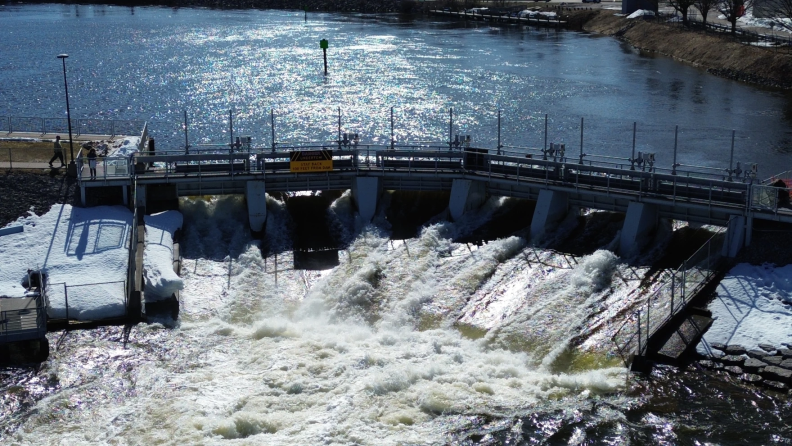
Crews continue to work around the clock to try and save the Cheboygan Dam and Lock complex as water levels continue to rise during severe weather in April 2026.( Michigan Department of Natural Resources)
The Michigan Senate on Thursday voted to overhaul Michigan’s lax dam safety laws, moving long-awaited reforms one vote away from reaching Gov. Gretchen Whitmer.
Both legislative chambers have now approved versions of two companion bills sponsored by Sen. Mallory McMorrow, D-Royal Oak, and Rep. Bill G. Schuette, R-Midland, to strengthen flood control standards, increase inspections and require owners to prove they can maintain the structures.
Because Thursday’s Senate vote included substitute language for one of those bills – House Bill 5485 – it must return to the House for concurrence before reaching Whitmer’s desk.
Schuette said he expects quick approval in the House, which last week passed McMorrow’s Senate Bill 947.
The votes represent a breakthrough in a long-stalled effort to strengthen Michigan’s dam safety standards, which are among the nation’s weakest.
Reforms were first proposed after dam failures in mid-Michigan caused more than $200 million in damages. They languished until this spring, when flooding caused another round of costly dam failures and near-failures.
“While we can’t undo what happened across our region in 2020, we can and should prioritize a better way forward,” Schuette told Bridge Michigan on Thursday.
He called the legislation “a huge win for communities and families across our state who have homes and livelihoods near high-hazard dams.”
Michigan is home to some of the nation’s oldest dams, averaging about 80 years old.
A Bridge Michigan investigation in June found more than 100,000 state residents live in the path of a potential flood from a high or significant-hazard dam, which could kill people or inflict widespread damage if they fail.
Many of those dams are in poor or unsatisfactory condition, while hundreds do not meet the national standard for flood control.
Across much of the nation, high-hazard dams must be capable of passing 100% of the so-called probable maximum flood, or the worst-case-scenario flood in the surrounding area.
Michigan’s standards are less than half as stringent.
“With inaction … other dams will fail. It’s just a matter of when,” Denver-based dam safety expert John France told Bridge at the time.
Thursday’s votes are the latest in a flurry of activity to shore up Michigan dams in recent months. Lawmakers in July allocated millions toward shoring up problem dams and boosting staffing in the Michigan Department of Environment, Great Lakes and Energy dam safety unit.
The funding, in part, was meant to alleviate concerns that higher dam safety standards would trigger costly infrastructure upgrades that communities couldn’t afford.
The Porcupine Mountains Wilderness State Park encompasses 60 thousand acres. Much of that is old growth forest. (Lester Graham / Michigan Public)
Opponents are going to court in hopes of blocking a controversial $50 million grant Michigan awarded in August to fund construction of a Canadian company’s copper mine in the western Upper Peninsula.
The money was approved by the Michigan Strategic Fund after several failed attempts by economic developers and regional lawmakers to subsidize the Copperwood Mine project with taxpayer money.
Supporters have said the mine will boost the local economy over its 11-year lifespan. Critics point to the site’s proximity to Lake Superior, the North Country Trail and Porcupine Mountain State Park.
The filing made Monday in Ingham County Circuit Court by the grassroots Protect the Porkies questions oversight of the public funding, with the $50 million coming from the also-controversial Strategic Outreach and Attraction Reserve (SOAR) fund.
The large-scale development fund has been defunded by lawmakers, who lost interest after the high-dollar spending yielded limited job growth and local backlash.
The money for the Copperwood award was authorized by lawmakers for an unnamed company in 2022. Other SOAR votes were promised to go through a public approval before lawmakers after the strategic fund vote.
But with the Copperwood award, the Michigan Economic Development Corp. said the funds went unused, making them available for the mine funding. State officials say the earlier appropriation means that the award faces no further approval by legislators.
That decision demands accountability, Tom Grotewohl, executive director of Protect the Porkies, told Bridge Michigan.
“Regardless of how one feels about the proposed Copperwood Mine, all should acknowledge the (strategic fund board) has set an extraordinarily dangerous precedent for future handouts of public money to foreign companies beyond the purview of elected lawmakers,” Grotewohl said.
MEDC spokesperson Danielle Emerson said the department had no comment on the filing.
Copperwood is planned by Highland Copper, which approached the state for the subsidy in 2023. It recently pegged construction costs at $450 million and has said 380 people will be hired at an average wage of $80,000.
In early 2024, the strategic fund board tabled a vote on a $50 million after members raised questions about whether Highland Copper had enough money or any other investors to see the project through.
After learning that the state would be the first investor, the board came back two months later with guardrails on the funding. Still, the request never made it through a state Senate appropriations committee vote.
Two attempts to add $50 million to state budget earmarks also did not reach the final budget.
The funding approved in August authorized about $45 million to Highland Copper to be used for reimbursements on construction and site improvement.
Another $5 million was awarded to the Gogebic County Road Commission to fund some of the road updates the project requires in Wakefield Township.
Several UP lawmakers spoke at the strategic fund board meeting in support of the funding.
Marty Fittante, CEO of InvestUP, an economic development group, described the project as “the most important economic opportunity” for the entire Upper Peninsula.
But a few dozen opponents also spoke ahead of the vote. They included representatives from statewide environmental groups. Several tribes retain rights to use the land around Copperwood, and many signed a letter sent to the state in 2025 against the project.
“Indigenous people have seen this pattern before: decisions about our lands and waters are made somewhere else, the economic benefits are promised to others, and our communities are expected to live with the consequences,” said Anahkwet “Guy” Reiter of the Menominee Nation.
Barry O’Shea, CEO of Highland Copper, described the state grant as foundational toward attracting financing and capital toward construction and mine operation.
He said he’s hoping for a $250 million loan from the Export-import Bank of the United States and federal grants to help cover the remainder.
“You truly can’t understate the importance of this to our company,” O’Shea said after approval on an investor-focused video.
The state grant is “a key first step as we think about the broader project financing,” he added. “It gives us incredible strength as we go into those next steps.”
The Attorney General’s office also has been asked to review the funding, a spokesman has told Bridge. No update was available on Tuesday.
___
This story was originally published by Bridge Michigan and distributed through a partnership with The Associated Press.
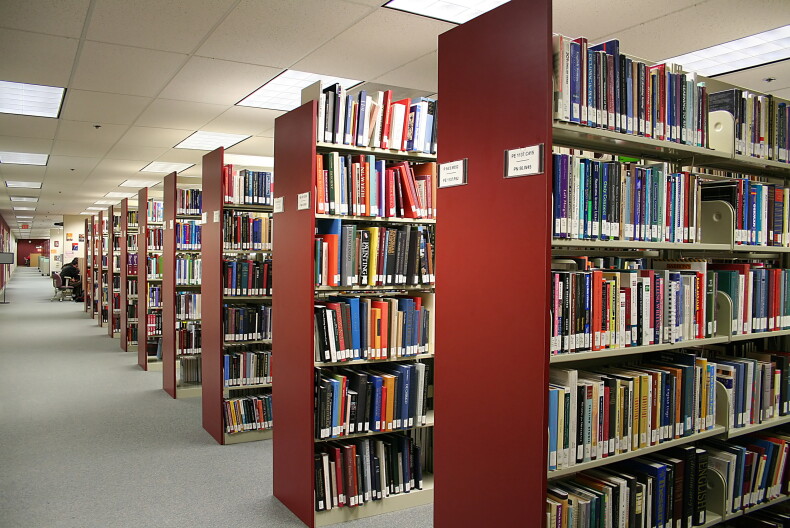
A photo inside a library(Stephen Coburn/Stephen Coburn - stock.adobe.com / 459667)
Michigan third grade reading scores continued to slide in the state’s most recent standardized tests this year, even as schools begin to implement reading reforms.
Just 38.2% of third grade students in Michigan are proficient in English Language Arts, down from 38.9% the previous year, according to results released Friday from the Michigan Student Test of Educational Progress, commonly known as the M-STEP. Students took the tests in spring 2026. It’s the lowest third graders have scored in the 12-year history of the exam.
The news comes after leaders have tried for a decade to improve reading scores with literacy coaches, optional teacher training and a short-lived law to retain struggling third graders.
Meanwhile, fourth through seventh grade reading scores are also down from the previous year. Just 44% of students grades 3-8 are proficient in reading, according to a Chalkbeat analysis of M-STEP and PSAT 8/9 tests.
“We need to improve the results of all these assessments for our students moving forward,” said State Superintendent Glenn Maleyko. “Michigan proficiency rates are not where we want them to be. We must increase proficiency rates in all subjects and areas, and in all grades. And we must do this over time, showing steady improvement in all areas.”
It’s the first M-STEP release since Maleyko took the helm of the Michigan Department of Education last December. The tests measure if students are able to achieve skills outlined in state standards.
Only 35.5% of students grades 3-8 are proficient in math.
Many proficiency rates moved less than one percentage point, which MDE acknowledged in a news release.
“Most proficiency rates are essentially flat when compared to 2025 results on the tests, with the rates on all except four of 20 tests staying within 2 percentage points of the numbers in 2025 and most staying within a percentage point,” the department said.
Other takeaways include:
1. Math proficiency is up in third and sixth grade compared with last year, down in fifth grade and flat in fourth and seventh grade.
2. Fifth grade science and social studies proficiency is down.
3. Eighth graders improved their proficiency in social studies but results dropped in science.
4. In the 11th grade, science and social studies proficiency is up but performance is down in reading and math.
What to know about key districts in the state:
5. Detroit Public Schools Community District, the state’s largest district, saw gains in reading and math. In third grade, 14.1% of students are proficient in reading, up from 12.9% the previous year. In math, 20.1% are proficient, up from 15.7%.
6. In Grand Rapids, third grade reading made a slight gain from 19.6% third grade reading proficiency to 20.1%. Math increased from 19.6% to 23.5%.
7. Lansing School District saw gains in reading proficiency in third, fourth, fifth and sixth grades. But proficiency declined in seventh and eighth grades.
MDE also shared information on what it is doing to improve student proficiency.
It plans to release the “Michigan Mathematics Framework” this fall that will include “a shared vision for mathematics learning; evidence-based curriculum, instruction, and assessment; and coordinated systems for mathematics,” according to a news release. MDE is also creating a committee focused on science, technology, engineering and math, commonly known as STEM.
State focus on literacy but results down
These are the last state test scores that will come out before term-limited Gov. Gretchen Whitmer leaves office. She has said literacy is her number one priority in her final year.
Voters will decide whether Democratic Secretary of State Jocelyn Benson or Republican US Rep. John James will be the next governor.
Maleyko emphasized that laws aimed at improving literacy are not fully in effect yet. He said the Legislature, governor, State Board of Education and educators needed to work together to improve outcomes.
Among those changes is a requirement that school districts use “evidence-based” reading instruction and screen students for characteristics of dyslexia by the 2027-2028 school year.
If a district uses a literacy curriculum not from a state-vetted list and fails to inform parents, the district loses its state funding. But MDE does not have a mechanism where districts report what curriculum they use.
While department officials emphasize the need to improve literacy, they caution that state test scores are only one way to measure student achievement.
Delsa Chapman, a deputy superintendent at MDE, told Bridge that “if a student is not proficient or partially proficient, that does not mean that the student cannot read.
“On that one test in time, their demonstration of mastering the standards is determined through a proficiency rating. But that absolutely, again, does not state or say that the student cannot read or cannot do mathematics.”
Who gets tested in Michigan
Third through seventh graders in public schools throughout the state take the English language arts and math test.
Fifth grade students also take a science and social studies test. Eighth grade students take the PSAT 8/9 test for English language arts and math and the M-STEP for science and social studies.
Ninth graders take the PSAT 8/9 while 10th graders take the PSAT 10.
In 11th grade, students take the SAT, WIN Readiness Assessment, and science and social studies M-STEP.
Some students with disabilities take the MI-Access tests instead of the other tests.
___
This story was originally published by Bridge Michigan and distributed through a partnership with The Associated Press.

 Login
Login