An aerial view of the Ridge Fire in Michigan's Upper Peninsula on Sunday, Oct. 11, 2026.(Michigan Department of Natural Resources)
Firefighters are working to contain two wildfires in Michigan's Upper Peninsula, one of which has forced evacuations.
The Ridge Fire was estimated at about 256 acres as of Sunday afternoon, burning about 10 miles northwest of Marquette between County Road 510 and North Basin Drive, according to Michigan's Department of Natural Resources.
Three residences on County Road 510 have been evacuated due to the fire. The Marquette County Sheriff's Office established Negaunee Township Hall on M-35 as an evacuation center.
The Craig Lake fire is estimated at about 30 acres, according to the Michigan DNR, and is burning north of Craig Lake State Park. That fire is in "a very remote area that is also rugged terrains that is very difficult to access," the Michigan DNR said.
An aerial view of the Craig Lake Fire in Michigan's Upper Peninsula as of 9 a.m. Sunday, Oct. 11, 2026.(Michigan Department of Natural Resources)
A temporary flight restriction is in place over both fires. Drones are not permitted in the area.
Fire danger is at "very high" levels in the Upper Peninsula today due to drought conditions, warm temperatures and strong winds, the Michigan DNR said.
Officials initiated the "Ready, Set, Go!" protocol for residents along North Basin Drive due to the Ridge Fire. The current status is "Set," meaning residents are encouraged to:
Monitor local media and emergency alerts.
Load vehicles with emergency bags and valuables.
Be ready to leave.
The Michigan DNR said Monday that heavy smoke may be present in Negaunee, Ishpeming, Marquette, Michigamme and surrounding areas this morning due to a shift in wind direction overnight and not as a result of significant increases in fire activity. The agency urged people in the area with certain underlying medical conditions to limit their time outdoors.
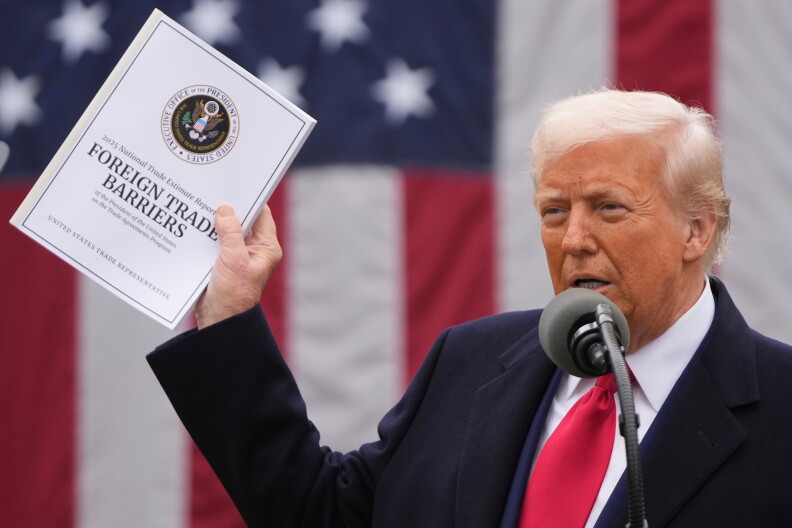
FILE - President Donald Trump speaks during an event to announce new tariffs in the Rose Garden at the White House, Wednesday, April 2, 2025, in Washington. (AP Photo/Mark Schiefelbein, File)(Mark Schiefelbein/AP Photo/Mark Schiefelbein / AP)
Last year, Vandermeer's premonition came true in a very personal way. The 62-year-old lost his job as a product designer at Howard Miller, a clockmaker that relied on parts produced overseas. After a century in business, the company in Zeeland, Michigan, closed its factory, sold off its inventory and brand name and laid off nearly 200 workers.
“So much for bringing jobs back,” Vandermeer said. Next month, he plans to vote straight Democrat in the midterms.
As if an unpopular war with Iran and persistent inflation were not enough trouble for Republicans, they are confronting a backlash over the tariffs that Trump made a cornerstone of his economic agenda. He promised that charging higher taxes on imports would spur a factory renaissance in the United States, but that has not come to pass. Although the country has added manufacturing jobs so far this year, the sector has fewer employees than when Trump returned to the White House in January 2025.
White House spokeswoman Taylor Rogers insisted that a factory boom is underway, citing increases in manufacturing output and more work in certain nonresidential construction trades. “Factory construction jobs of today mean more manufacturing jobs down the road once those factories come online,” she said.
Even before the tariffs, Howard Miller struggled as Americans lost their taste for fancy timepieces such as its signature grandfather and mantel clocks. So the company broadened its offerings years ago to include bar carts, cabinets and consoles.
But those products also depended on glass and other parts from abroad, and diversification did not ensure survival.
“I could still have a job, but now I don’t because of tariffs,” Vandermeer said. “It was like taking a knife to the back.”
Job losses pile up in battleground states
Vandermeer lives in Michigan's 4th Congressional District, which is represented by Republican Bill Huizenga, who is running for a ninth term in the November 3 election.
Before Trump implemented his broadest set of tariffs last year, on what the president called “Liberation Day,” Huizenga was supportive.
“Is it going to be easy? Not necessarily. Is it the right thing to do? Absolutely it is,” he told reporters at the time.
A spokesperson for Huizenga said last week that the congressman “sees a potential role for tariffs” for boosting domestic manufacturing "while recognizing the need to address their broader economic effects.” His Democratic opponent, state Senator Sean McCann, has criticized the incumbent for opposing legislation that would rein in tariffs that Trump imposed unilaterally.
There are similar issues in competitive races in Kansas, Iowa and Ohio, where Republican acquiescence could hurt the party on Election Day as their constituents face factory layoffs, farm foreclosures and higher prices.
Tracy Chew, 55, voted for Trump in 2016, then for Democrat Joe Biden in 2020 and Democrat Kamala Harris in 2024.
She used to work for Case, a backhoe manufacturer, but the company announced before the tariffs that it would close its plant in Burlington, Iowa. She lost her job in April, as did her daughter, followed by husband and son-in-law over the next few weeks.
Chew is leaning toward voting for Democrats again this year, feeling that Trump let them down.
“I’m furious he isn’t doing enough," she said. “Tariffs are not targeting the right companies, the right amount."
Layoffs in Iowa have piled up elsewhere.
Winnebago Industries, which produces recreational vehicles like campers, cut 200 jobs last year after the cost of importing aluminum, steel and electronics increased by tens of millions of dollars.
“It’s a day to day battle,” said Michael Happe, the company's chief executive.
In the tight race for an open U.S. Senate seat in Iowa, U.S. Rep. Ashley Hinson faces Democratic state Rep. Josh Turek. There is a close contest, too, in Kansas, where Democrat Adam Hamilton, the pastor of the largest United Methodist Church in the U.S., is trying to unseat Republican Roger Marshall.
Cole Hoppock, chief executive of appliance maker Vornado Air in Wichita, Kansas, said Trump's tariffs “impacted virtually everything.” The company known for its retro household fans laid off more than 70 factory workers in February, blaming higher prices for imported parts.
Trump's trade policy could force cutbacks soon at another Kansas employer, Canadian jet manufacturer Bombardier. Trump has threatened to ban the company's sales in the U.S. if Bombardier does not start making all its planes in the U.S. Bombardier said it buys parts from 2,800 companies in 47 states, including in Kansas, where it employs more than 1,000 people
Trump's approach to trade is unpopular
Trump has spent years complaining that other countries are ripping off the U.S. when it comes to trade. Most economists say he is wrong and that his remedy — broad universal tariffs — would cause more pain than help.
Now most Americans disagree with Trump's approach, according to The Associated Press-NORC Center for Public Affairs Research. A September poll showed only about 3 in 10 U.S. adults approve of Trump's handling of trade negotiations, compared with 4 in 10 in March.
Some of Trump's tariffs have been haphazard.
He targeted Brazil because of political differences and he jacked up tariffs on China to levels so extreme that they risked a recession and forced the president to retreat. The Supreme Court in February ruled against Trump's declaration of an emergency to roll out his “Liberation Day” tariffs last year, leaving foreign trade unsettled as the administration continues to adjust with new levies and threats.
Tariffs are far from the only reason for the lost of manufacturing jobs, and factories have cut workers for decades with or without them. Even some Republicans who dislike Trump's approach will not split with the party.
Bicycle Corp. of America, which closed its factory in South Carolina last year, blamed rising prices for imported parts. Koby Bird, who retired after working in quality control, likes tariffs but was frustrated by Trump's habit of raising and lowering them seemingly at whim.
“It was all over the place,” Bird said. “Businesses couldn't plan.”
Next month, Bird is likely to stick with Republicans, including U.S. Sen. Darline Graham, because tariffs are only one issue and he believes Democrats would spend too much money on the wrong things.
Ernie Goss, an economist at Creighton University in Nebraska, said manufacturing woes may not convert to Democratic victories. He said some people may “think the tariffs in the long run will work.”
Some workers may be turning on Trump
Wendell Young, a union leader in Pennsylvania, where several factories have had layoffs, said he senses a backlash among workers.
Last summer, Young said he got a firestorm of angry responses to his email blaming tariffs for a decision by Post Holdings to cut 160 jobs at a local pet food factory.
“Keep politics out of this," wrote one of workers at the plant in Bloomsburg, Pennsylvania. "President Trump isn’t the reason.”
“People used to beat me up for not supporting Trump. I haven’t heard that in a year," said Young, president of Local 1776 of the United Food and Commercial Workers International Union. “Some of these people are red Republicans and they are shocked. They expected more jobs."
Post Holdings ultimately agreed to reduce the head count by offering severance for people to leave, but lower production had a ripple effect.
Local can manufacturer Trivium Packaging decided to cut several jobs because they were getting less orders from Post and other companies, according to Young's union.
“I understand the mindset behind tariffs, but I just don't know if it's working," said former Trivium worker Heather Kingston. She left for another company before the layoffs, and her husband is still working at Trivium. “There doesn’t seem to be many manufacturing jobs moving into the area,” she said.
Kingston said she voted for Republican Dan Meuser in the 9th District last time but is having doubts this year. Meuser's seat is considered safe, but other races in the state are up for grabs, including in the 7th and 8th districts, which are near the Post and Trivium factories.
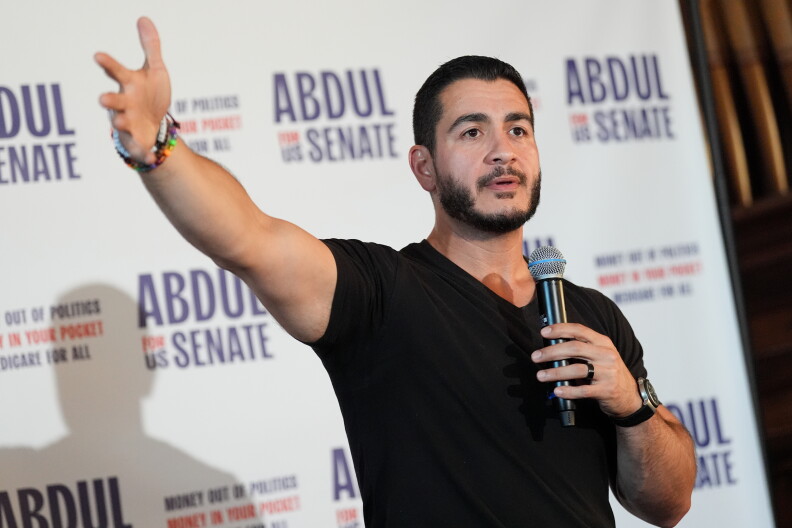
FILE - Abdul El-Sayed, a progressive candidate in the Democratic primary for U.S. Senate in Michigan, speaks during a campaign rally at a coffee shop, Aug. 3, 2026, in Detroit. (AP Photo/Julia Demaree Nikhinson, File)(Julia Demaree Nikhinson/AP Photo/Julia Demaree Nikhinson / AP)
PORT HURON, Mich. (AP) — Abdul El-Sayed, holding a handheld mic and wearing his signature V-neck black shirt, slowly shook his head as a woman at his town hall described how she burned through her savings after undergoing emergency brain surgery.
“I’m really sorry for your experience, and I hope that you’re on the mend,” said El-Sayed, the Democratic candidate for U.S. Senate in Michigan, after outlining proposals for guaranteed health care and paid leave.
Later that night, while talking to reporters in the basement below the theatre, his tone was far different. El-Sayed called his Republican opponent Mike Rogers a “coward,” said President Donald Trump was “afraid” to visit the state and dismissed as “dumb” a question about whether Iran or Israel posed a greater threat to the United States.
The exchanges captured two sides of a candidate who is the central figure in one of the nation’s most consequential Senate races. El-Sayed would be the country's first Muslim senator, and he's crisscrossing the state to counter a Republican effort, fueled by tens of millions of dollars, to portray him as a dangerous radical. But he has also embraced his confrontational side by mocking and taunting Trump and Rogers.
“If they want to make me the main character in the midterms, I’m not shying away from it,” El-Sayed said in an interview. “Run against me. See how well that works out for you.”
El-Sayed’s brash, swaggering confidence rubbed some Democrats the wrong way during a divisive primary against Rep. Haley Stevens. The former public health official has shown little interest in toning it down, remaining unapologetic about his progressive agenda and adversarial approach, emboldening supporters who believe he's the right candidate for an angry electorate that has lost faith in the political establishment.
“If you want their votes, you have to make nice with those people, and he’s not really doing that,” said Michigan political strategist Adrian Hemond, who supported Stevens. “Maybe he doesn’t have to. The entire theory of this candidacy has been he can remake what the electorate looks like.”
Republicans target El-Sayed
Even though Michigan backed Trump twice in his three presidential campaigns, no Republican has won a Senate race in the state since 1994.
The political landscape is no friendlier this year. Trump started an unpopular war with Iran, leading to higher gas prices. Rogers has opted for a low-key campaign with fewer public events than El-Sayed as he tries to make the race all about his Democratic opponent.
As of Oct. 10, Republicans had outspent Democrats by $78 million to $63 million in the Michigan Senate race, according to AdImpact, which tracks political advertising. Around $40 million in Republican spending has gone toward negative advertisements, compared to only around $20 million from Democrats.
The ads portray El-Sayed as “dangerously radical” and “too extreme,” highlighting his past calls to defund the police and relax immigration enforcement. Others tie him to Hasan Piker, a popular online streamer with whom El-Sayed has appeared and who has drawn criticism for past comments, including saying that “America deserved 9/11.”
On Friday, Rogers appeared alongside Louisiana Sen. John Kennedy, who told reporters that El-Sayed “sleeps in a Bin Laden jersey.” Rogers laughed.
Vice President JD Vance has called him “evil.” In one social media post, Trump shared a photo of himself with first lady Melania Trump alongside a photo of El-Sayed and his wife, who wears a hijab, with the caption: “Two VERY DIFFERENT America’s.”
Late Wednesday, Trump referred to El-Sayed as “Mohammed” and said he “goes back to the days of the Jihad.”
El-Sayed has hardly backed down. At the campaign stop in Port Huron, he taunted Trump to visit Michigan, suggesting Rogers and other Republicans were afraid the president would hurt their chances.
“Donald, if you’re watching, don’t wuss out, man,” El-Sayed said.
And he responded to Kennedy’s attack by suggesting the Republican is in the KKK.
“That’s rich coming from someone who wears his bed sheets out at night,” El-Sayed posted on social media.
El-Sayed uses a personal touch with voters
Before the Port Huron town hall, El-Sayed worked his way down a line of people who couldn’t fit inside the theater, shaking hands, taking photos and stopping for conversations.
Jeff Petrucella and his wife Alice traveled from Macomb County to see El-Sayed. They described themselves as politically “middle of the road” and said they had voted Republican in the past.
“I’m pretty done with the Republicans right now,” Jeff said.
Alice said she was “looking for a change that is better for my granddaughters,” pointing to El-Sayed’s support for Medicare for All. Nor was she put off by his more confrontational appearances on Fox News.
“I think he expresses himself well. You can tell he’s a well-spoken, educated man,” she said.
Pat Kreiner was among those who waited nearly an hour to see El-Sayed. Her children had persuaded her to support him in the Democratic primary.
“My son said to me, ‘I have been living with this trickle-down economy since the day I was born,’” Kreiner said. “‘It doesn’t work for me.’”
Kreiner also expressed anger about Trump's trade war with Canada, just across the river from Port Huron.
“We are heartsick about our neighbors,” she said. “They used to come over a lot. We don’t see them now.”
Visiting smaller towns such as Port Huron has become central to El-Sayed’s campaign, with his team recently saying he's held more than 500 events in over 100 cities across the state.
“Go everywhere. Talk to everyone. That’s what we do,” El-Sayed said in an interview.
The personal approach has not erased all the skepticism surrounding El-Sayed, including within his own party.
His criticism of Israel and association with Piker have raised concerns among some Jewish Democrats. El-Sayed has held a series of private gatherings with undecided Jewish voters as he works to win their support.
He has also sought to strengthen his standing with Black voters. In the Democratic primary, Stevens drew more support in Wayne County, home to Detroit and its large Black population.
Ahead of Thursday’s debate, El-Sayed attended two events with Black leaders before stopping at a Black barbershop, where he moved from chair to chair talking with customers. He stopped at one point to speak with a pregnant woman, congratulating her and asking when her baby was due.
“November 8th?” El-Sayed joked. “Make sure you vote early, huh?”
The race has become about more than just Michigan
While El-Sayed has spent much of his campaign trying to win over Michigan voters, his candidacy has taken on significance far beyond the state. Republicans have made him a symbol of what they warn is an increasingly radical Democratic Party, while progressives see his campaign as a chance to prove their politics can win in a closely divided state.
At a New York City fundraiser on Oct. 5, Rep. Alexandria Ocasio-Cortez cast his campaign as a test for progressives nationwide.
“If Abdul can win in Michigan, anybody can win anywhere,” said the New York Democrat, a potential presidential candidate.
The national stakes have also drawn renewed opposition. United Democracy Project, a super PAC affiliated with AIPAC, disclosed an initial $94,000 expenditure against El-Sayed on Friday, after spending nearly $30 million to oppose him in the Democratic primary.
And El-Sayed, despite insisting the election should focus on Michigan voters and their economic struggles, has embraced the larger implications of his candidacy.
“I am grateful for your support,” he told the audience at the New York fundraiser, according to remarks obtained by The Associated Press. He said he had two goals — “pick up a U.S. Senate seat” and “change the nature of our politics for the better.”
Macomb County to install two inflatable bladders into pipe to help reduce combined sewer overflows into Lake St. Clair( Macomb County)
The state of Michigan wants to know what you want to know about the state's infrastructure.
That includes roads, gas and electricity, drinking water, internet, and other essential services.
The Michigan Infrastructure Council is collecting questions in a survey, which will be used to create a Statewide Infrastructure Guide.
Palencia Mobley is head of the council. She says it's quite common for residents to have questions about the complex systems that support their daily lives, including who maintains them, and how they're paid for.
Mobley said there's been a serious lack of investment in many of these essential things for decades.
"There are multiple things that have led us to where we are now, and we just really believe that an engaged and an informed citizenry are our best advocates and our best allies for ensuring that we can meet the infrastructure challenges that do exist," she said.
The survey will be used to create a Citizens' Guide to help residents become better educated and more involved in the issues. The survey runs through October 30.
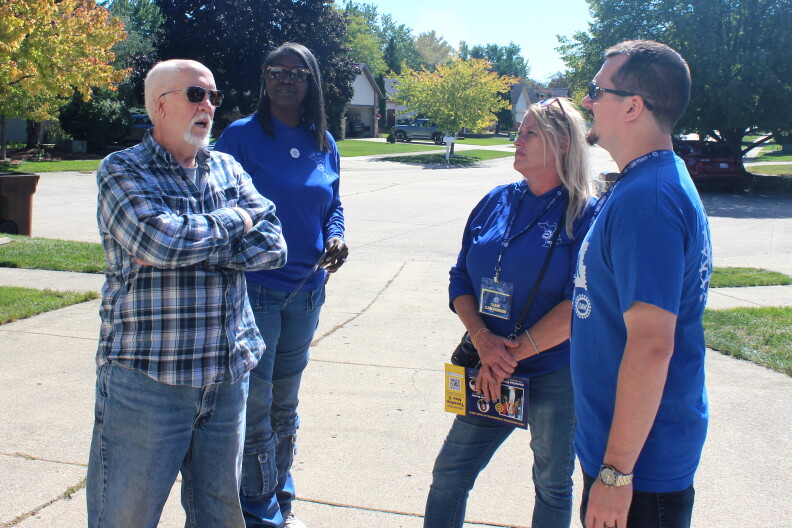
Walter Usakowski, from left, a retired worker from the Ford Motor Co.'s Sterling Axe Plant who plans to vote for the union's slate of Democratic candidates in the midterms, talks with United Auto Workers union canvassers LaShawn Barnett, Kim Avouris and JJ Jewell in Shelby Township, Mich., Saturday, Sept. 26, 2026. (AP Photo/Jacqueline GaNun)(Jacqueline GaNun/AP Photo/Jacqueline GaNun / AP)
SHELBY TOWNSHIP, Mich. (AP) — Walter Usakowski was mowing his lawn in a northern suburb of Detroit when three canvassers from the United Auto Workers approached.
“I don’t even need to talk to you,” Usakowski said. As a retired member, he was already supporting the union’s slate of Democratic candidates in the Nov. 3 midterms.
But he is not sure how many of the other “guys in the shop” will vote for Democrats. He worked at Ford Motor Co.’s Sterling Axle Plant for more than 45 years, and he knows many members who backed Republican President Donald Trump.
The election-year canvassing was one part of the UAW’s efforts to reassert its political power in Michigan, a premier political battleground. Although the union generally backs Democrats, its membership is more divided over which party best represents working-class interests. It also is reckoning with past corruption scandals, a drop in membership and a lack of transparency that has eroded trust within its ranks.
“It’s not going to be an overnight thing,” said JJ Jewell, who is part of the UAW’s Community Action Program executive committee. “Even if this election goes fantastically, that’s not mission accomplished. That means we’re 1% of the way done.”
Internal divisions and distrust pose challenges
Jewell and others made the rounds on a recent sunny Saturday in Macomb County, where Trump won by nearly 14 percentage points in 2024. Many of the union members they met in a neighborhood of well-kept suburban houses were retirees, and while most said the cost of living was their top concern, they did not agree on whether Democrats or Republicans would better address it.
One resident, who said she blamed billionaires for the country’s problems, planned to vote for Democrats. Another street over, a couple said they both supported Trump and declined to take a flyer of the UAW-endorsed candidates.
In a microcosm of broader political rifts, union voters remain politically divided. Union voters have traditionally been seen as a Democratic-leaning constituency, but Trump made direct appeals to them with his anti-elite rhetoric and promises to overhaul international trade agreements that sapped factory jobs. In 2024, voters who were union members or were in a household with a union member split between Trump and Democratic nominee Kamala Harris, with more than half voting for the then-vice president and 44% for Trump.
Betty Anderson, a UAW member, thinks the organization is on the right track, but she is not confident about bridging internal political divisions. She said she is angry with members who voted for Trump, whom she sees as selling out the working class.
“I don’t think those people are ever going to be on our side,” Anderson said. “They think they have an opportunity to be in an elite class.”
Leaders hope to rebuild trust with transparency
Since 2017, more than 10 UAW officials have pleaded guilty in a corruption investigation that found millions of dollars of union dues were stolen. Members also faulted leaders for closed-door contract negotiations that they said destroyed trust in the UAW.
Shawn Fain was elected UAW president in 2023 on a platform of transparency, and victories in labor disputes with Detroit's three major automakers bolstered member support. Leaders hope this will translate into votes for its candidates.
“I think the UAW members now are starting to fall a little more in line,” said Usakowski, the retired axle plant worker.
On Friday, Fain said he won reelection to lead the union for four more years. The results have not yet been certified.
Mark DePaoli, director for one of the UAW’s southeast Michigan regions, said the union hosted forums with candidates where any member could ask questions. The UAW endorsed progressive Democrat Abdul El-Sayed in the U.S. Senate primary even though rival Haley Stevens, a four-term congresswoman, worked as chief of staff on an auto bailout task force during the Great Recession, a position she frequently cited while campaigning.
“I don’t think anybody expected us to endorse him,” DePaoli said. In its announcement, the union referenced El-Sayed’s support for universal healthcare and criticism of corporate money in politics. El-Sayed wore a UAW pin during the first Senate debate with his Republican opponent, former U.S. Rep. Mike Rogers.
“The UAW’s backing of Abdul was critical in winning a historic primary despite being outspent by tens of millions of dollars, and will be just as critical in winning" next month, El-Sayed spokesperson Cole Wozniak said in a statement.
Rogers is emphasizing his opposition to controversial federal regulations under Democratic President Joe Biden that would have required automakers to ramp up production of electric vehicles, which some feared would lead to factory closures.
“Mike knows the challenges our autoworkers face, and he’ll be their champion in the U.S. Senate,” Rogers spokesperson Alyssa Brouillet said in a statement. “The same can’t be said for Abdul and UAW national leadership.”
The union needs to turn out the vote to be politically relevant
Robert Bruno, a professor in the School of Labor and Employment Relations at the University of Illinois Urbana-Champaign, said the UAW's strength relies on its ability to mobilize voters.
“You don’t win campaigns off of your endorsements,” Bruno said. “You win campaigns at the door, or at the bar, or at the union hall.”
In the 1980s, there were more than 600,000 active and retired UAW members in Michigan, according to the union. Today, that number hovers around 350,000. The UAW is still the largest union in the state.
UAW leaders are optimistic after a primary election campaign drive and what they see as better, more transparent leadership. The union said about 113,000 of its members voted early during Michigan’s August primary, and it has volunteers canvassing and calling voters before Election Day.
In September, the UAW hosted a conference of its Michigan political arm for the first time since 2018. Fain told reporters at the Lansing event that the organization wants members to drive the direction of the union, focusing on issues like affordability.
“We are as active as we can be right now,” he said.
___
GaNun is a corps member for The Associated Press/Report for America Statehouse News Initiative. Report for America is a nonprofit national service program that places journalists in local newsrooms to report on undercovered issues.
More intense storms fueled by climate change are knocking down more limbs and trees which takes a toll on power lines, sometimes knocking out power to hundreds of thousands of homes and businesses across the state.(Lester Graham / Michigan Public)
Utility bill credits for power outages would be significantly higher under legislation introduced by state Senate Democrats.
The credits would start out at $5 an hour, in the first hour a customer loses power, and ratchet up to $25 an hour after 72 hours without electricity.
Frequent outages would also result in credits: $100 for four service interruptions in a period of 12 months, and $200 for more than four service interruptions.
Renters whose landlords pay the electric bill would be eligible for a $50 credit for spoiled food, lodging, or other costs after four hours without electricity (more if the actual loss is greater) and a $200 credit after 24 hours (also more if the actual loss is greater).
The proposed credits are much more extensive than current credits required by the Michigan Public Service Commission, which mandates a credit of $44 a day during a widespread outage, and that only begins accruing four days after a customer has lost power. Six or more power outages in a 12-month period also merits an additional $44.
Democratic State Senator Stephanie Chang (D-Detroit) is one of the bills' sponsors. She said the legislation is intended to encourage utilities to reduce outages and speed restoration, and it would also better reflect the true costs to customers of losing power.
"We are really trying to incentivize our electric utilities to do a better job of restoring power quicker," Chang said. "We have heard time and again from residents that losing power, losing food, it could be really devastating. Food is really expensive. Replacing it is expensive."
Chang said the MPSC has been working to address reliability, and the legislation reflects the state Legislature working in partnership with the regulatory agency to that end.
Other bills in the package would require regulated utilities to submit reports to the MPSC delineating the cause of service interruptions, tree trimming projections, grid hardening and reliability projects, and a list of the top 20% worst-performing circuits in the utility's service territory.
Consumers Energy said in a statement that it is reviewing the legislation.
“Michigan and New York are currently the only states that require electric utilities to issue automatic bill credits or compensation to customers," the statement continued, "and Consumers Energy complies with the outage credit requirements established by the Michigan Public Service Commission. On the topic of outages, investing in reliability improvements and restoring power safely and quickly will remain our top priorities.”
DTE Energy said in a statement that it shares Michiganders' expectation that DTE keep the lights on and keep bills as low as possible.
The statement continued, "which is why we're making historic investments in infrastructure upgrades, tree trimming and grid modernization to build a stronger, more resilient electric system."
"Across Michigan, utilities are facing increasingly severe weather that can damage electric infrastructure and disrupt service. That's why we're focused on strengthening the grid, hardening critical equipment, and deploying new technologies that help reduce outages and speed restoration when storms occur."
"We're already seeing progress, and we remain committed to continuing the investments that improve reliability while keeping energy affordable for customers. Our goal is simple: fewer outages, shorter outages, and better service for the communities we serve," DTE said.
Editor's note: Consumers Energy is among Michigan Public's corporate sponsors.
In an unusual quirk of electoral politics, voters in Michigan are able to choose the governing boards of major public universities in statewide elections. Several are on the ballot this November.
Members of the University of Michigan Board of Regents, Michigan State University Board of Trustees, and the Wayne State University Board of Governors serve uncompensated for eight-year terms, and are elected two at a time in staggered, two-year cycles.
As part of a series of candidate profiles for the state’s three publicly elected university boards, Michigan Public sat down with the Democratic and Republican candidates for U of M’s Board of Regents to discuss their campaigns, platforms, and hopes for the future of the university.
The Republican Party’s nominees for regent are Lena Epstein and Michael Schostak. Epstein is the co-owner of Vesco Oil Corporation, and unsuccessfully ran for regent in 2022. Schostak is the treasurer of Bloomfield Township and a former finance lecturer at Wayne State University. Epstein is generally considered to be running to the right of Schostak, who has worked to portray himself as a moderate during his campaign.
Makled, a civil rights attorney from Dearborn, defeated incumbent regent Jordan Acker through an insurgent campaign that criticized U of M’s surveillance of student protesters and compliance with several of the Trump administration’s policies. Brown, an incumbent regent who is generally considered to be one of the board’s more liberal members, was renominated with comparative ease.
The candidates from each party are not running as a ticket in the traditional sense. Voters can select up to two candidates for regent, but may also vote for fewer, and are able to vote for two candidates from different political parties if they wish.
This year’s board race has proven unusually contentious, producing some unconventional cross-party endorsements. Acker refuses to vote for his replacement, and has instead endorsed Brown and Schostak. The editorial board of the Michigan Daily, U of M’s student newspaper, endorsed Makled and Schostak, opposing any candidates affiliated with the current board.
Like many elections across the country, the regents race is heavily centered around affordability. U of M is the most expensive public institution in the state, but has become cheaper over time for many students due to the Go Blue Guarantee — a financial aid policy which covers the tuition of in-state undergraduate students from families with yearly incomes and assets less than $125,000.
The Democratic candidates are campaigning on the success of the program, which was greatly expanded during Brown’s time on the board. Both support U of M’s current plans to expand the program to select graduate degrees; Makled also supports a broad tuition freeze. The pair also want to reduce the cost of attendance students experience outside of tuition.
“You have to look at the entire totality of what the experience is of attending an institution like U of M,” Makled said. “What are our students paying for when it comes to housing, what are they paying for food and transportation and books and childcare?”
The Republican candidates are also campaigning on affordability, though their focus is slightly different. Epstein, like Makled, has called for tuition to either be frozen or cut entirely. Schostak wants to expand the Go Blue Guarantee by removing home equity from its assets calculation, which would allow homeowners under the income threshold to qualify.
“That home equity is worthless to them,” Schostak said. “They can't do anything with it unless they were to sell their house. And I don't think we want to be a school that tells people that to pay for an education, they’ve got to sell their house.”
Like many colleges, U of M has felt significant pressure from the Trump administration since 2024, and in many cases it has chosen to comply rather than fight. The university ended its Diversity, Equity and Inclusion programs to avoid cuts to federal funding, and stopped providing gender-affirming care to patients under the age of 19 in response to a federal subpoena.
Makled has consistently campaigned on a stronger response to the Trump administration, and wants U of M to work with other universities facing similar federal disputes. Brown’s record is more mixed; he has previously defended U of M’s conciliatory actions, but has also called for the university to do more. He is now working to emphasize his anti-Trump credentials.
“I am now the named plaintiff, as a board member, in 11 suits against the Trump administration, suing them from everything from his attacks on trans rights to cancer and climate change research to immigration and visas for our scholars,” Brown said. “The university, as the premier public institution in the country, I think, must take a leadership role in that national debate.”
The two Republicans do not want U of M to be on bad terms with the Trump administration, and believe their party affiliation could help smooth over existing tensions. “We want good workings with government entities, seeing that this is a public university,” Epstein said.
However, Schostak is not pleased with many of Trump’s actions, and believes U of M must protect its own interests when threatened.
“I understand that when the federal government came in and threatened to cut a billion dollars in research grants, that the university had to respond to that in the near term,” Schostak said. “You need to protect the financial well-being of the institution.”
Given the statewide nature of the race, the candidates have focused on the ways in which they would benefit communities across Michigan. The Republican candidates want to significantly increase the percentage of in-state students, who currently constitute a slim majority at U of M's Ann Arbor campus.
The two Democrats want to increase funding to the university’s satellite campuses in Flint and Dearborn — the latter of which Makled graduated from — and expand Michigan Medicine’s services into rural areas with limited access to healthcare.
One of the most controversial aspects of the university’s statewide presence is its plans to build a data center in Ypsilanti Township with Los Alamos National Laboratory. The project is opposed by locals worried about its effect on their community and planned role in nuclear weapons research. The issue has followed the candidates throughout their campaigns.
Brown initially voted to approve the purchase of land for the data center’s planned site near Ypsilanti, along with the rest of the board. He has since changed course, calling the project “an example of environmental racism.” Makled has consistently called for U of M to heed local opposition, saying that he thinks “folks in Ypsilanti Township have been very clear.”
The two Republicans do not share a message on U of M’s data center plans. Epstein does not oppose the project, describing herself as “a free market capitalist” that “would love to grow the relationship between the university and the business community.” Schostak, himself a public official in a different township, sympathizes more with the locals, describing U of M’s conduct as “just atrocious.”
The candidates were unanimous on some issues; all thought free speech on campus needed protecting, and all agreed on a need for greater transparency within U of M’s administration, though they proposed slightly different solutions to get there. Epstein proposed making more of the university’s financial documents publicly available. Makled proposed making public comments more accessible at the regents’ monthly meetings. Schostak promised to hold office hours for interested constituents, and Brown bragged of handing out his personal cell phone to anyone who asked.
The University of Michigan holds Michigan Public’s broadcast license.
A Michigan Supreme Court case heard this week is testing the limits of state civil rights law.
It involves a former social work professor at Calvin University whose contract wasn’t renewed after he officiated a same-sex wedding for a colleague. His lawyers argued that amounted to sex-based discrimination by association.
The question before the court is whether the Elliott-Larsen Civil Rights Act applies in that case. The law bans discrimination “based upon religion, race, color, national origin, age, sex, sexual orientation, gender identity or expression, height, weight, familial status, marital status, or source of income.”
It follows a similar sentence structure as the federal Civil Rights Act, which bans discrimination “because of such individual's race, color, religion, sex, or national origin.”
Plaintiff Joseph Kuilema’s lawyers argue, by getting rid of the word “individual’s” in the Michigan law, state lawmakers meant for the law to apply in a broader context.
“Although ELCRA doesn't use the word ‘associational,’ it doesn't need to because it's broadly written, intended to apply to associational retaliation,” attorney Charissa Huang said to the justices Thursday.
Lawyer Steve van Stempvoort, representing Calvin University, disagreed.
“The most natural reading of the statute is these possessives are redundant and ... ELCRA just kind of made it more efficient. It didn't drastically expand the scope,” van Stempvoort said.
The school’s argued, even in cases where the law could apply to association, this matter would be different.
One key argument van Stempvoort made was that the colleague in the wedding didn’t also claim university discrimination. He said Kuilema’s complaint was moot without a member of the protected class making that case themselves.
“What his argument really boils down to is well, he still has to show that he himself, his employment discrimination, was because of sex,” van Stempvoort said.
The appellate court agreed with the university.
“Kuilema’s sex is irrelevant to Calvin University’s decision to terminate his employment. The university’s decision to terminate his employment was based upon his decision to officiate a same-sex wedding. That decision would not have been different if Kuilema were a female instead of a male,” the Court of Appeals majority opinion read.
In her closing remarks before the state Supreme Court, Huang claimed that reasoning would set a dangerous precedent.
“Allowing this Court of Appeals holding to stand that it must be because of the plaintiff's own sex, that would have a chilling effect upon people of different races and cultures, and sexes and sexual orientations. They could be fired for associating with one another with no recourse,” Huang said.
The candidates for Michigan's U.S. Senate seat faced off in their first debate, tackling issues including the cost of living, housing, data centers, and foreign policy. We discussed the major takeaways with Michigan Public Radio Network reporter Russ McNamara. Then, we revisited a conversation about the Native American Education Program Library at Grand Rapids Public Schools, home to more than 3,000 books in 16 languages. Plus, Democratic candidate Will Lawrence joined us to talk about his campaign for Michigan's 7th Congressional District, where he's challenging Republican incumbent Tom Barrett.
Guests on today's show
Russ McNamara, reporter for the Michigan Public Radio Network
Amy Westcott, who led the effort to establish the Native American Education Program Library at Grand Rapids Public Schools
Will Lawrence, Democratic candidate for Michigan's 7th Congressional District
Note: This segment originally aired on April 24, 2026
Have you ever thought about why we can't say "I'm gonna Pittsburgh"?
It's a reasonable question, once you think about the ways in which we use "gonna" in place of "going to." We can say things like "I'm gonna cry" or "I'm gonna get groceries" instead of "I'm going to cry" or "I'm going to get groceries." However, if you say "I'm gonna Pittsburgh" instead of "I'm going to Pittsburgh," you might be accused of trying to force a new verb into the language.
Listener Amber Sheerin brought the "Pittsburgh" conundrum to our attention after seeing a post about it on social media: "Why does 'gonna' work when we’re talking about actions, but not when we’re talking about destinations — even though, on the surface, it’s replacing the same words, 'going to'?"
The answer has to do with a process that linguists call grammaticalization. In this process, a content word — nouns, verbs, adjectives, and adverbs — becomes a grammatical element. Grammatical elements are things like prepositions, prefixes, suffixes, and auxiliary verbs.
For example, a noun or a verb will sometimes turn into a grammatical form. The verb "will," for example, started as a content word that meant "to want" or "to wish." We still use it that way when we say things like, "I will it to happen."
Over time, "will" got grammaticalized and became just a way to talk about the future. When we say things like "I will drive" or "I will call her," we're talking about what's going to happen, not wanting. Linguists call this loss of meaning "bleaching."
Something similar happened to "going to." The content verb "going to," expresses motion. However, "going to" has also gotten grammaticalized and bleached of that motion meaning and just means future. When you say "I'm going to call her," you're generally not talking about the physical act of going somewhere to make a call. You're talking about something you plan to do.
Sometimes in grammaticalization, we'll also see what linguists call "phonological reduction." In other words, some of the sounds of the word also fall out, and that's how "going to" becomes "gonna." So, that means there's a difference between "I'm going to Pittsburgh" and "I'm gonna go shopping."
To hear us unpack that, and to hear more about how "gonna" works, we're gonna recommend that you listen to the audio above.
Democratic nominee for U.S. Senate Abdul El-Sayed, left, appears with Republican nominee for U.S. Senate Mike Rogers during a televised debate at WOOD-TV, on Thursday, Oct. 8, 2026, in Grand Rapids, Mich.(Paul Sancya / POOL AP)
ATLANTA — Not long ago, Georgia gubernatorial nominee Rick Jackson eagerly compared himself to his fellow billionaire in the Oval Office. He promised to be Donald Trump “with a Southern tone.” And sharing a summer rally stage, Jackson pointed at the president and declared, “I’m going to be this man’s favorite governor.”
On the debate stage this week with his Democratic opponent, however, Jackson discussed Trump only when Keisha Lance Bottoms brought him up. And he assured his audience that he’d “stand up to anybody.”
Jackson is not alone in his recalibration: Republican nominees for Senate, the U.S. House and governor’s offices across the country are sidestepping Trump or openly distancing themselves as they debate before Election Day.
Those tactics, not unlike Republicans scrubbing Trump from their campaign websites, are the latest signs of how much Trump’s standing has fallen because of voters’ frustration with inflation, the Iran war and other matters. And the dynamics highlight the perilous options many Republicans face as they try to stitch together winning coalitions that go beyond Trump’s core supporters.
“Republicans right now are facing a voter turnout problem” in their own party, said GOP pollster Paul Shumaker, and must win “unaffiliated voters” who care most about the economy.
“You have to have something significant to change this narrative,” Shumaker said. But, he explained, that means “a significant victory in Iran” and seismic economic improvements — not something any Republican midterm candidate can force from behind a debate podium.
There’s a Trump tightrope on Iran, tariffs and rhetoric
Some Republicans are taking specific positions at odds with the president.
Michigan Senate candidate Mike Rogers said in his debate Thursday with Democrat Abdul El-Sayed that he’d urged the White House privately to reach a trade deal with Canada and end the president’s tariffs. Canada is Michigan’s largest trading partner, as it is for many Great Lakes and Midwestern states.
Days before, Rogers unveiled a new ad in which he said, “We know that Canada is not our enemy. We need to end the tariff war — now.”
That's a noticeable departure from Rogers’ earlier, less specific statements praising Trump’s “America First” economic agenda while saying tariffs are not a “one-size-fits-all” solution.
Another Michigan Republican, Rep. Tom Barrett, already had bucked the president by voting for a war powers resolution intended to assert congressional authority over military actions in Iran. But debating Democrat Will Lawrence in their central Michigan district, Barrett added a criticism of Trump's rhetoric Monday in Nebraska, where he floated the possibility of Iran attacking San Diego and Los Angeles.
The president mentioned those cities as part of his argument that higher gas prices because of his Iran war are a “small price to pay” to keep the country safe. But Democrats seized on the remarks, some insisting that Trump was calling for Iran to attack U.S. cities.
Barrett was asked whether Trump’s words were acceptable. Given the opportunity to echo the White House explanation that Trump was offhandedly mentioning a worst-case scenario he was trying to prevent, Barrett offered no defense.
“Nope,” he said flatly.
Many Republicans prefer a more generalized stiff arm
Reflecting the complex electoral balance, most Republicans have attempted to separate themselves without naming any firm difference with the president.
Running for a promotion to the Senate, Iowa U.S. Rep. Ashley Hinson tried in her debate Wednesday against Democrat Josh Turek to reconcile her earlier promises to be a Trump ally in Congress’s upper chamber. She said it would be “really easy” to keep her word and still be bipartisan — a buzz word she’s already been featuring in her campaign.
“I’ll be President Donald Trump’s ally when it is important for Iowa, but I will push back on him — he knows this, because I talk to him regularly — on things that are wrong for our state,” she said. “That’s true no matter who’s in the White House. That’s true no matter who is governing and who has the gavel.”
That’s the same path Jackson took in Georgia, as he pivoted away from Trump by embracing outgoing Georgia Gov. Brian Kemp, a Republican who has clashed with the president, starting with Trump's false claims that he won Georgia in the 2020 presidential election.
“I will stand up to anybody, just like Brian Kemp has done,” Jackson said.
Another Republican House member, Mike Lawler of New York, made a point of name-checking a Democratic colleague, New Jersey’s Josh Gottheimer, and discussing bills they’d work on together. It was part of his argument that he’s able to challenge Trump and the party line.
“When I agree with the president I say it. When I disagree with the president, I say it,” he said in his closing remarks.
Hinson, meanwhile, referenced bills she’s worked on in the House that have been signed into law by both President Joe Biden and Trump.
But she also avoided criticizing Trump when asked about the president sending Affordable Care Act rebate checks to some Americans and promising a $5,000 bonus after the midterm elections if Republicans retain control of the House and Senate.
She said she “cares very deeply” about making sure Congress maintains the power of the purse and thinks it’s important to “live better within our means.”
Democrats pounce on either approach
Regardless of the Republican efforts, Democrats have continued peppering them with attacks and retorts about Trump. The most heated moments came when Democrat Cait Conley repeatedly said Lawler always voted with Trump.
“No matter how many times you say 100% of the time,” the congressman answered, “it’s provably false.”
When Rogers conceded in his back-and-forth with El-Sayed that the administration “probably” made errors in its mass deportation strategy, the Democrat answered swiftly.
“He said it was probably not right. I mean, it’s definitely not right,” El-Sayed said. “They killed two people.”
And while Georgia’s Jackson seemed uncomfortable talking about Trump, Bottoms was more than happy to mention him.
“I’m not running to be his favorite governor,” she said. “I’m running to work on behalf of people like you."
Associated Press reporters Joey Cappelletti in Washington; Hannah Fingerhut in Des Moines, Iowa; and Jill Colvin in New York contributed to this report.
It was a jam-packed week of political debates in Michigan. We’re covering the gubernatorial, U.S. Senate, 7th Congressional District, and secretary of state debates today. Biggest takeaway: Each debate offered insight into how the candidates want voters to evaluate them. Let’s dig in.
Michigan Gubernatorial Debate
Democratic Secretary of State Jocelyn Benson and her Republican opponent, Congressman John James (R-MI 10), used questions on foreign policy and energy to argue who should be held responsible for Michigan’s problems and who has the authority to fix them.
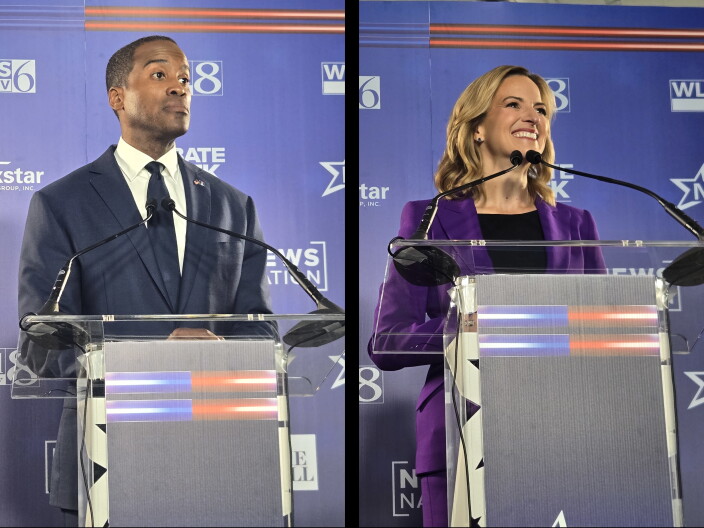
Republican John James and Democrat Jocelyn Benson stand at their lecterns during a gubernatorial debate on October 6, 2026.(Colin Jackson / Michigan Public Radio Network)
When talking about federal policy, like tariffs or the war with Iran, Benson repeatedly tried to connect James to President Donald Trump. All the while, James pointed to instances that showed his willingness to stand up to the president.
On the subject of affordability, Benson said she would suspend Michigan’s gas tax, a stance she hasn’t previously taken publicly. She also proposed negotiating a sub-national trade agreement with Canada that could exempt Michigan from tariffs. James challenged whether a state has the authority to make such an agreement, given federal control over international trade policy.
When discussing data centers, Benson said she supported a statewide moratorium while additional protections are being considered. James said he also supported a moratorium, but would support local communities’ choices to welcome or reject data centers.
When pressed on how that would count as a moratorium, he said “it’s a moratorium on Lansing and not the people.”
The exchanges highlighted two different arguments.
Benson sought to connect James to the Trump administration’s policies, while James questioned the feasibility of some of Benson’s proposals and emphasized his own disagreements with the president.
Democratic nominee for U.S. Senate Abdul El-Sayed, left, appears with Republican nominee for U.S. Senate Mike Rogers during a televised debate at WOOD-TV, on Thursday, Oct. 8, 2026, in Grand Rapids, Mich.(Paul Sancya / POOL AP)
U.S. Senate Debate
Former Republican Congressman Mike Rogers and his Democratic opponent Abdul El-Sayed had a particularly heated debate.
WOOD-TV’s Rick Albin had to repeatedly chime in, telling both candidates to keep their responses short in order to stay on time. At one point, Albin said, “I’d like to be a part of the debate, too.”
Throughout the debate, Rogers launched personal attacks on El-Sayed. El-Sayed’s response: Rogers was distracting voters from economic concerns, like gas and grocery prices, and repeatedly flip-flopping on positions.
This debate highlighted the significant differences between the candidates’ stances on Iran, Israel, surveillance and federal spending, but the confrontations became so disruptive Albin had to repeatedly ask candidates to answer the questions.
There were two obvious competing campaign messages: Rogers wants voters to scrutinize El-Sayed’s associations and judgment, while El-Sayed wants them focused on economic conditions and Rogers’s political record.
Republican Congressman Tom Barrett and Democratic challenger Will Lawrence prepare to debate.(Andrew Roth / WKAR)
7th Congressional District Debate
Republican U.S. Representative Tom Barrett and Democrat Will Lawrence met for their first debate Tuesday. Each candidate spent the debate trying to turn each other’s record into a liability.
Barrett kept referring to Lawrence’s past social media statements, particularly his previous support for defunding the police, to use his opponent’s past to discredit his current political positions.
After the debate, Lawrence told WKAR’s Andrew Roth, “I'm somebody who thinks out loud.” He added, "I've spent my share of time thinking out loud, like lots of millennials on the internet. I'm not afraid to change my mind and live and learn. And I've answered for those comments."
Lawrence has said he now supports funding police alongside community violence intervention and mental health programs. Barrett, however, questioned whether Lawrence’s change in position was genuine.
During the debate, Lawrence pressed Barrett on his voting record, specifically on policies that affected tariff rates, healthcare subsidies, data centers and artificial intelligence. All the while repeatedly connecting his opponent’s voting record to the current presidential administration’s policies.
Barrett defended his tariff-related vote and argued that AI regulation should have a strong federal framework, while allowing states and local governments to add certain protections.
The 7th district includes strongly Democratic communities, around Lansing and Michigan State University, as well as strongly Republican areas, such as Howell, meaning neither candidate can rely exclusively on voters in their party's strongest communities.
That makes the candidates’ contrasting arguments particularly relevant: Barrett is asking voters to consider Lawrence’s past statements, while Lawrence is asking them to consider Barrett’s recent decisions in Congress.
With control of the U.S. House potentially coming down to a handful of competitive districts, the arguments these candidates make about one another could have consequences beyond mid-Michigan.
Garlin Gilchrist and Anthony Forlini, candidates for Michigan Secretary of State, at a debate held in Ann Arbor(Etai Smotrich-Barr / Michigan Public)
Secretary of State Debate
Democratic Lieutenant Governor Garlin Gilchrist and Republican Macomb County Clerk Anthony Forlini covered a lot of topics, but their sharpest disagreement concerned election integrity and denialism.
Gilchrist specifically criticized Forlini’s decision to hire a January 6 protester to help recruit and train election workers. Forlini defended the hiring decision as an example of including people with differing opinions, while distancing himself from the employee’s public views.
Forlini argued addressing election security concerns was important. He also noted that Gilchrist had questioned the results of the 2017 election for Detroit city clerk, which Gilchrist lost.
As Michigan Public’s Etai Smotrich-Barr reports, “Gilchrist sought a partial recount in the 2017 race, which found errors with the way ballots were processed and stored but confirmed Gilchrist’s loss. After the recount, Gilchrist conceded the election.”
That distinction matters.
Requesting a recount through an established election process isn't the same as denying a verified election result.
The exchange also revealed different approaches to public distrust. Forlini emphasized addressing concerns from voters who question election procedures, while Gilchrist warned that giving credence to unsupported claims can undermine confidence in elections.
Because Michigan's Secretary of State oversees statewide elections, that disagreement illuminates how each candidate says they would approach the office.
What do these debates show?
All four debates highlighted the different issues, records and responsibilities that these candidates want voters to consider.
The gubernatorial race is asking: Who is responsible for Michigan’s problems and political independence?
The U.S. Senate race is asking: Do personal associations outweigh policy proposals?
The 7th Congressional District race is questioning: Which past matters more–publicly available statements or congressional voting records?
The Secretary of State debate is asking: Which approach to election integrity and maintaining public trust matters more?
All different races and responsibilities, but with a common thread: the candidates are trying to shape not only how voters see their opponents, but which issues and records voters consider most important.
Throughout all four, candidates aren’t just competing over the answers to questions on how they would perform in office, but also over which questions voters should be asking in the first place.
In our last episode of On Hand, we explored the origins of Detroit techno with producer and DJ Carl Craig, including how the sound changed Detroit's local music scene.
For this week's Your Stories, we hear from someone who helped make those changes happen behind the scenes.
In 1989, Mike Fotias was running a mobile DJ business when his brother and a friend convinced him to provide sound for an underground party in Detroit's Eastern Market. After hauling equipment up three flights of stairs, working through the night, and breaking some of his gear, Fotias was hooked.
As Detroit's underground techno scene grew from loft parties to massive warehouse raves, Fotias was there providing the sound. He witnessed the scene's explosive growth, police crackdowns, and eventual move into nightclub culture.
Today, Fotias and longtime collaborator Alan Bogl run Audio Rescue Team, providing production services for major Detroit events including Movement and the Detroit Jazz Festival.
GUEST:
Mike Fotias, sound engineer and founder of Audio Rescue Team
Want to submit a question or story to On Hand? Do it here:
Detroit Red Wings center Dylan Larkin, left, skates past Ottawa Senators center Dylan Cozens (24) during the first period of an NHL hockey game Tuesday, Oct. 6, 2026, in Detroit. (AP Photo/Duane Burleson)(Duane Burleson/AP Photo / FR38952 AP)
What do Michigan and Michigan State football, the Detroit Red Wings, and the Detroit Lions have in common this fall?
Their seasons are not off to great starts.
For more on those stories and other sports news, Michigan Public sports commentator John U. Bacon joined host Doug Tribou on Morning Edition on Friday.
Doug Tribou:Let's start with the Red Wings. The team's best player, who was stripped of his captaincy in the off season, Dylan Larkin, was booed in his first game this week. He still wants to be traded. That's a demand he made months ago.
Now, 23-year-old defenseman Simon Edvinsson has returned to his home country, Sweden, to train while he sits out over a contract dispute. And the team is still operating with an interim general manager. Other than that, John, everything seems fine...
John U. Bacon: [Laughs] Yeah, perfect. The rink is not on fire. You left that out. On the plus side, you also left out that in the first two games, the fans' favorite chant is to Chris Ilitch, the owner of the team. "Sell the team. Sell the team." I can't recall any Red Wings season, maybe any NHL season, starting off so miserably as this one. So what else you got, Doug?
DT: [Laughs] Well, new Michigan State Athletic Director Dan Bartholomae published an open letter to Spartan Nation this week. In it, he vowed to provide transparency about the ventures set up to fund the athletic department. He also promised to provide the Spartans football program with the funding it needs to compete with the nation's elite programs.
The Green and White have lost three straight in football and been blown out in all of those losses. What got your attention in Bartholomae's letter?
JUB: Well, really the simple fact that he had to write it, which tells us a few things. One, that we are in an era where an AD has got to pledge fundraising expertise in this manner. All these things add up to this letter, of course. We're going to raise money, it's going to be up front, etc. But that's the new world we're in.
DT: And in the letter, he did pledge some transparency, but sort of said it would be coming later. So there wasn't a lot of clarity within it about either of these ventures.
JUB: [Laughs] The letter on transparency lacked transparency. There's your problem.
DT: John, things are looking good for the Wolverines this weekend... They're off.
JUB: [Laughs] Yeah. Best news in Ann Arbor in a while.
DT: Michigan probably needs some time to regroup. They have lost two straight. And in each of those games, the Wolverines have failed to score 20 points. What are you seeing from this team so far this season, John?
JUB: Well, you're seeing a truly great defense, one of the best in the country, and a truly miserable offense, one of the very worst in the country. And the shocking fact about that is you have probably the most expensive quarterback in college football in Bryce Underwood, who's making $3 million a year. And one of the very expensive offensive coordinators, Jason Beck, who's also making $3 million a year. That's about half a million dollars a point, Doug. That's not very good.
DT: The Lions are 2-2 on the season. Up next, they'll play the Arizona Cardinals. Detroit has had a lot of trouble stopping teams from scoring, but the Cardinals haven't scored much. It's a little tough to say which team that combination favors more this weekend...
JUB: Yes, the very weak offense or the very weak defense. This is going to be a true battle. Stay tuned on this one.
The Lions have got a great offense with Jared Goff at quarterback. They've got a good defensive line. They've got a miserable defensive secondary. And that's why they're losing games. Man, Doug, you don't have a whole lot of good news today... The weather's been lovely, that's the good news.
DT: [Laughs] That's right. Justin Verlander officially retired from baseball at the end of the Tigers' regular season. That retirement lasted approximately six minutes before he started a new job. He's now on television on the Fox MLB pregame. You know the old adage, John, if you can't make the playoffs, analyze them.
JUB: [Laughs] Yeah, I think that's from Aesop, I believe? I'll tell you what though, Justin Verlander is very good on Fox, and perhaps because he had 3 or 4 months to get ready while he was injured. But man, hats off. That is the first happy news we've had in today's show. JV, go get 'em.
Editor's note: Some quotes in this article have been lightly edited for length and clarity. You can play the full audio of the interview near the top of this page.
The University of Michigan holds Michigan Public's broadcast license.
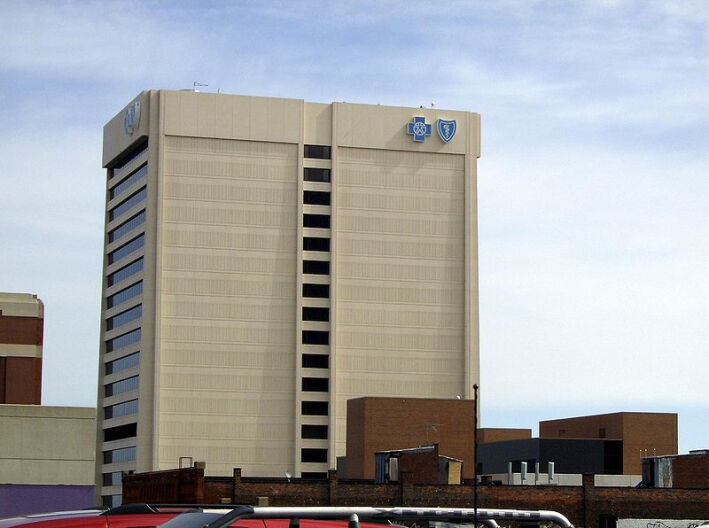
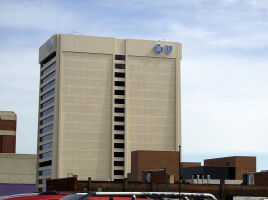
Blue Cross Blue Shield building on Lafayette in Detroit.(Mikerussell / <a href="https://commons.wikimedia.org/wiki/File:BlueCrossBuildingonLafayetteDetroit.jpg" target="_blank" link-data="{"cms.site.owner":{"_ref":"00000179-84c8-d933-ad7f-f5f846b10000","_type":"ae3387cc-b875-31b7-b82d-63fd8d758c20"},"cms.content.publishDate":1791501709976,"cms.content.publishUser":{"_ref":"0000017d-95e3-dada-a9ff-fdeb3d1e0000","_type":"6aa69ae1-35be-30dc-87e9-410da9e1cdcc"},"cms.content.updateDate":1791501709976,"cms.content.updateUser":{"_ref":"0000017d-95e3-dada-a9ff-fdeb3d1e0000","_type":"6aa69ae1-35be-30dc-87e9-410da9e1cdcc"},"cms.directory.paths":[],"anchorable.showAnchor":false,"link":{"cms.directory.paths":[],"attributes":[],"linkText":"<i class=\"rte2-style-italic\">wikimedia commons</i>","target":"NEW","attachSourceUrl":false,"url":"https://commons.wikimedia.org/wiki/File:BlueCrossBuildingonLafayetteDetroit.jpg","_id":"000001a1-1dd2-da7a-a3f7-fdd2a52d0000","_type":"ff658216-e70f-39d0-b660-bdfe57a5599a"},"_id":"000001a1-1dd2-da7a-a3f7-fdd2a52d0001","_type":"809caec9-30e2-3666-8b71-b32ddbffc288"}">Wikimedia Commons</a>)
Michigan Attorney General Dana Nessel sued the state’s biggest health insurance company in federal court Thursday. She accused Blue Cross Blue Shield of Michigan of forming an illegal monopoly
The lawsuit argues BCBSM worked with Blue Cross Blue Shield Association companies in other states to keep competition out. The complaint cites license agreements and territorial rights deals as ways BCBSM built influence.
Nessel said that’s illegal under state and federal antitrust laws.
“Competition is good, not just for the quality of care but of course to bring down prices. And that’s the purpose of the antitrust laws in the first place, that it allows us to break up these big monopolies that are so harmful,” Nessel told reporters during a press conference in Lansing Thursday morning.
While the lawsuit names several Blue-branded companies in other states as coconspirators, only BCBSM is listed as a defendant. The attorney general is suing in her capacity as both a representative of the state government and of Michigan residents.
Blue Cross Blue Shield of Michigan serves state employees. Assistant Attorney General Jonathan Comish said the company’s size and power made it the only realistic option for the state to contract with.
“They’re able to charge us, what we would call in the antitrust world, as supracompetitive fee. That is an unlawfully large amount of money per employee, per head, and with the size of the state workforce, that adds up to a real drain on the state’s resources,” Comish said.
A 2025 American Medical Association study found BCBSM controlled around 65% of the state’s healthcare insurance market. That was among the highest market concentrations in the country.
When asked for a comment on the lawsuit Thursday afternoon, BCBSM said it hadn’t yet been served and could not comment on the “specific merits” of the case. In a written statement, the company sided it was “blindsided.”
“We fundamentally disagree with the Attorney General’s characterization of an uncompetitive insurance market in Michigan. Competition exists everywhere in our state’s insurance markets, with strong local and national insurers competing with us every day. For nearly 90 years, Blue Cross has provided coverage for citizens across Michigan, in every county, without exception. This heritage, and the quality of products and services we provide, is foundational to our success in Michigan,” the company said.
The state alleges BCBSM used its power to negotiate unsustainably low reimbursement rates for care providers. Earlier this year, the company went to battle with Michigan Medicine over those concerns.
The health insurer and the University of Michigan’s health system eventually worked out a deal. But southeast Michigan father Andrew Bashi said the dispute put critical care for his infant son at risk.
“When one company holds all that power, it doesn’t have to worry about what happens to us in a negotiation, we have nowhere else to go, and they know it. Patients stop being customers. We become leverage,” Bashi said.
The lawsuit was filed in District Court for the Eastern District of Michigan. Federal cases often take months or years to play out.
Nessel, who is term-limited, is leaving office after December. She said she hopes her successor decides to keep pursuing the matter.
Keith Schipper is a campaign spokesperson for Republican Attorney General nominee Doug Lloyd. He said Lloyd would consider it.
"Since the case was just filed, Doug hasn't been privy to all the facts and evidence, but he is committed to protecting Michigan consumers, just as he protected Eaton County consumers as its prosecutor," Schipper said in a statement.
"Under Doug's leadership, the Eaton County Prosecutor's Office started the Eaton County Economic Crimes Unit to go after fraud and other illegal business practices that hurt Eaton County residents. When Doug is Attorney General, he will review this case to understand all the facts and evidence and make a determination,” said Schipper.
Naina Agrawal-Hardin is with Democratic nominee Eli Savit.
“Eli has not yet had an opportunity to review the case or the evidence, but as with any matter he will inherit, he will make a determination based on the facts, the law, and the best interest of the people of Michigan. More broadly, Eli is committed to using every available tool to lower costs for Michiganders who are struggling, just as he has done throughout his career,” Agrawal-Hardin said in an email.
The attorney general's court filing demands a trial by jury. The state is seeking monetary damages and an end to what it described as Blue Cross Blue Shield of Michigan's monopoly on the market.
Then, Interlochen Public Radio brought us a story about how Northern Michigan tribes are trying to bring back the Arctic grayling. The freshwater fish species was once abundant in the region’s rivers and streams.
And, state leaders have gone back and forth on the issue of resident IDs, or the ability for anyone living in the state to get a driver's license, regardless of citizenship. Two reporters discussed the history of resident IDs and its connection to local police department's collaboration with immigration enforcement officers.
Plus, we revisited a conversation with Irene Butter, a public health scholar and Holocaust survivor who lived in Ann Arbor. Her experience as a child led to decades of teaching and activism around global human rights. Butter passed away on Friday, Oct. 2.
Finally, we revisited a conversation with Anne Carson in celebration of her recently announced Nobel Prize for Literature.
GUESTS ON TODAY'S SHOW:
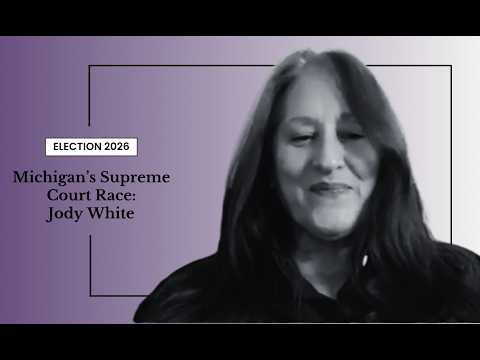
Jody White, Michigan Supreme Court candidate and real estate broker
Vivian La, climate solutions reporter at Interlochen Public Radio
Kate Furby, senior environment reporter at Michigan Public
Adam Yahya Rayes, data reporter at Michigan Public
Koby Levin, senior reporter at Outlier Media
Irene Butter, retired public health scholar and human rights activist
Have you made it to a cider mill yet? Or maybe celebrated the season with a fall festival? If not, Michigan Public has you covered. We’ve gathered some of our favorite events, including some of the exciting fall festivities, happening around the state this weekend. Whether you want to celebrate or just need an idea for how to spend your weekend, you’re in the right place. Check out some of these fun, interesting, and timely events, handpicked from event calendars by Michigan Public.
Planning to go to any of these events this weekend? Let us know how much you enjoyed it by emailing digital@michiganpublic.org.
In November, Michigan voters will choose two justices to serve on the state Supreme Court. Michigan Public's Morning Edition is featuring interviews with the six candidates.
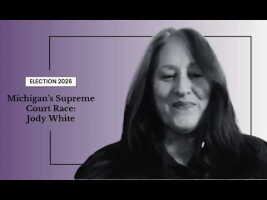
Jody White is a long-time real estate broker in Southeast Michigan. She also ran as a candidate for the state Senate in 2022 and the state House of Representatives in 2018.
White spoke with Michigan Public's Morning Edition host Doug Tribou.
Doug Tribou: As we get started here, I want to note for our listeners that judicial candidates in Michigan are listed without any party affiliation on the ballot. However, parties do nominate candidates for the court, and the U.S. Taxpayers Party of Michigan selected you as one of its nominees. There are currently six Democratic nominees and one Republican nominee on the court.
You're a real estate broker. You used to own your own firm. You've run for other offices, weren't elected, but ran for a couple of offices. So you've been a candidate before, but you are not an attorney. And Michigan law requires Supreme Court justices to be licensed to practice law in Michigan, and to have been admitted to the practice of law for at least five years. You don't meet either of those requirements. So if you won the election, you wouldn't be able to serve on the court. Why are you running?
Jody White: I am part of the National Association of Realtors and the Michigan Association of Realtors. Those are memberships. I get a membership card. And I actually have a state license to practice the field of real estate, which is ownership, title work, lending. If you can show me a bar license, that'd be great. If you look at their P-number on their little card, it's called membership.
Why I'm running is because of the close network of bar members that have been running the judiciary for many decades. I've been very much an advocate in the civil end of it, which is what really real estate is about, making sure that we're protecting your ownership or protecting your liberty and the rights to have property. And then we end up in probate court where these attorneys are working in probate court and are able to take what is your inheritance or your generational wealth.
A note from Michigan Public:
During our interview, Jody White told us about a complex probate case in her own family. We did not have time to go into detail about that case for this interview, but it included charges of embezzlement against a relative. As the conversation continued, Doug Tribou read her the requirements to take office as a Supreme Court justice.
DT: A person must be a registered and qualified elector of the state of Michigan by the filing deadline — that means an eligible voter — licensed to practice law in Michigan, and at the time of the election or appointment, be less than 70 years of age. In addition, the individual must have been admitted to the practice of law for at least five years.
We checked with the Secretary of State, and it's perfectly valid for you to be on the ballot. Those things only have to happen by the time you're in office, but you can't practice law for five years between now and January...
JW: I've never stopped practicing law. You know, we are all supposed to be lawful, legal, and compliant people. We're supposed to follow traffic signals and 55 miles per hour. But there's been a membership of people, this closed cultural profession, that are able to basically rule our judiciary.
And if you look at my background and when I ran for state representative and state Senate, it was about the credibility of the courts. And our goal is to make sure that maybe laypeople who are not part of this membership get a fair chance. Nobody is of nobility. There's no king in America. We are all created equal. And I do love Judge [Michael] Warren because he's very good at quoting things verbatim.
DT: He's one of the Republican nominees in this cycle.
JW: Right. And he was talking about our inalienable rights. And one of them is we are all created equal. And by being created equal doesn't mean just because you're an esquire, that you get more privilege or more power over the rest of us.
DT: But Judge Warren is an attorney. I'm sorry to cut you off.
JW: He's a bar member. He's a member of the bar.
DT: He's a member of the bar, which makes him an attorney who has practiced law and then become a judge. And he is one of the candidates running. He's currently a judge in Oakland County and running [for the Supreme Court].
But to go back to one of your points there, you referenced the people being in charge of the courts, but we elect the members of the court. So the election is the voice of the people. A constitutional change would be another matter. But it's clearly stated "the practice of law." And I think it's fair to say that that means actually being an attorney who is doing the work of assisting clients with the law, not just being a good standing citizen who follows the law as hopefully we all try to do.
JW: See, that's the thing. A lawyer does not have different standards. There is a systemic issue going on in the courts. We have wrongful convictions. We have plea bargains that are being coerced by this profession of cultural professionals who have put themselves above the people. So I just want to be one of those justices that continue to be that public functionary to work for the people.
DT: Under Michigan law and in the state Constitution, followed by a 1997 opinion from the state attorney general, it is legal for you to run for the Michigan Supreme Court, and you can qualify for the statewide ballot, which you've done, even if you don't meet the requirement of five years of legal practice. But you have to meet that requirement by the time you're sworn in. And again, since you don't practice law, it would appear that you are not able to be sworn in if you're elected. But I want to ask...
JW: And again, I'm going to argue that because I do practice the law and I'm telling you...
DT: But not as an attorney, you don't.
JW: We are a law-abiding group of people. I want everybody to go back and look at the Republican organization, the Democrat organization, and the lawyers' organization. They are all trade organizations, no different than the real estate organization.
DT: It's not hard to imagine someone getting into the voting booth who's interested in third-party candidates and either read or heard about your name or your fellow party nominee, Tom Howe, and chooses you on their ballot assuming that you might actually take office, which again, it appears you cannot. Do you have any concerns about confusing voters? At the very least, you're acknowledging that it will be a contentious point if you were to be elected.
JW: Well, and again, I'm going to go back to the Michigan Code of Judicial Conduct that says that the court is...
DT: Do you have any worry about confusing voters? You've made...
JW: No, we're going to go back to the rules of what the judiciary is supposed to be for: for the people and the litigants, and not these club members that are really overtaking our state of Michigan. And I think Michigan deserves better. I think the people deserve better. And I do believe that the people want better. I hope if anybody is confused that they do their own research about what I said about the different trade organizations; we're just not going to follow the status quo.
DT: Thank you very much for your time.
JW: Thank you, Doug.
Jody White emailed us shortly after our interview. In that email, she acknowledged the state's constitutional requirements to become a Supreme Court justice.
She added, "My candidacy asks voters to examine whether exclusive professional control over eligibility and judicial administration continues to serve the public interest." ____________ Editor's note: Quotes in this article have been lightly edited for length and clarity. You can play the full audio of this interview near the top of this page.
Late on a cool evening in spring 2025, Brownstown Township police officer Matthew Lyles stopped a black SUV as it exited a parking lot.
One headlight was out, he wrote in a police report. But when the driver provided a Colombian license, Lyles called Border Patrol to “validate” it. Federal agents arrested the driver.
Brownstown police didn’t have to turn this minor traffic violation into a federal immigration enforcement operation. Local police generally are not required to assist with immigration enforcement.
Attorneys and some police chiefs argue officers should instead issue a citation or impound the car without involving Border Patrol. Michigan generally recognizes driver’s licenses from foreign countries.
But some police advocates argue that officers need to call federal immigration enforcement to verify identities, check for warrants and ensure road safety.
State policy helped create this dynamic. Since the driver in Brownstown lacked legal status, she wasn’t able to get a Michigan driver’s license. Just a month earlier, in March 2025, state lawmakers shot down a bill that would have expanded driver’s license eligibility for migrants.
Immigrant advocates had spent years making a public safety case for such legislation. They argued that licenses allow migrants to take driving tests and appear in state databases. Without licenses, they warned, routine police interactions could escalate into federal enforcement actions.
Those warnings were well-founded. An investigation by Outlier Media and Michigan Public found that local police reported migrants to Border Patrol at least 388 times since 2021. In most cases, migrants’ lives were upended for minor violations that could have easily resulted in a warning or ticket.
“Usually, my clients get detained because they’re driving and a local police officer will pull them over,” said Shahad Atiya, an immigration attorney in metro Detroit. “Let’s say they run a stop sign. When they cannot produce the driver’s license, usually that’s used as evidence that someone might have a legal status issue.”
More than a dozen states give migrants access to driver’s licenses. Some have also adopted policies designed to separate local policing from federal immigration enforcement.
What the law says
For decades, Michigan politicians have debated whether migrants should be allowed to obtain driver’s licenses.
In 1995, Democratic Attorney General Frank Kelley gave everyone access to licenses as long as they could pass a driving test and prove they lived in the state. Michigan was one of only a handful of states with such a policy.
In 2007, Republican Attorney General Mike Cox issued an opinion that reversed Kelley’s decision, citing implications for state and national security and the potential for fraud.
Some Michigan police chiefs warn that involving local departments in federal immigration enforcement discourages people from reporting crimes. Others — particularly those politically aligned with the Trump administration — view assisting immigration agents as part of their job.
While Michigan lawmakers have left those decisions to municipalities, other states have created guardrails.
Some put direct limits on cooperation between local police and immigration agents. A 2017 Illinois law forbids police from transferring people to U.S. Immigration and Customs Enforcement without a criminal warrant signed by a judge.
When Democrats won full control of Michigan government in 2022, immigration advocates renewed their focus on driver’s licenses.
The coalition backing the reforms called the campaign Drive SAFE, arguing that unlicensed drivers are a danger to everyone on the road.
State Senator Stephanie Chang (D-Detroit) is part of a group of lawmakers who’ve continued to introduce driver’s license legislation during each legislative session. She said Drive SAFE didn’t pass because some Democrats saw it as too “controversial.”
“I don’t know if there’s a way to know exactly how many people have been deported ... because of our failure as a state to get this done in 2024,” Chang said.
Republicans forced the resident drivers license bill up for a vote after taking gaining control of the state House of Representatives. It failed with six Democrats voting against it alongside Republicans. (Michigan House TV)
In 2025, Republicans gained control of the state House. They put the driver’s license bill to a vote as Trump ratcheted up his anti-immigrant campaign. The vote failed 39-64, with six Democrats voting against.
“If this bill passes, Michigan would become a destination state for every illegal alien and prospective illegal alien all over the world,” said state Representative Josh Schriver (R-Oxford).
What’s next?
Chang said the reforms are even more urgent with the second Trump administration’s immigration crackdown.
“Now, [if] you call Border Patrol, there is no question — even if there is no warrant at all, no history of criminal behavior — Border Patrol is coming,” she said. “I think the ramifications of someone not having a driver’s license or state ID now [are] that much greater.”
The sting of Democratic defections during the vote last year hasn’t faded for Danny Celaya, a community organizer who was involved in the Drive SAFE campaign and characterized the “no” votes as “cowardice.”
Still, both Chang and Celaya said they believe Michigan will eventually pass the reforms. Democrats have a chance of retaking the state House next year. Until the bills pass, Celaya said it will be normal for “a grocery trip to lead to a family separation.”

 Login
Login