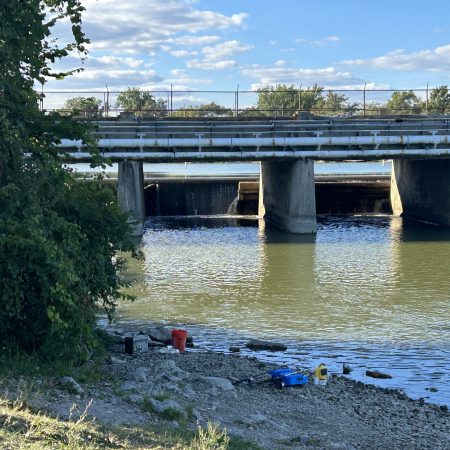
Located in Flat Rock on the Huron River, the 100-year-old dam is in fair condition, but has a “high hazard potential”rating. Despite the risk, Flat Rock residents and officials strongly opposed the Metroparks’ plan for partial removal.
Flat Rock Mayor Steve Beller spoke at an Aug. 14, 2025 board meeting after Flat Rock City Council unanimously passed a resolution to urge Metroparks not to remove the dam.
The city spent months weighing their options and ultimately decided not to take ownership of the dam.
Huron-Clinton Metroparks CEO Amy McMillan says the organization respects the City of Flat Rock’s decision:
“No matter how we look at it, this is a change for that community. And so, being transparent and listening and disagreeing where reasonable people will disagree, we’re happy that we’ve come to this conclusion and we’re looking forward to moving forward.”
John Webb, president of the Flat Rock Dam Coalition said in a statement his group supports the partial removal plan, as long as Huron-Clinton Metroparks ensures water levels are maintained.
“It is critical that the [Huron-Clinton Metroparks] clearly and unequivocally mandate to their engineers and contractors the requirement to maintain existing impoundment waters or preferably raise these water levels.”
Dam removals growing more common
A third of the dams in metro Detroit have “high” or “significant hazard” ratings from the National Dam Inventory. Catastrophic flooding like that seen in Midland with the Edenville Dam failure has drawn attention to questions of ownership and accountability of privately owned dams.
Proponents of dam removals point to improved river health and biodiversity. They also mitigate the risk of catastrophic dam failures.
In the case of Flat Rock Dam, the Metroparks feasibility study for this project notes improved fish passage for sturgeon, walleye, and salmon to travel up the Huron River to spawn.
Brian Graber, senior director of river restoration at American Rivers. He spoke with the Metro’s David Leins. Dave started by asking why Michigan has so many dams in the first place?
Listen to The Metro weekdays from 10 a.m. to noon ET on 101.9 FM and streaming on demand.
One-of-a-kind podcasts from WDET bring you engaging conversations, news you need to know and stories you love to hear. Keep the conversations coming. Please make a gift today.
Lathrup Village is creating a new tree garden as part of a larger effort to keep its mature trees healthy, add more green spaces, and teach residents about how important trees are to the community.
The project is taking place on a triangular piece of public green space that once hosted the city’s first Arbor Day tree planting after the tree committee was formed.
Brandon Wynn, a resident of Lathrup Village is a certified tree expert and chair of the tree committee. He explained that the long-term plan includes planting different types of trees, putting up signs to educate people, and eventually adding benches and space for community activities.
The city is mainly focusing on planting trees native to Michigan, like white oak, swamp white oak, black gum, and American hornbeam.
They are also thinking about including some non-native trees that can handle changing weather patterns and road salt.
Some trees like ginkgo, dawn redwood, river birch, and a donated tulip tree have already been planted there.
Bahm says the community will consider adding a pavilion or pergola, flower beds, shrubs, and evergreen trees. The committee is funding these efforts through grants, donations, and partnerships with the community to gradually develop the arboretum.
Jill Bahm, a planning expert working with Giffels Webster and serving as Lathrup Village’s planning consultant, explained that trees and other green spaces can help manage stormwater, reduce runoff and erosion, and improve air and water quality.
She says that by including the tree committee’s work in the city’s updated master and recreation plans, they can ensure this project fits into Lathrup Village and support future projects and grants.
WDET strives to make our journalism accessible to everyone. As a public media institution, we maintain our journalistic integrity through independent support from readers like you. If you value WDET as your source of news, music and conversation, please make a gift today.
The Detroit Water and Sewerage Department (DWSD) celebrated the completion of a $40 million stormwater development on Detroit’s westside Thursday.
The Far West Detroit Stormwater Improvement Project is the department’s largest green stormwater infrastructure plan.
DWSD Deputy Director Sam Smalley says the new system will push more than 100 million gallons of water to the Rouge River.
“This this feature provides filtering and settling, so there are actually water quality standards for the stormwater that we discharge, so it’s cleaner water faster. So we either slow the water down or better yet get it out of the system altogether.”
The sewer network will move stormwater through to two new detention basins in Rouge Park for filtering and slow down water before discharging it into the Rouge River.
Smalley says the new infrastructure will make the 1,200 homes nearby more resilient to weather related basement flooding.
Additional headlines for Friday, July 31, 2026
Iris Taylor dies
Detroit health care and education leader Iris Taylor has died. She was 74.
A lifelong city resident, Taylor worked in health care for 45 years, serving as CEO of Detroit Receiving Hospital. She also helped shape the city’s response to the COVID-19 pandemic as the health department’s head of nursing.
Taylor was also a member and former president of the Detroit school board. Mayor Mary Sheffield calls Taylor one of the city’s most dedicated and impactful servant leaders.
Bike lanes blocked by parked cars
Residents in Detroit’s Grandmont Rosedale neighborhood are complaining about drivers parking in bike lanes on Grand River.
Bike lanes were installed on Grand River between Woodward and McNichols in 2019.
The road falls under the Michigan Department of Transportation’s jurisdiction. However, the state says the city is responsible for maintaining bike lanes.
Detroit Police say they are planning to deploy officers in the neighborhood next week to ticket anyone parked illegally.
Early election turn out
The Michigan Department of State reports a turnout rate of 11.3% of all active registered voters who have already cast their ballot a week ahead of the primary election.
More than 800,000 residents have voted with a mail in or absentee ballot and over 30,000 cast their ballot at an early voting site. Compared to the same time in 2022, the number of mail ballot requests have increased 58.8%.
Early voting will continue through Sunday. Mail in ballots must be received by clerks no later than 8 p.m. on election night, Tuesday, Aug. 4.
Listen to the latest episode of the “Detroit Evening Report” on Apple Podcasts, Spotify, NPR.org or wherever you get your podcasts.
Support the podcasts you love.
One-of-a-kind podcasts from WDET bring you engaging conversations, news you need to know and stories you love to hear. Keep the conversations coming. Please make a gift today.
Detroit and Windsor sit across a narrow river from each other, close enough to see the lights on the other side. For decades, they existed like one town in two countries. Auto parts crossed the water again and again before a single car was finished. Families, music, and Saturday nights moved back and forth with a constant rhythm.
Then, after 9/11, crossing got harder with longer waits and tougher searches.
Soon, the two cities will cut the ribbon on something new between them: the Gordie Howe International Bridge. That ribbon cutting, scheduled for June 12, has been postponed, and officials aren’t saying exactly why.
Canadian Prime Minister Mark Carney has called the bridge a symbol, but also a fact of cooperation. Yet it comes at a tense moment. President Donald Trump has threatened to block it, wrongly claiming the U.S. would get nothing from a bridge that Michigan actually co-owns.
So what does this bridge, the first publicly-owned one at this border, do for Windsor and Detroit — and for the people who have spent their lives crossing between them?
On The Metro, host Robyn Vincent spoke with Lee Rodney, a border-culture scholar at the University of Windsor and creator of the Border Bookmobile, about what a new bridge actually does for a region the border has divided.
Hear the full conversation using the media player above.
Listen to The Metro weekdays from 10 a.m. to noon ET on 101.9 FM and stream on-demand.
One-of-a-kind podcasts from WDET bring you engaging conversations, news you need to know and stories you love to hear. Keep the conversations coming. Please make a gift today.
A former Detroit Police sergeant accused of raping six women and girls will stand trial. The Detroit Free Press reports Benjamin Wagner faces 20 charges, including criminal sexual conduct and kidnapping.
Prosecutors allege that he committed the crimes between 1999 and 2003, attacking females ranging from 14 to 23 years old. He was charged in March, based on DNA evidence from a rape kit that sat in storage for years. The survivors testified against Wagner at his preliminary hearing.
His lawyer argued some of their stories had changed over the years. A judge ruled that enough evidence exists to let a jury decide.
Additional headlines for Tuesday, May 19, 2026
DHS may end TPS for Burmese refugees
The Department of Homeland Security wants to end Temporary Protected Status for Burmese refugees. TPS allows those fleeing dangerous conditions in their home country to live and work in the U.S.
TPS status was granted when the U.S. declared the mass killings of the Rohingya people a decade ago to be genocide. A federal judge postponed the effort to end Temporary Protected Status for Burmese refugees. DHS claimed conditions were safe enough for refugees to return.
Detroit sidewalk repairs
The city currently has a backlog of 6,300 sidewalk repair requests. Some residents have been waiting up to five years for a response.
Detroit City Council approved an $8 million contract two weeks ago to fix the sidewalks and allocated an additional $1.5 million in carry-over funds from the previous budget.
Detroit Mayor Mary Sheffield says when she was on city council, she constantly received questions about sidewalk repairs. “Oftentimes I think we think about big developments and big investments that residents want and deserve in their neighborhoods, but it’s also about simple quality of life things like lights and sidewalks that residents deserve to get addressed.”
Officials say the backlog should be cleared by the end of this construction season. The city is now taking requests for 2027.
Monsanto and the state of Michigan have reached a settlement to help pay for cleaning up PCB contamination.
PCBs are a class of chemicals that had a wide range of industrial uses before they were banned. They’re linked to cancer, weakened immune systems and neurological disfunction, among other things.
PCBs are particularly troublesome because they persist in the environment and build up in the food chain. For example, the state has had to issue advisories warning people not to eat certain types of fish because of contamination.
Attorney General Dana Nessel says Monsanto has agreed to pay somewhere between $108 million and $240 million once the settlement is paid in full. As part of the deal, Monsanto does not acknowledge any wrongdoing.
It will be up to the state Department of Environment, Great Lakes and Energy and the Department of Natural Resources to develop cleanup plans.
Local governments prepare to spend opioid settlement money
Local governments in Michigan are sitting on $176 million from the nationwide opioid settlement. The attorney general’s office reports that cities, townships, and counties have spent less than 20% of the money they’ve received since checks started going out in 2023. The funds are supposed to help communities reduce drug overdoses and deaths. An adviser to the Michigan Association of Counties tells Bridge Michigan some local governments are preparing to spend part of that money this year.
Last year, Michigan recorded the fewest drug-related deaths since 2013.
Listen to the latest episode of the “Detroit Evening Report” on Apple Podcasts, Spotify, NPR.org or wherever you get your podcasts.
Trusted, accurate, up-to-date.
WDET strives to make our journalism accessible to everyone. As a public media institution, we maintain our journalistic integrity through independent support from readers like you. If you value WDET as your source of news, music and conversation, please make a gift today.
One of the largest data center projects in the country is happening in Michigan, in the small farming community of Saline Township. Southwest of Ann Arbor, Saline Township is home to roughly 2,300 people.
Many of those residents did not want a data center. Their board voted against it, and their neighbors packed the meeting hall. Then the lawsuit came.
The companies are Oracle and OpenAI. Together, they are worth more than a trillion dollars. The township said it could not justify the fight, so it settled, and construction began.
State lawmaker Morgan Foreman represents the district where it is being built. She says her constituents were not partners in this project; they were bystanders to it. She joined Robyn Vincent on The Metro to discuss how a small community of farmers and small-business owners ended up hosting one of the most consequential pieces of AI infrastructure in the country.
Hear the full conversation using the media player above.
Listen to The Metro weekdays from 10 a.m. to noon ET on 101.9 FM and streaming on demand.
One-of-a-kind podcasts from WDET bring you engaging conversations, news you need to know and stories you love to hear. Keep the conversations coming. Please make a gift today.
Highland Park is an odd shape—a trapezoid to be exact. Its borders include West McNichols Road on the north side, railroad tracks along the eastern edge, alleys behind Tennyson and Tuxedo streets to the south, and the Lodge freeway forming part of its western boundary.
Highland Park is a trapezoid with an area of less than 3 square miles
These have been Highland Park’s city limits since officials incorporated it 1918.
That’s how it managed to avoid becoming part of Detroit, which had already annexed most of the surrounding land.
Leaders and residents wanted autonomy
Jeff Horner is a professor at Wayne State University‘s Department of Urban Studies and Planning. He says Detroit wanted to absorb Highland Park even before the latter became a city.
“Highland Park was not open to the idea of being absorbed,” Horner says. “They wanted to have some local autonomy.”
Jeff Horner is a professor in Wayne State University’s Department of Urban Studies and Planning
Michigan’s Home Rule law in 1909 made it difficult for one city to annex another. That same year, Henry Ford finished building his Model T factory in Highland Park. It was the first Ford plant to use an assembly line. Horner says the city’s population exploded.
“From the 1910 U.S. census to the 1920 census, the population of the city grew by over 1,000% from about 4,500 to about 45,000,” Horner says. “That is remarkable growth.”
Auto industry drove growth
Highland Park kept growing until 1930, peaking at almost 53,000 people. Marsha Battle Philpot grew up in the city and has written about its history. She says Henry Ford’s offer of $5 a day to work on his assembly line drew thousands of people from across the country.
“This was an astronomical sum in those days,” she says. “Maybe an average person might make $5 a month”.
The city’s population steadily declined through the 1930s and 1940s. But it was still relatively prosperous. Philpot says the schools were among Michigan’s best in the 1950s and 1960s.
“Even our elementary schools had swimming pools,” Philpot says. “It was really an extraordinary place to live.”
But good schools were not enough to keep people from leaving the city decade after decade. Ford eventually closed its Highland Park factory, which is now a Michigan historical landmark. Chrysler moved its headquarters, established in 1925, from Highland Park to Auburn Hills. The city’s tax base evaporated. It had so much trouble paying its bills its streetlights were repossessed. State-appointed emergency managers ran the city and the school district for much of the early 2000s, closing the McGregor Library and the high school. Glenda McDonald, Highland Park’s mayor since 2022, says those decisions hit young people especially hard.
“Children need a place to go, and literacy is a very important part of our children’s learning,” the mayor says. “It kind of put a very bad taste in people’s mouths.”
Lansing takes over
McDonald says emergency management didn’t solve Highland Park’s long-term financial problems. One was literally bubbling under the surface: leaky water pipes, some more than 100 years old. The city incurred tens of millions of dollars in debt to the Great Lakes Water Authority. Each side sued the other with the city accusing GLWA of overcharging residents who were too poor to pay for water. The legal dispute pushed Highland Park to the brink of financial ruin.
Glenda McDonald is the mayor of Highland Park
In 2023, the state intervened again, this time giving the city $100 million to pay its debt and fix its water infrastructure. McDonald says workers are now replacing every lead water line in town.
“We’re working with the state, we’re working with GLWA, and hopefully we’ll continue moving forward that way,” McDonald says.
Had the state not thrown Highland Park that lifeline, the city likely would have filed for bankruptcy. The financial crisis raised a question: would Highland Park be better off becoming part of Detroit? The mayor demurred.
“Blasphemy,” she says.
Legal hurdles, local pride make merging difficult
For one local government to absorb another, state law requires residents of both communities to vote in favor of it after weighing the pros and cons. Stephanie Leiser directs the Center for Local, State, and Urban Policy at the University of Michigan’s Ford School of Public Policy. She says uniting Detroit and Highland Park could reduce bureaucracy.
“You can eliminate some layer of management there,” she says. “They don’t need to have an additional mayor and a clerk and all of those things.”
Stephanie Leiser directs the Center for Local, State, and Urban Policy at the University of Michigan.
But Leiser says there’s not a ton of evidence that it would help Highland Park financially.
“They’re not going to save money necessarily on like plowing the roads, picking up trash, or maintaining the infrastructure,” she says.
Leiser says Highland Park’s finances are in better shape than they were when officials were considering bankruptcy in 2023. But it still has challenges, such as high property taxes.
Highland Park has some of Wayne County’s highest millage rates
In 2025, the city’s millage rate for principal residences was 63.221. That’s $63.22 for every $1,000 of a home’s taxable value. The non-homestead rate as over 79 mills. Rates for industrial and commercial personal property were over 57 mills and 67 mills respectively.
Former Highland Park Councilman Ken Bates says the city’s millage rates and pervasive poverty make it hard to attract new investment.
“We have to look into the future as to what will help Highland Park become sustainable,” he says. “What kind of industry should we count on?”
Ken Bates has lived in Highland Park since 2000. He served on the city council from 2018-22.
Bates says city leaders need a plan and the expertise to implement it.
“If not, it’s just you maintaining the status quo year after year,” he says. “You’re just one disaster away from financial calamity.”
Bates says Highland Parkers are fiercely loyal to their community and that most want to remain a city within a city. Resident Michael Williams, Sr. admits he wouldn’t rule out becoming part of Detroit.
“We would get more popularity, probably more services,” Williams says.
But other residents, like Kim McDade, don’t see the benefit of giving up Highland Park’s identity.
“Highland Park needs to be given a chance to continue to build,” McDade says. “Our mayor is doing a great job in doing some things and making connections with the right people.”
Mayor Glenda McDonald says the city’s greatest strength is its people.
“They’re resilient, they’re loving, they’re kind, and we take care of each other,” she says. “I know a person on every single street.”
The mayor says that resilience defines Highland Park more than its shape on a map.
Support local journalism.
WDET strives to cover what’s happening in your community. As a public media institution, we maintain our ability to explore the music and culture of our region through independent support from readers like you. If you value WDET as your source of news, music and conversation, please make a gift today.
WDET reporters have been visiting the city since March, getting to know Highland Park, its history, and its people. These conversations are part of our Crossing the Lines series, which explores what unites and divides metro Detroit as a region.
Highland Park is a city within a city, an enclave of Detroit. At its peak, more than 45,000 people lived in Highland Park, mostly auto workers. Ford and Chrysler called the city home for years. When they moved out, people left in droves. Today, the population is less than 9,000.
One person who stayed is Glenda McDonald. She came to Highland Park as a child in the 1970s and still lives in the city. Voters elected her mayor in 2022.
WDET’s Pat Batcheller spoke with the mayor about her life in Highland Park and her efforts to make the city better.
Listen: A conversation with Highland Park’s mayor
People, not borders, define the city.
Pat Batcheller: How has Highland Park managed to survive as a city despite enormous financial challenges?
Mayor Glenda McDonald: It’s a place where you come and you’re in a neighborhood, but it’s also a city, so everybody in the city rallies around each other, supports each other. We get our support from our partners, Wayne County, the state of Michigan, and others. And they continue to believe in the city, just like I know that right now, I’m believing in this city, and we’re going to move forward, and it’s going to continue to grow.
PB: What makes you believe in it?
GM: I believe because I’ve been here, I saw what the possibilities are, and I know the endless possibilities for Highland Park. You don’t find a place like this, like the housing stock is 100 years old and it’s still standing and they are beautiful. You don’t find neighbors and community the way you do here. This is one community, and that’s what I use as one of my models, is we are one community, even though it’s 2.9 square miles. I know a person on every single street here. You can’t find it in Detroit because it’s so large.
PB: So, it’s not just the borders that define the city, that make it unique?
GM: It’s the people. The people make it unique. It’s hard to explain that we love each other. We take care of each other when it when it’s necessary, and then also we can disagree with each other and move forward and continue to move forward.
Grow the tax base
PB: No city can survive long without a stable tax base at a stable population. As mayor, what are you doing to keep businesses and residents that you already have here and then attract new ones?
GM: One is to make sure that everybody knows that they’re loved and needed here. That’s one thing we have to do is to make sure that people in those businesses and in this community understand we are a people of unity. And you know, we have to make sure that they all already know, that they’re doing a service for folks that some other people are not willing to do.
And a lot of people stay here because they just love the space, they love the area. They love the fact that Highland Park is just a small community.
Yes, our budget is low right now, but it’s not going to always be that way, and that’s the hope for the future. And people that stay here know that there’s a future.
Fix the infrastructure
PB: Tell me about some of the work that’s going on in Highland Park.
GM: We’re replacing every lead line in this city. We were blessed to get some appropriations from the State of Michigan, and they are having us replace every single lead line in the city. Some of them were over 100 years old. Some were wood. There was, at one time, a lead problem, but there’s not anymore. We have our testing, and our testing show that there’s not lead in the water so. But it’s inevitable that [the lead lines] need to come up, because there’s popping going on.
You know, we have water main breaks, like every other city. And so, at this moment, it’s a great thing to be able to change. And that will help businesses come here, because they didn’t want to come to a failing infrastructure that they would have to replace on their own. Right now, it’s being replaced.
It’s a good opportunity for everyone to come now and start the developments that they would like to see, to start the growth of Highland Park again, get in on the ground floor and be the beacon of light for Highland Park.
A sign breaks down the city of Highland Parks water main replacement project.
PB: This was something that you’d been going back and forth with the Great Lakes Water Authority (GLWA) for years. You were looking, as I recall, at the prospect of maybe having to go through bankruptcy if you couldn’t work all that out.
You did make a deal. As you mentioned, the state came in with $100 million to help pay off not only the debt [to GLWA], but to fix the root cause of the problems. If you had not been able to secure that money, would Highland Park still exist?
GM: I think it would. I mean, we’re resilient. If we couldn’t go in directions that we needed to go, we could always find another direction. We have been surviving now with this water situation for 20 years. It’s been ongoing and ongoing, and I decided, and along with my team, we’re going to put an end to it right here in some kind of way. And so we got that tentative agreement taken care of.
We’re working with the state. We’re working with GLWA, and hopefully we’ll continue that moving forward. I would say that I would have used whatever was necessary for us to do, to survive in Highland Park, to stay alive.
The state took over in 2001
PB: Going back the beginning of the century, the state appointed an emergency manager for the city that lasted about eight years and then state returned control. That fixed some of the immediate problems, but it didn’t really fix all of the financial difficulties. What did the state get wrong?
GM: Emergency management! I mean, I think the biggest issue we had was that eliminating the things that brought people to the city or kept people here caused a flight. And that would be a reason for the decline of revenues.
So, I think if it should have been a different plan of, how do we keep people in the city? What do we do to make sure that the children, the working-class people, the seniors, and everyone else benefit from what we’re about to do? And I didn’t see a benefit in that. I think that especially closing our library, that has been a devastating point for the city of Highland Park.
PB: What kind of shape is the [McGregor Library] in after being closed this long?
GM: Well, we did have an evaluation done, and there are some things that need to be done to it, to get it back in place. And it will take some doing. But it’s not impossible to do.
Attract business
PB: Do you have any businesses coming in in the near future?
GM: Yes, we have, I think, three that’s going to be opening up by the summer. One, there’s a coffee shop coming. Two, there’s going to be a restaurant, and three, there’s going to be a juicing bar, all coming in the same building. One of our developers has a building that has a mixed use at the bottom, and he’s starting to rent it out. So there will be spaces there for them and other businesses that are in the queue.
Here to stay
PB: You say you’ve been here since you were 11. Why did you stay when so many other people left?
GM: Why should I leave? That’s the question. I mean, I own my home. I raised my children here. They were born here in Highland Park. Well, they were born in hospitals, but they grew up here, and it’s beautiful place to me.
It’s the people. You can’t match the people here that stay in Highland Park. They’re resilient, they’re loving, they’re kind, and we take care of each other. Like I said, we have our issues sometimes, but all in all, we love Highland Park, and I love Highland Park.
My children have started to convince me to leave for years, and I will not. I don’t want to go to Atlanta. I don’t want to go to North Carolina. I don’t want to go to where they are. I want to stay right here in the city that raised me and bring it back to where it should be so future generations can feel the same way I feel when they’ve been here 54 years.
Highland Park City Hall sits on Woodward Ave.
PB: What gives you pride in Highland Park?
GM: Everything. The people, the places, the possibility. I have a connection to every aspect of the city, the industry, the auto industry, everything like that, is something that has been a part of my life since I’ve been here. The schools, bringing back the school system, Highland Park Public School System, and we’re still working with the charter system that we have.
We are people who believe in in good things. We are people who believe that things are possible. And I’m one of those people that believes that things are possible if you just put your mind to it. It’s a challenge, but it’s a good challenge. As long as I live here, I’m going to do whatever I have to do to try to make sure that the city survives.
What happens in Detroit affects Highland Park
PB: Even though Highland Park and Detroit are different cities, their fates seem to be intertwined. The things that happen in Detroit have an effect here. We do now see some things, some progress in Detroit. Do you hope that Highland Park will benefit from that?
GM: I know it will. We’re the next leg of the development chain they have developed from Woodward downtown all the way up to the north end in Detroit. And when you’re the nucleus of a large city—and we call ourselves the capital of Detroit because we sit right in the middle—everything affects us. Because you can’t go to Pontiac without coming through Highland Park, leaving from downtown. Even coming through a freeway, you’re going to enter Highland Park off of Chrysler. You’re going to enter Highland Park off the Lodge. You’re going to be connected to the Davidson, which was the first freeway.
We have a connection that is like a bond. What affects them affect us, and that’s why we need to be working together to make sure that every aspect of this is healed, and Highland Park needs to be healed, and that’s what I see for it. I see a healing coming.
PB: Why wouldn’t being physically part of Detroit foster that healing.
GM: Blasphemy! I had to clutch my pearls. I’m sorry [laughs]. Because then it wouldn’t be Highland Park. Most people in Highland Park do not claim Detroit.
I love Detroit. Don’t get me wrong, I go to visit there. But if it’s just looking at Detroit, then you’re missing out on the opportunity to see what Highland Park has to offer, what Hamtramck has to offer. And I’m not advocate. You know, I love Hamtramck too, but my city has a lot to offer, and you miss out on that.
Everywhere I travel, the first thing they say is, “where are you from?” I said, “Highland Park.” “Oh, you’re from Detroit?” “No, I’m from Highland Park. And you need to look that up.”
PB: So, sell me. If I’m looking for a place, either to open a business or perhaps buy a home, what does Highland Park have to offer?
GM: Highland Park has a lot to offer. We have two corridors that are ripe for the picking right now to run a business. You have Woodward Avenue. There’s over 100,000 people who travel up and down Woodward Avenue every single day. And then you have Hamilton Avenue, which is what we used to call the antique row. We had all of these small businesses, and we’re building back that. We have a lot of people ready to build up on Hamilton.
Our housing stock here is one of the best in the country. We have had people travel from across the country to come buy houses. When we’re selling in the auction, we get people from California, from everywhere, who has done the research about Highland Park and the stock here, and why you can’t beat this. For the price of a house that you get here, you’re going to take that house and pick it up and put it in California, and it’s going to be $500,000 to almost $1 million.
So yes, you have to come here. You have to check out what we have. As far as housing stock, it’s amazing. It’s beautiful. We have Craftsmen houses. I live in a Craftsman bungalow. Those houses are very unique. We have Tudors, we have Colonials, we have a variety of housing here. We even have ranches and smaller ones, but they are here. So that’s the uniqueness of Highland Park. There’s every type of house that you imagine.
Support local journalism.
WDET strives to cover what’s happening in your community. As a public media institution, we maintain our ability to explore the music and culture of our region through independent support from readers like you. If you value WDET as your source of news, music and conversation, please make a gift today.
Metro Detroit’s infrastructure is old. Many of the homes people live in, the streets they drive on, and the drainage systems they use were constructed many decades ago. And most of that infrastructure is considered gray — it’s made of concrete, steel, and asphalt.
That material is sturdy. But it’s less helpful for navigating extreme weather, especially flooding. The good news is that across metro Detroit, green infrastructure projects are cropping up.
What do those look like? Why do they matter? And, how can more residents create green infrastructure projects to prevent flooding, and beautify their communities?
WDET’s unique music programs are dedicated to exploring the music and culture of our region and the world. Keep the music going. Please make a gift today. Give now »

 Login
Login