Reading view

There are new articles available, click to refresh the page.

Lindsey Vonn clips gate and crashes in Winter Olympic downhill, taken away by helicopter

Lindsey Vonn 's defiant bid to win the Winter Olympic downhill at the age of 41, on a rebuilt right knee and a badly injured left knee, ended Sunday in a frightening crash that saw her taken to safety by a rescue helicopter for the second time in nine days.

Vonn lost control within moments of leaving the start house, clipping a gate with her right shoulder and pinwheeling down the slope before ending up awkwardly on her back, her skis crisscrossed below her and her screams ringing out soon after medical personnel arrived. She was treated for long, anguished minutes as a hush fell over the crowd waiting far below at the finish line.

She was strapped to a gurney and flown away, possibly ending the skier's storied career. The U.S. Ski Team did not disclose details of her injury but said Vonn "is in stable condition and in good hands with a team of American and Italian physicians.

Shell be OK, but its going to be a bit of a process, said Anouk Patty, chief of sport for U.S. Ski and Snowboard. This sports brutal and people need to remember when theyre watching (that) these athletes are throwing themselves down a mountain and going really, really fast.

Breezy Johnson, Vonn's teammate, became only the second American woman to win the Olympic downhill after Vonn did it 16 years ago. The 30-year-old Johnson held off Emma Aicher of Germany and Italys Sofia Goggia on a bittersweet day for the team.

I dont claim to know what shes going through, but I do know what it is to be here, to be fighting for the Olympics, and to have this course burn you and to watch those dreams die," said Johnson, whose injury in Cortina in 2022 ruined her hopes of sking in the Beijing Olympics. I cant imagine the pain that shes going through and its not the physical pain we can deal with physical pain but the emotional pain is something else.

Vonn had family in the stands, including her father, Alan Kildow, who stared down at the ground while his daughter was being treated after just 13 seconds on the course where she holds a record 12 World Cup titles. Others in the crowd, including rapper Snoop Dogg, watched quietly as the star skier was finally taken off the course. Fellow American star Mikaela Shiffrin posted a broken heart emoji on social media.

Vonns crash was tragic, but its ski racing," said Johan Eliasch, president of the International Ski and Snowboard Federation.

I can only say thank you for what she has done for our sport, he said, because this race has been the talk of the games and its put our sport in the best possible light.

All eyes had been on Vonn, the feel-good story heading into the Olympics. She returned to elite ski racing last season after nearly six years, a remarkable decision given her age but she also had a partial titanium knee replacement in her right knee, too. Many wondered how she would fare as she sought a gold medal to join the one she won in the downhill at the 2010 Vancouver Games.

The four-time overall World Cup champion stunned everyone by being a contender almost immediately. She came to the Olympics as the leader in the World Cup downhill standings and was a gold-medal favorite before her crash in Switzerland nine days ago, when she suffered her latest knee injury. In addition to a ruptured ACL, she also had a bone bruise and meniscus damage.

Still, no one counted her out even then. In truth, she has skied through injuries for three decades at the top of the sport. In 2006, ahead of the Turin Olympics, Vonn took a bad fall during downhill training and went to the hospital. She competed less than 48 hours later, racing in all four events shed planned, with a top result of seventh in the super-G.

Cortina has had many treasured memories for Vonn beyond the record wins. She is called the queen of Cortina, and the Olympia delle Tofana is a course that had always suited Vonn. She tested out the knee twice in downill training runs over the past three days before the awful crash on Sunday in clear, sunny conditions.

This would be the best comeback Ive done so far, Vonn said before the race. Definitely the most dramatic.

The drama was of a different sort this time. Not since perhaps Hermann Maiers cartwheeling crash at the 1998 Nagano Games had there been such a high-profile and spectacular fall in Alpine skiing at the Olympics.

Dear Lindsey, were all thinking of you. You are an incredible inspiration, and will always be an Olympic champion, International Olympic Committee president Kirsty Coventry said.

News of the crash spread quickly, including to the fan zone down the mountain in Cortina.

Its such a huge loss and bummer," American Megan Gunyou said. I feel like hearing her story and just like the redemption of her first fall and like fighting to come back to the Olympics this year, I mean, I feel so sad for her.

Dan Wilton of Vancouver, Canada, watched the race from the stands.

It was frightening, he said. Really, your heart goes out for such a champion who is coming to the end of her career. Everyone wanted a successful finish.

___

AP Olympics: https://apnews.com/hub/milan-cortina-2026-winter-olympics

FBI concluded Jeffrey Epstein wasn’t running a sex trafficking ring for powerful men, files show

The FBI pored over Jeffrey Epsteins bank records and emails. It searched his homes. It spent years interviewing his victims and examining his connections to some of the worlds most influential people.

But while investigators collected ample proof that Epstein sexually abused underage girls, they found scant evidence the well-connected financier led a sex trafficking ring serving powerful men, an Associated Press review of internal Justice Department records shows.

Videos and photos seized from Epsteins homes in New York, Florida and the Virgin Islands didnt depict victims being abused or implicate anyone else in his crimes, a prosecutor wrote in one 2025 memo.

RELATED STORY | Powerful men, including 'Melania' director, dispute Epstein connection after appearing in more files

An examination of Epsteins financial records, including payments he made to entities linked to influential figures in academia, finance and global diplomacy, found no connection to criminal activity, said another internal memo in 2019.

While one Epstein victim made highly public claims that he lent her to his rich friends, agents couldnt confirm that and found no other victims telling a similar story, the records said.

Summarizing the investigation in an email last July, agents said four or five Epstein accusers claimed other men or women had sexually abused them. But, the agents said, there was not enough evidence to federally charge these individuals, so the cases were referred to local law enforcement.

The AP and other media organizations are still reviewing millions of pages of documents, many of them previously confidential, that the Justice Department released under the Epstein Files Transparency Act and it is possible those records contain evidence overlooked by investigators.

But the documents, which include police reports, FBI interview notes and prosecutor emails, provide the clearest picture to date of the investigation and why U.S. authorities ultimately decided to close it without additional charges.

Dozens of victims come forward

The Epstein investigation began in 2005, when the parents of a 14-year-old girl reported she had been molested at the millionaires home in Palm Beach, Florida.

Police would identify at least 35 girls with similar stories: Epstein was paying high school age students $200 or $300 to give him sexualized massages.

IN CASE YOU MISSED IT | DOJ to let lawmakers review unredacted Jeffrey Epstein files

After the FBI joined the probe, federal prosecutors drafted indictments to charge Epstein and some personal assistants who had arranged the girls visits and payments. But instead, then-Miami U.S. attorney Alexander Acosta struck a deal letting Epstein plead guilty to state charges of soliciting prostitution from an underage girl. Sentenced to 18 months in jail, Epstein was free by mid-2009.

In 2018, a series of Miami Herald stories about the plea deal prompted New York federal prosecutors to take a fresh look at the accusations.

Epstein was arrested in July 2019. One month later, he killed himself in his jail cell.

A year later, prosecutors charged Epsteins longtime confidant, Ghislaine Maxwell, saying shed recruited several of his victims and sometimes joined the sexual abuse. Convicted in 2021, Maxwell is serving a 20-year prison term.

Prosecutors fail to find evidence backing most sensational claims

Prosecution memos, case summaries and other documents made public in the departments latest release of Epstein-related records show that FBI agents and federal prosecutors diligently pursued potential coconspirators. Even seemingly outlandish and incomprehensible claims, called in to tip lines, were examined.

Some allegations couldnt be verified, investigators wrote.

In 2011 and again in 2019, investigators interviewed Virginia Roberts Giuffre, who in lawsuits and news interviews had accused Epstein of arranging for her to have sexual encounters with numerous men, including Britains former Prince Andrew.

Investigators said they confirmed that Giuffre had been sexually abused by Epstein. But other parts of her story were problematic.

Two other Epstein victims who Giuffre had claimed were also lent out to powerful men told investigators they had no such experience, prosecutors wrote in a 2019 internal memo.

No other victim has described being expressly directed by either Maxwell or Epstein to engage in sexual activity with other men, the memo said.

Giuffre acknowledged writing a partly fictionalized memoir of her time with Epstein containing descriptions of things that didn't take place. She had also offered shifting accounts in interviews with investigators, they wrote, and had "engaged in a continuous stream of public interviews about her allegations, many of which have included sensationalized if not demonstrably inaccurate characterizations of her experiences." Those inaccuracies included false accounts of her interactions with the FBI, they said.

Still, U.S. prosecutors attempted to arrange an interview with Andrew, now known as Andrew Mountbatten-Windsor. He refused to make himself available. Giuffre settled a lawsuit with Mountbatten-Windsor in which she had accused him of sexual misconduct.

In a memoir published after she killed herself last year, Giuffre wrote that prosecutors told her they didn't include her in the case against Maxwell because they didn't want her allegations to distract the jury. She insisted her accounts of being trafficked to elite men were true.

Prosecutors say photos and videos don't implicate others

Investigators seized a multitude of videos and photos from Epsteins electronic devices and homes in New York, Florida and the U.S. Virgin Islands. They found CDs, hard copy photographs and at least one videotape containing nude images of females, some of whom seemed as if they might be minors. One device contained 15 to 20 images depicting commercial child sex abuse material pictures investigators said Epstein obtained on the internet.

No videos or photos showed Epstein victims being sexually abused, none showed any males with any of the nude females, and none contained evidence implicating anyone other than Epstein and Maxwell, then-Assistant U.S. Attorney Maurene Comey wrote in an email for FBI officials last year.

Had they existed, the government would have pursued any leads they generated, Comey wrote. We did not, however, locate any such videos.

Investigators who scoured Epsteins bank records found payments to more than 25 women who appeared to be models but no evidence that he was engaged in prostituting women to other men, prosecutors wrote.

Epstein's close associates go uncharged

In 2019, prosecutors weighed the possibility of charging one of Epsteins longtime assistants but decided against it.

Prosecutors concluded that while the assistant was involved in helping Epstein pay girls for sex and may have been aware that some were underage, she herself was a victim of his sexual abuse and manipulation.

Investigators examined Epstein's relationship with the French modeling agent Jean-Luc Brunel, who once was involved in an agency with Epstein in the U.S., and who was accused in a separate case of sexually assaulting women in Europe. Brunel killed himself in jail while awaiting trial on a rape charge in France.

Prosecutors also weighed whether to charge one of Epstein's girlfriends who had participated in sexual acts with some of his victims. Investigators interviewed the girlfriend, who was 18 to 20 years old at the time, but it was determined there was not enough evidence, according to a summary given to FBI Director Kash Patel last July.

Days before Epsteins July 2019 arrest, the FBI strategized about sending agents to serve grand jury subpoenas on people close to Epstein, including his pilots and longtime business client, retail mogul Les Wexner.

Wexners lawyers told investigators that neither he nor his wife had knowledge of Epsteins sexual misconduct. Epstein had managed Wexner's finances, but the couple's lawyers said they cut him off in 2007 after learning he'd stolen from them.

There is limited evidence regarding his involvement, an FBI agent wrote of Wexner in an Aug. 16, 2019, email.

In a statement to the AP, a legal representative for Wexner said prosecutors had informed him that he was neither a coconspirator nor target in any respect," and that Wexner had cooperated with investigators.

Prosecutors also examined accounts from women who said they'd given massages at Epstein's home to guests who'd tried to make the encounters sexual. One woman accused private equity investor Leon Black of initiating sexual contact during a massage in 2011 or 2012, causing her to flee the room.

The Manhattan district attorneys office subsequently investigated, but no charges were filed.

Black's lawyer, Susan Estrich, said he had paid Epstein for estate planning and tax advice. She said in a statement that Black didn't engage in misconduct and had no awareness of Epstein's criminal activities. Lawsuits by two women who accused Black of sexual misconduct were dismissed or withdrawn. One is pending.

No client list

Attorney General Pam Bondi told Fox News in February 2025 that Epsteins never-before-seen client list was sitting on my desk right now. A few months later, she claimed the FBI was reviewing tens of thousands of videos of Epstein with children or child porn.

But FBI agents wrote superiors saying the client list didn't exist.

On Dec. 30, 2024, about three weeks before President Joe Biden left office, then-FBI Deputy Director Paul Abbate reached out through subordinates to ask "whether our investigation to date indicates the client list, often referred to in the media, does or does not exist, according to an email summarizing his query.

A day later, an FBI official replied that the case agent had confirmed no client list existed.

On Feb. 19, 2025, two days before Bondis Fox News appearance, an FBI supervisory special agent wrote: While media coverage of the Jeffrey Epstein case references a client list,' investigators did not locate such a list during the course of the investigation.

Police seen at home of Savannah Guthrie's sister as search for their mother persists

Authorities in Arizona were seen Saturday night leaving the home of Today show co-host Savannah Guthries sister as the search for their missing 84-year-old mother, Nancy Guthrie, continues.

According to KGUN, the Scripps News Group station in Tucson, authorities spent several hours inside Annie Guthries home before leaving with what appeared to be a brown paper sack and another larger item. However, the Pima County Sheriffs Department (PCSD) did not say why they were at the home.

At least 3 Pima County Sheriff's Deputies were captured leaving Annie Guthrie's house around 10:30 pm on Saturday, spending several hours inside the house before leaving. PCSD has not said why they were at the house as of tonight.Find out more on KGUN 9. pic.twitter.com/S1YDxTPidt KGUN 9 (@kgun9) February 8, 2026

Nancy Guthrie has now been missing for more than a week, and authorities believe she was taken from her home against her will. The Pima County Sheriffs Office has said they still do not have a suspect.

"The Nancy Guthrie investigation is ongoing. Follow-up continues at multiple locations," the PCSD said Sunday. "No suspects, persons of interest, or vehicles have been identified. No scheduled press briefings. If any significant developments occur in the case, a press conference will be called."

RELATED STORY | Son of missing 84-Year-Old Nancy Guthrie urges captors to make contact

Savannah Guthrie released a video message on Saturday, addressing the apparent kidnappers of her mother and offering to pay them.

We received your message, and we understand, Guthrie said in a video posted on social media. We beg you now to return our mother to us, so that we can celebrate with her. This is the only way we will have peace. This is very valuable to us, and we will pay.

Savannahs brother and sister also appear in the video but do not speak. The post was captioned with the words, Bring her home.

This comes after media outlets, including KGUN, previously received a ransom note demanding $6 million in Bitcoin for Guthries release. The note set a payment deadline of 5 p.m. on Monday.

How trade for Maxx Crosby would impact Lions’ salary cap

Pro Bowl defensive end Maxx Crosby appears to have played his final snap as a member of the Las Vegas Raiders, and as a result could be wearing a new uniform in 2026.

Crosby, who has amassed 69.5 career sacks since entering the league as a fourth-round pick in 2020 and has received Pro Bowl honors five times in his career, reportedly wants out after a rocky end to the season with the Raiders.

Should Crosby actually be on the market, a logical destination would be the Detroit Lions. Crosby was born in Lapeer, Michigan, and played collegiately at Eastern Michigan. The field at EMU is named after him, and his ties to the school remain strong as he currently co-hosts a podcast with two of his former teammates.

Detroit has one of the NFL’s best EDGE rushers in Aidan Hutchinson, but have struggled to nail down a running mate for him on the opposite side of the defensive line. There’s no question that if Crosby was to join the Lions, they would have one of the most fearsome pass-rush duos in the entire NFL.

However, there are factors that would complicate the potential addition of Crosby. For starters, the Lions aren’t in the greatest salary cap standing on account of the extensions they’ve handed out to players they’ve drafted and identified as part of their core.

Crosby is currently set to make $30 million in base salary in 2026, then will begin a three-year, $106.5 million extension starting in 2027. The Eastern Michigan product will carry heavy cap hits each of the next four seasons.

Below is a breakdown of the money a new team that trades for Crosby would take on beginning in 2026 and through the duration of his contract. Crosby does not have any salary currently guaranteed beyond 2026, though his 2027 salary is set to be guaranteed in March of this year. Numbers are courtesy of Spotrac.

2026: $30.7 million ($30 million guaranteed)

2027: $29.7 million (Guarantees in March 2026)

2028: $27.8 million (Non-guaranteed)

2029: $28.2 million (Non-guaranteed)

From the Raiders’ perspective, a trade could make plenty of sense. They would take on $5 million in dead cap this year, but none in the following three on account of his extension should he be traded.

Detroit is currently in the red when it comes to cap space in 2026, sitting around -$13 million in effective cap space according to Over The Cap. They do have more space available in future years, but the books are already getting heavy and could get heavier with potential extensions for Jahmyr Gibbs, Jack Campbell, Brian Branch and Sam LaPorta potentially coming as soon as this offseason.

However, the Lions do have some room to spend over the next two years. Detroit currently is listed with just under $49.5 million in cap space for the 2027 season, and just under $110 million for the 2028 season based on Over The Cap’s estimations.

Making a trade for Crosby work would require some cap rearranging, such as cuts and restructures, but it truly is not out of the realm of possibility. While it could make extensions difficult, the Lions could certainly make a deal work and not feel it too much from a cap perspective.

For general manager Brad Holmes, it boils down to whether or not making the move is worth the shift in payroll allocation for potential extensions to bring on an elite pass-rusher for the next four seasons.

This article was produced by the staff at Detroit Lions On SI. For more, visit si.com/nfl/lions/onsi

Las Vegas Raiders defensive end Maxx Crosby (98) reacts during the second half of an NFL football game against the Pittsburgh Steelers in Las Vegas, Sunday, Oct. 13, 2024. (AP Photo/David Becker)

Why the Pistons are confident in building a championship team differently

By Jacob Richman, Tribune News Service

DETROIT — The Detroit Pistons are different than most modern NBA teams. They’re just fine with that.

It’s only Year 2 with coach J.B. Bickerstaff and president of basketball operations Trajan Langdon leading the franchise ahead, but their rapid rise to success is undeniable.

They took a team in the dregs of the league and made the playoffs in their first year and have held the top spot in the Eastern Conference since early November.

Their culture is unmistakable, focused on team accountability and an imposing defensive effort that has stifled some of the best players in the NBA this season.

So when they had a modest NBA trade deadline that involved one deal — trading Jaden Ivey to the Chicago Bulls to bring in Kevin Huerter — it didn’t look exactly like a potential finals contender going all-out for a championship.

That’s not how the Pistons believe they get to the peak of the NBA or build a team that can compete for years to come.

“It wasn’t just, for us, let’s take a shot for one year and have that impact us going forward. Philosophically that didn’t fit,” Langdon said during a press conference on Friday. “If there was a move we could make, a carry-forward move that not only helped us this year, but we could carry that thing forward. That’s kind of what we were looking for.”

The Pistons were linked to countless players at the deadline as a team with multiple expiring contracts to salary match almost any player potentially coming in for the short term and all of their first-round draft capital for the next seven years.

On paper, the Pistons could use another high-level scorer to work with star Cade Cunningham or an elite three-point shooter to help spark the offense.

Instead they potentially boosted their first-rounder in 2026 with a pick swap as part of the Ivey deal and added a rotation player in Huerter, whose gravity could help open things up on the court.

Huerter’s a decent threat from deep as a career 37% shooter, joining the NBA’s 19th-ranked three-point shooting team. His numbers dipped this season without a true playmaker beside him in Chicago, but there’s still potential for the 27-year-old to be impactful.

The moves that looked good on their face — like trying to add a player like the Brooklyn Nets’ Michael Porter Jr. — to building the prototypical finals competitor didn’t seem to interest the Pistons all that much.

“I think there’s different ways to skin a cat,” Langdon said. “And I think we’ve been doing it different, doing it on the defensive end and really getting after it. And I think we’ll continue to do that.”

Even though the last seven NBA champions have been from different teams, the Pistons don’t truly match any of them.

Their defense is top of mind, leading the NBA in steals, blocks and, yes, personal fouls with their unrelenting physical play.

It’s leading to an unusual level of success. Since 2000, only two teams — the Indiana Pacers in 2023-24 and Utah Jazz four times in the 2000s — have led the NBA in fouls per game and finished with a record above .500.

No team in NBA history has had a winning percentage over 70% while leading the league in fouls. The Pistons own a 38-13 (74.5%) record coming off a lopsided win over the New York Knicks on Friday.

Their defensive focus and energy is the heartbeat of the team and what they have confidence will make them unique for years to come.

“Not everybody has to do it the same way,” Bickerstaff said Tuesday. “I think that’s where our league has come to a point where everybody’s just trying to follow one example and do things just one way because it’s easier, right? It’s easier to justify.

“They do it and it works, so (others) can do it. But it’s not a matter of that for us. We’re confident in the group of guys that we have that, no matter what situation you put them in, they’re going to be competitive and give themselves an opportunity. ”

Offensively, Bickerstaff understands the analytics behind being a high-volume three-point shooting team. Four of the last five NBA champions were in the top 10 for three-point attempts per game and the Pistons are currently 28th.

But when it comes down to winning games, his approach remains keyed in on being consistent in finding layups, dunks, paint attempts and mid-range shots because if they shoot them well enough, it’s more valuable to match with Detroit’s brand of defense that limits possessions.

“We’re not going to panic and try to be somebody else because that’s just not the way we’re built,” Bickerstaff said.

Langdon said there were some deals out there at the deadline that did tempt him, but between other teams pulling out and the Pistons’ staff saying “now’s not the right time for that” they didn’t get particularly close to doing any other business.

The Pistons are keen on continuing to develop their young group helmed by Cunningham, All-Star center Jalen Duren and rising defensive star Ausar Thompson. Langdon plans to use the end of the season and however deep Detroit can go in the playoffs as a jumping off point after getting another season of data and experience with this group.

Cunningham is the only player on the team locked up long term and contract negotiations are coming up soon for Duren and Thompson.

The Pistons are starting to see what that trio can accomplish and they could be the core of Detroit’s future. That path forward meant the Pistons’ front office would be frugal with their commitments in the short term and leads to them going at this year’s playoffs with something of a by-committee approach to a lot of their offense.

“Sometimes it will be difficult. Sometimes we’ll have to be creative. I think what’s been good for our team is different people step up every night,” Langdon said. “Cade, obviously, has been consistent. (Duren) has taken a step. We have to have other guys be aggressive and step up at different times. We’ll have to be creative in the way we play. But I think our identity has always been defense and we can’t stop doing that.”

Detroit’s unwavering confidence in being defense first has them 4.5 games ahead of the closest team in the Eastern Conference and a real threat to reach its first NBA Finals since 2005.

For them, it wasn’t the time to introduce a heavy-hitter at the trade deadline.

The Pistons want to dig in and let the players who have bought into their distinctive style and put them in this prime position to get the opportunity to show just how far they can take it this season.

©2026 Advance Local Media LLC. Visit mlive.com. Distributed by Tribune Content Agency, LLC.

Detroit Pistons president of basketball operations Trajan Langdon addresses the media during the NBA basketball team’s media day, Monday, Sept. 30, 2024, in Detroit. (JOSE JUAREZ — AP Photo)

Housing costs are crippling many Americans. Here’s how the two parties propose to fix that

By Gavin J. Quinton, Los Angeles Times

WASHINGTON — Donald Trump’s promises on affordability in 2024 helped propel him to a second term in the White House.

Since then, Trump says, the problem has been solved: He now calls affordability a hoax perpetrated by Democrats. Yet the high cost of living, especially housing, continues to weigh heavily on voters, and has dragged down the president’s approval ratings.

In a poll conducted this month by the New York Times and Siena University, 58% of respondents said they disapprove of the way the president is handling the economy.

How the economy fares in the coming months will play an outsize role in determining whether the Democrats can build on their electoral success in 2025 and seize control of one or both chambers of Congress.

With housing costs so central to voters’ perceptions about the economy, both parties have put forward proposals in recent weeks targeting affordability. Here is a closer look at their competing plans for expanding housing and reining in costs:

How bad is the affordability crisis?

Nationwide, wages have barely crept up over the last decade — rising by 21.24% between 2014 and 2024, according to the Federal Reserve. Over the same period, rent and home sale prices more than doubled, and healthcare and grocery costs rose 71.5% and 37.35%, respectively, according to the Fed.

National home price-to-income ratios are at an all-time high, and coastal states like California and Hawaii are the most extreme examples.

Housing costs in California are about twice the national average, according to the state Legislative Analyst’s Office, which said prices have increased at “historically rapid rates” in recent years. The median California home sold for $877,285 in 2024, according to the California Assn. of Realtors, compared with about $420,000 nationwide, per Federal Reserve economic data.

California needs to add 180,000 housing units annually to keep up with demand, according to the state Department of Housing. So far, California has fallen short of those goals and has just begun to see success in reducing its homeless population, which sat at 116,000 unsheltered people in 2025.

What do the polls say?

More than two-thirds of Americans surveyed in a Gallup poll last month said they felt the economy was getting worse, and 36% expressed approval for the president — the lowest total since his second term began.

The poll found that 47% of U.S. adults now describe current economic conditions as “poor,” up from 40% just a month prior and the highest since Trump took office. Just 21% said economic conditions were either “excellent” or “good,” while 31% described them as “only fair.”

An Associated Press poll found that only 16% of Republicans think Trump has helped “a lot” in fixing cost of living problems.

What have the Democrats proposed?

The party is pushing measures to expand the supply of housing, and cut down on what they call “restrictive” single-family zoning in favor of denser development.

Senate Minority Leader Chuck Schumer (D-N.Y.) said Democrats plan to “supercharge” construction through bills like California Sen. Adam Schiff’s Housing BOOM Act, which he introduced in December.

Schiff said the bill would lower prices by stimulating the development of “millions of affordable homes.” The proposal would expand low-income housing tax credits, set aside funds for rental assistance and homelessness, and provide $10 billion in housing subsidies for “middle-income” workers such as teachers, police officers and firefighters.

The measure has not been heard in committee, and faces long odds in the Republican-controlled body, though Schiff said inaction on the proposal could be used against opponents.

And the Republicans?

A group of 190 House Republicans this month unveiled a successor proposal to the “Big Beautiful Bill,” the sprawling tax and spending plan approved and signed into law by Trump in July.

The Republican Study Committee described the proposal as an affordability package aimed at lowering down payments, enacting mortgage reforms and creating more tax breaks.

Leaders of the group said it would reduce the budget deficit by $1 trillion and could pass with a simple majority.

“This blueprint … locks in President Trump’s deregulatory agenda through the only process Democrats can’t block: reconciliation,” said Rep. August Pfluger, R-Texas, who chairs the group. “We have 11 months of guaranteed majorities. We’re not wasting a single day.”

Though the proposal has not yet been introduced as legislation, Republicans said it would include a mechanism to revoke funding from blue states over rent control and immigration policy, which they calculated would save $48 billion.

President Trump has endorsed a $200-billion mortgage bond stimulus, which he said would drive down mortgage rates and monthly payments. And the White House, which oversees Fannie Mae and Freddie Mac — the two enterprises that back most U.S. mortgages — continues to push the idea of portable and assumable mortgages.

Trump said the move would allow buyers to keep their existing mortgage rate or enable new homeowners to assume a previous owner’s mortgage.

The Department of Justice, meanwhile, has launched a criminal investigation into Federal Reserve Chair Jerome Powell over the Fed’s renovation costs, as Trump bashed him over “his never ending quest to keep interest rates high.”

The president also vowed to revoke federal funding to states over a wealth of issues such as child care and immigration policy.

“This is not about any particular policy that they think is harmful,” California Democratic Rep. Laura Friedman said. “This is about Trump’s always trying to find a way to punish blue states.”

Is there any alignment?

The two parties are cooperating on companion measures in the House and Senate.

The bipartisan ROAD to Housing Act seeks to expand housing supply by easing regulatory barriers. It passed the Senate unanimously and has support from the White House, but House Republicans have balked, and it has yet to receive a floor vote.

A bipartisan proposal — the Housing in the 21st Century Act — was approved by the House Financial Services Committee by a 50-1 vote in December. It also has yet to receive a floor vote.

The bill is similar to its twin in the Senate, with Rep. French Hill (R-Ark.) working across the aisle with Rep. Maxine Waters (D-Los Angeles). If approved, it would cut permitting times, support manufactured-housing development and expand financing tools for low-income housing developers.

There was also a recent moment of unusual alignment between the president and California Gov. Gavin Newsom, who both promised to crack down on corporate home buying.

What do the experts say?

Housing experts recoiled at GOP proposals to bar housing dollars from sanctuary jurisdictions and cities that impose rent control.

“Any conditioning on HUD funding that sets up rules that explicitly carve out blue cities is going to be really catastrophic for California’s larger urban areas,” said David Garcia, deputy director of policy at UC Berkeley’s Terner Center for Housing Innovation.

More than 35 cities in California have rent control policies, according to the California Apartment Assn. The state passed its own rent stabilization law in 2019, and lawmakers approved a California sanctuary law in 2017 that prohibits state resources from aiding federal immigration enforcement.

The agenda comes on the heels of a series of HUD spending cuts, including a 30% cap on permanent housing investments and the end of a federal emergency housing voucher program that local homelessness officials estimate would put 14,500 people on the streets.

In Los Angeles County, HUD dollars make up about 28% of homelessness funding.

“It would undermine a lot of the bipartisan efforts that are happening in the House and the Senate to move evidence-backed policy to increase housing supply and stabilize rents and home prices,” Garcia said.

The president’s mortgage directives also prompted skepticism from some experts.

“Fannie Mae and Freddie Mac were pressed to get into the riskier parts of the mortgage market back in the housing bubble and that was a part of the problem,” said Eric McGhee, a researcher at the Public Policy Institute of California.

©2026 Los Angeles Times. Visit at latimes.com. Distributed by Tribune Content Agency, LLC.

An American flag flies near new home construction at a housing development in the Phoenix suburbs on June 9, 2023, in Queen Creek, Arizona. (Mario Tama/Getty Images North America/TNS)

‘I can’t tell you’: Attorneys, relatives struggle to find hospitalized ICE detainees

Family members and attorneys for patients hospitalized after being detained by federal immigration officials said they are facing extreme difficulty trying to locate patients, get information about their well-being, and provide them emotional and legal support. (Oona Zenda//KFF Health News/TNS)

By Claudia Boyd-Barrett, Oona Zenda, KFF Health News

Lydia Romero strained to hear her husband’s feeble voice through the phone.

A week earlier, immigration agents had grabbed Julio César Peña from his front yard in Glendale, California. Now, he was in a hospital after suffering a ministroke. He was shackled to the bed by his hand and foot, he told Romero, and agents were in the room, listening to the call. He was scared he would die and wanted his wife there.

“What hospital are you at?” Romero asked.

“I can’t tell you,” he replied.

Viridiana Chabolla, Peña’s attorney, couldn’t get an answer to that question, either. Peña’s deportation officer and the medical contractor at the Adelanto ICE Processing Center refused to tell her. Exasperated, she tried calling a nearby hospital, Providence St. Mary Medical Center.

“They said even if they had a person in ICE custody under their care, they wouldn’t be able to confirm whether he’s there or not, that only ICE can give me the information,” Chabolla said. The hospital confirmed this policy to KFF Health News.

Julio Cesar Peña, who has terminal kidney disease, sits on his bike in the backyard of his home in Glendale, California. (Peña family/Peña family/TNS)

Family members and attorneys for patients hospitalized after being detained by federal immigration officials said they are facing extreme difficulty trying to locate patients, get information about their well-being, and provide them emotional and legal support. They say many hospitals refuse to provide information or allow contact with these patients. Instead, hospitals allow immigration officers to call the shots on how much — if any — contact is allowed, which can deprive patients of their constitutional right to seek legal advice and leave them vulnerable to abuse, attorneys said.

Hospitals say they are trying to protect the safety and privacy of patients, staff, and law enforcement officials, even while hospital employees in Los Angeles, Minneapolis, and Portland, Oregon, cities where Immigration and Customs Enforcement has conducted immigration raids, say it’s made their jobs difficult. Hospitals have used what are sometimes called blackout procedures, which can include registering a patient under a pseudonym, removing their name from the hospital directory, or prohibiting staff from even confirming that a patient is in the hospital.

“We’ve heard incidences of this blackout process being used at multiple hospitals across the state, and it’s very concerning,” said Shiu-Ming Cheer, the deputy director of immigrant and racial justice at the California Immigrant Policy Center, an advocacy group.

Some Democratic-led states, including California, Colorado, and Maryland, have enacted legislation that seeks to protect patients from immigration enforcement in hospitals. However, those policies do not address protections for people already in ICE custody.

Julio Peña Jr. hugs his stepmother, Lydia Romero, outside an immigration detention facility in downtown Los Angeles as they try to get information about his father, Julio Cesar Peña, who was detained by Immigration and Customs Enforcement in front of his Glendale, California, home in December. (Immigrant Defenders Law Center/Immigrant Defenders Law Center/TNS)

More detainees hospitalized

Peña is among more than 350,000 people arrested by federal immigration authorities since President Donald Trump returned to the White House. As arrests and detentions have climbed, so too have reports of people taken to hospitals by immigration agents because of illness or injury — due to preexisting conditions or problems stemming from their arrest or detention.

ICE has faced criticism for using aggressive and deadly tactics, as well as for reports of mistreatment and inadequate medical care at its facilities. Sen. Adam Schiff, D-Calif., told reporters at a Jan. 20 news conference outside a detention center he visited in California City that he spoke to a diabetic woman held there who had not received treatment in two months.

While there are no publicly available statistics on the number of people sick or injured in ICE detention, the agency’s news releases point to 32 people who died in immigration custody in 2025. Six more have died this year.

The Department of Homeland Security, which oversees ICE, did not respond to a request for information about its policies or Peña’s case.

According to ICE’s guidelines, people in custody should be given access to a telephone, visits from family and friends, and private consultation with legal counsel. The agency can make administrative decisions, including about visitation, when a patient is in the hospital, but should defer to hospital policies on contacting next of kin when a patient is seriously ill, the guidelines state.

Asked in detail about hospital practices related to patients in immigration custody and whether there are best practices that hospitals should follow, Ben Teicher, a spokesperson for the American Hospital Association, declined to comment.

David Simon, a spokesperson for the California Hospital Association, said that “there are times when hospitals will — at the request of law enforcement — maintain confidentiality of patients’ names and other identifying characteristics.”

Although policies vary, members of the public can typically call a hospital and ask for a patient by name to find out whether they’re there, and often be transferred to the patient’s room, said William Weber, an emergency physician in Minneapolis and medical director for the Medical Justice Alliance, which advocates for the medical needs of people in law enforcement custody. Family members and others authorized by the patient can visit. And medical staff routinely call relatives to let them know a loved one is in the hospital, or to ask for information that could help with their care.

But when a patient is in law enforcement custody, hospitals frequently agree to restrict this kind of information sharing and access, Weber said. The rationale is that these measures prevent unauthorized outsiders from threatening the patient or law enforcement personnel, given that hospitals lack the security infrastructure of a prison or detention center. High-profile patients such as celebrities sometimes also request this type of protection.

Several attorneys and health care providers questioned the need for such restrictions. Immigration detention is civil, not criminal, detention. The Trump administration says it’s focused on arresting and deporting criminals, yet most of those arrested have no criminal conviction, according to data compiled by the Transactional Records Access Clearinghouse and several news outlets.

Taken outside his home

According to Peña’s wife, Romero, he has no criminal record. Peña came to the United States from Mexico in sixth grade and has an adult son in the U.S. military. The 43-year-old has terminal kidney disease and survived a heart attack in November. He has trouble walking and is partially blind, his wife said. He was detained Dec. 8 while resting outside after coming home from dialysis treatment.

Initially, Romero was able to find her husband through the ICE Online Detainee Locator System. She visited him at a temporary holding facility in downtown Los Angeles, bringing him his medicines and a sweater. She then saw he’d been moved to the Adelanto detention center. But the locator did not show where he was after he was hospitalized.

When she and other relatives drove to the detention facility to find him, they were turned away, she said. Romero received occasional calls from her husband in the hospital but said they were less than 10 minutes long and took place under ICE surveillance. She wanted to know where he was so she could be at the hospital to hold his hand, make sure he was well cared for, and encourage him to stay strong, she said.

Shackling him and preventing him from seeing his family was unfair and unnecessary, she said.

“He’s weak,” Romero said. “It’s not like he’s going to run away.”

ICE guidelines say contact and visits from family and friends should be allowed “within security and operational constraints.” Detainees have a constitutional right to speak confidentially with an attorney. Weber said immigration authorities should tell attorneys where their clients are and allow them to talk in person or use an unmonitored phone line.

Hospitals, though, fall into a gray area on enforcing these rights, since they are primarily focused on treating medical needs, Weber said. Still, he added, hospitals should ensure their policies align with the law.

Family denied access

Numerous immigration attorneys have spent weeks trying to locate clients detained by ICE, with their efforts sometimes thwarted by hospitals.

Nicolas Thompson-Lleras, a Los Angeles attorney who counsels immigrants facing deportation, said two of his clients were registered under aliases at different hospitals in Los Angeles County last year. Initially, the hospitals denied the clients were there and refused to let Thompson-Lleras meet with them, he said. Family members were also denied access, he said.

One of his clients was Bayron Rovidio Marin, a car wash worker injured during a raid in August. Immigration agents surveilled him for over a month at Harbor-UCLA Medical Center, a county-run facility, without charging him.

In November, the Los Angeles County Board of Supervisors voted to curb the use of blackout policies for patients under civil immigration custody at county-run hospitals. In a statement, Arun Patel, the chief patient safety and clinical risk management officer for the Los Angeles County Department of Health Services, said the policies are designed to reduce safety risks for patients, doctors, nurses, and custody officers.

“In some situations, there may be concerns about threats to the patient, attempts to interfere with medical care, unauthorized visitors, or the introduction of contraband,” Patel said. “Our goal is not to restrict care but to allow care to happen safely and without disruption.”

Leaving patients vulnerable

Thompson-Lleras said he’s concerned that hospitals are cooperating with federal immigration authorities at the expense of patients and their families and leaving patients vulnerable to abuse.

“It allows people to be treated suboptimally,” Thompson-Lleras said. “It allows people to be treated on abbreviated timelines, without supervision, without family intervention or advocacy. These people are alone, disoriented, being interrogated, at least in Bayron’s case, under pain and influence of medication.”

Such incidents are alarming to hospital workers. In Los Angeles, two health care professionals who asked not to be identified by KFF Health News, out of concern for their livelihoods, said that ICE and hospital administrators, at public and private hospitals, frequently block staff from contacting family members for people in custody, even to find out about their health conditions or what medications they’re on. That violates medical ethics, they said.

Blackout procedures are another concern.

“They help facilitate, whether intentionally or not, the disappearance of patients,” said one worker, a physician for the county’s Department of Health Services and part of a coalition of concerned health workers from across the region.

At Legacy Emanuel Medical Center in Portland, nurses publicly expressed outrage over what they saw as hospital cooperation with ICE and the flouting of patient rights. Legacy Health has sent a cease and desist letter to the nurses’ union, accusing it of making “false or misleading statements.”

“I was really disgusted,” said Blaire Glennon, a nurse who quit her job at the hospital in December. She said numerous patients were brought to the hospital by ICE with serious injuries they sustained while being detained. “I felt like Legacy was doing massive human rights violations.”

Handcuffed while unconscious

Two days before Christmas, Chabolla, Peña’s attorney, received a call from ICE with the answer she and Romero had been waiting for. Peña was at Victor Valley Global Medical Center, about 10 miles from Adelanto, and about to be released.

Excited, Romero and her family made the two-hour-plus drive from Glendale to the hospital to take him home.

When they got there, they found Peña intubated and unconscious, his arm and leg still handcuffed to the hospital bed. He’d had a severe seizure on Dec. 20, but no one had told his family or legal team, his attorney said.

Tim Lineberger, a spokesperson for Victor Valley Global Medical Center’s parent company, KPC Health, said he could not comment on specific patient cases, because of privacy protections. He said the hospital’s policies on patient information disclosure comply with state and federal law.

Peña was finally cleared to go home on Jan. 5. No court date has been set, and his family is filing a petition to adjust his legal status based on his son’s military service. For now, he still faces deportation proceedings.

©2026 KFF Health News. Distributed by Tribune Content Agency, LLC.

Family members and attorneys for patients hospitalized after being detained by federal immigration officials said they are facing extreme difficulty trying to locate patients, get information about their well-being, and provide them emotional and legal support. (Oona Zenda//KFF Health News/TNS)

Sick of fighting insurers, hospitals offer their own Medicare Advantage plans

By Susan Jaffe, KFF Health News

Ever since Larry Wilkewitz retired more than 20 years ago from a wood products company, he’s had a commercial Medicare Advantage plan from the insurer Humana.

But two years ago, he heard about Peak Health, a new Advantage plan started by the West Virginia University Health System, where his doctors practice. It was cheaper and offered more personal attention, plus extras such as an allowance for over-the-counter pharmacy items. Those benefits are more important than ever, he said, as he’s treated for cancer.

“I decided to give it a shot,” said Wilkewitz, 79. “If I didn’t like it, I could go back to Humana or whatever after a year.”

He’s sticking with Peak Health. Members of Medicare Advantage plans, a privately run alternative to the government’s Medicare program, can change plans through the end of March.

Now entering its third year, Peak Health has tripled its enrollment since last year, to “north of 10,000,” said Amos Ross, its president. It expanded from 20 counties to 49, he said, and moved into parts of western Pennsylvania for the first time.

Although hospital-owned plans are only a sliver of the Medicare Advantage market, their enrollment continues to grow, reflecting the overall increase in Advantage members. Of the 62.8 million Medicare beneficiaries eligible to join Advantage plans, 54% signed up last year, according to KFF, the health information nonprofit that includes KFF Health News. While the number of Advantage plans owned by hospital systems is relatively stable, Mass General Brigham in Boston and others are expanding their service areas and types of plan offerings.

Health systems have dabbled in the insurance business for years, but it’s not for everyone. MedStar Health, serving the greater Washington, D.C., area, said it closed its Medicare Advantage plan at the end of 2018, citing financial losses.

“It’s a ton of work,” said Ross, who spent more than a decade in the commercial health insurance industry.

Like any other health insurer, hospitals entering the business need a back-office infrastructure to enroll patients, sign up providers, fill prescriptions, process claims, hire staff, and — most importantly — assure state regulators they have a reserve of money to pay claims. Once they get a state insurance license, they need approval from the federal Centers for Medicare & Medicaid Services to sell Medicare Advantage policies. Some systems affiliate with or create an insurance subsidiary, and others do most of the job themselves.

Kaiser Permanente, the nation’s largest nonprofit health system by revenue, started an experimental Medicare plan in 1981 and now has nearly 2 million people enrolled in dozens of Advantage plans in eight states and the District of Columbia. The Justice Department announced Jan. 14 that KP had agreed to pay $556 million to settle accusations that its Advantage plans fraudulently billed the government for about $1 billion over a nine-year period.

Last year, UCLA Health introduced two Medicare Advantage plans in Los Angeles County, the most populous county in the United States. Other new hospital-owned plans have cropped up in less profitable rural areas.

“These are communities that have been very hard for insurers to move into,” said Molly Smith, group vice president for public policy at the American Hospital Association.

But Advantage plans offered by hospitals have a familiar, trusted name. They don’t have to move into town, because their owners — the hospitals — never left.

Bad Breakups

Medicare Advantage plans usually restrict their members to a network of doctors, hospitals, and other clinicians that have contracts with the plans to serve them. But if hospitals and plans can’t agree to renew those contracts, or when disputes flare up — often spurred by payment delays, denials, or burdensome prior authorization rules — the health care providers can drop out.

These breakups, plus planned terminations and service area cuts, forced more than 3.7 million Medicare Advantage enrollees to make a tough choice last year: find new insurance for 2026 that their doctors accept or, if possible, keep their plan but find new doctors.

About 1 million of these stranded patients had coverage from UnitedHealthcare, the country’s largest health insurer. In a July earnings update for financial analysts, chief financial officer John Rex blamed the company’s retreat on hospitals, where “most encounters are intensifying in services and costing more.”

The turbulence in the commercial insurance market has upset patients as well as their providers. Sometimes contract disputes have been fought out in the open, with anxious patients in the middle receiving warnings from each side blaming the other for the imminent end to coverage.

When Fred Neary, 88, learned his doctors in the Baylor Scott & White Health system in central and northern Texas would be leaving his Medicare Advantage plan, he was afraid the same thing could happen again if he joined a plan from another commercial insurer. Then he discovered that the 53-hospital system had its own Medicare Advantage plan. He enrolled in 2025 and is keeping the plan this year.

“It was very important to me that I would never have to worry about switching over to another plan because they would not accept my Baylor Scott & White doctors,” he said.

Eugene Rich, a senior fellow at Mathematica, a health policy research group, said hospital systems’ Medicare Advantage plans offer “a lot of stability for patients.”

“You’re not suddenly going to discover that your primary care physician or your cardiologist are no longer in the plan,” he said.

A Health Affairs study that Rich co-authored in July found that enrollment in Advantage plans owned by hospital systems grew faster than traditional Medicare enrollment for the first time in 2023, though not as rapidly as the overall rise in sign-ups for all Advantage plans.

The massive UCLA Health system introduced its two Medicare Advantage plans in Los Angeles County in January 2025, even though patients already had a list of more than 70 Advantage plans to choose from. Before rolling out the plan, the University of California Board of Regents discussed its merits at a November 2024 meeting. The meeting minutes offer rare insight into a conversation that private hospital systems would usually hold behind closed doors.

“As increasing numbers of Medicare-enrolled patients turn to new Medicare Advantage plans, UC Health’s experience with these new plans has not been good, either for patients or providers,” the minutes read, summarizing comments by David Rubin, executive vice president of UC Health.

The minutes also describe comments from Jonathon Arrington, CFO of UCLA Health. “Over the years, in order to care for Medicare Advantage patients, UCLA has entered numerous contracts with other payers, and these contracts have generally not worked out well,” the minutes read. “Every two or three years, UCLA has found itself terminating a contract and signing a new one. Patients have remained loyal to UCLA, some going through three iterations of cancelled contracts in order to remain with UCLA Health.”

Costs to Taxpayers

CMS pays Advantage plans a monthly fixed amount to care for each enrollee based on the member’s health condition and location. In 2024, the federal government paid Advantage plans an estimated $494 billion to care for patients, according to the Medicare Payment Advisory Commission, which monitors the program for Congress.

The commission said this month that it projects insurers in 2026 will be paid 14%, or about $76 billion, more than it would have cost government-run Medicare to care for similar patients.

Many Democratic lawmakers have criticized overpayments to Medicare Advantage insurers, though the program has bipartisan congressional support because of its increasing popularity with Medicare beneficiaries, who are often attracted by dental care and other coverage unavailable through traditional Medicare.

Whenever Congress threatens cuts, insurers claim these generous federal payments are essential to keep Medicare Advantage plans afloat. UCLA Health’s Advantage plans will need at least 15,000 members to be financially sustainable, according to the meeting minutes. CMS data indicates that 7,337 patients signed up in 2025.

A study published in JAMA Surgery in August compared patients in commercial Medicare Advantage who had major surgery with those covered by Medicare Advantage plans owned by their hospital. The latter group had fewer complications, said co-author Thomas Tsai, an associate professor in the Department of Health Policy and Management at the Harvard T.H. Chan School of Public Health.

Smith, of the American Hospital Association, isn’t surprised. When insurers and hospitals are not on opposite sides, she said, care delivery can be smoother. “There’s more flexibility to manage premium dollars to cover services that maybe wouldn’t otherwise be covered,” Smith said.

But Tsai warns seniors that hospital-owned Medicare Advantage plans operate under the same rules as those run by commercial health insurance companies. He said patients should consider whether the extra benefits of Advantage plans “are worth the trade-off of potentially narrow provider networks and more utilization management than they would get from traditional Medicare.”

In Texas, Neary hopes the closer relationship between his doctors and his insurance plan means there’s less of a chance that bills for his medical care will be kicked back.

“I don’t think I would run into a situation where they would not provide coverage if one of their own doctors recommended something,” he said.

©2026 Kaiser Health News. Visit khn.org. Distributed by Tribune Content Agency, LLC. ©2026 KFF Health News. Distributed by Tribune Content Agency, LLC.

MedStar Health, serving the greater Washington, D.C., area, said it closed its Medicare Advantage plan at the end of 2018, citing financial losses. (May1985/Dreamstime/TNS)

UK leader's chief of staff quits over appointment of Mandelson as ambassador despite Epstein ties

British Prime Minister Keir Starmers chief of staff resigned Sunday over the furor surrounding the appointment of Peter Mandelson as the U.K. ambassador to the U.S. despite his ties to Jeffrey Epstein.

Morgan McSweeney said he took responsibility for advising Starmer to appoint Mandelson, 72, to Britain's most important diplomatic post in 2024.

The decision to appoint Peter Mandelson was wrong. He has damaged our party, our country and trust in politics itself, McSweeney said in a statement. When asked, I advised the Prime Minister to make that appointment and I take full responsibility for that advice."

RELATED STORY | UK police open criminal investigation into politician Peter Mandelson over alleged leaks to Epstein

Starmer is facing a political storm and questions about his judgement after newly published documents, part of a huge trove of Epstein files made public in the United States, suggested that Mandelson sent market-sensitive information to the convicted sex offender when he was the U.K. governments business secretary during the 2008 financial crisis.

Starmers government has promised to release its own emails and other documentation related to Mandelsons appointment, which it says will show that Mandelson misled officials.

Mandelson, a former Cabinet minister, ambassador and elder statesman of the governing Labour Party, has not been arrested or charged.

RELATED STORY | Powerful men, including 'Melania' director, dispute Epstein connection after appearing in more files

Metropolitan Police officers searched Mandelsons London home and another property linked to him on Friday. Police said the investigation is complex and will require a significant amount of further evidence gathering and analysis.

Starmer had fired Mandelson in September from his ambassadorial job over earlier revelations about his Epstein ties. But critics say the emails recently published by the U.S. Justice Department have brought serious concerns about Starmers judgment to the fore. They argue that he should have known better than to appoint Mandelson in the first place.

Co-workers of different generations mentor each other to reduce workplace misunderstandings

By CATHY BUSSEWITZ, Wellness Writer

NEW YORK (AP) — Barbara Goldberg brings a stack of newspapers to the office every day. The CEO of a Florida public relations firm scours stories for developments relevant to her clients while relishing holding the pages in her hand. “I want to touch it, feel it, turn the page and see the photos,” Goldberg said.

Generation Z employees at O’Connell & Goldberg don’t get her devotion to newsprint when so much information is available online and constantly updated, she said. They came of age with smartphones in hand. And they spot trends on TikTok or Instagram that baby boomers like Goldberg might miss, she said.

The staff’s disparate media consumption habits become clear at a weekly Monday staff meeting. It was originally intended to discuss how the news of the day might impact the firm’s clients, Goldberg said. But instead of news stories, the conversation often turns to the latest slang, digital tools and memes.

The first time it happened, she listened without judgment, and thought, “Shoot, this is actually really insightful. I need to know the trending audio and I need to know these influencers.” Of her younger colleagues, she said, “they know the cultural conversation that I wasn’t thinking about.”

With at least five generations participating in the U.S. workforce, co-workers can at times feel like they speak different languages. The ways people born decades apart approach tasks may create misunderstandings. But some workplaces are turning the natural divides between age groups into a competitive advantage through reverse mentoring programs that recognize the strengths each generation brings to work and uses them to build mutual skills and respect.

Unlike traditional mentorships that involve an older person sharing wisdom with a younger colleague, reverse mentoring affords less experienced staff members the opportunity to teach seasoned colleagues about new trends and technologies.

“The generational differences, to me, are something to leverage. It’s like a superpower,” Goldberg said. “It’s where the magic happens.”

Here are some ways to make the most of a multigenerational workplace.

Mentoring up

Beauty product company Estée Lauder began a reverse mentoring program globally a decade ago when its managers realized consumers were rapidly getting beauty tips from social media influencers instead of department stores, said Peri Izzo, an executive director who oversaw the initiative.

The voluntary program now has roughly 1,200 participants. The mentors are millennials, born 1981 to 1986, and Gen Zers, born starting in 1997. They’re paired with mentees who are part of the U.S. baby boom of 1946 to 1964, and members of Generation X, born 1965 to 1980, according to the generational definitions of the Pew Research Center.

At the start of a new mentoring relationship, participants do icebreaker activities like a Gen Z vocabulary quiz. The young mentors take phrases they use with friends in group chats and quiz older colleagues about what they mean, said Izzo, who at age 33 qualifies as a young millennial. For example, if a Gen Zer says something is “living rent-free in your head,” it refers to someone or something that constantly occupies your thoughts.

“Most of the mentees knew what it was, but then one mentee’s reaction was, ‘Oh I get it, my son lives rent-free in my house,’ and everyone thought it was so funny because they were like, ‘You really don’t understand the context that it’s being used on TikTok and amongst millennial and Gen Z,’” Izzo said.

Madison Reynolds, 26, a product manager on the technology team at Estée Lauder, is a Gen Zer and serves as a reverse mentor in the program. She and her contemporaries teach their older colleagues phrases such as “You ate it up,” which means you did a good job. When her manager tries out Gen Z phrases, Reynolds offers feedback, saying, “No, that’s not right,” or “You got it.”

Give and take

When 81-year-old hotelier Bruce Haines brought in athletes from Lehigh University’s wrestling team to participate in a mentorship program at the Historic Hotel Bethlehem in Pennsylvania, he taught them about entrepreneurship by having the students shadow managers in various departments. He also gained valuable marketing insights from the students, which he hadn’t anticipated.

“It’s been energizing for me. It’s almost reinvigorating,” Haines, the hotel’s managing partner, said. “We tended to be Facebook-focused. We’re a luxury destination hotel, so we tend to be an older crowd that we’re reaching. They enhanced our marketing by alerting us that we need to be on Instagram and YouTube and get out there and reach the younger people.”

The students also suggested offering prepackaged pints of ice cream to the hotel’s in-house parlor because their contemporaries didn’t want to wait around for cones. “We were really missing out, and it’s truly increased our ice cream sales and our profitability,” Haines said.

Old-fashioned people skills

Carson Celio, 26, is an account supervisor at the PR firm Goldberg leads. She’s part of the cohort that advises the CEO about what’s trending on TikTok and what’s over with. She says Goldberg has taught her how to successfully work a room and spark conversations that feel natural and organic.

Celio was a sophomore in college when COVID-19 hit, which pushed most of her classes online, including a public speaking course. “We have spent so much time online and conducting meetings over Zoom or Teams.” As a result, in-person networking can feel overwhelming to her generation, she said. “Learning the value of actually being face to face with people and building those connections — Barbara has helped me a lot with that.”

A text or a tome

At Harvard Medical Faculty Physicians, a medical group that employs 2,400 doctors in eastern Massachusetts, Dr. Alexa B. Kimball adapts her communication style to a range of age groups. Some mature clinicians send very long emails, which can be unproductive.

“When you have an email conversation that’s in its 15th response, that tells you you should pick up the phone,” Kimball, the group’s CEO, said. On the other extreme, some of the youngest trainees communicate with six-word texts, she said.

A reverse mentoring program that teachers doctors about different communication styles helped when the practice launched a new medical records system that required 14 hours of training. Following the training, Kimball paired workers with more tech-savvy colleagues, who tended to be younger, to provide support.

Phased retirement

Robert Poole, 62, is the only person at health care technology company Abbott who manages the laser used to create nearly microscopic components of a cardiovascular device. Since he’s approaching retirement, Abbott hired Shahad Almahania, 33, an equipment engineer, to work alongside him and absorb some of his decades of knowledge.

“The equipment is all custom, so it takes a long time to learn how to run it and keep it running,” Poole said.

Poole, who began working in the 1980s, said he also learns from Almahania. When Abbott removed landline telephones five years ago, he migrated to group chats like Slack, asking her for help deciphering the meaning of emojis.

“When you strip away all the generational stereotypes, … every age group, every person, is looking for some of the same things,” said Leena Rinne, vice president at online learning platform Skillsoft. “They want supportive leadership. They want the opportunity to grow and to contribute in their workplace. They want respect and clarity.”

Share your stories and questions about workplace wellness at cbussewitz@ap.org. Follow AP’s Be Well coverage, focusing on wellness, fitness, diet and mental health at https://apnews.com/hub/be-well

(AP Illustration / Peter Hamlin)

Fears stars for No. 10 Michigan State in OT win over No. 5 Illinois after Izzo debated benching him

Jeremy Fears played one of his best games to help No. 10 Michigan State earn a much-needed win after his coach thought about benching him.

Fears started the game and finished with 26 points 11 in OT and 15 assists in 42 minutes, lifting the Spartans to an 85-82 win over No. 5 Illinois on Saturday night, after coach Tom Izzo debated whether to discipline the standout point guard after his sportsmanship was called into question in two straight games.

Late in the first half, Fears was scrutinized again.

If he breathes on somebody now, theres going to be a call," Izzo said after the game.

Fighting Illini coach Brad Underwood asked officials to review whether Fears intentionally tripped David Mirkovic after stopping in front of him.

I didnt have any worry that it wasnt a basketball play, Fears said.

Underwood lost the appeal.

They looked at it, Underwood said. It's always going to be a judgment. He stopped. It's what he does.

He was terrific. We didn't do a very good job of squaring him up.

Izzo said on the pregame radio show that he doesn't condone what Fears has done in recent games, adding he hasn't done anything to merit a suspension.

He's remorseful, Izzo said.

In a 76-73 loss at Minnesota on Wednesday night, Fears swung his leg backward into Langston Reynolds groin area after the whistle when Reynolds was called for a foul on Fears. Officials gave Fears a technical on review.

I had some mistakes that I made in past game that I dont want to let happen, Fears said. "I hurt my team.

In last weeks 83-71 loss to rival and second-ranked Michigan, Fears appeared to intentionally trip preseason All-America forward Yaxel Lendeborg.

The day before facing the Fighting Illini, Izzo said he still was considering benching Fears for at least a portion of the game. Izzo said the redshirt sophomore needed to grow up a little bit."

Entering the game against Illinois, Fears led the nation with 204 assists and was averaging nearly 15 points a game as Michigan State's leading scorer.

While Izzo was considering disciplining Fears, Izzo has made clear he remains upset about Michigan coach Dusty Mays public criticism of Fears. May accused the Spartans of several plays that are very dangerous," during a news conference.

Things got blown up," Izzo said.

Fears has had a breakout season in his third year at Michigan State, following up a bounce-back season.

His freshman year was cut short because he needed a 3-hour surgery to remove a bullet from his left thigh. While hanging out with friends on Dec. 23, 2023 during a holiday break from the team, Fears and a 19-year-old woman were shot by a male with a handgun after the man entered a residence and opened fire before fleeing.

___

Get poll alerts and updates on the AP Top 25 throughout the season. Sign up here and here (AP News mobile app). AP college basketball: https://apnews.com/hub/ap-top-25-college-basketball-poll and https://apnews.com/hub/college-basketball

Slide 1 of 5PreviousNext

Michigan State guard Jeremy Fears Jr. (1), right, goes up to shoot against Illinois center Zvonimir Ivisic, left, and guard Andrej Stojakovic, third from left, during the second half of an NCAA college basketball game, Saturday, Feb. 7, 2026, in East Lansing, Mich. (AP Photo/Al Goldis)

Photo Metadata (1 of 5) Date Feb 7, 2026 11:00 PM Headline Illinois Michigan St Basketball Source FR11125 AP

Use information

Use of this content is for editorial purposes only. For inquiries regarding non-editorial uses, contact your licensing representative.

SMART provides warming buses across metro Detroit during extreme cold

As bitterly cold temperatures grip southeast Michigan, the Suburban Mobility Authority for Regional Transportation is deploying warming buses across Wayne, Oakland, and Macomb counties to help protect vulnerable community members from dangerous weather conditions.

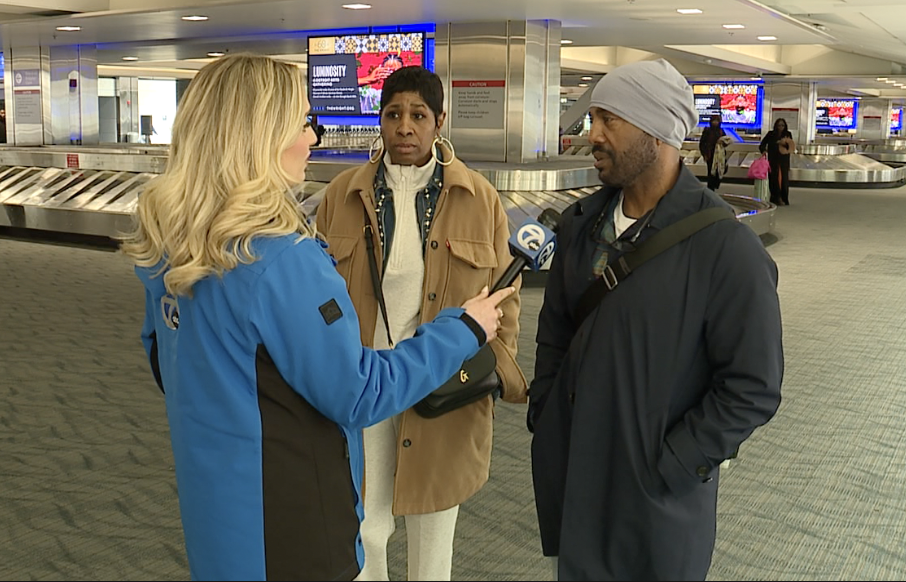
I visited one of the mobile warming centers near Macomb Mall in Roseville, where the SMART bus remained stationary to serve as a refuge for anyone needing to escape the freezing temperatures.

Watch Tiarra's report below

SMART provides warming buses across metro Detroit during extreme cold

"I think that's nice," said Sheila, a woman waiting for her regular bus near the mall. "It was very freezing cold, very freezing, very freezing cold."

The warming buses operate free of charge from Saturday, Feb. 7-Sunday, Feb. 8, running during two shifts: 5 a.m. to 9 a.m. and 7 p.m. to 11 p.m. The mobile warming centers are stationed at various locations throughout metro Detroit, including:

Phoenix Center in Pontiac Southland Center in Taylor, 23000 Eureka Rd, Taylor, MI 48180 Fairlane Mall in Dearborn, 18900 Michigan Ave, Dearborn, MI 48126 Old Redford Meijer in Detroit, 21433 Grand River Ave, Detroit, MI 48219 Mack Avenue and Moross Road Greenfield and Joy roads (DDOT may be moved around based on usage) Macomb Mall,  32233 Gratiot Ave, Roseville, MI 48066

"This is something that is important to us; safety is a cornerstone," said Bernard Parker, chief marketing officer at SMART.

Parker explained the reasoning behind the warming bus program during our conversation aboard one of the mobile units.

"Michigan has had, I would say, this year alone, probably unprecedented temperatures below 20, and we want to do something for the greater good," Parker said.

The warming buses also attract community organizations looking to help those in need. Gail Marlow from Motor City Mitten Mission visited the different warming bus locations to distribute food, blankets, bus passes and other essential items.

"It's so important to have the buses because it's become quite the respite center for people who are struggling with homelessness and don't have any place to go to," Marlow said.

Parker emphasized the meaningful impact of the program on the community.

"To be able to help folk is a blessing," Parker said.

This story was reported on-air by a journalist and has been converted to this platform with the assistance of AI. Our editorial team verifies all reporting on all platforms for fairness and accuracy.

What do we make of Colin Kaepernick now?

SAN FRANCISCO — The most relevant figure to Super Bowl LX is absent from it. The game will be played in his former home stadium, in the place where his protest made him a national lightning rod and a global symbol. The social issues swirling around America’s largest sporting spectacle carry distinct echoes of what prompted his actions and what led to his exile. And yet he remains outside the conversation and invisible within the confines of the NFL.

Colin Kaepernick might as well be a ghost.

“Colin Kaepernick?” Seattle Seahawks safety Julian Love said this week, as if hearing a name he had not considered in a long time. “Oh, wow.”

This summer will bring the 10-year anniversary of the first time Kaepernick sat as the national anthem played before a preseason San Francisco 49ers game. He soon switched to a kneeling position out of respect for military members. The image of Kaepernick on a knee became a worldwide emblem of protest against police violence and racial injustice, and a tempest that led to unwanted political entanglement for the NFL, fierce ire from the political right and Kaepernick’s ostracism from professional football.

The current moment and the Super Bowl’s location provide a platform to examine the legacies of Kaepernick’s protest. Kaepernick served as a flash point, and even as he semi-receded from public life, his influence hovers over the league as an example of both courage and consequences.

“He made a decision to talk about something other than football that ultimately resulted in every player in the National Football League kneeling when the president of the United States called all of their mothers a b—-,” said DeMaurice Smith, who was the NFL Players Association executive director during Kaepernick’s protest. “For a guy that literally begged for players to engage in collective action, Colin was more successful than I ever was.”

Assessing Kaepernick’s legacy also means grappling with the backlash. He raised awareness on issues the country had long ignored, several years before the nation’s racial reckoning in the wake of George Floyd’s killing. His boldness and prescience did not ensure triumph. Donald Trump, the president who referred to players who knelt as “that son of a b—-,” won reelection. Mass demonstrations have erupted in multiple cities against the tactics of federal policing forces and immigration agents, culminating with the killings of U.S. citizens Renée Good and Alex Pretti at the hands of federal agents.

“The problems he knelt against haven’t improved,” said Vann Graves, the executive director of Virginia Commonwealth University’s Brandcenter, which studies advertising and the branding industry. “They’ve metastasized.”

Even as it stands astride American culture, the NFL has managed to sidestep involvement in the widespread national tension. Players have largely remained silent. Denver Broncos offensive lineman Quinn Meinerz wrote “Abolish ICE” in a since-deleted Instagram story, but experts have not seen current players pick up Kaepernick’s mantle. It has not been a topic at the Super Bowl. Kaepernick’s exclusion from the league created “a chilling effect” on players, Villanova sociology professor Glenn Bracey said.

Kaepernick’s protest “permanently changed the boundaries of what the league will tolerate,” said Michigan State professor Christina Myers, who has written extensively about race and sports. “Kaepernick forced the NFL – and the country overall, really – to confront police violence and racial injustices on football’s stage. And in doing so, he exposed how tightly the league links patriotism, profit and control. His protest made racial injustice impossible to ignore, but it also triggered a backlash so severe that it’s functioned as a warning.

“The league officially absorbed his language – slogans like ‘Inspire Change’ – while rejecting his message and himself. That co-optation is part of his legacy – activism rebranded as corporate messaging, stripped of disruption. We are seeing those elements as it relates to the players.”

The NFL’s monocultural dominance and historic, perhaps inherent ties to patriotism for years frequently placed the league inevitably in the crosshairs of political storms. Kaepernick’s protest inflamed those ties, to the league’s financial detriment. In the fall of 2017, a nationwide poll conducted by The Washington Post and the University of Massachusetts at Lowell found that 17 percent of fans who said their interest in the NFL had decreased specifically cited anthem protests or Kaepernick – a greater cause than head injuries or violence. Owners treated fan sentiment as a crisis.

In the decade since, the NFL has flowed with political and cultural shifts. After the killing of George Floyd, the league released a statement that players roundly criticized as perfunctory and unacceptable. In alignment with the national racial reckoning of the moment, Commissioner Roger Goodell responded with a video in which he apologized and said, “We, the National Football League, believe Black Lives Matter.” Goodell may have been acting out of his personal moral imperative as opposed to the will of the NFL’s team owners, from whom all the league’s power truly flows. But it still shifted how the league publicly presented itself. The league also committed to donate $90 million to social justice initiatives.

Ultimately, the NFL has seemingly attempted to separate itself from social activism and political matters. Last year, in the first Super Bowl after Trump’s second inauguration, the NFL changed the motto it stenciled in the end zones from “End Racism” to “Choose Love.” The league insisted it made the switch in response to recent tragedies, including a mass killing in New Orleans.

To many, the change appeared to be a reflection of how the league – and specifically the league’s owners – viewed the promotion of social justice slogans from their introduction.

“Nobody called me when I was the [executive director] and said, ‘Hey man, we’ve come to grips with our White male fragility and are now understanding the whole system is rigged and gosh darn it, we’re going to do something about it,’” Smith said. “Nobody gave me that call. When they do put it in, why would I be so naive to believe they had come to some sort of self-awakening? And if they decide to take it out, why would I ever believe they are reneging on said awakening?”

NFL spokesman Brian McCarthy did not respond to multiple messages.

The league remains selective in how it interfaces with societal issues. The NFL instructed the Green Bay Packers to hold a moment of silence for conservative firebrand Charlie Kirk before a Thursday night game the day after his murder last fall, and that Sunday several NFL teams held moments of silence of their own volition. At the Super Bowl, players will wear a jersey patch commemorating the 250th anniversary of America, and the same logo will be imprinted on the ball.

The Minnesota Vikings joined a letter signed by dozens of local businesses calling for the “immediate de-escalation of tensions” in Minneapolis. The NFL has released no statements about federal agents shooting and killing U.S. citizens in that city.

Kaepernick himself maintains a limited public profile. He rarely gives media interviews. He collaborated with Spike Lee on a multipart documentary tentatively titled “Da Saga of Colin Kaepernick,” which was set to appear on ESPN before production was halted last summer. Kaepernick and his wife have written multiple children’s books. His activism focuses mostly on his Know Your Rights Camp, which deals with youth education and enrichment.

“Kaepernick has become a symbol rather than a participant,” Myers said. He’s “become this moral reference point rather than an active quarterback.”

At the Super Bowl hosted by his former team, Kaepernick was rarely broached. When asked about him, current players viewed Kaepernick with reverence.

“Oh, yeah, Colin Kaepernick,” Seattle star wide receiver Jaxon Smith-Njigba said. “I mean, a legend. Definitely respect him and all the things he was able to do on the field and fight for off the field. I have a lot of respect for him. It takes a lot to stand up for what you believe in. As long as it’s not causing danger and harm and stuff like that, I can go for it.”

“It’s bigger than football,” Love said. “It’s a legacy of standing on what you believe in and just being unapologetic about it. It goes along with his message, but it goes along with a lot of things that are going on today. He had to do it alone a lot of the time. I was probably in high school when that was going on. But it’s as prevalent now as it was back then.”

The NFL has dodged any controversy or connection to current events. Even within its own sphere, issues of diversity and inclusion have been de-emphasized. Last week, the surprise of Bill Belichick missing induction into the Hall of Fame garnered more coverage and outrage than the NFL’s coaching cycle ending with no Black coaches hired for 10 openings.

“The silence there is very, very loud from athletes both in and outside of Minneapolis,” said Ayesha Bell Hardaway, director of Case Western Reserve University’s Social Justice Institute. “That, too, is Colin’s legacy. The impact of him paying that consequence, we should all wonder if what he had to endure has made others feel as if they cannot speak out and therefore not speak out.”

“The uncomfortable truth is that Kaepernick’s impact on the NFL was ultimately contained,” Graves said. “The protest was absorbed, metabolized and excreted as corporate social responsibility.”

Kaepernick resonated differently in 2017 than he does today, just as he will resonate differently 50 years from now. At the moment, his aims appear just as far from being met – if not further – than when he knelt. But that, to many supporters, is wholly beside the point.

“Leaders write a story going forward, and the rest of us read a book that was written backward,” Smith said. “A trailblazer’s courage lies in not knowing the ending. You do it going forward in the hope that it makes a positive difference. What Colin did was far too noble, far too brave and far too visionary for him to be judged by anybody else’s sense of backlash.”

In some ways, the ebb of Kaepernick’s influence may have been foreseeable. In January 2020, University of California at Berkeley sociology professor Harry Edwards led a reporter through an exhibit about the Olympic Project for Human Rights, which he helped organize, at the San Jose Museum of Art.

“One of the things that is clear is that all such movements, they come with an expiration date on them, and it’s six years,” Edwards said then. “In six years, it’s over. This thing with Kaepernick has run out of time.”

For the youngest NFL players, who were not even high-schoolers in 2016, Colin Kaepernick is a quarterback who was exiled after kneeling during the national anthem, and Donald Trump is a politician who runs for president every four years and usually wins. Players in their early 20s know what Kaepernick did and what happened to him, but they may not understand the gravity of his protest.

“I am afraid that he isn’t staying in young people’s minds in the way that would be helpful,” Bracey said. “That’s why we need somebody else to pick it up. His original protest is losing relevance to the younger cohort.”

“History just moves so fast now,” Bracey added. “If there’s not somebody giving attention to something, it’s as if it doesn’t exist.”

Former NFL quarterback Colin Kaepernick throws during halftime of an NCAA college football intra-squad spring game, Saturday, April 2, 2022, in Ann Arbor, Mich. (CARLOS OSORIO — AP Photo, file)

First look: Galacticoaster at Legoland Florida, inside and outer space

WINTER HAVEN – Final preparations are being made inside and outside Galacticoaster, Florida’s newest roller coaster, which is set to open at Legoland Florida theme park this month.

Space-themed Lego models — rotating ride vehicles that are customized by passengers and a next-generation animatronic named Biff Dipper — are prominent parts of the indoor coaster.

Near the entrance is a brick-by-brick and way-bigger-than-life model of Lego set 918, a spaceship introduced in 1979.

It’s “a classic ship, but it’s got some extra flourishes that you only really find in the Legoland park,” says Rosie Brailsford, senior project director for Merlin Magic Making, the creative arm of Merlin Entertainments.

About four years ago, Brailsford was instructed to work with Lego Group to develop an attraction that would work on a global platform, she says.

“They have a line, kind of from the ’70s and various different iterations of that, which is what you will find in Lego Galaxy,” she says. “So, it’s kind of a merge of past and present and opportunity for future iterations as well.”

Brailsford guided the Orlando Sentinel on an exclusive walk-through — no riding yet — of the attraction, which opens to the public Feb. 27.

  • An upsided minifigure is one of the aliens that greets...
    An upsided minifigure is one of the aliens that greets Legoland Florida visitors to Lego Galaxy area and Galacticoaster. The new indoor roller coaster opens Feb. 27. (Dewayne Bevil/Orlando Sentinel)
1 of 11
An upsided minifigure is one of the aliens that greets Legoland Florida visitors to Lego Galaxy area and Galacticoaster. The new indoor roller coaster opens Feb. 27. (Dewayne Bevil/Orlando Sentinel)
Expand

What’s outside

The new coaster is on the site of the Flying School ride that was closed in August 2023. The exterior queue looks down at the park’s Driving School attraction. There are two entrances, including one from Legoland’s water park.

The spaceship is surrounded by Lego characters, including photo opportunities. The Alien Tourist figure — outfitted in a floral shirt, red shorts, aqua hat and big old-school camera — takes snaps of a green and antennaed alien family. A Duplo play area dubbed Tot Spot and designed for the youngest visitors, includes a Lego Shuttle. (A shade structure is being added.) Nearby are large Lego space flowers and a robot dog.

Early on, potential riders meet Capt. Olivia on screen.

“She’s welcoming you to the Lego Galaxy, telling you about a little snippet of the mission that you’re going to go on,” Brailsford says.

New Super Bowl ad launches Universal Orlando campaign

A large screen televises a 10-minute loop of details about what’s coming up.

“There are little moments of backstory here, so that if you are milling around in the land, you’ve already started to absorb in your subconscious what’s going on,” Brailsford says.

What’s going on? In the Galacticoaster universe, they are bracing for “the asteroid of probable destruction.”

Biff Dipper, a next-generation animatronic for Legoland Florida, greets theme park visitors as part of the queue for the new Galacticoaster. The ride opens to the public Feb. 27. (Dewayne Bevil/Orlando Sentinel)

What’s inside

The front lobby features a large blocky version of the Lego Galaxy logo, which is a bit interplanetary and a bit NASA meatball. Below it are actual assembled Lego models on display, some of which are vintage and difficult to find, Brailsford says.

A series of halls and customized posters lead to a big Briefing Room with animatronic Biff Dipper, the chief engineer. He’s about 4 feet tall and standing on an elevated platform. His arms, legs and head move, and his face is animated below the visor of his space helmet. He greets future riders — there can be as many as 80 people in the room — and explains the goal. It’s us versus the asteroid.

“Most of our minifigures in our Legoland are static, smooth minifigures. … Biff is essentially next generation of how we want to do that on a show basis,” Brailsford says. They partnered with Engineered Arts of Cornwall, United Kingdom, to create this figure, which sports 45 facial animations, Legoland says.

Merlin is “working really closely with Lego to make sure all of that motion that they do is true to how a minifigure would move, and we’re not just making them do random things,” she says.

Disney board taps Josh D’Amaro to succeed retiring CEO Bob Iger

Other on-screen characters give ride instructions and advance the storyline of how to deal with that asteroid. Plans A and B (one involving a giant net) were flops, and they need help with Plan C. It involves “separator swarms.”

The room includes interesting visuals such as a blueprint for vehicle options and a sign that reads “Interested in time travel? Meet here last Monday, 2 p.m.”

From here, Biff sends riders into a room where ride vehicle options are selected. Riders pick design features for wings, tail, nose and such. The choices range from practical to fanciful — add-ons such as hamburger wings and disco balls. The console allows 15 seconds for each selection, and then the total look is uploaded onto an RFID-enabled bracelet. There are more than 600 possible combinations.

The idea, we’re told, is to make the spacecraft “so awesome that it grabs the separators’ attention like nothing else.” Also, don’t let them catch you.

Next stop: the Galacticoaster loading bay.

The spinning ride vehicles for Galacticoaster include a lap bar that comes down over passenger heads. Visitors access the cars via a moving sidewalk. (Dewayne Bevil/Orlando Sentinel)
The spinning ride vehicles for Galacticoaster include a lap bar that comes down over the heads of passengers. Visitors access the cars via a moving sidewalk. (Dewayne Bevil/Orlando Sentinel)

The ride stuff

Passengers navigate a moving sidewalk to the in-real-life vehicles, which seat four passengers across and have lap bars that lower from overhead.

The ride moves into an airlock space, and there “you’ll see yourself in your awesome creation,” Brailsford says. You’ll linger for about 10 seconds, “then you will launch, up to 40 miles an hour, off on your adventure,” she says.

“And you have your kind of save-the-day moment on the ride.”

The Sentinel walk-through did not include a ride-through. Brailsford said the experience is smooth and the launch makes it punchy, probably more intense than the Dragon coaster, its Legoland Florida sister attraction. The height requirement is 36 inches for riders accompanied by an adult. Unaccompanied visitors must be at least 48 inches tall.

“It’s not like terrifying or anything, but being indoors, we do feel like they’ll get a little bit more of that thrill factor as well,” she says. “Because it’s dark, you don’t necessarily quite know where you’re going.”

The first lobby of the new Galacticoaster includes Lego spaceship models, some of which are discontinued and difficult to find. The indoor roller coaster opens to the public Feb. 27. (Dewayne Bevil/Orlando Sentinel)

The spinning is programmed, she said. “It’s not like a free spinning.”

Legoland’s website says to expect “Special effects, synchronized lighting and surprise appearances from classic Lego Space characters.”

Ride time is about 1 minute and 30 seconds, and, per theme park tradition, the exit is through the gift shop (official name: Orbital Outpost).

Another Galacticoaster is under construction that’s set to open March 6 at Legoland California, and, in theory, there could be more. There are also Legoland theme parks in New York, the United Kingdom, Denmark, Germany, Malaysia, Dubai, Japan, South Korea and China.

“We have, like, a base story and land concept that we can adjust and tweak if we were to roll a version of it out,” Brailsford says. “It might not necessarily be this ride. It might be a different ride with another story from the world.”

Email me at dbevil@orlandosentinel.com. BlueSky: @themeparksdb. Threads account: @dbevil. X account: @themeparks. Subscribe to the Theme Park Rangers newsletter at orlandosentinel.com/newsletters.

The exterior of Galacticoaster includes a re-creationg of actual Lego playsets with space themes. The coaster opens at Legoland Florida on Feb. 27. (Dewayne Bevil/Orlando Sentinel)

Representing the red, white and blue is complicated for some Olympians

BORMIO, Italy — Hunter Hess has waited a lifetime for this moment.

The 27-year-old freestyle skier failed to qualify for the 2022 Olympic Games after a knee injury derailed his bid for Beijing. Next week at the Milan Cortina Games, he is finally set to drop into the Olympic halfpipe, wearing the uniform he has imagined since he was a kid.

The excitement is real. But it isn’t the only feeling.

“It brings up mixed emotions to represent the U.S. right now, I think,” Hess said. “It’s a little hard. There’s obviously a lot going on that I’m not the biggest fan of, and I think a lot of people aren’t.”

For some American Olympians, wearing red, white and blue has rarely felt more complicated. Many say they have been forced to ask themselves what their country represents, what they represent as individuals, and how to reconcile the distance between the two.

“For me, it’s more I’m representing my friends and family back home … all the things I believe are good about the U.S.,” Hess said. “I think if it aligns with my moral values, I feel like I’m representing it. Just because I’m wearing the flag doesn’t mean I represent everything that’s going on in the U.S.”

That unease wasn’t confined to conversations among athletes, and tensions found the spotlight at the outset of these Winter Games. During Friday’s Opening Ceremonies, Team USA athletes were cheered as they marched into the stadium. But the crowd quickly turned when Vice President JD Vance and his wife, Usha, appeared on the big screens, and boos filled the stadium.

For many Americans, the backdrop to these Games has been unusually tense. On the global stage, U.S. policy disputes – including disagreements with European allies over tariffs and Arctic strategy – have raised questions about American leadership and strained long-standing partnerships. Meanwhile, back home in the United States, immigration enforcement operations in Minneapolis drew widespread outrage after the fatal shootings last month of two U.S. citizens – Renée Good and Alex Pretti – by federal immigration personnel, sparking nationwide protests and debates about federal policing and civil rights.

Like much of the world, Olympians have watched news reports of ICE raids and tried to make sense of what’s happening. For cross-country skier Jessie Diggins, the tension between pride and pain is rooted squarely in home.

“I was born and raised in Minnesota. That’s the community that raised me,” said Diggins, a three-time Olympic medalist competing in her fourth Games.

In recent weeks, she said, it has been difficult to focus solely on skiing while watching events unfold back home. Friends and members of her community have reached out to tell her they’re watching, they’re proud, and that her presence at the Games has mattered to them during a painful moment.

“I think it’s still important to try to race my hardest and bring joy to those people,” she said. “I’m very focused on representing the version of America that’s respectful and loving and caring and open and just looks out for one another. To me, it’s really important to show that to the world and put love and respect and honesty first.”

Athletes from all corners of the world grapple with global perceptions, of course. Israeli athletes, for example, were roundly booed at Friday’s Opening Ceremonies. But Olympians work for years and feel like their journey encompasses something bigger than political policies.

“I think there’s a lot of hardship in the world, globally, and there’s a lot of heartbreak. There’s a lot of violence. It can be tough to reconcile that when you’re also competing for medals in an Olympic event,” said Alpine skier Mikaela Shiffrin, a four-time Olympian. “… I’m really hoping to show up and represent my own values. Values of inclusivity, values of diversity and kindness and sharing, tenacity, work ethic.”

Chris Lillis, the freestyle aerialist who won Olympic gold in Beijing, said he feels that same pull between pride and heartbreak.

“As athletes, we’re proud to represent our country. I love the U.S.A., and I think I would never want to represent a different country in the Olympics,” Lillis said. “With that being said, a lot of times athletes are hesitant to talk about political views and how we feel about things.

“I feel heartbroken about what’s happened in the United States,” he continued. “I think that, as a country, we need to focus on respecting everybody’s rights and making sure that we’re treating our citizens as well as anybody with love and respect. I hope that when people look at athletes competing in the Olympics, they realize that’s the America that we’re trying to represent.”

U.S. Olympic athletes
Kelly Pannek (right) and Cayla Barnes (center) of Team United States enter the rink prior to the Women’s Preliminary Round Group A match between the United States and Czechia on Day minus one of the Milano Cortina 2026 Winter Olympic games at Milano Rho Ice Hockey Arena on Feb. 05, 2026 in Milan, Italy. (JAMIE SQUIRE — Getty Images)

Sport in many ways is a platform for values. Kelly Pannek, a forward on the U.S. women’s hockey team and a Minnesota native, finished a recent Professional Women’s Hockey League season in St. Paul, Minnesota, and offered a statement before taking a single question.

“It’s obviously really heavy,” Pannek said, becoming choked up. “I think people have been asking a lot of us what it’s like to represent our state and our country. I think what I’m most proud to represent is the tens of thousands of people that show up on some of the coldest days of the year to stand [at protests] and fight for what they believe in.”

The backdrop for those personal reckonings extends well beyond the United States. When news surfaced that U.S. Immigration and Customs Enforcement agents would be in Italy to assist American security efforts at the Games, it sparked protests in Milan and opposition from Italian residents and politicians.

That discomfort filtered into even the most routine elements of the Olympic experience. Three U.S. Olympic bodies – U.S. Figure Skating, USA Hockey and U.S. Speedskating – changed the name of their shared hospitality space from “Ice House” to “Winter House,” aiming to eliminate a potential distraction.

Figure skater Amber Glenn said the change reflected how deeply current events are resonating with athletes.

“It’s unfortunate that the term ‘ice’ isn’t something we can embrace because of what’s happening and the implications of what some individuals are doing,” Glenn told reporters after a practice this week. “Unfortunately, in my own country, it is very upsetting and very distressing to see. A lot of people say, ‘You’re just an athlete. Like, stick to your job, shut up about politics.’ But politics affects us all.”

U.S. Olympic officials said they prepared athletes for the possibility of mixed reactions in Italy, even as they expressed confidence that competition venues would largely remain respectful environments.

“Our experience has been that, more often than not, those spectators who come to watch Olympic competitions have an incredible amount of respect and appreciation for what athletes have achieved,” said Sarah Hirshland, the chief executive of the U.S. Olympic and Paralympic Committee. “We don’t anticipate a lot of negative energy on the field of play.”

For some athletes, the act of competing itself feels like a way to define what they stand for.

“I’d say our country’s been having issues for 250 years,” said snowboarder Nick Goepper, a four-time Olympian. “I’m here to uphold classic American values of respect, opportunity, freedom, equality and project those to the world.”

Noted Alex Ferreira, a two-time Olympic medalist in freestyle halfpipe skiing: “The Olympics represent peace, so let’s not only bring world peace, but domestic peace within our country as well.”

– – –

Barry Svrluga contributed to this report.

U.S. Olympians Kate Gray, Hunter Hess, Birk Irving, Alex Ferreira, Nick Goepper, Svea Irving, Riley Jacobs and Abby Winterberger attend the Team USA Welcome Experience at the 2026 Milan-Cortina Olympics on Feb. 05, 2026 in Milan, Italy. (JOE SCARNICI — Getty Images)

Lindsey Vonn crashes in Olympic downhill, taken away by helicopter as US teammate Johnson wins gold

Lindsey Vonn, racing on a badly injured left knee, crashed early in the Olympic downhill on Sunday and was taken off the course by a helicopter after the 41-year-old American received medical attention on the snow for long, anguished minutes.

Vonn lost control over the opening traverse after cutting the line too tight and was spun around in the air. She was heard screaming out after the crash as she was surrounded by medical personnel before she was strapped to a gurney and flown away by a helicopter, possibly ending the skier's storied career. Her condition was not immediately known, with the U.S. Ski Team saying simply she would be evaluated.

RELATED STORY | Milan-Cortina Olympics opens with record-breaking, multi-city celebration

Breezy Johnson, Vonn's teammate, won gold and became only the second American woman to win the Olympic downhill after Vonn did it 16 years ago. The 30-year-old Johnson held off Emma Aicher of Germany and Italys Sofia Goggia on a bittersweet day for Team USA.

Vonn had family in the stands, including her father, Alan Kildow, who stared down at the ground while his daughter was being treated after just 13 seconds on the course. Others in the crowd, including rapper Snoop Dogg, watched quietly as the star skier was finally taken off the course she knows so well and holds a record 12 World Cup wins.

Vonns crash was tragic, but its ski racing," said Johan Eliasch, president of the Internationl Ski and Snowboard Federation.

I can only say thank you for what she has done for our sport, he said, because this race has been the talk of the games and its put our sport in the best possible light.

All eyes had been on Vonn, the feel-good story heading into the Olympics. She had returned to elite ski racing last season after nearly six years, a remarkable decision given her age but she also had a partial titanium knee replacement in her right knee, too. Many wondered how she would fare as she sought a gold medal to join the one she won in the downhill at the 2010 Vancouver Games.

IN CASE YOU MISSED IT | Vance says Olympics unite the entire country as he meets US athletes in Milan

The four-time overall World Cup champion stunned everyone by being a contender almost immediately. She came to the Olympics as the leader in the World Cup downhill standings and was a gold-medal favorite before her crash in Switzerland nine days ago, when she suffered her latest knee injury. In addition to a ruptured ACL, she also had a bone bruise and meniscus damage.

Still, no one counted her out even then. In truth, she has skied through injuries for three decades at the top of the sport. In 2006, ahead of the Turin Olympics, Vonn took a bad fall during downhill training and went to the hospital. She competed less than 48 hours later, racing in all four events shed planned, with a top result of seventh in the super-G.

Its definitely weird, she said then, going from the hospital bed to the start gate.

Cortina has always had many treasured memories for Vonn beyond the record wins. She is called the queen of Cortina, and the Olympia delle Tofana is a course that had always suited Vonn. She tested out the knee twice in downill training runs over the past three days before the awful crash on Sunday in clear, sunny conditions.

This would be the best comeback Ive done so far, Vonn said before the race. Definitely the most dramatic.

After the crash, the celebration for the medalists was held and fellow skiers thought about Vonn's legacy.

She has been my idol since I started watching ski racing, said Kajsa Vickhoff Lie of Norway. We still have a World Cup to do after Olympics ... I wouldnt be surprised if she suddenly shows up on the start gate, but the crash didnt look good.

The Birmingham Bloomfield Art Center serves the Detroit region’s visual arts community

The Birmingham Bloomfield Art Center is on a mission to connect people of all ages and abilities across Southeast Michigan with visual arts education, exhibitions, and other creative experiences.

The BBAC's 2026 student arts show exhibition is currently underway and runs through March 12. The center is also where you can find unique Valentines Day Gift ideas and learn about Sundays at the Center.

To learn more about The Birmingham Bloomfield Art Center and all it has to offer, visit

https://bbartcenter.org/birmingham-bloomfield-art-center/

Savannah Guthrie pleads for mother’s return, says family will pay

Savannah Guthrie, co-host of the "Today" show, released a video message on Saturday, telling the apparent kidnappers of her mother, Nancy, that she has received their message.

"We received your message, and we understand," Guthrie says in a video posted on social media. "We beg you now to return our mother to us, so that we can celebrate with her. This is the only way that we will have peace. This is very valuable to us, and we will pay."

Savannah's brother and sister also appear in the video, but do not speak. The post was captioned with the words, "Bring her home."

It's unclear whether the message Savannah Guthrie is referring to is a new message or older messages that have been sent to news organizations, including KGUN, the Scripps station in Tucson.

Nancy Guthrie has now been missing for a week. Authorities believe she was taken from her home against her will. The Pima County Sheriff's Office said on Saturday that they still have no suspects in the case

RELATED STORY | Nancy Guthrie search update: President Trump says there are 'very strong clues' in case

Just hours earlier, however, President Donald Trump, who has ordered federal resources to assist in the case, said he believes a "solution" could be possible soon.

"I think we're doing very well on that regard. You're probably surprised to hear that. I think we're doing very well, very well, meaning we have some clues, I think that are very strong, and I think we could have some answers coming up fairly soon," Trump said.

While there have been no leads on a suspect, the Pima County Sheriff's Office was seen towing a car from Nancy Guthrie's residence Friday night.

Authorities would not say why the vehicle was closed nearly a week after Nancy Guthrie was first reported missing.

"This remains an active and ongoing investigation, which includes the review of multiple pieces of evidence," the Pima County Sheriff's Office said in a statement on Saturday. "At this time, we will not confirm or release additional details regarding what is being analyzed."

Company pulls candy in 20 states from shelves after packaging error

More than 6,000 bags of peanut and classic M&Ms are being recalled after packaging failed to disclose that the products contain milk, soy or peanuts.

The recalled candy was sold in roughly 20 states, some in promotional packages marked with the Make Your Mark logo, the company said.

According to the Centers for Disease Control and Prevention, about 6% of adults and 8% of children live with a food allergy, with peanuts among the foods causing the most severe reactions.

RELATED STORY | Huge range of branded foods recalled for rodent contamination

Peanut allergies can cause diarrhea, difficulty breathing, hives, skin rash, nausea, vomiting, stomach cramps and swelling, according to the Cleveland Clinic. Severe reactions can include anaphylaxis, which can make it hard or impossible to breathe.

The Food and Drug Administration requires food producers to properly label products containing major allergens such as peanuts, milk, fish and others.

The recall was issued for the following states: Alabama, Arizona, California, Florida, Iowa, Kansas, Kentucky, Massachusetts, Maryland, Minnesota, North Carolina, New York, Ohio, Pennsylvania, South Dakota, Tennessee, Texas, Virginia, Washington, and Wisconsin.

Full lot codes are on the FDA's website.

❌